
What legal steps to verify after a car crash
A verification workflow for the legal steps after a serious car crash, identifying where evidence is lost, deadlines are missed, and claims are undervalued, with data-backed checkpoints at each stage to prevent those failures.
- Applicable role
- attorney
- Workflow stage
- pre-filing
Not legal advice. Last verified: July 31, 2026. Category: verification-workflows. Serious crash claims are jurisdiction-specific; use this as a record-preservation and issue-spotting workflow, then verify deadlines, coverage duties, and demand strategy under current state law.
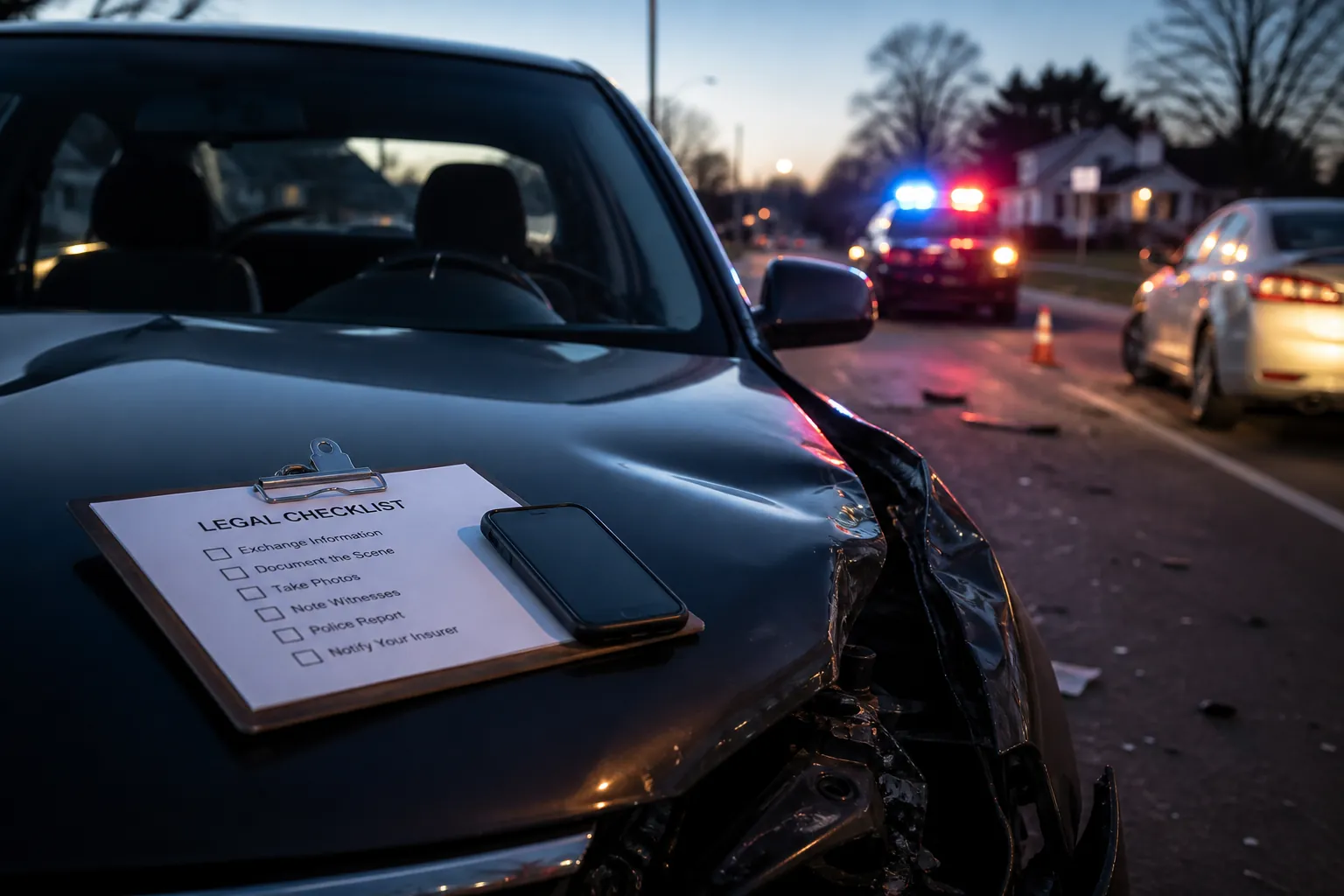
The legal steps after a serious car crash do not begin when a demand letter is drafted. They begin while glass is still on the road, when the injured person is least able to think like a future witness. That is the uncomfortable part of these files: the claim starts degrading before anyone has named it as a claim.
Attorney Brian Diamond put the scene problem bluntly in a July 2026 KBTX segment: “all of that stuff’s gone the second you drive away.” He was talking about scene facts—vehicle positions, debris, lighting, traffic controls, road conditions, and nearby witnesses—that often cannot be reconstructed cleanly later.[1]
A useful workflow therefore asks a narrower question than ordinary post-crash advice asks: what must be independently checked before evidence disappears, deadlines run, or settlement value is anchored too low?
| Stage | Verification point | Failure this prevents |
|---|---|---|
| Scene and immediate aftermath | Photos, videos, witness identities, vehicle positions, road and signal conditions, dashcam or nearby camera sources | A liability record built from memory, vague police notes, or after-the-fact assumptions |
| Medical care | Prompt evaluation, symptom reporting, follow-up instructions, diagnostic changes, work restrictions | A treatment gap or incomplete record that lets causation and damages be discounted |
| Police or crash report | Report number, officer agency, factual corrections, diagram accuracy, witness listing | A public record that omits the facts counsel later needs |
| Insurance notice and coverage review | Notice duties, cooperation clauses, UM/UIM coverage, recorded-statement limits | Coverage disputes, waived leverage, or missed uninsured-motorist protection |
| Counsel engagement and preservation | Representation decision, spoliation letters, vehicle preservation, electronic data sources | Lost EDR, dashcam, telematics, repair, and inspection evidence |
| Deadline verification | State personal-injury limitation, property-damage limitation, tolling, government-notice rules | A viable claim barred by an unnoticed statutory or notice deadline |
| Demand and settlement review | Medical specials, wage loss, future care, venue, fault rules, insurance limits, comparator data, first-offer analysis | A settlement accepted before value is tested against the actual file |
Preserve the crash scene before it becomes a memory contest
Emergency care comes first. Once people are safe and 911 has been called where appropriate, the legal record depends on what can still be captured without interfering with responders or creating new risk. The verification target is not “take some pictures.” It is to make the later file show what the scene showed before tow trucks, traffic, rain, repairs, and adrenaline erased it.
- Photograph all vehicles from multiple distances, including final resting positions, points of impact, license plates, visible damage, deployed airbags, and open containers or cargo only if safely visible.
- Capture the roadway, lane markings, traffic signs, signals, skid marks, debris fields, sight lines, weather, construction zones, lighting, and anything blocking visibility.
- Record the names, phone numbers, and brief location of witnesses before they leave; a witness who was “near the bus stop” is harder to find than a witness with a verified number.
- Identify video sources: dashcams, rideshare cameras, business cameras, doorbell cameras, traffic cameras, school buses, delivery vehicles, and nearby parking-lot systems.
- Save the vehicle condition before repair or salvage when injuries are serious enough that crash severity, seat position, airbag deployment, intrusion, or mechanical failure may matter.
The practical dividing line is departure from the scene. After that, counsel may still obtain a police report, photographs from a wrecker yard, or nearby video, but each item now depends on someone else’s retention system. That is why scene capture is a verification step, not a courtesy detail.
For serious crashes, the preservation request should also move quickly beyond ordinary photographs. Event data recorders, dashcam files, infotainment data, trucking telematics, phone records, repair invoices, inspection logs, and surveillance footage may sit with different custodians. The same spoliation logic that applies in more specialized evidence-preservation workflows—such as AI telematics and tire-blowout cases—applies here: identify the custodian early, send a targeted preservation letter, and avoid asking for “everything” so vaguely that no one can verify compliance.
Make the medical record specific enough to prove the injury later
Medical follow-up is not just a health instruction. It is the first independent record of what the crash did to the body. The file needs timestamps, complaints, objective findings where available, referrals, imaging decisions, work restrictions, medication changes, and follow-up instructions. A chart that says “sore after MVC” is not the same record as one that documents headache onset, loss of consciousness, neck pain, radiating symptoms, dizziness, nausea, cognitive complaints, sleep disruption, or worsening pain over time.
Traumatic brain injury deserves caution in both directions. A small 2014 study of 62 crash-related TBI patients reported that about 58% were initially missed, but that figure should not be treated as a current population-wide rate; it is an older, single-study signal that initial evaluation can miss clinically important injuries.[2] The safer workflow point is narrower: if head impact, loss of consciousness, confusion, vomiting, dizziness, memory problems, visual disturbance, sleep changes, or personality changes appear, the record should show that those symptoms were reported and evaluated, not reconstructed months later.
- Verify the first treatment date and explain any delay in the record rather than letting an insurer infer that the injury was minor.
- Ask providers to document functional limits: missed work, lifting restrictions, driving limits, sleep disruption, childcare limits, and activities the patient cannot perform.
- Preserve discharge papers, referrals, imaging orders, medication lists, bills, health-insurance explanations of benefits, and out-of-pocket receipts.
- Track symptom progression in plain language, but do not edit medical facts to fit a settlement theory.
Get the crash report, then audit it
A police or crash report often becomes the first document an adjuster, intake lawyer, or claims reviewer reads. It is not the whole case. It is a government-created starting point that may contain omissions, shorthand, diagram errors, incomplete witness information, or statements taken while someone was injured, shaken, or medicated.
The verification task is mechanical: obtain the report number, identify the responding agency, request the report when available, compare the diagram with scene photos, confirm whether witnesses are listed, check vehicle and insurance information, and flag any factual error that can be corrected or supplemented under local procedure. Counsel should keep the original report, the correction request, and any agency response in the file. If the report is wrong and no correction is available, the contradiction still needs to be documented before memories harden around the mistake.
Notify insurance without giving away the file
Most auto policies require prompt notice and cooperation. California’s Department of Insurance, for example, tells policyholders they must cooperate with the insurance company’s investigation and warns that failure to timely notify can void coverage.[3] That is a coverage-preservation point, not an invitation to narrate the whole case casually to every adjuster who calls.
The notice record should confirm the date, claim number, adjuster, policy coverages, vehicles, drivers, and whether any recorded statement was requested. For serious injuries, it is usually safer to give basic claim notice and verify representation before giving a broad recorded statement, signing medical authorizations, or accepting a quick payment tied to a release. The risk is not politeness; it is an early statement made before diagnoses, wage loss, future care, fault allocation, or coverage layers are understood.
Coverage review should also include uninsured and underinsured motorist protection. The Insurance Research Council, cited by the Insurance Information Institute, estimated that 14% of U.S. motorists were uninsured in 2022, with state rates ranging from 5.9% in Wyoming to 25.2% in the District of Columbia.[4] That does not prove the at-fault driver in a particular crash is uninsured. It does mean the claimant’s own UM/UIM coverage should be checked before assuming the other driver’s liability policy will be enough.
Decide early whether the file needs counsel, not after the first offer
Representation is not a moral category. It is a measurable risk variable in settlement behavior. FairSettlement.org, citing the Insurance Research Council’s 2023 Paid in Full report, reports average settlements of $77,600 for represented claimants and $17,600 for unrepresented claimants, described as a 340% gross difference and a 226% net difference after a 33% contingency fee.[5] Public aggregates of settlement outcomes are imperfect, and averages can be skewed by case severity, but the gap is too large to ignore when a serious-injury claimant is considering an early release.
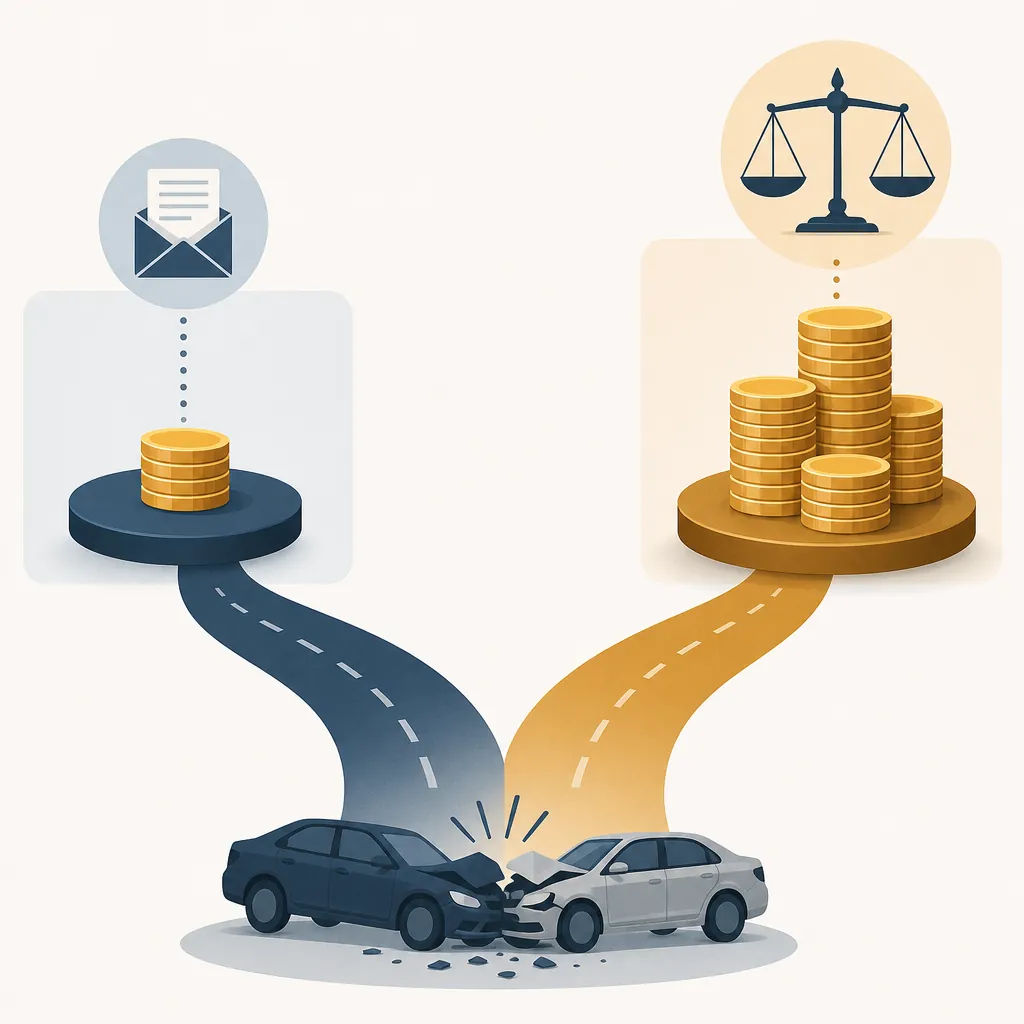
The engagement decision should be made before the insurer’s valuation becomes the working number in everyone’s head. Counsel can send preservation letters, manage recorded-statement requests, identify additional coverage, obtain medical and wage documentation, evaluate venue and comparative-fault rules, and prevent a claimant from signing a release before the injury course is known. For claimants using referral directories or AI-assisted intake tools, the same caution applies: verify the lawyer, jurisdiction, fee terms, and scope of work directly. The AI-risk problem is not limited to settlement math; it also appears in referral and eligibility contexts, including multilingual claimant searches such as a Spanish-speaking car accident lawyer directory or AI-assisted hit-and-run evaluation tools.
Verify the deadline from current law, not from a generic table
Limitations deadlines are where generic car-crash content becomes dangerous. ConsumerShield’s 2026 state-by-state summary lists personal-injury limitation periods ranging from 1 year in Kentucky, Louisiana, and Tennessee to 6 years in Maine and North Dakota.[6] That range alone is enough to make any national “you have two years” statement unsafe.
The check cannot stop with the personal-injury deadline. Property-damage deadlines may differ in the same state; ConsumerShield’s summary lists California as 2 years for personal injury and 3 years for property damage, while Illinois is listed as 2 years for personal injury and 5 years for property damage.[6] Government-entity claims may require much shorter notice, with government notice periods commonly flagged around 6 months in public limitation summaries.[6]
Recent statutory changes make stale content especially risky. Florida’s HB 837 reduced the negligence personal-injury limitations period from 4 years to 2 years, a change that has been widely mishandled in auto-generated summaries and older web pages.[6] A file checklist should therefore record who verified the governing deadline, what source was checked, when it was checked, and whether any tolling, minor, death, government defendant, out-of-state defendant, or insurance-contract issue changes the analysis.
| Deadline item | What to verify | Why it matters |
|---|---|---|
| Personal-injury limitation | Current state statute, accrual date, tolling, and recent amendments | The bodily-injury claim can be time-barred even when liability appears clear |
| Property-damage limitation | Separate deadline for vehicle damage and related property loss | It may not match the personal-injury deadline |
| Government notice | Notice deadline, recipient agency, required form, service method, and proof of delivery | Some claims fail before the ordinary lawsuit deadline arrives |
| Insurance-contract deadlines | UM/UIM notice, proof-of-loss, consent-to-settle, arbitration, or suit-limitation provisions | Coverage can be narrowed by policy conditions even when tort deadlines remain open |
| Jurisdiction-specific fault rules | Comparative fault, contributory negligence, no-fault thresholds, and recent legislative changes | Valuation and viability can change sharply by state |
State-specific issue spotting belongs in the deadline and valuation file, not in a later research memo no one reads until demand drafting. Recent-change articles, including New York 2026 car accident injury law changes and negligence-regime reviews such as Virginia contributory negligence, are useful only if the file owner still confirms the current statute and controlling local authority.
Test settlement value against the file, not the first number
The first settlement number is often less important for what it pays than for what it anchors. FairSettlement.org, citing IRC and Martindale-Nolo data, reports that 73% of unrepresented claimants accept the insurer’s first offer and describes first offers as typically 40% to 60% below fair value.[5] Because that source is a public aggregate rather than a court dataset, it should be used as a risk indicator, not as a prediction for any individual case.
The valuation record should separate economic damages from non-economic damages and separate known losses from projected losses. Medical bills, paid amounts, liens, wage loss, lost earning capacity, future care, impairment ratings, scarring, pain, loss of normal life, fault allocation, venue, policy limits, and collectability do different work. A calculator that multiplies medical bills cannot decide whether a fractured wrist with clean recovery, a concussion with persistent symptoms, and a spinal injury with future surgery risk belong in the same settlement neighborhood.
Public benchmarks can keep a file from floating without any external reference. FairSettlement.org reports a mean auto settlement of about $31,000, a median of about $23,900, and broad injury-severity ranges from about $12,000 for soft-tissue claims to more than $1.1 million for spinal-cord injuries, citing IRC and Jury Verdict Research data.[5] Those numbers are not a substitute for venue-specific verdicts, policy limits, medical proof, or liability analysis. Their use is to force the reviewer to explain why the actual file should sit below, within, or above a benchmark range.
Multiplier methods should be treated the same way. Nolo describes common settlement-formula discussions in which medical expenses are multiplied by ranges such as 1.5 to 2 for minor injuries, 2 to 3 for moderate injuries, 3 to 4 for serious injuries, and 4 to 5 or higher for severe or permanent injuries.[7] Those ranges are negotiation shorthand, not law. They can help identify an outlier offer, but they cannot supply missing medical proof, jurisdictional negligence analysis, or evidence of future damages.
State law can move value more than any formula does. Comparative-fault reductions, contributory-negligence bars, no-fault thresholds, punitive-damages limits, prejudgment interest, lien rules, and local verdict history all change settlement posture. For a state-specific example of how settlement inputs must be localized, see Connecticut car accident settlement factors.
Use AI and insurer software as prompts, not authority
AI settlement calculators are useful only if everyone in the file understands what they are not. FindLaw warns that car-accident settlement calculators lack legal authority and can be misleading.[8] The most common failure is not that a calculator is obviously absurd. It is that it gives a clean-looking number while omitting jurisdiction, liability disputes, lien reductions, future treatment uncertainty, policy limits, venue, credibility, and the human evidence that makes non-economic damages real.
The same skepticism should apply to insurer-side valuation tools. Practitioner sources widely report that proprietary systems such as Colossus can undervalue non-economic damages, but the public record does not provide a clean universal percentage that can be applied to a given claim. The verification point is therefore procedural: do not accept a number until the demand file shows the medical record, wage proof, liability evidence, coverage analysis, comparable results where available, and jurisdiction-specific law that support or refute it.
AI can still help organize a file, draft document-request checklists, summarize medical chronology for human review, and identify missing proof. It should not be the source of current statutes, standing rules, filing deadlines, settlement authority, or legal conclusions without independent verification. The same hallucination risk that appears in workflows such as Virginia wrongful-death standing verification is present in serious car-crash claims when a tool confidently supplies old law or invents a safe deadline.
What the file should contain before settlement authority is requested
Before a claimant accepts an offer or counsel seeks settlement authority, the file should be able to answer a few unglamorous questions without relying on memory. If the answer is “probably,” the file is not ready.
- Scene proof: photos, videos, witness identities, report number, vehicle condition, and any preservation requests for third-party video, vehicle data, or telematics.
- Medical proof: first treatment date, complete records and bills, diagnosis history, symptom progression, work restrictions, permanency or future-care opinions where available.
- Coverage proof: liability limits if disclosed or discoverable, claimant UM/UIM coverage, health liens, medical payments coverage, and any reservation of rights.
- Deadline proof: personal-injury limitation, property-damage limitation, government notice, insurance-contract deadlines, and the date each was verified against current law.
- Valuation proof: economic damages, non-economic damages narrative, fault analysis, state-law adjustments, venue considerations, comparator data, and written reasons for rejecting or accepting the current offer.
- Release review: parties released, claims released, liens handled, confidentiality or indemnity terms, minor or probate approval if applicable, and whether future claims are being waived knowingly.
A serious car-crash claim is not protected by completing steps in order. It is protected by independently verifying the few points where evidence, time, and value are most likely to disappear.
References
- What to do after a serious car crash: legal steps to protect your rights, KBTX, July 29, 2026.
- Missed diagnoses of traumatic brain injury in patients with traumatic spinal cord injury, PubMed, 2014.
- So You've Had an Accident, What's Next?, California Department of Insurance.
- Facts + Statistics: Uninsured motorists, Insurance Information Institute.
- Personal Injury Settlement Statistics, FairSettlement.org.
- Car Accident Statute of Limitations by State, ConsumerShield, 2026.
- Is There a Car Accident Settlement Formula?, Nolo.
- Are Car Accident Settlement Calculators Accurate?, FindLaw.
Grounded in
This procedure is grounded in the cited rule or opinion, independent of any single documented case. See the Regulation tracker for the governing text.
Cases this step would have prevented
No cases have been explicitly linked to this checklist yet. See Risk Digest for documented incidents generally.
← Back to WorkflowsReport a correction or tip
Spotted an outdated figure, a misstated fact, or a ruling this workflow checklist should reflect? Public comments are disabled for this content given the professional cost of a misreported case outcome, penalty amount, or rule text — use the structured correction channel instead.
Report a correction or tip for this record →