
What to Say After a Car Accident to Protect Your Claim
Within the first days after a crash, an apology, a casual "I'm fine," or a guessed detail can be turned into evidence that damages an injury claim. This record gives scripted say-this / don't-say-that alternatives for conversations with police, the other driver, and insurers, and flags the recorded statements and settlement releases to refuse until counsel reviews them.
- Applicable role
- pro se litigant
- Workflow stage
- pre-filing
This record is legal information, not legal advice. It is written for communication discipline after a crash and should be checked against the law, insurance policy, and facts that apply to the specific claim. Legal-background review: Marissa Lang, J.D.
The phone rings before the bruising has settled. Or you are still standing beside the car, hands shaking, trying to be decent to the other driver while an officer writes notes. This is the first practical answer to what to do after a car accident to protect an injury claim: be humane, be factual, and stop yourself from filling silence with guesses, apologies, or reassurance you do not yet know is true.
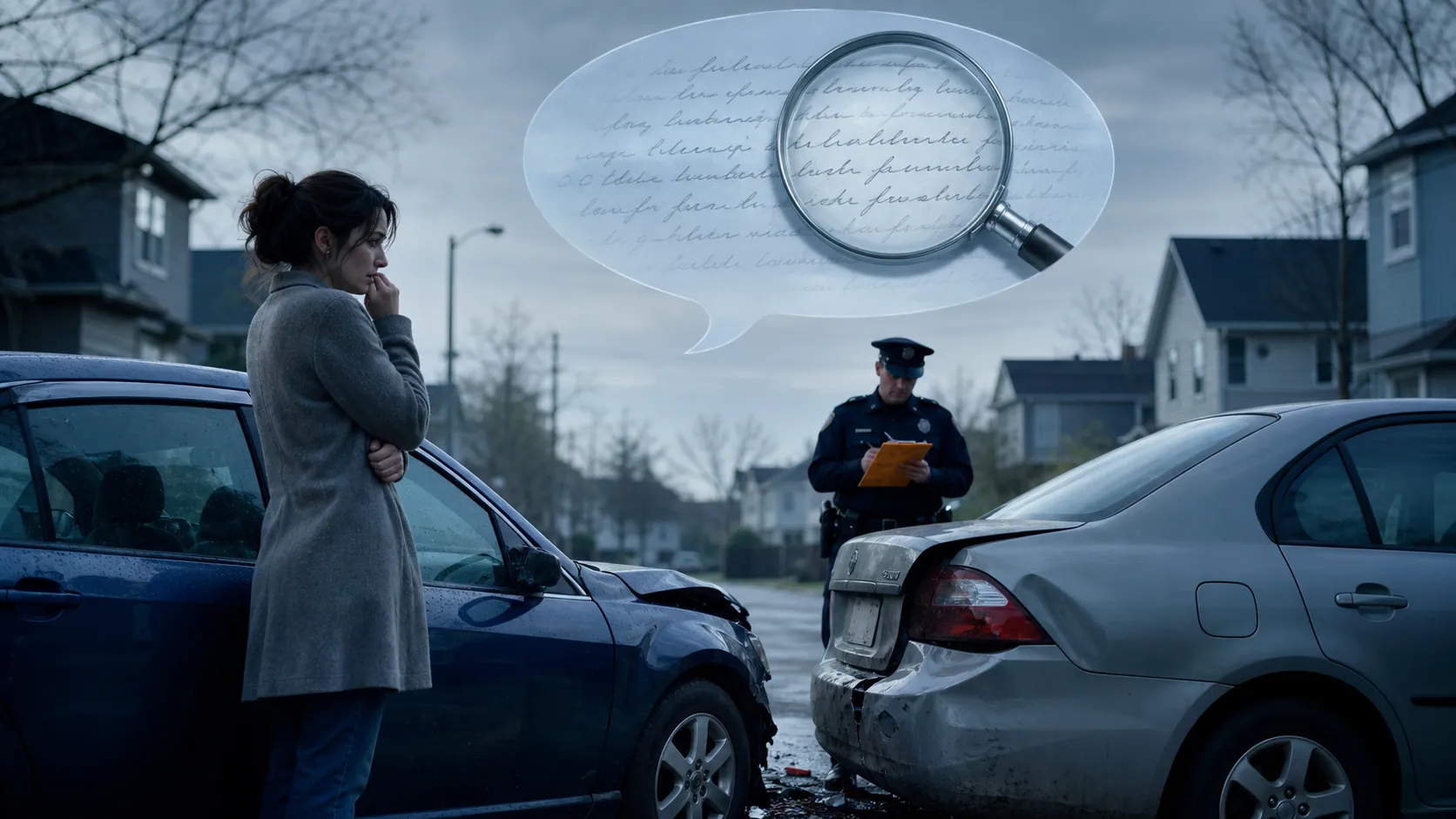
The damaging sentence is often not dramatic. It is “I’m sorry.” It is “I’m fine.” It is “I think they were going about 45.” Injury lawyers warn that apologizing, minimizing symptoms, guessing about speed or distance, and accepting a quick settlement can later be used against the claimant as fault language, injury-minimization evidence, credibility impeachment, or a release that ends the claim. [1]
One law firm also cautions that adjusters may contact an injured person within 24 to 72 hours after a crash, before the person understands the injuries or has gathered records. That is a firm-reported practice warning, not a universal rule, but it explains why the first call can be more dangerous than it sounds. [2]
| When you feel pressure to say… | Use this instead |
|---|---|
| “I’m sorry.” | “Is anyone hurt? I’m calling 911.” |
| “I’m fine.” | “I’m shaken and I need to be evaluated before I can describe injuries.” |
| “They were going about 45.” | “I do not have a reliable speed estimate.” |
| “It was probably partly my fault.” | “I can describe what I saw, but I’m not assigning fault.” |
| “Yes, you can record me.” | “I’m not giving a recorded statement until counsel reviews the request.” |
| “I’ll sign if this closes things quickly.” | “I will not sign a release until I understand what claims and future treatment it gives up.” |
At the scene: talk about safety and facts, not blame
At the scene, your job is narrow: check for injuries, call for help, exchange required information, cooperate with police, and preserve what you can without turning yourself into an accident reconstruction witness. The evidence-and-deadline side of that work belongs in the companion crash-verification workflow. This article stays with the words.
The impulse to apologize is understandable. It is also one of the easiest sentences to lift out of context. “I’m sorry” may be said because a person is frightened, polite, or sorry the crash happened at all. In a claim file, it can be treated as an admission of responsibility. [1]
| Scene conversation | Do not say | Safer wording |
|---|---|---|
| Someone appears injured | “I’m so sorry, I didn’t see you.” | “Are you hurt? I’m calling 911.” |
| The other driver accuses you | “Maybe I should have stopped sooner.” | “Let’s wait for the officer. I’ll give my statement about what I saw.” |
| You feel embarrassed | “This was my fault.” | “I’m shaken. I’m going to make sure everyone is safe and exchange information.” |
| A passenger asks what happened | “I must have missed the light.” | “I’m not sure yet. I need to think through what I actually saw.” |
This is not permission to be cold. You can ask if someone needs an ambulance. You can move to safety if the vehicles are creating a hazard. You can give your name, contact information, insurance information, vehicle information, and location. What you should not do is narrate fault while adrenaline is still doing the talking.
If police ask what happened
A police officer may need a basic account. Give one. The difference is between observation and conclusion.
| Question | Risky answer | Better answer |
|---|---|---|
| “How fast was the other car going?” | “Probably 45 or 50.” | “I can’t give a reliable estimate. It appeared to be moving quickly, but I did not measure speed.” |
| “Did you see the light?” | “I think it was green.” | “My best memory right now is that the light was green, but I’m still shaken.” |
| “Where did the impact happen?” | “Right in the middle of the intersection.” | “I believe it was in the intersection, but I would want the photos and vehicle positions checked.” |
| “Are you hurt?” | “No, I’m fine.” | “I’m shaken and feeling pain, and I need medical evaluation before I know the extent.” |
Speed and distance guesses deserve special restraint. Anapol Weiss specifically warns that estimated speed or distance can be contradicted later by event-data recorders or other evidence and then used to attack credibility. [1]
The clean sentence is not “I don’t remember anything.” Use that only if it is true. The clean sentence is: “I do not have a reliable estimate.” If you saw a car approach from your left, say that. If you heard braking before impact, say that. If you do not know whether the driver was speeding, do not donate a number.
Do not let politeness become a medical record
“I’m fine” is often a social answer, not a medical one. After a crash, it can become a claim answer. Lawyers warn that saying injuries are minor or that you are fine can later be used to argue that pain was not crash-related, especially where whiplash or concussion symptoms may appear days later. [1][2]
| Instead of | Say |
|---|---|
| “I’m okay.” | “I’m shaken, and I need to see how I feel after medical evaluation.” |
| “It’s just my neck.” | “I’m feeling neck pain. I do not know the full extent yet.” |
| “Nothing serious.” | “I can’t assess seriousness at the scene.” |
| “I don’t need a doctor.” | “I’ll decide on medical care after I’m away from the scene and can be evaluated.” |
With the other driver: exchange information and stop
The other driver is not the audience for your explanation. The useful exchange is administrative: names, contact information, driver’s license information if required, insurance carrier, policy information, plate number, vehicle description, and the responding officer’s information if one is present.
If the other driver wants to argue fault, the answer can be short: “I’m not going to discuss fault at the scene. We should exchange information and let the report and insurers handle the claim.” If the driver says, “You hit me,” do not answer, “I know.” Say, “I’m not making a fault statement here.”
If the driver tries to settle privately at the curb, do not take cash, promise not to report, or agree that there are no injuries. A quick private agreement can be made before pain, vehicle damage, coverage issues, or fault evidence are understood.
Why fault language matters: comparative negligence can reduce or bar recovery
Careless wording matters because fault is often divided. Comparative negligence rules reduce a claimant’s recovery by the claimant’s share of fault, and modified comparative negligence systems can bar recovery once the claimant’s fault crosses the state’s threshold. [3]
The thresholds are not national. Pennsylvania is commonly described as using a 51% bar: a claimant who is more than 50% at fault cannot recover. Oklahoma is also treated as a modified comparative negligence state in the Tulsa-focused guidance cited here. Those state examples explain the danger of casual fault language; they should not be treated as a rule for every crash in every state. [1][2]
That is the reason to avoid “maybe,” “probably,” and “I guess” when the question is really about fault. If you know a fact, state the fact. If you do not know, say you do not know. If you only have an impression, label it as an impression.
When an insurer calls, first identify who is listening
Before answering claim questions, slow the call down. Ask for the caller’s name, company, phone number, claim number, the name of the insured, and whether the caller represents your insurer or the other driver’s insurer. Write that down before discussing anything else.
| Caller | Your starting point |
|---|---|
| Other driver’s insurer | You can usually decline a recorded statement and decline to discuss injuries, fault, or settlement until counsel reviews the request. Richardson Law Firm states that claimants are generally not legally required in most states to give a recorded statement to the other driver’s insurer. [2] |
| Your own insurer | Do not assume you can simply refuse all cooperation. Your policy may require notice and cooperation. You can still ask whether the call is recorded, ask for questions in writing, answer only facts you know, and seek legal review before giving a recorded statement. |
| No-fault or PIP-related contact | The first insurer you deal with may be your own carrier. That changes the cooperation issue, so confirm the coverage and request before answering substantive questions. |
| Unknown caller or unclear role | Do not proceed. Ask the caller to send the request in writing and say you will respond after review. |
The safest first sentence is boring: “Before we discuss the claim, please tell me who you represent and whether this call is being recorded.” If the answer is unclear, the next sentence is: “I’m not comfortable discussing the accident until I know who is asking and what the request is.”
If the other driver’s adjuster asks for a recorded statement
A recorded statement is not a casual conversation. It is a permanent account that can be compared against medical records, police reports, photos, repair estimates, later testimony, and every later description of pain. Richardson’s warning is direct: the other driver’s insurer may ask for a recorded statement, but that does not mean the injured person is generally required to provide one. [2]
| Adjuster says | Do not answer with | Use this |
|---|---|---|
| “This will only take a few minutes.” | “Okay, sure.” | “I’m not giving a recorded statement today. Please send the request in writing.” |
| “We need your version to move the claim forward.” | “I was probably going too fast for the rain.” | “I can provide basic identifying information, but I will not discuss fault in a recorded statement without legal review.” |
| “Are you injured?” | “I’m fine, just sore.” | “I’m still being evaluated and do not know the full extent of my injuries.” |
| “Do you know how fast the other car was going?” | “Maybe 45.” | “I do not have a reliable speed estimate.” |
| “Can we get your permission to record?” | “If you need to.” | “No. I do not consent to a recorded statement at this time.” |
If you have no lawyer yet, you do not have to improvise a legal answer on the phone. A plain refusal is enough: “I’m not refusing to communicate. I’m refusing to give a recorded statement or discuss fault and injuries until I’ve had the request reviewed.”
If your own insurer asks questions
Your own insurer is different. Many policies require prompt notice and cooperation. That does not make every question safe, and it does not mean you should guess. It means the response should be controlled: report the crash, provide known facts, ask whether the statement is being recorded, and ask to review your policy duties before answering questions that go beyond basic notice.
| Topic | Safe scope |
|---|---|
| Notice of crash | Date, location, vehicles involved, whether police responded, and whether medical evaluation is needed. |
| Injuries | Current symptoms only, with limits: “I’m experiencing neck and shoulder pain, and I’m still being evaluated.” |
| Fault | Facts observed, not legal conclusions: “The impact occurred after the other vehicle entered my lane,” not “They are 100% liable.” |
| Uncertain facts | Say uncertainty clearly: “I do not know,” “I do not have a reliable estimate,” or “I need to check the report.” |
| Recorded statement | Ask whether it is required under your policy, ask for the request in writing, and seek legal review before proceeding. |
The distinction is important because a blanket “never talk to any insurer” rule can create its own problem. The other driver’s carrier is trying to evaluate liability against its insured. Your own carrier may be handling notice, collision coverage, medical payments, uninsured motorist coverage, or no-fault benefits. The safer rule is not silence; it is controlled cooperation.
Do not make the injury smaller for the caller’s convenience
Adjusters ask ordinary questions in ordinary language: “How are you feeling?” “Are you back at work?” “So it was just soft tissue?” The problem is that ordinary answers can become anchors. If you say “I’m fine” on Tuesday and a doctor documents worsening symptoms on Friday, the earlier sentence may be used to argue that the later symptoms are unrelated or exaggerated. [1][2]
| Question | Risky answer | Better answer |
|---|---|---|
| “How are you?” | “I’m fine.” | “I’m still having symptoms and am getting medical evaluation.” |
| “Is it just soreness?” | “Yes, basically.” | “I can describe what I feel now, but I’m not qualified to diagnose it.” |
| “Are you back to normal?” | “Mostly.” | “No. I’m still monitoring symptoms and treatment.” |
| “Did you have any prior pain?” | “I’ve always had a bad back.” | “I’m not prepared to discuss medical history on this call. Please send any request in writing.” |
Do not exaggerate either. If your knee hurts only when walking stairs, say that. If you have a headache and dizziness, say that. The point is not to make the injury sound worse. The point is to stop making it sound medically resolved before anyone has examined it.
Quick settlement language can close more than today’s bill
A quick settlement offer may arrive before treatment is complete. The danger is not only the amount. It is the release. Anapol Weiss warns that accepting an early settlement can prevent recovery for later treatment, and FindLaw explains that settlement agreements commonly include a release of claims. [1][4]
| If you hear | Do not say | Say |
|---|---|---|
| “We can send a check today.” | “That would help; I’ll take it.” | “I will not discuss settlement until I understand my injuries and have reviewed the release.” |
| “This covers your inconvenience.” | “Okay, as long as the car is fixed.” | “Please send the full proposed release and settlement terms in writing.” |
| “You just need to sign this form.” | “Where do I sign?” | “I will not sign any release or medical authorization until it has been reviewed.” |
| “This is the final offer.” | “I guess I have no choice.” | “I need time to review the offer, my treatment status, and the legal effect of the release.” |
For the valuation side of that decision, use the separate settlement-value workflow. The communication rule here is simpler: do not sign away a claim while symptoms, treatment, wage loss, fault, coverage, or release language are still unclear.
Short scripts for the first few days
Use sentences you can repeat under stress. Long explanations invite follow-up questions. These are enough for most first-contact situations.
- To police: “I will tell you what I observed. If I do not know or cannot estimate something reliably, I will say so.”
- To the other driver: “I’m not discussing fault at the scene. Let’s exchange information and wait for the officer.”
- To any insurer: “Please identify who you represent and whether this call is recorded.”
- To the other driver’s insurer: “I am not giving a recorded statement or discussing injuries and fault until counsel reviews the request.”
- To your own insurer: “I want to comply with my policy. Please send the request in writing, including whether you contend a recorded statement is required.”
- About injuries: “I am still being evaluated and do not know the full extent yet.”
- About speed or distance: “I do not have a reliable estimate.”
- About settlement: “I will not discuss settlement or sign a release until I understand my treatment and the legal effect of the document.”
If you are tempted to paste crash facts into a consumer AI chatbot, keep that separate from this immediate phone script and read the site’s existing AI-chatbot caution record before doing so. The safer habit in the first days is to keep crash communications formal, limited, and reviewable.
Stop talking and get review before you continue
The next safest sentence is “Please send that in writing; I will respond after legal review” when any of these appears:
- Someone asks for a recorded statement.
- Fault is disputed or you are being asked to estimate speed, distance, timing, visibility, or blame.
- You have delayed, worsening, or not-yet-diagnosed symptoms.
- An adjuster pressures you to settle before treatment is complete.
- You receive a release, medical authorization, settlement agreement, or form you do not fully understand.
- You are unsure whether the caller represents your insurer, the other driver’s insurer, a no-fault/PIP unit, or someone else.
References
- 5 Things You Should Never Say to an Insurance Adjuster (And Why), Anapol Weiss
- What to Say (and Not Say) To an Insurance Claim Adjuster After a Car Accident in Tulsa, Richardson Richardson Boudreaux
- What Is Comparative Negligence?, FindLaw
- Car Accident Settlement Process and Timeline, FindLaw
Grounded in
This procedure is grounded in the cited rule or opinion, independent of any single documented case. See the Regulation tracker for the governing text.
Cases this step would have prevented
No cases have been explicitly linked to this checklist yet. See Risk Digest for documented incidents generally.
← Back to WorkflowsReport a correction or tip
Spotted an outdated figure, a misstated fact, or a ruling this workflow checklist should reflect? Public comments are disabled for this content given the professional cost of a misreported case outcome, penalty amount, or rule text — use the structured correction channel instead.
Report a correction or tip for this record →