
How to verify Epstein files claims against the court record
Viral 'Epstein files' claims are not evidence: the DOJ warned its own release may include fake or falsely submitted content, and AI-generated images have surrounded each unsealing wave. This workflow turns a claim into a checkable record — anchor it to the official datasets and court orders, inspect for documented AI artifacts, and flag the result as confirmed or reported.
- Applicable role
- attorney, pro se litigant
- Workflow stage
- review
- Primary source
- Epstein Files Transparency Act; Giuffre v. Maxwell, No. 24-182 (2d Cir. July 23, 2025)
When a claim about the epstein case documents unsealed starts moving through X, TikTok, a newsletter, or a client alert draft, the first question is not whether the screenshot looks official. It is whether the claim can be walked back to a source that can bear the sentence someone is about to publish: an official DOJ file, a docket entry, an order, or a transcript in a reliable archive.
That distinction matters because the government’s own production is not a warranty that every submitted item is true. On Jan. 30, 2026, DOJ said it had published about 3.5 million responsive pages, including more than 180,000 images and more than 2,000 videos, while identifying about 6 million pages as potentially responsive; it also warned that the production “may include fake or falsely submitted images, documents or videos” because public FBI submissions were included.[1]
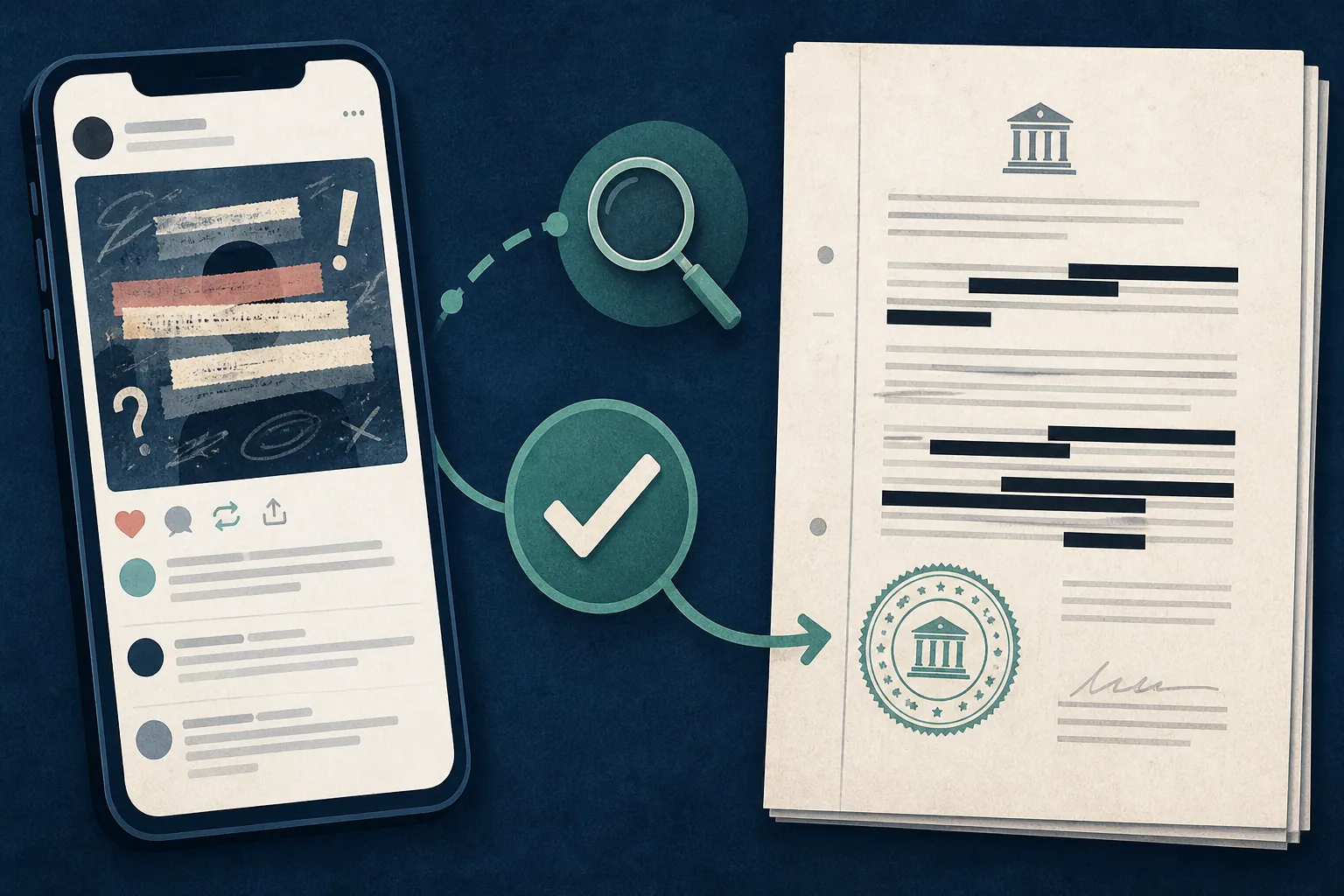
A usable verification file therefore starts with a modest rule: treat the viral post as the allegation, not the source. Then test whether the allegation survives contact with the record.
| Stage | Question to answer | Acceptable output |
|---|---|---|
| Anchor | Does the item appear in an official dataset, docket, order, or reliable transcript archive? | Source URL, file name or docket reference, page or exhibit location |
| Provenance | Which order, release, or docket event explains why this item is public? | Court order or release identified; scope not overstated |
| Artifact inspection | Does the item show documented AI or fabrication signals? | Signals recorded as corroborating evidence, not automatic proof |
| Cross-check | Do independent archives, named debunks, or reporting confirm or limit the claim? | Conflicts and unavailable sources noted |
| Status | What can be safely said now? | Confirmed, reported, disputed, unsupported, or false — with last-verified date |
Start where the record is supposed to live
The DOJ Epstein Library is the first stop for the federal production, not because it answers every question, but because it defines one public corpus that DOJ has chosen to publish.[2] If a viral claim says “new Epstein files show…” and supplies only a cropped image, the verification note should ask for the corresponding DOJ file path, PDF, image, video, metadata, or other locator before the claim is repeated.
Finding something in the DOJ portal still does not end the review. The Jan. 30 release combined responsive material with public submissions to the FBI, and DOJ expressly cautioned that fake or falsely submitted material may be present.[1] A file’s presence in that production establishes only that it is in the production. It does not, by itself, establish that the content of the file is accurate, that the person named did what the caption says, or that the image depicts what a viral account claims it depicts.
That is the first place many weak claims fail. The post says “unsealed court record.” The item turns out to be a public tip submission included in a DOJ release. Or the post says “court confirmed.” The court may have ordered access to records without adopting the factual truth of every allegation in them. The verification note should preserve that difference.
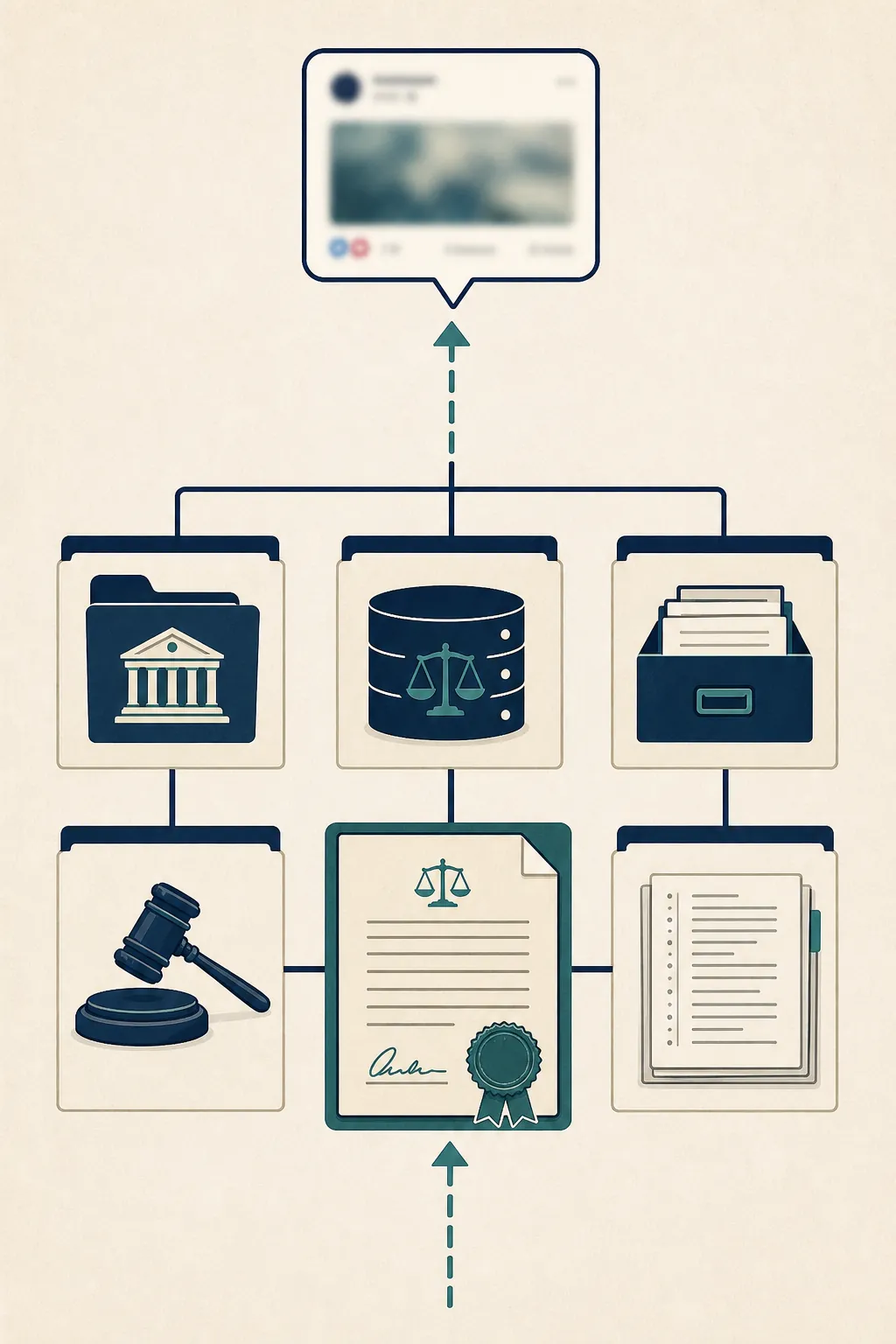
Do not let a searchable archive stand in for an unsealing order
Search is useful. It is not provenance. A hit in a third-party archive, a PDF bundle, or a deposition collection can help locate a document quickly, but the next question is still: what legal event made this item public, and what did that event actually cover?
For the Giuffre v. Maxwell materials, the Second Circuit’s July 23, 2025 decision is one of the controlling public-record markers. The court addressed unsealing in Giuffre v. Maxwell, No. 24-182, and its decision should be read for the scope of what was before the court rather than treated as a general license to describe every later internet file as “court-unsealed.”[3]
The same discipline applies to later district-court materials. Judge Paul A. Engelmayer’s Dec. 9, 2025 opinion is a separate source with its own procedural posture and limits.[4] Judge Loretta Preska’s Aug. 11, 2026 order, as reported by Courthouse News, concerned unsealing Ghislaine Maxwell-related grand jury subpoenas; that is not the same thing as a universal release of every sealed Epstein-related record.[5]
A clean provenance note should name the order, court, date, and document category. If the source is a docket database or a document-hosting archive rather than the court’s own PDF, say so. If the page is blocked, mirrored, excerpted, or available only through secondary reporting at the moment of review, say that too. The defect may not defeat the claim, but it changes the confidence label.
A practical provenance note
For each candidate item, record the narrowest supportable lineage:
- Claim being checked: quote the exact public claim, not a cleaned-up version.
- Primary locator: DOJ file, court docket entry, order, transcript, exhibit, or archive URL.
- Release authority: the order, statute, production, or docket event that explains public access.
- Scope limit: what the source does not prove.
- Last verified: date and time of the check, especially where portals or blocked pages may change.
Read the document before repeating the caption
A surprising number of viral Epstein-files claims are caption claims. The document may exist, but the caption adds the conclusion. A name appears near another name, and the post calls it a “client list.” A photograph appears in a production, and the post treats the depicted event as authenticated. A deposition excerpt mentions a person, and the post implies a finding by the court.
The safer reading sequence is mechanical. First, identify the document type: deposition, exhibit, correspondence, public submission, order, transcript, docket entry, or media file. Second, identify who created it and who submitted it. Third, separate statements made by a witness, allegations in a filing, judicial findings, and administrative production choices. Fourth, quote only the proposition the source actually supports.
That restraint is not pedantry. It is the difference between “the name appears in a released deposition exhibit” and “the court found this person was involved.” The first may be verifiable. The second may be unsupported.
This is also where prior method work helps. A credibility review such as the Ruemmler-Epstein testimony record is useful not because it supplies a global answer, but because it shows the habit required: keep the proposition tied to the record that actually supports it.
Inspect AI artifacts, but do not overclaim the detector
The AI layer around the Epstein releases is not hypothetical. DW reported on viral images falsely suggesting Epstein was alive in Israel, identifying signals such as a Gemini watermark, nonsensical street-sign text, and a HIVE AI-detection estimate of 94.6%; DW also cautioned that AI-detection tools are not fully reliable.[6] Open Measures measured the spread of identical Feb. 5, 2026 posts at more than 10.5 million views and described individual posts in the roughly 2 million to 5 million-plus view range.[7]
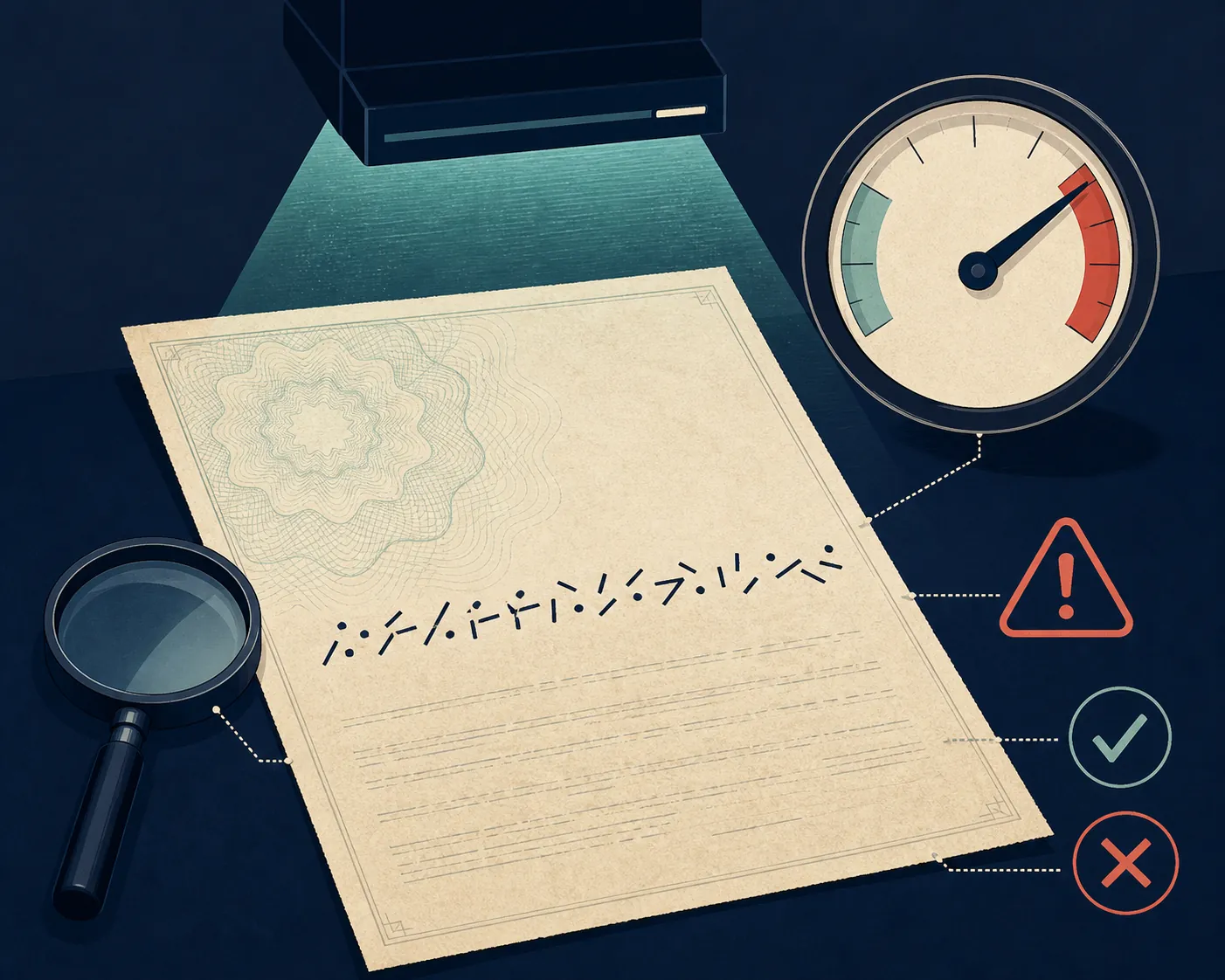
Those facts support a useful but bounded practice. A visible watermark is a strong inspection signal. Garbled environmental text is another. A high detector score can corroborate suspicion. None of them should be written as an infallible authentication result unless the underlying method, image chain, and source file support that conclusion.
Reuters separately fact-checked a poolside image purporting to show Jeffrey Epstein with prominent figures and concluded that the image was AI-generated.[8] That type of named debunk belongs in the file because it tests the same proposition the viral post is making. It should be cited as a fact-check conclusion, not silently converted into a broader rule that every image in circulation is false.
The same caution applies in the other direction. If an image lacks obvious AI artifacts, that does not authenticate it. If a watermark has been cropped out, a viewer may lose one visible clue without gaining proof of authenticity. If a detector returns a low score, the result may reduce suspicion, but it does not establish court provenance.
The Grok “unblur victims’ faces” trend shows why tool output needs an especially hard boundary. DW reported that such prompts produce hallucinated faces rather than recover redacted content, and cited one post with more than 17.6 million views.[6] A generated face is not a restoration of the sealed record. It is a new image attached to an old document.
For the same reason, a verification memo should not say “AI proves this is fake” when the actual support is “visible watermark, garbled text, and a detector estimate support the conclusion that this circulating image is AI-generated.” The second sentence is longer. It is also the sentence someone can defend.
For adjacent watermark and proof-of-life analysis, see our discussion of AI proof-of-life controversy. For the broader Epstein-related deepfake risk pattern, see our AI evidence risks note on Epstein deepfakes and the model scout death.
Use independent archives as indexes and conflict checks
Independent searchable projects can save hours. They can surface deposition pages, cluster names, and reveal whether a phrase appears across multiple documents. They are discovery aids, not replacements for the document or order that will be cited.
The same is true of media explainers. PBS/AP warned before a release wave that the court records were not expected to be a simple “client list,” a useful corrective to one of the most persistent framing errors in public discussion.[9] That helps narrow the review: if the claim depends on the phrase “client list,” ask which document uses that term, who used it, and whether the court adopted it.
A cross-check should look for four kinds of friction:
- The item appears in an archive but not in the official dataset or cited docket material.
- The item appears in the official production, but the caption makes a factual assertion the file does not support.
- A named fact-check addresses the same image, video, email, or quotation and reaches a narrower or contrary conclusion.
- The strongest source is secondary reporting because the primary page is blocked, removed, or not yet obtained.
That last category is not a failure condition. It is a label. A reported order can be important, especially when a reputable court reporter has seen it. But until the order itself is in the file, the verification status should say “reported,” not “confirmed from order.”
Assign a status that matches the evidence
The end product should be boring enough to reuse. A partner, editor, or pro se filer should be able to see exactly what was checked and what remains open. These labels are usually sufficient:
| Status | Use when | Example wording |
|---|---|---|
| Confirmed in primary record | The exact item and proposition are supported by an official dataset, order, docket entry, transcript, or exhibit. | Confirmed: the document appears in the DOJ Epstein Library at [locator], last verified Aug. 25, 2026. |
| Confirmed as present, not authenticated for truth | The item appears in a government production, but DOJ or the document type leaves factual accuracy unresolved. | Confirmed as present in the production; content not independently authenticated. |
| Reported | A reputable secondary source reports the order, item, or conclusion, but the primary source has not been obtained or is blocked. | Reported by [source]; underlying order not yet reviewed. |
| Disputed | Primary and secondary sources conflict, or a named fact-check contradicts the viral claim. | Disputed: viral caption conflicts with Reuters/DW fact-check and no primary source has been identified. |
| Unsupported | No primary locator, reliable archive match, or credible secondary source supports the claim. | Unsupported as of Aug. 25, 2026. |
| False | A reliable fact-check or primary record directly refutes the specific claim. | False as stated: the cited image was identified as AI-generated. |
The timestamp is not decoration. In a fast-moving release environment, a claim can move from unsupported to confirmed when a docket entry is obtained, or from plausible to false when the original image is traced to an AI-generation tool. The file should show when the check was performed and what source set was available at that time.
A model verification note
A concise internal note might read:
Claim checked: viral post states that a newly unsealed Epstein file proves [specific proposition]. Source supplied by post: screenshot only. Primary-record search: no matching DOJ Epstein Library locator or court docket entry identified as of Aug. 25, 2026. Related materials: DOJ’s Jan. 30, 2026 release warns that public FBI submissions may include fake or falsely submitted images, documents, or videos. AI/fabrication check: screenshot quality insufficient for image analysis; no original file available. Cross-check: no named fact-check located for this exact screenshot. Status: unsupported. Do not cite as court record without a primary locator.
If the item is later located, the note changes rather than disappears. The revised version might say that the file is confirmed as present in the DOJ production, while the truth of the submitted content remains unconfirmed. That is a real improvement in evidence without becoming a broader claim than the record permits.
This is the same discipline required for AI hallucination problems outside the Epstein record: a citation can be real while the proposition attached to it is unsupported. We have covered that failure mode in the Knox-Kercher legal AI hallucination probe, and the same check applies here.
Where the record stops
A verified answer will often be narrower than the public wants. It may say that a document exists, but not that its contents are true. It may say that an order was reported, but not yet reviewed. It may say that a generated image is false, while leaving a separate textual allegation unresolved. It may say that a name appears in a record, but not on any judicially recognized “client list.”
That narrowness is the point. The Epstein releases combine official portals, sealed-record litigation, public submissions, secondary archives, and AI-generated material circulating at enormous speed. The only safe way through is to make the lineage visible: source, order, artifact check, cross-check, status, and last-verified date.
For statutory-compliance questions around the broader release process, see the related analysis on what the Epstein Files Act reveals about compliance gaps. For verification, the answer should stay limited to what the record supports.
References
- Department of Justice Publishes 3.5 Million Responsive Pages in Compliance with the Epstein Files Transparency Act, U.S. Department of Justice, Jan. 30, 2026
- The Epstein Files, U.S. Department of Justice
- Giuffre v. Maxwell, No. 24-182, U.S. Court of Appeals for the Second Circuit, July 23, 2025
- PAE Maxwell Opinion 2025.12.09 (As Docketed), U.S. District Court for the Southern District of New York, Dec. 9, 2025
- New York judge orders unsealing of Ghislaine Maxwell-related grand jury subpoenas, Courthouse News Service
- Fact check: AI fakes distort claims on Epstein files, DW
- AI Images & Epstein Files, Open Measures
- Poolside image of Jeffrey Epstein with prominent figures is AI-generated, Reuters, Feb. 13, 2026
- Court records related to Jeffrey Epstein are set to be released soon, but they aren’t a client list, PBS NewsHour
Grounded in
This procedure is grounded in Epstein Files Transparency Act; Giuffre v. Maxwell, No. 24-182 (2d Cir. July 23, 2025), independent of any single documented case. See the Regulation tracker for the governing text.
Cases this step would have prevented
No cases have been explicitly linked to this checklist yet. See Risk Digest for documented incidents generally.
← Back to WorkflowsReport a correction or tip
Spotted an outdated figure, a misstated fact, or a ruling this workflow checklist should reflect? Public comments are disabled for this content given the professional cost of a misreported case outcome, penalty amount, or rule text — use the structured correction channel instead.
Report a correction or tip for this record →