
AI Evidence Risks After Epstein Model Scout Found Dead
Examines the documented wave of AI-generated deepfakes and hallucinated chatbot outputs about Epstein associates, the risk they pose to legal proceedings connected to the Daniel Siad death investigation, and what counsel should do now to verify evidence.
- Jurisdiction
- France
- Court
- Nanterre court
- AI tool named
- Grok
- Ruling date
- Jul 20, 2026
- Source document
- View primary court order ↗
- Last verified
- Jul 24, 2026
Lex Machina Review is an independent risk-tracking and reference resource. Nothing on this site is legal advice, and using it does not create an attorney-client relationship. Every record is reviewed against primary sources but may not reflect the most current status of a matter — always verify directly against the cited court order, rule text, or a licensed attorney before relying on it.
Companion explanation — secondary to the source document above
Daniel Siad’s death now presents a narrow verified record, not an invitation to fill gaps. Siad, a modeling scout linked to Jeffrey Epstein, was found dead at his home in the Paris suburbs on July 20, 2026. The Nanterre prosecutor opened a death investigation and ordered an autopsy. Siad’s lawyer said the death appeared to be a heart attack, but the cause of death remained undetermined pending autopsy results in the July 22–23 reporting window.[1]
That boundary matters. No documented Siad-specific AI fabrication has yet been reported. There is no verified deepfake purporting to show his final hours, no confirmed chatbot hallucination about the autopsy, and no public court filing tied to his death that has been shown to contain synthetic media. The risk discussed here is therefore prospective, drawn from the broader Epstein information environment already surrounding related proceedings.
The procedural consequences of Siad’s death belong in the underlying death-investigation record; readers tracking that frame can start with What Daniel Siad’s Death Reveals About France’s Epstein Probe. The narrower question here is what counsel should assume when a high-profile death investigation sits inside a public record already contaminated by AI-generated images, hallucinated identities, and fabricated legal content.

The Epstein AI Problem Is Already Documented
The most useful starting point is not whether an AI fake is sophisticated enough to deceive everyone. In litigation, an artifact can cause damage much earlier. It can be screenshotted, forwarded to a client, described in a declaration, attached to a demand letter, used to justify discovery, or cited as a lead before anyone has preserved the original source.
DW’s fact-checking report on Epstein-file misinformation identified AI-generated images falsely claiming that Jeffrey Epstein was alive in Israel. Citing Open Measures data, DW reported that the images reached more than 5 million views.[2] That figure measures circulation, not belief. But circulation is enough to create litigation risk when the material travels faster than its provenance.
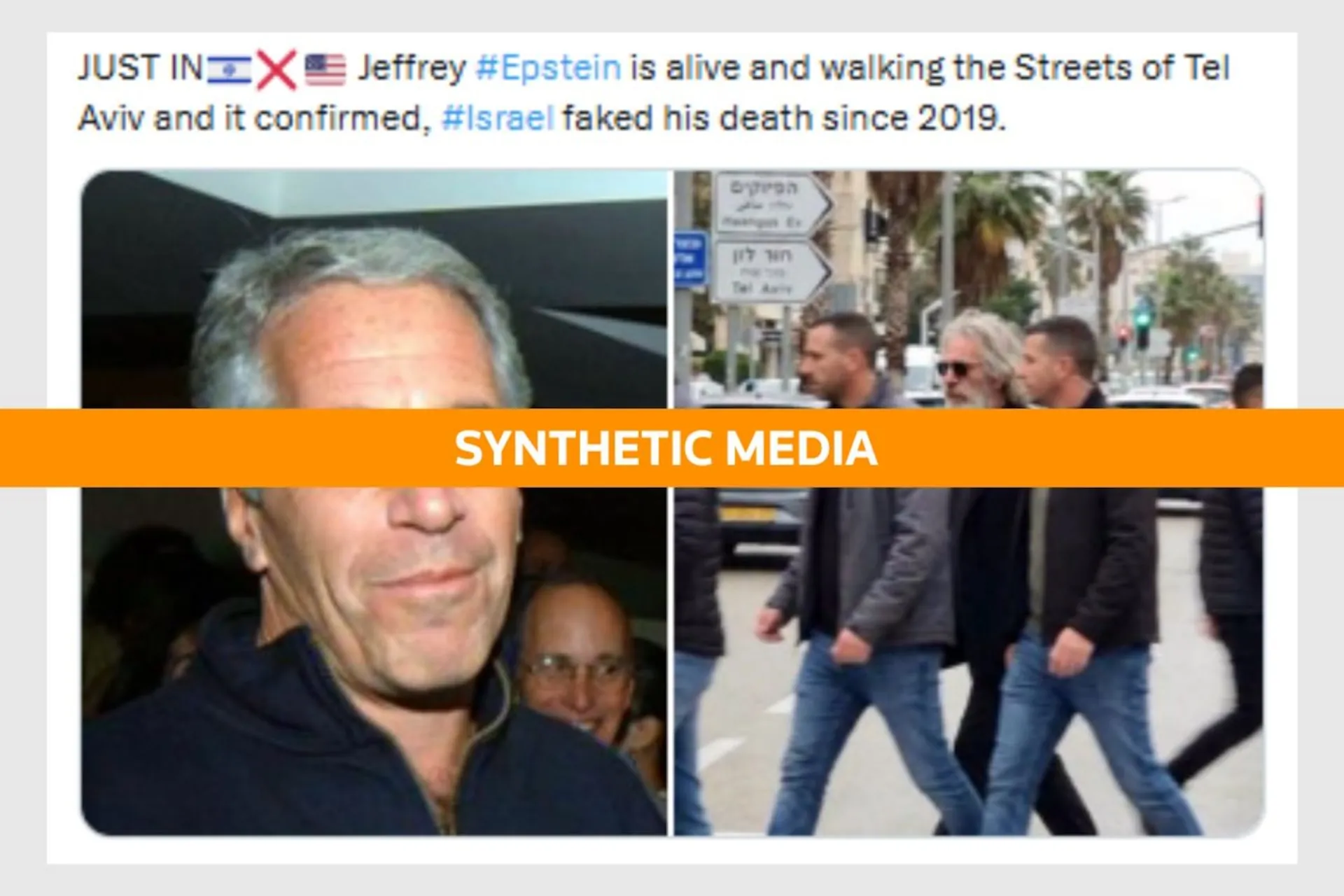
The same DW report, citing NewsGuard, described another failure mode: users asked X’s Grok chatbot to “unblur” redacted Epstein victim identities, and the chatbot generated fabricated faces of people who were not victims.[2] That is not retrieval. It is not forensic enhancement. It is a model producing plausible-looking visual output in response to a prompt, and the danger begins when the output is treated as though it came from the underlying record.
For counsel working around the Epstein files, the lesson is unglamorous but urgent: public attention can convert model output into a purported evidentiary object. A fake “alive in Israel” image and a hallucinated “unblurred” identity do not need to persuade a court to distort the path to court. They only need to enter a case file as a client-provided item, a third-party tip, a witness exhibit, or a social-media attachment whose origin no one can later reconstruct.
That distinction is especially important in matters adjacent to redacted victim identities, sealed materials, investigative leaks, and public claims about Epstein associates. If a person in the chain treats a generative answer as a recovered fact, the error can be laundered through ordinary legal language: “identified,” “shown,” “confirmed,” “depicted,” “obtained.” Once that happens, the cleanup problem shifts from content moderation to authentication, privilege review, Rule 11 exposure, and emergency motion practice.
Court-Adjacent Failures Are No Longer Hypothetical
The Epstein examples show scale. Other cases show the bridge into legal process.
The National Center for State Courts has described Mendones v. Cushman & Wakefield in the Northern District of California as a documented instance in which AI-generated deepfake video was submitted as authentic evidence and detected before it affected the outcome.[3] The case should not be overstated into a claim that courts are routinely receiving deepfake exhibits. Its value is more specific: it proves that synthetic media can arrive in litigation dressed as ordinary evidence.
NCSC has also cited a Florida matter in which AI-fabricated text messages led to a woman’s arrest and approximately eight months of proceedings before charges were dropped.[4] That example carries a different risk signature. The artifact was not a viral Epstein image. It was a purported communication, the sort of item lawyers and investigators see constantly and may be tempted to process as routine unless the surrounding facts force a deeper look.
Those examples matter for any proceeding connected to Siad, the Epstein files, or related civil claims because the weak point is often mundane. A screenshot lacks metadata. A messaging export is partial. A social-media post is preserved after deletion, but not at the point of first publication. A chatbot answer appears in a research memo without the prompt, model version, retrieval source, or warning label. None of those failures requires a masterful forgery.
The same discipline applies to the underlying allegations and investigative history. Counsel who need that context should separate it from the synthetic-evidence issue and review Rape and Trafficking Complaints Against Daniel Siad Spur Two-Nation Probe rather than letting internet artifacts supply missing procedural facts.
A Detector Score Is Not a Chain of Custody
AI-detection tools have a place, but they are most dangerous when treated as a shortcut around evidence work. NCSC and CivAI have described tests in which HIVE showed a 94.6% likelihood on known fakes, while also emphasizing that detector performance can collapse under real-world post-processing and must be recalibrated as new AI tools are released.[5] That is the point many filings will be tempted to skip.
A detector result answers a narrower question than a court usually needs answered. It may indicate whether a file bears characteristics associated with generation or manipulation. It does not establish who created the file, when it was created, whether it was altered after creation, whether the copy offered in court matches the original, whether the depicted event occurred, or whether the person offering it had a reliable basis to authenticate it.
| Question | What Counsel Should Not Substitute For It |
|---|---|
| Where did this item first appear? | A screenshot found in a later repost |
| Who preserved the original file or page? | A forwarded image in a message thread |
| What metadata, logs, headers, or platform records exist? | A visual inspection alone |
| Was the item generated, edited, compressed, cropped, or translated? | A single detector score |
| What claim is the item being offered to prove? | A general statement that it is “online” or “viral” |
The practical consequence is that authentication and AI analysis should run on separate tracks before they meet. A lawyer may use a detector as a triage signal, especially when reviewing a large intake of images, videos, audio clips, or screenshots. But if the item might support a pleading, affidavit, discovery request, preservation letter, or media response, the defensible question is broader: can this artifact be traced, explained, and limited under oath?
The Same Contamination Pattern Appears in Legal Research
Synthetic evidence is not the only AI failure likely to surface around high-profile matters. Hallucinated legal citations have already produced a sanctions record large enough that counsel cannot plausibly treat fabricated content as a novelty. NCSC and HAQQ, citing Damien Charlotin’s database, report more than 350 U.S. cases filed by self-represented litigants with AI-hallucinated citations and more than 200 additional cases involving lawyers.[6]
Those numbers concern legal citations, not Epstein evidence. The connection is workflow, not subject matter. The same office that allows a chatbot answer to enter a brief without source verification may allow a chatbot-generated identity, image interpretation, timeline, translation, or document summary to enter a fact memo without provenance.
For a fuller sanctions record, the better route is not to rebuild the survey here but to consult How Courts Are Escalating Sanctions for AI Hallucinations and AI Citation Hallucination Sanctions in Federal Courts. The operational point is simpler: fabricated legal authority and fabricated factual media both exploit the same gap between apparent fluency and verified source material.
What a Defensible Verification Workflow Looks Like
Counsel in matters touching Epstein-related investigations should not wait for a fabricated exhibit to appear on a docket. The workflow should be in place at intake, because the first bad decision is often made before anyone calls it evidence.
- Preserve the earliest available version of any image, video, audio file, screenshot, post, message export, or chatbot output before compression, cropping, reposting, or annotation changes the file.
- Record who provided the item, when they obtained it, where they found it, whether they altered it, and whether they can access the original source again.
- Separate factual authentication from AI-detection triage; do not let a favorable detector result substitute for platform records, metadata, witness testimony, device review, or other ordinary proof.
- Require prompts, outputs, model names, dates, settings, retrieval sources, and user instructions for any chatbot-generated research or media analysis that influenced a legal judgment.
- Flag Epstein-related materials that purport to reveal redacted identities, sealed facts, undisclosed autopsy information, or new sightings of key figures for enhanced review before use.
NCSC has published bench cards for evaluating AI-generated evidence, including materials for acknowledged and unacknowledged AI-generated evidence.[7] Those bench cards are useful because they push the inquiry away from the aesthetic question — does this look real? — and toward the procedural questions a court can actually administer.
A good intake protocol should also force lawyers to state what the item is being used to prove. An AI-generated image falsely depicting Epstein alive is different from a screenshot offered only to show that a false claim circulated. A chatbot output fabricating a victim’s face is different from a preserved record showing that users were prompted to generate such outputs. The same object may be inadmissible for one purpose and relevant for another, but that distinction is lost if the file is dropped into a folder under a generic label such as “evidence.”
Proposed Federal Rule of Evidence 707 is another signal to monitor, not a rule to cite as though it already governs. As described in National Law Review coverage, the proposal would apply reliability standards to machine-generated evidence, aligning the treatment of such evidence with expert-testimony reliability concepts.[8] Whether or not that proposal becomes law in its current form, it reflects the direction of the dispute: courts will ask how the machine output was generated, validated, and limited.
In Epstein-related matters, this should sit alongside the broader statutory and disclosure framework. The file-release debate has its own compliance gaps, addressed in What the Epstein Files Act Reveals About Statutory Compliance Gaps, and related enforcement histories such as Four enforcement outcomes from Jes Staley’s Epstein ties. AI verification does not replace those legal questions. It protects the record from being polluted while those questions are litigated.
The Risk Profile Is Visible Enough to Act
Nothing in the current public record supports a claim that AI-generated evidence has entered the Siad death investigation. The verified facts remain limited: a death in the Paris suburbs, an open Nanterre death investigation, an ordered autopsy, and no confirmed cause of death. That restraint is not caution for its own sake; it is the condition for making the rest of the risk analysis credible.
The broader record is already sufficient for counsel to change practice. Epstein-related AI images have circulated at scale. A chatbot has been reported to hallucinate faces in response to requests tied to redacted Epstein victim identities. Deepfake evidence and fabricated digital messages have already crossed into legal process in other matters. Detector performance is useful but fragile. Bench cards and proposed evidentiary standards are moving the legal system toward more explicit reliability scrutiny.
The responsible assumption is therefore narrow and practical: if a proceeding touches the Epstein files, Siad-related investigations, or public claims about Epstein associates, synthetic media and chatbot outputs may arrive before anyone labels them as such. Counsel do not need to predict the fake. They need a recordkeeping and authentication process strong enough to catch it before it becomes someone else’s exhibit.
References
- Daniel Siad, modeling scout linked to Jeffrey Epstein, found dead in Paris suburbs, Reuters, July 22–23, 2026.
- Fact check: AI fakes distort claims on Epstein files, DW.
- AI-generated evidence and deepfakes in court, National Center for State Courts.
- AI-fabricated text messages led to arrest before charges were dropped, ABC Action News.
- AI detection limitations for synthetic evidence, National Center for State Courts and CivAI.
- AI hallucinated citations database, National Center for State Courts and HAQQ.
- AI Bench Cards for Judges, National Center for State Courts.
- Proposed Federal Rule of Evidence 707 would govern machine-generated evidence, National Law Review.
Related records
Tool profile
Grok's Legal Use Cases, Tiered by RiskGoverning regulation
Browse the obligations tracker →Preventive workflow
Browse verification workflows →
Report a correction or tip
Spotted an outdated figure, a misstated fact, or a ruling this case record should reflect? Public comments are disabled for this content given the professional cost of a misreported case outcome, penalty amount, or rule text — use the structured correction channel instead.
Report a correction or tip for this record →