
AI Contract Review Accuracy: What the 2026 Benchmarks Actually Show About Purpose-Built vs. General-Purpose Models
This article synthesizes the 2026 LegalOn, Harvey Contract Intelligence, and ContractEval benchmarks to explain why purpose-built AI platforms significantly outperform general-purpose LLMs on precision-critical contract review tasks — and why the gap is driven by system architecture, not foundation model intelligence. Written for in-house counsel, legal ops leaders, and law firm partners evaluating AI contract review adoption.
Why Accuracy Is the Deciding Factor for AI Contract Review Adoption
Every legal team evaluating AI contract review software confronts the same threshold question: can the machine be trusted to get it right? The stakes are not abstract. A missed indemnification cap, an overlooked change-of-control provision, or a hallucinated cross-reference can produce a signed agreement that exposes the client to liability the lawyer never intended to accept.
The 2026 market data suggests that most practitioners have already made a pragmatic peace with imperfect accuracy. A survey of 72 lawyers conducted for the LegalBenchmarks.ai study found that 55% are comfortable with accuracy below 90%, while only 6% require 100% accuracy before they will use AI tools. That tolerance is not recklessness — it reflects a profession that has always relied on review processes, not single-pass perfection. The same survey found that 86% of respondents already employ multiple AI tools, suggesting that adoption is proceeding even as the accuracy debate continues.
The core thesis of this article is straightforward: the 2026 benchmark evidence shows that purpose-built legal AI platforms significantly outperform general-purpose LLMs on precision-critical contract review tasks, but the gap is driven more by system architecture than by the underlying foundation model. Understanding that distinction — intelligence versus harness — is essential for any legal team making a procurement decision. It determines which vendor claims are credible, which failure modes are structural versus fixable, and where human oversight remains irreplaceable.
What the Major Benchmarks Say: LegalOn 2026, Harvey Contract Intelligence, and ContractEval
Three benchmarks released between late 2025 and mid-2026 provide the most comprehensive picture available of how AI systems perform on contract review. Each uses a different methodology and scope, but together they converge on a consistent finding: purpose-built platforms outperform general-purpose models, and the margin is largest on precisely the tasks that matter most in legal practice.
| Benchmark | Scope | Methodology | Key Finding |
|---|---|---|---|
| LegalOn 2026 Contract Review Benchmark | 3,282 pairwise reviews, 21 precision-critical guidelines, 11 AI models | Independent LLM judge with attorney validation; two-pass bias control | LegalOn preferred 1.9x to 3.8x over top general-purpose models on specific clause types |
| Harvey Contract Intelligence Benchmark | 4,000+ data points across varying contract types | Extraction accuracy measurement; human+AI synergy testing | Lawyers + Review tables outperform either alone by 5% or more |
| ContractEval (Carnegie Mellon, Rutgers, Stanford, NJIT) | 19 LLMs (4 proprietary, 15 open-source); 41 clause categories; 4,128 data points | Academic benchmark using CUAD dataset; F1 scoring for clause-level extraction | Proprietary models lead; open-source models lag by ~16% on F1 scores |
The LegalOn benchmark is the most granular. It tested 11 models against LegalOn across 21 precision-critical guidelines covering provisions such as assignment rights, business associate agreement (BAA) PHI ownership, non-disclosure agreement (NDA) defined purpose, master service agreement (MSA) statement of work (SOW) execution, and clinical trial agreement manuscript review timelines. LegalOn was ranked first across all provision types. The specific margins are instructive: LegalOn was preferred 3.8x more often than GPT-5 on triple net lease unconditional assignment right checks, 2.6x more often than Gemini 3.1 Pro on BAA PHI ownership, and 2.4x more often than Claude Sonnet 4.6 on NDA defined purpose.
The Harvey Contract Intelligence benchmark (November 2025) took a different approach, measuring extraction accuracy across more than 4,000 data points. Its most important finding is that out-of-the-box LLMs only identified around 65–70% of valid deal points. The best performance came from lawyers working with Review tables in Vault, who routinely outscored either the lawyer or LLM alone by 5% or more. This human-plus-AI synergy finding has direct implications for how legal teams should structure their review workflows.
The ContractEval benchmark is the strongest independent source in this set. Conducted by researchers at Carnegie Mellon, Rutgers, Stanford, and NJIT, it evaluated 19 LLMs on clause-level contract review using the CUAD dataset (41 clause categories, 4,128 data points). Proprietary models (GPT 4.1, GPT 4.1 mini) achieved the highest F1 scores at 0.641 and 0.644. The best open-source model (Qwen3 8B) achieved an F1 of 0.540 — about 16% lower than GPT 4.1. The authors found that larger open-source models show diminishing returns, and that 'thinking' mode improves output effectiveness but reduces correctness. Critically, models struggled significantly with rare or high-risk clause types like 'Uncapped Liability', 'Joint IP Ownership', and 'Notice Period to Terminate Renewal', scoring near zero F1.
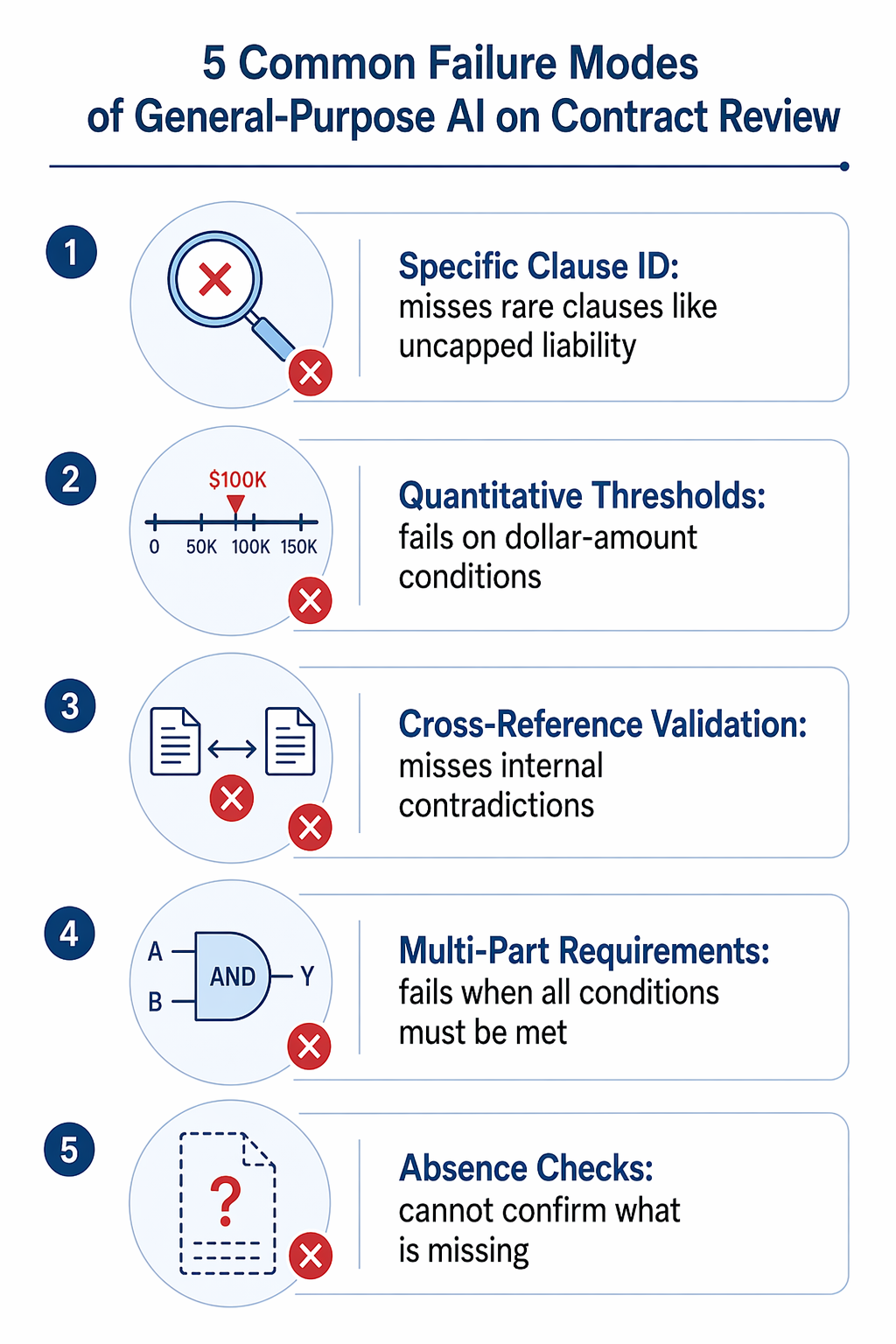
Five Documented Failure Modes of General-Purpose AI on Contract Review
The benchmarks do not merely show that purpose-built platforms score higher. They reveal specific, recurring failure patterns in general-purpose models that explain why the gap exists. These are not edge cases — they are structural weaknesses in how single-pass LLMs process contract language.
1. Specific Clause Identification
General-purpose models consistently miss rare or highly specific clause types. The ContractEval benchmark found that models scored near zero F1 on clauses like 'Uncapped Liability' and 'Joint IP Ownership' — precisely the provisions that carry the highest risk in commercial agreements. A general-purpose LLM scanning a contract may simply not recognize that an unusual formulation of a limitation-of-liability clause constitutes an uncapped liability exposure.
2. Quantitative Threshold Checks
Contracts are full of numbers: dollar caps, time periods, percentage thresholds, notice periods. The LegalOn benchmark documented that general-purpose models fail at quantitative threshold checks — for example, verifying whether a liability cap exceeds a specified dollar amount or whether a notice period meets a minimum requirement. These are not complex reasoning tasks, but they require precise extraction and comparison that single-pass models handle poorly.
3. Cross-Reference Validation
A single contract may define a term in Section 1, impose a condition in Section 4, and reference both in Section 12. General-purpose models struggle to validate that these cross-references are consistent. The LegalOn benchmark found that models failed at tasks requiring them to confirm that a provision in one section was properly incorporated or referenced in another — a task that purpose-built platforms handle through explicit cross-reference mapping.
4. Multi-Part AND Requirements
Many contract provisions require multiple conditions to be satisfied simultaneously: "The party may terminate if (a) a material breach occurs, (b) the breaching party fails to cure within 30 days, and (c) the non-breaching party provides written notice." General-purpose models frequently identify only a subset of these conditions, treating the provision as satisfied when only one or two of the three requirements are met. The LegalOn benchmark documented this as a systematic failure mode.
5. Absence Checks
Perhaps the most counterintuitive failure: general-purpose models cannot reliably confirm that something is absent from a contract. A lawyer reviewing a contract needs to know not only what is present but what is missing — a non-compete clause that should be there but is not, a governing law provision that was omitted. The LegalOn benchmark found that general-purpose models fail at absence checks because their architecture is optimized to find what is present, not to verify what is absent. Purpose-built platforms handle this through explicit playbook rules that define required provisions and flag their absence.
The Architectural Explanation: Intelligence vs. Harness
The most common misconception in the legal AI market is that the foundation model — GPT-5.1, Claude Opus 4.6, Gemini 3.1 Pro — is the primary determinant of accuracy. The benchmark evidence tells a different story. The gap between purpose-built platforms and general-purpose models is driven less by which LLM is under the hood and more by the system architecture that surrounds it.
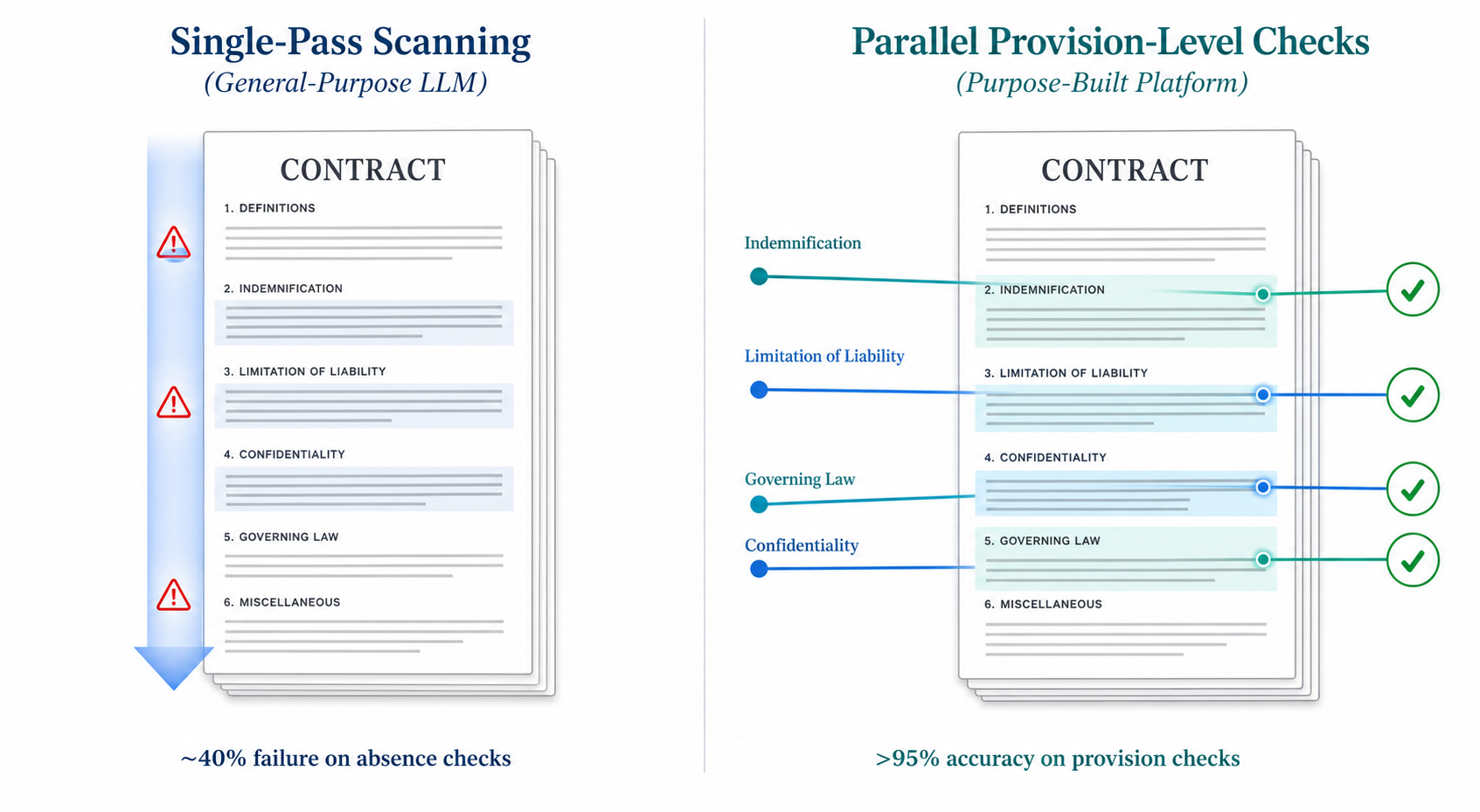
The LegalOn benchmark introduces a useful framework: intelligence versus harness. The 'intelligence' is the foundation model — its ability to understand language, reason about context, and generate responses. The 'harness' is the system architecture that directs that intelligence at specific tasks. A purpose-built platform like LegalOn runs approximately 25 focused provision-level checks per contract in parallel. Each check is a targeted query: "Does this indemnification clause cap liability?" "What is the notice period?" "Is there a change-of-control provision?" The results are then synthesized into a structured review.
A general-purpose LLM, by contrast, performs a single-pass scan. It reads the entire contract and produces a summary or answers to open-ended questions. This approach works well for broad comprehension tasks — "What is this contract about?" — but fails on the precision-critical tasks that contract review requires. The single pass cannot simultaneously check 25 different provisions with focused attention on each one. It cannot verify absence because it has no checklist of required provisions. It cannot validate cross-references because it has no explicit mapping of where terms are defined and used.
For a deeper technical dive into how purpose-built systems work, see our explainer on AI contract review software architecture, which covers RAG architecture, playbook automation, and the technical differences between purpose-built and general-purpose systems.
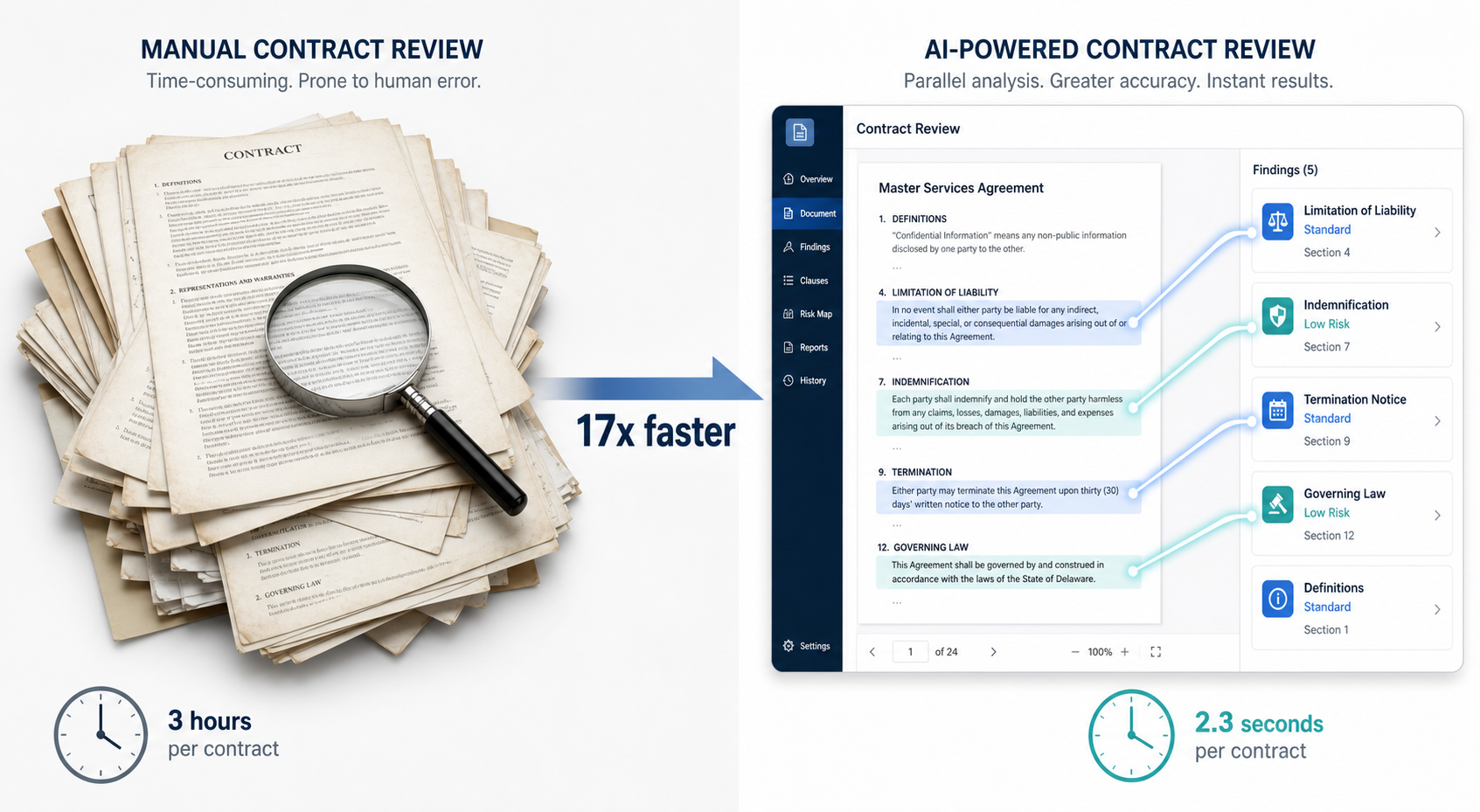
Speed Does Not Trade Off With Accuracy: 2.3 Seconds vs. 40.4 Seconds
A common concern among legal teams evaluating AI contract review is that higher accuracy might require slower processing — that a more thorough review necessarily takes more time. The benchmark evidence refutes this assumption directly.
The LegalOn benchmark measured speed across models. LegalOn completed a full contract review in 2.3 seconds. Claude Opus 4.6, the fastest general-purpose model tested, averaged 40.4 seconds per contract. That is a 17x speed advantage for the purpose-built platform — and it achieved that speed while also achieving higher accuracy on every provision type tested.
The explanation is architectural. Parallel provision-level checks are inherently faster than sequential single-pass scanning because they divide the work across multiple focused processes rather than forcing a single model to handle everything at once. Each of the 25 parallel checks is a narrow, well-defined task that can be completed quickly. The single-pass model must process the entire contract sequentially, holding all of its context in a single attention window, which is computationally expensive and time-consuming.
Humans and AI Are Complementary: What the Harvey Benchmark Reveals
The Harvey Contract Intelligence benchmark offers one of the most practically useful findings in the current research: the best contract review performance comes from humans and AI working together, not from either alone.
Harvey found that lawyers working with Review tables in Vault routinely outperformed either the lawyer alone or the LLM alone by 5% or more. This is not a marginal improvement — in contract review, where a single missed provision can create material liability, a 5% accuracy gain is significant.
The benchmark also identified why the combination works: the error patterns are complementary. LLM limitations fall into two patterns: being overeager (making assumptions beyond the four corners of the contract) and overthinking (producing technically correct but overly literal responses that miss the practical intent). Human errors, by contrast, are harder to predict — they consist of idiosyncratic mistakes like accidental transpositions or missing key phrases. Because the error patterns are different, a human reviewing AI-generated output catches things the AI missed, and the AI catches things the human missed.
This finding has direct implications for workflow design. It suggests that the optimal deployment model is not full automation but structured human-AI collaboration — where the AI handles the systematic, high-volume checking of defined provisions and the human focuses on judgment calls, unusual provisions, and verification of AI output. For a more critical perspective on why AI tools that outperform lawyers in benchmarks can still lag in daily practice, see our analysis of the Harvey AI and CoCounsel adoption gap.
Practical Recommendations for Evaluating Vendor Accuracy Claims
The benchmark evidence provides a framework for evaluating vendor accuracy claims that goes beyond asking "how accurate is your tool?" Legal teams making procurement decisions should apply the following criteria:
- Demand benchmark methodology transparency. Ask vendors to disclose the number of reviews, the provision types tested, the models compared, and the validation method. The LegalOn benchmark's methodology (LLM judge with attorney validation, two-pass bias control, 3,282 reviews) sets a reasonable standard for transparency.
- Distinguish between model-level and system-level accuracy claims. A vendor may claim "GPT-5.1 powers our platform" — but the relevant question is what architecture surrounds that model. A general-purpose LLM with a thin wrapper is not the same as a purpose-built platform with parallel provision-level checks, even if both use the same foundation model.
- Request clause-level breakdowns, not aggregate scores. A vendor that reports 90% overall accuracy may be masking near-zero performance on high-risk clauses like uncapped liability or joint IP ownership. The ContractEval benchmark showed that models scoring well on common clauses can score near zero on rare but critical provisions.
- Verify against independent benchmarks where available. The ContractEval benchmark (Carnegie Mellon, Rutgers, Stanford, NJIT) is the strongest independent source currently available. Ask vendors how their performance compares on the CUAD dataset or similar standardized evaluations.
- Test on your own contracts, not vendor-provided samples. Run a blind test using a representative sample of your organization's actual contracts — including the unusual provisions, the poorly drafted clauses, and the edge cases that make contract review difficult. The benchmark results are directional; your actual experience will depend on your contract types and review requirements.
- Assess the human-in-the-loop workflow. The Harvey benchmark shows that human+AI outperforms either alone. Evaluate how the vendor's platform supports human review — does it flag provisions for human verification? Does it provide clear explanations of its findings? Does it allow lawyers to override AI determinations?
The 2026 benchmark evidence is unambiguous: purpose-built AI contract review platforms significantly outperform general-purpose LLMs on the tasks that matter most in legal practice. But the gap is not about which model is smarter — it is about which system is designed for the job. Legal teams that understand this distinction will make better procurement decisions, design more effective review workflows, and ultimately deliver better outcomes for their clients.
Grounded in
This procedure is grounded in the cited rule or opinion, independent of any single documented case. See the Regulation tracker for the governing text.
Cases this step would have prevented
No cases have been explicitly linked to this checklist yet. See Risk Digest for documented incidents generally.
← Back to WorkflowsReport a correction or tip
Spotted an outdated figure, a misstated fact, or a ruling this workflow checklist should reflect? Public comments are disabled for this content given the professional cost of a misreported case outcome, penalty amount, or rule text — use the structured correction channel instead.
Report a correction or tip for this record →