
How to Use AI Legal Research Without Getting Sanctioned
A step-by-step guide to a verification-first workflow for AI-assisted legal research, showing how to capture time savings while avoiding sanctions and ethical violations. Based on ABA Formal Opinion 512 and independent accuracy benchmarks, the six-step protocol reduces risk and nets 40-60% time savings over traditional research.
The dangerous moment in AI legal research work is not when the tool is obviously hallucinating. The dangerous moment is when the answer looks usable, the deadline is close, and the citation list is tidy enough to tempt someone into pasting it into a draft.
ABA Formal Opinion 512 did not create a special AI regime. It treated generative AI as another setting where the ordinary duties still apply: competence, candor to the tribunal, meritorious claims, and supervision of lawyers and nonlawyers remain in force when a legal professional uses AI-generated material.[1] That is the floor. The workflow has to be built for the person who will be asked, later, not whether the AI sounded persuasive, but what they checked before relying on it.
The accuracy data explains why that floor matters. In Stanford RegLab and HAI’s 2024 assessment of leading legal research tools, purpose-built legal AI systems still produced hallucinations on complex legal queries often enough to make ordinary confidence unsafe: Lexis+ AI was wrong more than 17% of the time, and Westlaw AI-Assisted Research more than 34% of the time in the study’s tested conditions. On straightforward single-jurisdiction questions, the tools performed better, in the 75–85% range, but complex queries are where filed work usually lives.[2]
Those figures should not be used as a permanent leaderboard. Products change, vendors dispute methods, and a benchmark from one point in time cannot tell you exactly how a platform will perform on your next question. But the numbers are enough to support a working rule: do not treat an AI research answer as an answer. Treat it as a lead packet.
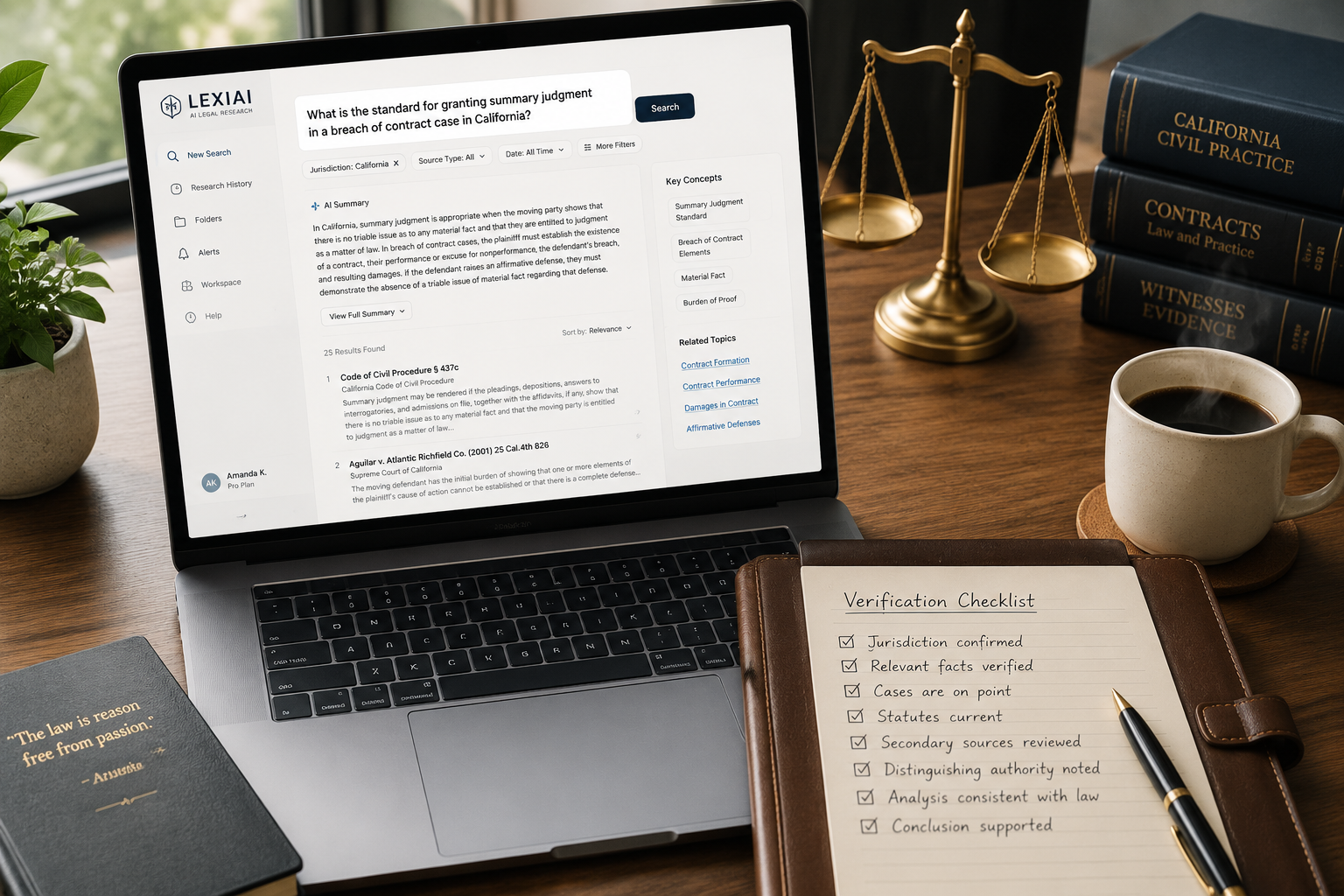
The bargain: save time, then spend some of it checking
A disciplined AI-assisted research session can still come out well ahead of a fully traditional one. The practical range worth using is 40–60% time savings, with an added 20–30 minutes reserved for verification against a traditional 60–90 minute research session.[3] That is not a promise for every question. A messy issue of first impression will not behave like a routine venue question. A lawyer new to the platform will not move like a staff attorney who has already built saved prompts and validation habits.
Still, the trade is real enough to build around: let AI compress the first pass, issue spotting, and retrieval work, then spend a controlled block of time proving what survives. The saved time is not available for billing, filing, or client advice until the verification is done.
The sanctions record gives that rule teeth without needing to turn every mistake into a horror story. Damien Charlotin’s tracking has documented more than 750 instances of lawyers being reprimanded for AI-generated fake citations, including 324 in U.S. federal, state, and tribal courts; Mata v. Avianca became the landmark 2023 example because ChatGPT fabricated entire case citations that made their way into court papers.[3] The lesson is not that AI research is forbidden. The lesson is that an unchecked citation is not research.
A six-step verification-first workflow
This protocol is meant for ordinary litigation research: a motion, a response, a bench memo, a demand letter, or a partner question where the output may influence a legal position. It is not a substitute for firm policy, court rules, or jurisdiction-specific ethics guidance. It is the working file discipline that should exist before anyone signs, files, or forwards the conclusion as reliable.
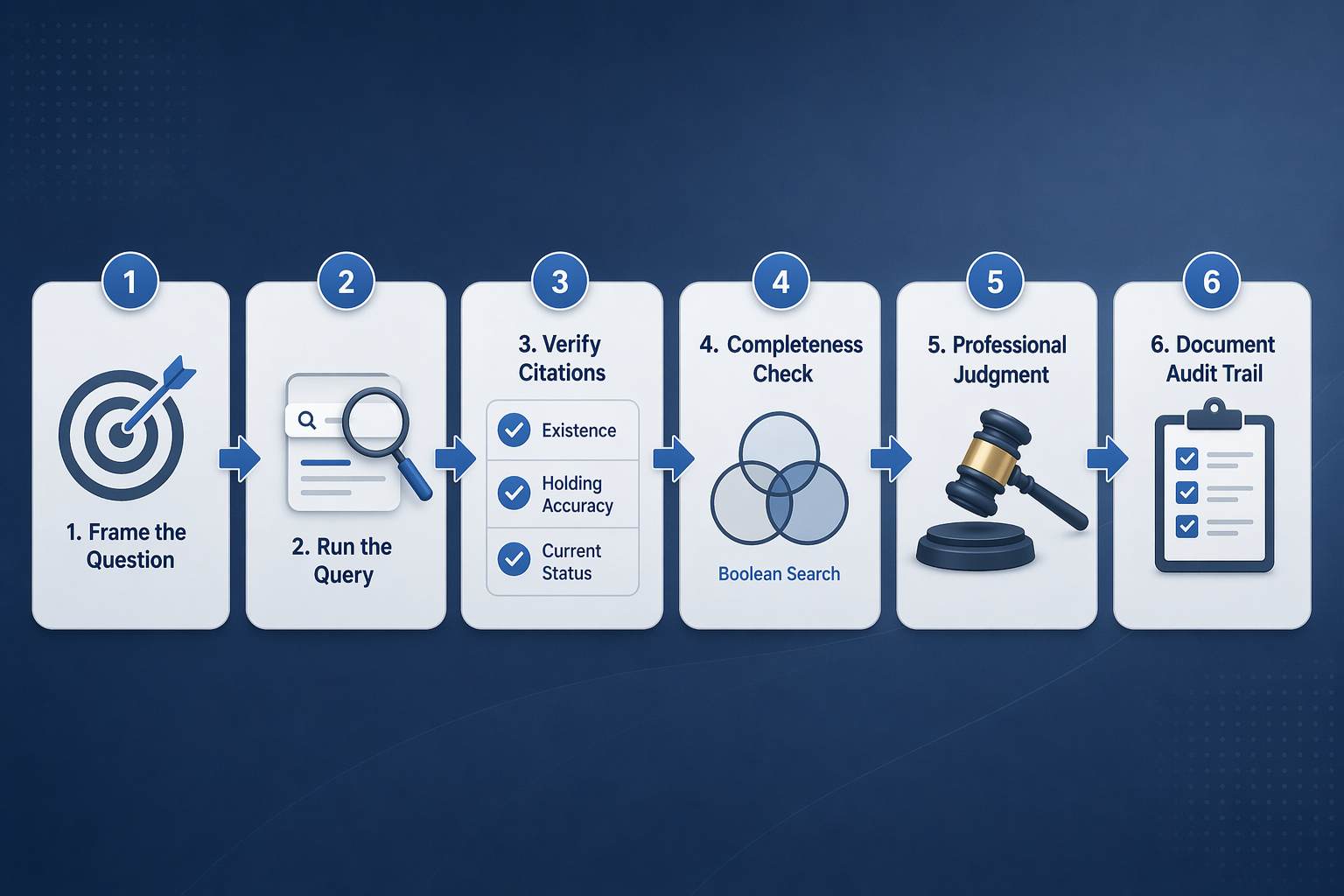
| Step | Action | Work product to keep |
|---|---|---|
| 1 | Frame the question before using AI | Issue statement, jurisdiction, date limits, procedural posture |
| 2 | Run the AI query as a lead-generation pass | Prompt, tool used, date, full output |
| 3 | Verify every citation | Existence, holding accuracy, current status, pin cite notes |
| 4 | Completeness-check outside the AI answer | Boolean search log and omitted authority notes |
| 5 | Apply professional judgment | Fit analysis, adverse authority assessment, use-or-reject decisions |
| 6 | Document the audit trail | Final verification memo or research log |
1. Frame the question before the tool frames it for you
Start outside the AI interface. Write the research question in the form a supervising lawyer or court would recognize: jurisdiction, court level, procedural posture, governing date range, key facts, and the legal standard you think may apply. If those elements are missing, the AI system will often supply structure for you. Sometimes that structure is helpful. Sometimes it quietly moves the question into the wrong jurisdiction, the wrong standard, or the wrong procedural lane.
A usable prompt does not need to be theatrical. It needs constraints. For example, a strong research prompt tells the tool that the matter is in federal district court, identifies the circuit, states whether the issue is pleading, discovery, summary judgment, or appeal, and asks for controlling authority first. If you are comparing tools before building this habit, use a dedicated AI legal research tools comparison rather than burying tool selection inside a live filing deadline.
2. Run the query, but save the raw output
Run the AI query as a first-pass research assistant, not as a final drafter. Ask for the cases, the rule statements, and the reasoning chain. If the tool supports source display, ask it to show the authorities it used. If it offers a generated memo, keep the memo, but do not let polished prose substitute for source work.
Save the prompt, the date, the tool, and the complete output before editing. This matters because AI interfaces can regenerate, update, or lose context. A clean research file lets someone reconstruct what was available to the person at the keyboard when the decision was made.
Tool choice still matters. A general-purpose chatbot and a legal-native system do not carry the same source environment, retrieval design, or risk profile. For that threshold decision, use a separate general-purpose versus legal-native AI risk guide before deciding where live legal research belongs.
3. Verify every citation for existence, holding, and current status
This is the step that cannot be compressed into “the citation looks real.” A citation check has three separate jobs: prove the authority exists, prove it says what the AI says it says, and prove it remains good law for the proposition being used.
- Existence: open the case, statute, rule, regulation, or secondary source in a reliable legal database or official source. Confirm the name, reporter, court, year, docket or citation format, and page or paragraph reference.
- Holding accuracy: read the relevant passage yourself. Do not rely on the AI’s summary, headnote language, or a quoted sentence without context. Confirm that the cited authority supports the specific proposition in your draft.
- Current status: Shepardize, KeyCite, or otherwise update the authority. Check whether the case has been reversed, vacated, abrogated, limited, distinguished on the relevant point, superseded by statute, or affected by later rule changes.
- Pinpoint support: record the page, paragraph, section, or rule subsection that carries the proposition. If the support is only general background, label it that way instead of forcing it into a holding.
LeanLaw’s citation verification checklist and Clio’s legal quality-control guidance both emphasize that AI-generated legal citations need independent review rather than surface confirmation.[4][5] That is the right instinct, but the practical point is narrower: citation verification is not finished until the proposition in your sentence has been matched to the authority in front of you.
A common failure looks like this: the case exists, the citation is clean, and the quoted rule is recognizable, but the AI has attached it to the wrong procedural setting. A summary judgment standard appears in a pleading-stage argument. A criminal suppression case is used for a civil discovery dispute. A state intermediate appellate decision is treated as controlling when the jurisdiction requires a different hierarchy. None of those errors are caught by asking only whether the citation is fabricated.
For higher-risk filings, use a separate citation audit sheet. A deeper AI hallucination audit checklist is useful when the answer includes many authorities, unfamiliar jurisdictions, or authorities that seem unusually perfect.
4. Completeness-check the answer outside the AI result
Clio’s quality-control framework is useful because it separates three different AI failure types: hallucinations, omissions, and misfit authorities.[5] Hallucinations get the attention because they are embarrassing once found. Omissions are quieter. Misfit authorities are worse than they look because they can survive a lazy cite-check.
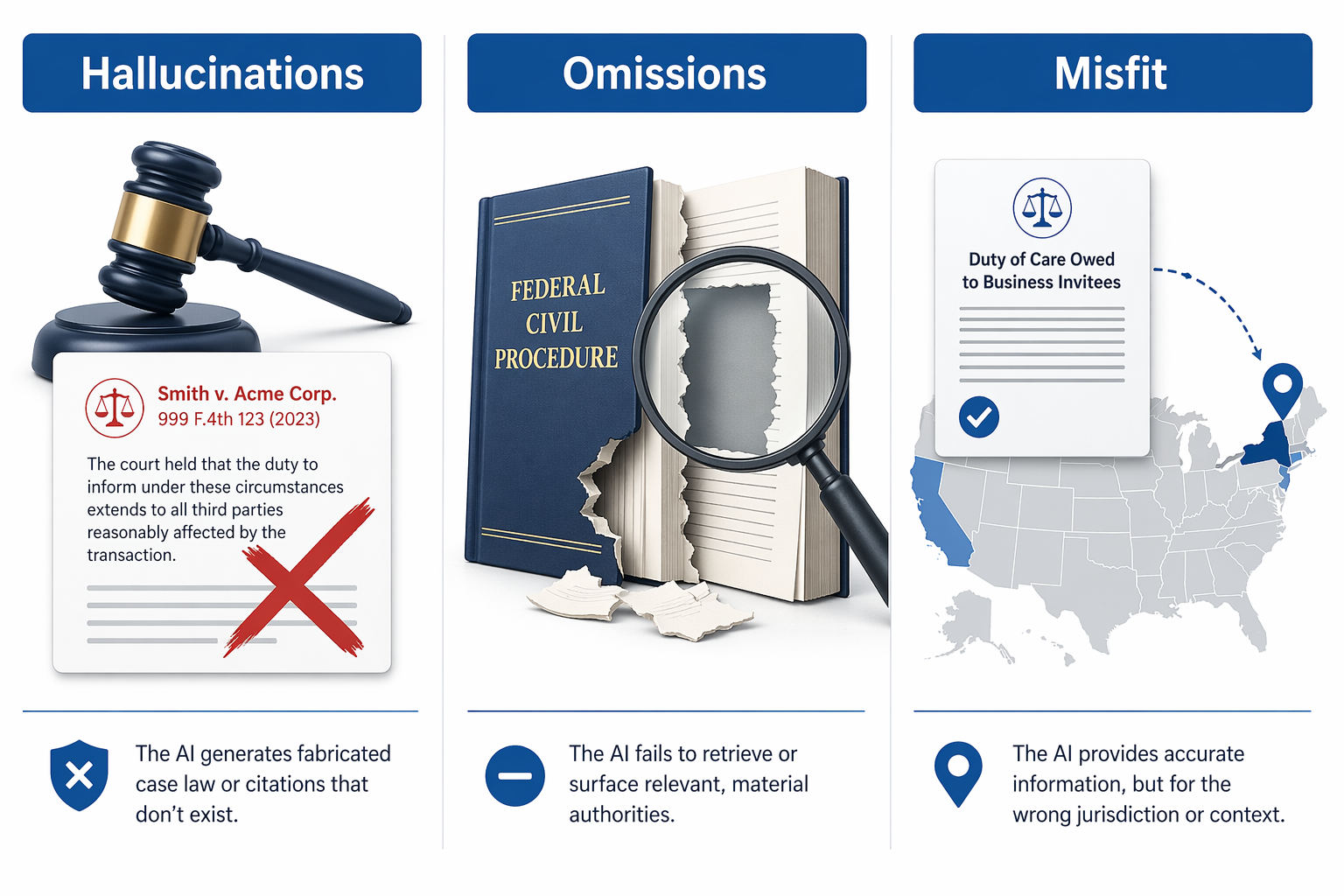
Completeness checking means running at least one conventional search outside the AI answer. Use Boolean terms, filters, and citators in the research platform you would have used before AI. Search the controlling jurisdiction first. Then search the most likely adjacent source: circuit law for a federal district issue, state supreme court law for an intermediate appellate case, the statute or rule text for a case-law answer, or the local rule for a procedural answer.
The goal is not to duplicate the entire traditional research session. The goal is to test whether the AI answer missed the authority that would change the advice. Look especially for:
- controlling authority not mentioned in the AI answer;
- adverse authority from the same court or higher court;
- exceptions, burden-shifting rules, safe harbors, or statutory amendments;
- recent cases decided after the authority the AI emphasized;
- local rules, standing orders, or judge-specific requirements that the AI answer did not surface.
A clean completeness note can be short: search terms used, databases searched, filters applied, date searched, and what changed after the check. If the AI found the same controlling line of cases your Boolean search found, say so. If the Boolean search found an adverse case the AI omitted, the research file should show how the final draft handled it.
5. Cross-reference with professional judgment
This is where the research stops being a database exercise. A verified citation can still be the wrong authority to lead with, the wrong analogy to make, or the wrong risk to ignore. Professional judgment asks whether the authorities that survived verification actually fit the client’s facts, forum, posture, and burden.
For each authority that will appear in filed work product, decide what role it plays. Is it controlling law, persuasive law, background, a factual analogy, a standard-of-review case, or an adverse case that must be distinguished? If the AI treated persuasive authority as controlling, fix that before the draft leaves your hands. If the best authority cuts against the client, do not let the AI’s more comfortable answer hide it.
This step is also where subject-matter expertise matters. A lawyer who understands the area can often see that a case belongs to a neighboring doctrine but not the one at issue. A paralegal or research attorney can flag the mismatch, but someone responsible for the legal position has to decide whether the authority can fairly carry the argument. For a deeper treatment of that boundary, see the guide on AI competence and subject-matter expertise.
A useful professional-judgment note is blunt. “Use for general standard only.” “Do not cite; distinguishable because arbitration clause was consumer, not employment.” “Adverse controlling case; address in footnote.” “Persuasive only; no state supreme court authority found.” These notes protect the final answer from becoming a polished collection of unranked sources.
6. Document the verification trail before the answer leaves the file
The last step is not administrative decoration. It is how the person at the keyboard shows that the AI output was handled as unverified material and converted into defensible research.
A verification trail should identify the tool, prompt, date, output, authorities checked, citator results, completeness search, omitted or rejected authorities, and final use decisions. It does not need to be beautiful. It needs to be intelligible to a supervising attorney, later reviewer, or ethics counsel trying to understand what happened.
| Research file entry | Minimum contents |
|---|---|
| AI output record | Tool name, prompt, date, complete response |
| Citation verification | Source opened, pin cite confirmed, holding checked, current status checked |
| Completeness search | Search terms, database, jurisdiction filters, date range, results that changed the answer |
| Professional judgment | Why each key authority was used, limited, distinguished, or rejected |
| Final signoff | Reviewer name or initials, date, remaining uncertainty if any |
For firms building this into a repeatable process, the individual research log should connect to a broader ABA Formal Opinion 512 compliance playbook. The person doing the work should not have to invent the audit trail from scratch every time a deadline is close.
What cite-checking alone misses
A lot of AI research guidance stops at “verify the cases.” That is necessary, but it is not enough. The remaining risk often sits in authorities that exist, are accurately quoted, and still should not be used the way the AI used them.
Misfit authority is the easiest to underestimate. A case may be accurate in its own jurisdiction but irrelevant in yours. A federal procedural rule may not answer a state-court question. A decision interpreting one statutory version may be stale after amendment. A dissent, concurrence, parenthetical, or district-court gloss may be presented as if it were the rule. These are not hallucinations in the Mata sense. They are research errors, and they can be just as damaging in a filed brief.
Omissions are harder because there may be nothing visibly wrong on the page. The AI answer can cite five real cases and still miss the controlling one. It can state the majority rule and omit the local exception. It can identify a favorable standard and skip the burden the moving party must actually satisfy. That is why the independent Boolean search and professional-judgment pass are not optional extras.
How to budget the verification time
The 20–30 minute verification block is easiest to defend when it is planned before the research starts, not begged for after the draft is done.[3] For a routine question, that block may be enough to verify a small set of authorities, run one targeted completeness search, and make a short file note. For a motion that turns on unsettled law, the AI first pass may save time on orientation, but the verification block should expand.
| Risk level | Verification posture |
|---|---|
| Low-risk internal orientation | Confirm obvious authorities and label the result as preliminary |
| Client-facing research memo | Verify all cited authorities, run completeness search, document limitations |
| Filed brief or dispositive motion | Full citation audit, adverse-authority search, supervising attorney review |
| Unfamiliar jurisdiction or issue of first impression | Treat AI as orientation only; expand traditional research and review |
This is also where benchmark humility matters. Stanford’s 2024 results are important evidence of reliability limits, but they describe tested products at a point in time, and vendors have released updates since then.[2] Thomson Reuters has publicly challenged benchmark methods in this area, which is another reason not to turn any one study into a permanent ranking.[6] The practical response is not to ignore benchmarks. It is to build a workflow that does not depend on a vendor’s confidence score being right.
A final pre-filing check
Before AI-assisted research becomes filed work product, someone should be able to answer five questions without reopening the whole matter:
- Which AI output influenced the answer?
- Which cited authorities were opened and verified?
- Which authorities were checked for current status?
- What search was run to test for omitted controlling or adverse authority?
- Who decided that the final authorities fit the jurisdiction, facts, posture, and burden?
If the file cannot answer those questions, the research is not ready. If it can, AI has done what it is best suited to do in legal research: accelerate the path to leads that a human can verify, rank, limit, and defend.
References
- Legal Ethics: Practical Considerations for Lawyers Using AI in Modern Legal Practice, American Bar Association Business Law Today, July 2026, link
- Hallucination-Free? Assessing the Reliability of Leading AI Legal Research Tools, Stanford Law School, link
- Which AI Is Most Accurate Legal Research?, AI Vortex, 2026, link
- The Hallucination Problem: A Checklist for Verifying AI-Generated Legal Citations, LeanLaw, link
- How to Verify Legal AI Outputs (Legal Quality Control Checklist), Clio, link
- From Trust but Verify to Do Not Trust Until Verified: How the Legal Profession Is Redefining AI Accountability, Thomson Reuters, link
Grounded in
This procedure is grounded in the cited rule or opinion, independent of any single documented case. See the Regulation tracker for the governing text.
Cases this step would have prevented
No cases have been explicitly linked to this checklist yet. See Risk Digest for documented incidents generally.
← Back to WorkflowsReport a correction or tip
Spotted an outdated figure, a misstated fact, or a ruling this workflow checklist should reflect? Public comments are disabled for this content given the professional cost of a misreported case outcome, penalty amount, or rule text — use the structured correction channel instead.
Report a correction or tip for this record →