
How to Choose AI Software for Your Law Firm: A Workflow-First Decision Framework
A structured method for managing partners and legal ops leaders at solo, small, and mid-size firms to evaluate AI tools by mapping workflows first, running controlled pilots, and measuring ROI against real documents — avoiding the budget waste and ethical exposure of feature-list buying.
The 2026 AI Adoption Landscape: Why a Structured Selection Process Is Now Urgent
The numbers are no longer debatable. According to the 8am 2026 Legal Industry Report, which surveyed more than 1,300 U.S. legal professionals between September and October 2025, 69% of legal professionals now use general-purpose AI tools for work — more than double the 31% recorded in 2025. Nearly a third (28%) use these tools daily, and 31% use them several times a week. The time savings are real: 38% of users report saving 1 to 5 hours per week, and 14% save 6 to 10 hours weekly.
Yet the same data reveals a governance gap that should concern every managing partner. Only 9% of firms have a written and actively enforced AI policy. A staggering 54% have provided no training on responsible AI use and have no current plans to do so. Meanwhile, 43% have no formal AI policy and no plans to create one. The Thomson Reuters 2026 AI in Professional Services Report, surveying more than 1,500 respondents across 27 countries, found that only 18% of organizations track the ROI of their AI tools.
This article does not re-litigate the readiness gap. For a deeper analysis of the strategic paradox between high individual usage and low institutional readiness, see our companion piece, The Law Firm AI Adoption Paradox: High Usage, Low Readiness — and What to Do About It. Here, we provide the practical decision methodology that firms need next: a workflow-first framework for selecting AI software that aligns with your actual practice, not with vendor marketing.
The Six Functional Families of Legal AI Software
One of the most common mistakes firms make is treating "legal AI" as a single category. In practice, the market has matured into six distinct functional families, each serving a different workflow. Confusing these families leads directly to buying the wrong platform — a contract review tool cannot substitute for a legal research engine, and an eDiscovery platform will not help with client intake.
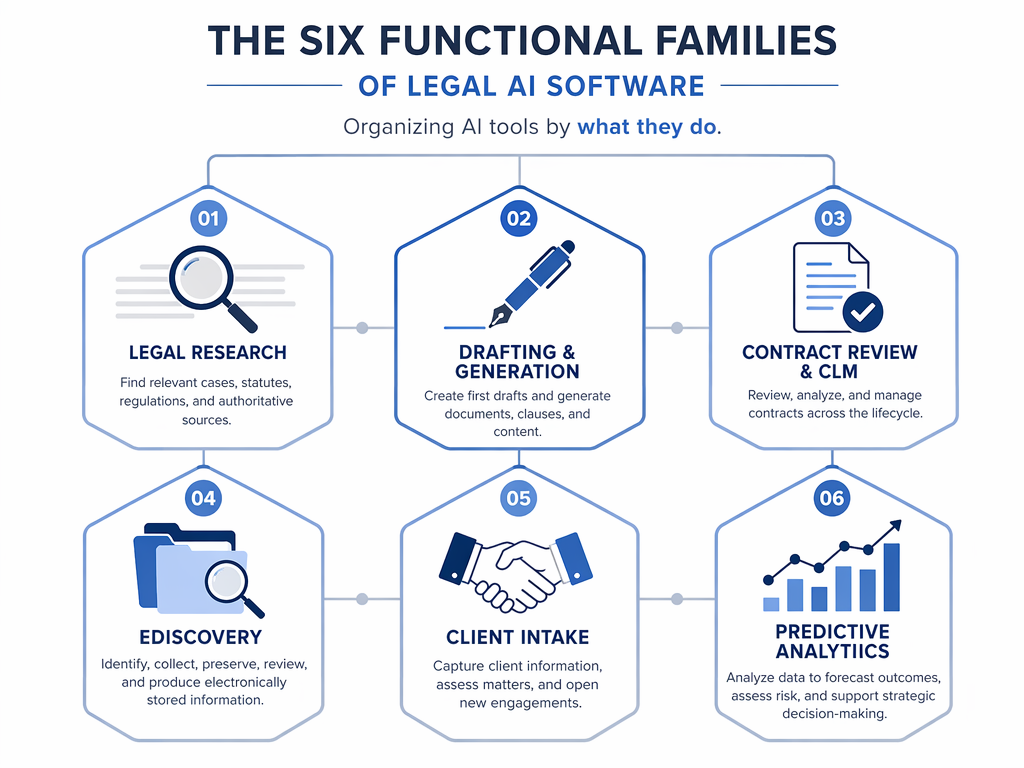
| Functional Family | Primary Workflow | Example Tools | Best For |
|---|---|---|---|
| Legal Research & Case Law Engines | Finding, verifying, and synthesizing case law, statutes, and secondary sources | Westlaw CoCounsel, Lexis+ AI, Bloomberg Law AI | Litigators, corporate attorneys, any practice area requiring frequent legal research |
| Drafting & Contract Generation | Generating first drafts of briefs, memos, contracts, and correspondence from prompts or templates | Spellbook, Harvey, Leya | Transactional attorneys, litigators drafting motions, any high-volume document practice |
| Contract Review & CLM | Analyzing, redlining, and managing contract terms, obligations, and renewals | Ironclad, Luminance, Kira, Conga | Corporate counsel, M&A teams, in-house legal departments, firms with heavy contract volumes |
| eDiscovery & Document Review | Processing, searching, and classifying large document sets for litigation or investigation | Relativity, Everlaw, Logikcull | Litigation teams, firms handling discovery-heavy cases, compliance investigations |
| Client Intake & Marketing | Automating initial client questionnaires, conflict checks, and lead qualification | Clio+AI, Josef, Lawmatics | Solo and small firms, plaintiff-side practices, firms with high-volume intake |
| Predictive Analytics & Litigation Strategy | Analyzing judge behavior, opposing counsel patterns, case outcomes, and settlement ranges | Pre/Dicta, Lex Machina, Gavelytics | Litigation-focused firms, insurance defense, firms with data-driven case strategy needs |
Grounded in
This procedure is grounded in the cited rule or opinion, independent of any single documented case. See the Regulation tracker for the governing text.
Cases this step would have prevented
No cases have been explicitly linked to this checklist yet. See Risk Digest for documented incidents generally.
← Back to WorkflowsReport a correction or tip
Spotted an outdated figure, a misstated fact, or a ruling this workflow checklist should reflect? Public comments are disabled for this content given the professional cost of a misreported case outcome, penalty amount, or rule text — use the structured correction channel instead.
Report a correction or tip for this record →