
AI Contract Review Software in 2026: A Category-Based Comparison for Legal Teams
This guide organizes the AI contract review market into five distinct platform categories — legal productivity platforms, general legal AI platforms, CLM suites, purpose-built review tools, and Word-native drafting tools — and provides a decision framework to help in-house counsel and legal ops leaders choose the right tool based on contract volume, complexity, implementation timeline, and primary workflow bottleneck.
- Hallucination rate
- Not measured / undisclosed
The AI Contract Review Market Has Fragmented — Here’s How to Navigate It
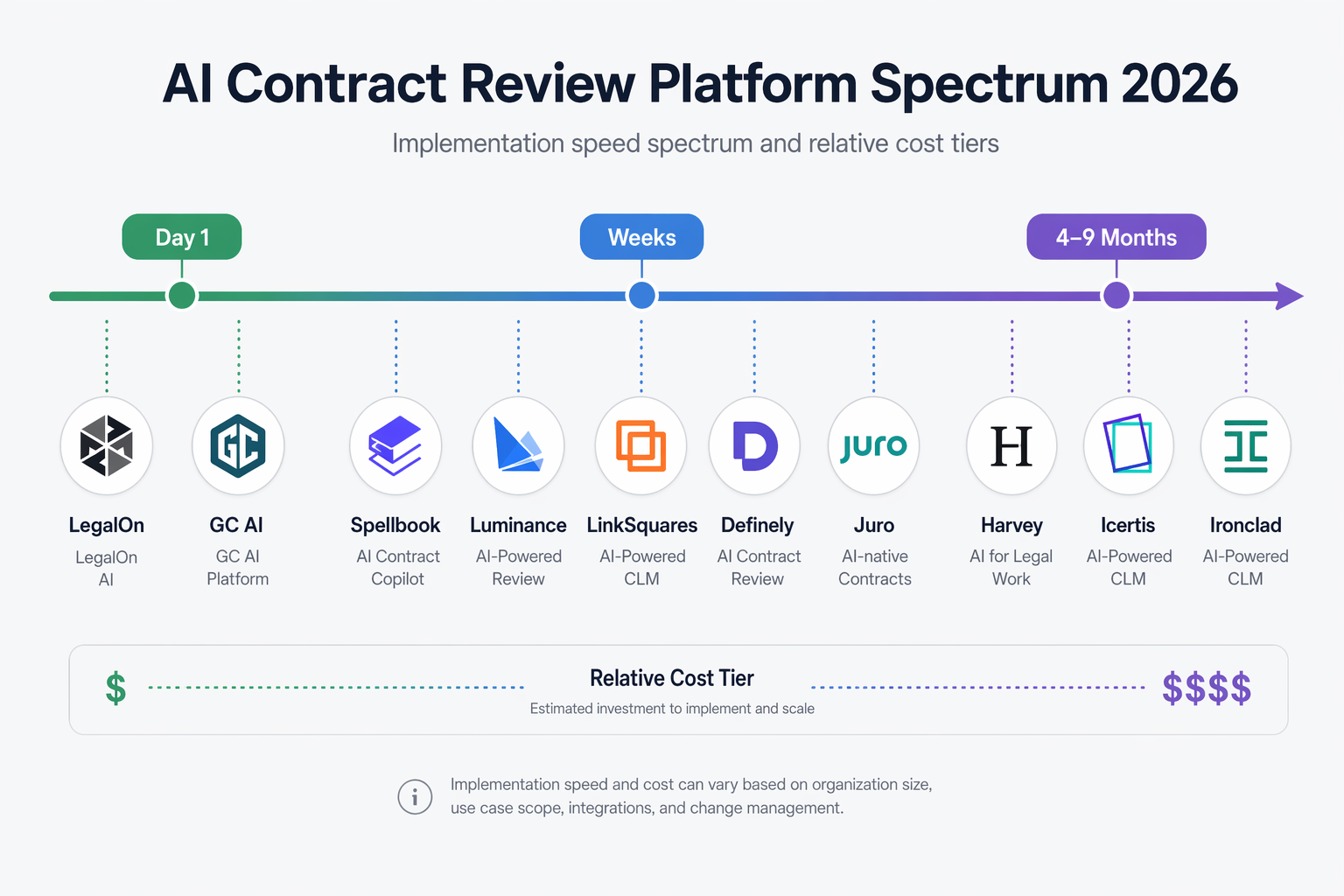
In 2026, the AI contract review market is no longer a single category. The tools available to in-house counsel and legal operations leaders have diverged into five distinct platform types, each with a different architectural philosophy, implementation profile, and best-fit use case. Treating them as interchangeable options leads to expensive mismatches: a team that needs same-day deployment will not survive a nine-month CLM rollout, and a firm handling complex M&A diligence will find little value in a tool designed for standard NDA review.
The five platform types are:
- Legal productivity platforms — playbook-based, pre-configured for immediate use (e.g., LegalOn, GC AI).
- General legal AI platforms — broad-purpose legal AI with contract review as one module (e.g., Harvey).
- CLM suites with embedded AI — full lifecycle management platforms that have added AI review capabilities (e.g., Ironclad, Icertis, Agiloft).
- Purpose-built review tools — specialized for clause extraction, risk scoring, and anomaly detection (e.g., Luminance, LinkSquares, Kira Systems).
- Word-native drafting tools — AI assistants that operate inside Microsoft Word for drafting and inline review (e.g., Spellbook, Definely).
The right choice depends on three variables: the volume and complexity of contracts your team handles, your tolerance for implementation timeline, and whether the primary bottleneck is review speed, drafting support, or lifecycle management. This guide organizes the market by category, benchmarks 14 platforms across those dimensions, and provides a decision framework that maps team profiles to platform types — not a ranked list, but a methodology for making the call yourself.
The Five Platform Categories: Architecture, Strengths, and Trade-Offs
Legal Productivity Platforms (Playbook-Based)
These platforms ship with pre-built playbooks — attorney-vetted clause libraries and review guidelines — that work out of the box. LegalOn, for example, provides 50 to 100+ pre-loaded playbooks covering standard contract provisions. GC AI offers a similar model with a claimed 86.8% accuracy on in-house legal tasks in its self-published May 2026 benchmark. The defining characteristic is Day 1 implementation: no training data, no playbook configuration, no months-long setup. Pricing reflects this efficiency: LegalOn ranges from $3,000 to $8,000 per year, and GC AI charges $500 per seat per month with a 14-day free trial.
Best for: teams with standard contracts (NDAs, vendor agreements, MSAs) who need immediate ROI and cannot afford a multi-month implementation. The trade-off is limited customization for highly specialized or unusual contract language.
General Legal AI Platforms
Harvey is the primary example in this category. It is a broad legal AI platform — covering contract review, legal research, due diligence, and drafting — rather than a contract-review-only tool. Harvey's Contract Intelligence module allows teams to codify knowledge and apply it across documents. Implementation typically takes 2 to 6 months, and pricing starts at approximately $30,000 per month, making it the most expensive category on a per-seat basis. Harvey reports that 60%+ of the Am Law 100 and over 1,500 customers globally use the platform.
Best for: large law firms and enterprise legal departments that need a unified AI platform across multiple practice areas and have the budget and timeline to support a full rollout.
CLM Suites with Embedded AI
Traditional contract lifecycle management platforms — Ironclad, Icertis, Agiloft, DocuSign CLM, Juro — have added AI-powered review capabilities to their existing workflow and repository functions. These are not AI-first tools; they are CLMs with AI features layered on. Implementation timelines are the longest in the market: Ironclad reports 2 to 9 months, Icertis 4 to 6 months, Agiloft 3 to 6 months, and DocuSign CLM 2 to 6 months. Pricing is enterprise-level and rarely published, but Ironclad is estimated at $30,000 to $100,000+ per year, and Icertis is reported to cost 2 to 3 times comparable platforms.
Best for: organizations that already need a CLM for contract storage, workflow automation, and compliance tracking, and want AI review as an integrated feature rather than a separate tool.
Purpose-Built Review Tools
This category includes tools built specifically for contract analysis — clause extraction, risk scoring, anomaly detection, and redlining — without the broader CLM or general AI platform scope. Luminance, LinkSquares, Kira Systems, and Robin AI fall here. Luminance is trained on 150 million+ documents and specializes in M&A due diligence and cross-border contract review. LinkSquares, a five-year G2 category leader, offers an A-F risk scoring agent for third-party agreements. Kira Systems provides 1,400+ clause models for extraction. Implementation is relatively fast: Luminance takes 2 to 6 weeks, LinkSquares 2 to 4 weeks, and Kira 2 to 6 weeks. Pricing varies widely: Luminance is reported at $100,000+ per year for M&A-focused deployments, while LinkSquares and Kira are typically in the mid-five-figure range.
Best for: teams that need deep, accurate contract analysis — particularly for M&A diligence, high-volume third-party contract review, or complex clause extraction — and do not need a full CLM or a general AI platform.
Word-Native Drafting Tools
These tools operate inside Microsoft Word, providing inline drafting suggestions, clause language, and risk flagging as the user works. Spellbook and Definely are the leading examples. Spellbook functions as a GPT-4-based drafting co-pilot in Word, but is generally considered weak for end-to-end review. Definely is purpose-built for complex contract navigation inside Word, with features for clause and definition cross-referencing, gap analysis, and precedent comparison. Implementation is fast — 1 to 2 weeks for Spellbook — and pricing is per-user or enterprise. Definely is trusted by JP Morgan, Barclays, and BT Group, with enterprise pricing typically in the mid-five figures per year.
Best for: legal teams whose primary workflow is drafting and negotiating contracts in Word, and who need AI assistance integrated into that environment rather than a separate review portal.
Platform Comparison Table: 14 Tools Benchmarked by Use Case
The following table organizes 14 platforms by category, pricing, implementation timeline, key differentiator, and best-fit use case. Use it as a quick-reference scan before diving into the decision framework in the next section.
| Platform | Category | Pricing (Published Range) | Implementation Timeline | Key Differentiator | Best-Fit Use Case |
|---|---|---|---|---|---|
| LegalOn | Legal Productivity | $3,000–$8,000/yr | Day 1 | 50+ pre-built playbooks, 17x faster than Claude Opus 4.6 in self-published benchmark | Standard contract review for small to mid-size in-house teams |
| GC AI | Legal Productivity | $500/seat/mo | Day 1 (14-day trial) | 86.8% accuracy on in-house legal tasks (self-published May 2026 bench) | In-house teams needing broad legal AI beyond contract review |
| Harvey | General Legal AI | $30,000+/mo | 2–6 months | Character-level citation, Contract Intelligence module, 60%+ Am Law 100 adoption | Large law firms and enterprise legal departments |
| Ironclad | CLM Suite | $30,000–$100,000+/yr | 2–9 months | Strong CLM workflow automation with AI review layer | Organizations needing full CLM with integrated AI |
| Icertis | CLM Suite | 2–3x cost of comparable platforms | 4–6 months | Enterprise-grade CLM, 6-year Gartner Leader | Large enterprises with complex contract lifecycle needs |
| Agiloft | CLM Suite | Enterprise (not published) | 3–6 months | 6-year Gartner Leader, flexible no-code configuration | Mid-market to enterprise CLM deployments |
| DocuSign CLM | CLM Suite | Enterprise (not published) | 2–6 months | Integrated with DocuSign eSignature ecosystem | Organizations already using DocuSign |
| Luminance | Purpose-Built Review | $100,000+/yr (M&A) | 2–6 weeks | 150M+ docs trained, M&A and cross-border specialist | M&A due diligence, complex contract review |
| LinkSquares | Purpose-Built Review | Mid-five figures/yr (est.) | 2–4 weeks | A-F risk scoring, 5-year G2 category leader | High-volume third-party contract review |
| Kira Systems | Purpose-Built Review | Mid-five figures/yr (est.) | 2–6 weeks | 1,400+ clause models, established extraction accuracy | Clause extraction and due diligence |
| Robin AI | Purpose-Built Review | Enterprise (not published) | Varies | Managed service + AI hybrid model | Teams wanting AI with human-in-the-loop support |
| Juro | CLM Suite | ~$34,500/yr avg. | 2–6 weeks | All-in-one contract platform with AI redlining | Mid-market teams wanting CLM + AI in one tool |
| Spellbook | Word-Native Drafting | Per-user, sales-led | 1–2 weeks | GPT-4 drafting co-pilot in Word | Drafting and negotiation support in Word |
| Definely | Word-Native Drafting | Mid-five figures/yr (est.) | 1–2 weeks | Clause/definition navigation, gap analysis, precedent comparison | Complex contract review inside Word |
Decision Framework: Which Platform Category Fits Your Team?
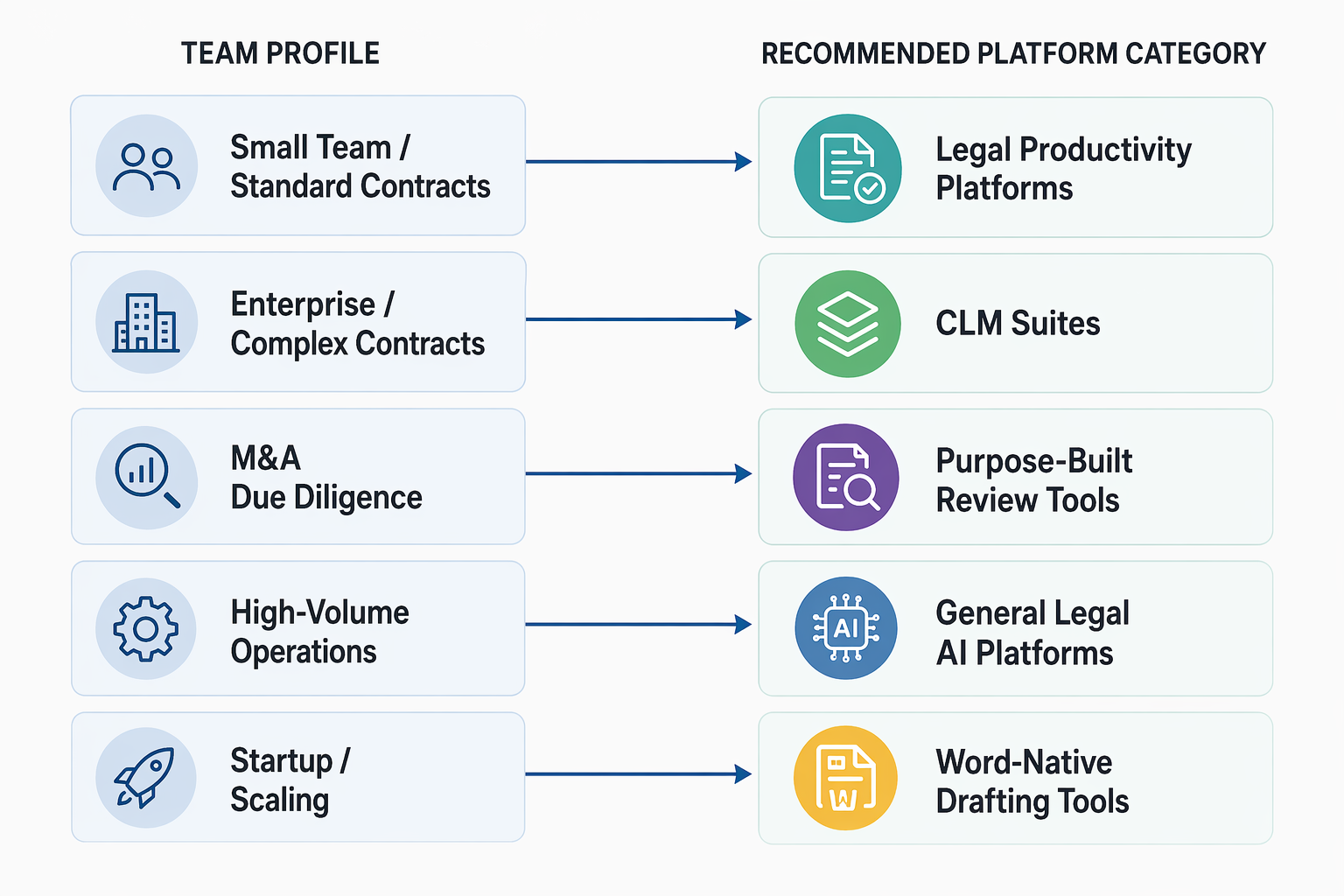
Rather than ranking vendors, this framework maps team profiles to platform categories. Identify your profile below, then use the category recommendation as a starting point for your evaluation.
| Team Profile | Contract Characteristics | Primary Bottleneck | Recommended Category | Why |
|---|---|---|---|---|
| Small in-house team (1–5 attorneys) | Standard NDAs, MSAs, vendor agreements; moderate volume (100–500/yr) | Review speed — too much time spent on low-risk contracts | Legal Productivity Platform (LegalOn, GC AI) | Day 1 deployment, low cost, pre-built playbooks cover standard language. No months of configuration needed. |
| Enterprise legal department (10+ attorneys) | Mix of standard and complex contracts; high volume (1,000–5,000+/yr) | Lifecycle management — tracking obligations, renewals, compliance | CLM Suite with AI (Ironclad, Icertis, Agiloft) | Full lifecycle management plus AI review. Worth the longer implementation for organizations with existing CLM needs. |
| M&A / due diligence team | Highly complex, bespoke contracts; variable volume per deal | Deep clause extraction and anomaly detection at speed | Purpose-Built Review Tool (Luminance, Kira Systems) | Trained on millions of documents, specialized for diligence. Luminance's 150M+ document training set is built for this. |
| High-volume operations team (legal ops, procurement) | High volume of third-party contracts (2,500+/yr); standard but numerous | Risk triage — quickly separating low-risk from high-risk agreements | Purpose-Built Review Tool (LinkSquares, LegalOn) | Risk scoring (A-F) and automated triage. LinkSquares' Softonic case study shows nearly 400% NDA processing improvement. |
| Startup / scaling company | Standard contracts, growing volume; limited legal headcount | Speed and cost — need maximum output per attorney | Legal Productivity Platform or Word-Native Drafting Tool | Low cost, fast deployment. GC AI's $500/seat/month with 14-day trial or LegalOn's $3K–$8K/yr are appropriate. |
| Large law firm (transactional practice) | Complex, bespoke contracts; billable-hour pressure | Drafting efficiency and research integration | General Legal AI Platform (Harvey) or Word-Native Drafting (Spellbook, Definely) | Harvey's broad platform supports multiple practice areas. Word-native tools fit drafting-heavy workflows. |
Implementation Reality: Timelines, Hidden Costs, and Data Readiness
The gap between a vendor's sales pitch and the actual implementation experience can be wide. Understanding the real timelines, hidden costs, and your team's data readiness is essential before making a decision.
Timelines: Day 1 to 9 Months
Implementation timelines vary dramatically by category:
- Day 1: Legal productivity platforms (LegalOn, GC AI) are pre-configured and can be used immediately after account setup. No training data, no playbook configuration.
- 1–6 weeks: Purpose-built review tools (Luminance, LinkSquares, Kira) and Word-native drafting tools (Spellbook, Definely) require some configuration but can be deployed within weeks.
- 2–9 months: CLM suites (Ironclad, Icertis, Agiloft) and general legal AI platforms (Harvey) require significant configuration, data migration, workflow design, and user training.
Hidden Costs Beyond the License
The license fee is only part of the total cost. According to Dan Cumberland Labs, hidden costs include:
- Integration fees: Connecting the AI tool to your existing contract repository, CRM, or document management system may require custom development or paid middleware.
- Data migration: Moving existing contracts into the new platform — especially if they are stored across multiple systems or in inconsistent formats — can be a significant project.
- Training and change management: Getting legal teams to adopt a new tool requires training time and ongoing support. Harvey reports that Macfarlanes achieved more than 80% lawyer adoption, but that level of uptake is not automatic.
- Custom playbook development: For trainable AI platforms, building and refining custom playbooks can take months of attorney time.
Data Readiness: The Playbook Gap
A 2026 survey by LegalOn found that 95% of legal teams have playbook gaps — meaning their contract review guidelines are incomplete, inconsistent, or undocumented. Specifically:
- 42% rely on general or somewhat comprehensive playbooks
- 34% have no playbooks at all
- 19% rely only on basic clause libraries
- Only 5% have comprehensive playbook coverage
This matters because playbook-based platforms (LegalOn, GC AI) ship with pre-built playbooks that can be used immediately, while trainable AI platforms require your team to supply or develop the playbook content. If your team is among the 95% with playbook gaps, a playbook-based platform may deliver faster ROI — but you will eventually need to close those gaps to handle edge cases.
ROI Benchmarks: What Real Teams Are Achieving
The business case for AI contract review is supported by a growing body of reported outcomes. While most figures come from vendor case studies and should be treated as directional rather than independently audited, the pattern across multiple sources is consistent: significant time savings, reduced outside counsel spend, and measurable ROI for teams processing sufficient volume.
| Metric | Reported Figure | Source | Context |
|---|---|---|---|
| Review cycle time reduction | 45–90% (63% average) | Dan Cumberland Labs | Across multiple platforms and contract types |
| Annual benefits (2,500+ contracts) | $2M+ | Dan Cumberland Labs | Switching from manual or general-purpose tools to purpose-built platforms |
| Time savings per attorney | 14 hours/week | GC AI customer survey (Dec 2025, 100+ users) | Self-reported by GC AI users |
| Outside counsel cost reduction | 14% | GC AI customer survey (Dec 2025, 100+ users) | Self-reported by GC AI users |
| NDA processing time improvement | Nearly 400% | LinkSquares (Softonic case study) | Vendor-reported case study |
| Vendor contract review time reduction | From 2 days to 2 hours | Harvey (Bridgewater Associates case study) | Vendor-reported case study |
| Contract review time reduction | Up to 85% | LegalOn | Vendor-reported |
| Contract review time reduction | From 2 hours to 15 minutes | LegalFly (Agristo case study) | Vendor-reported case study |
| In-house teams using or evaluating AI for contract review | 52% | LegalOn 2026 survey | Industry adoption benchmark |
The broader adoption trend supports the direction: 52% of in-house legal teams are actively using or evaluating AI for contract review, according to LegalOn's 2026 survey. This suggests that the question is no longer whether to adopt AI contract review, but which category of platform best fits your team's specific needs.
Frequently Asked Questions
What is the difference between playbook-based and trainable AI?
Playbook-based platforms (LegalOn, GC AI) ship with pre-built, attorney-vetted clause libraries and review guidelines. They work immediately with no configuration. Trainable AI platforms (Luminance, Kira, Ironclad AI) require your team to upload contracts and train the model on your specific language and preferences. Playbook-based platforms offer faster deployment but may miss edge cases; trainable platforms handle more complex language but require months of setup. For a deeper analysis of this trade-off, see our AI Contract Review vs. General-Purpose AI: Why the Gap Persists in 2026.
How long does implementation really take?
It depends entirely on the platform category. Legal productivity platforms can be used on Day 1. Purpose-built review tools typically take 2 to 6 weeks. CLM suites and general legal AI platforms require 2 to 9 months. The implementation timeline should be a primary factor in your platform selection — if you need results this quarter, do not choose a platform with a 9-month rollout.
What are the hidden costs?
Beyond the license fee, expect potential costs for integration with existing systems, data migration, user training, change management, and custom playbook development. For enterprise CLM deployments, these hidden costs can equal or exceed the license fee. Always ask vendors for a total cost of ownership estimate that includes implementation services.
Can a general-purpose AI like ChatGPT replace a purpose-built contract review tool?
No. LegalOn's 2026 benchmark tested 11 general-purpose AI models (including Claude Opus 4.6, Gemini 3.1 Pro, and GPT-5.1) across 3,282 contracts and 21 precision-critical guidelines. The purpose-built tool outperformed every general-purpose model on every category. General AI failed on precise language, numeric thresholds, multi-part requirements, cross-references, and absence checks. A Stanford RegLab study also found that generic AI models hallucinate legal information. For a detailed breakdown, see our AI Contract Review Accuracy: What the 2026 Benchmarks Actually Show.
Which platform is best for a small in-house team?
For small teams (1–5 attorneys) handling standard contracts, a legal productivity platform like LegalOn ($3,000–$8,000/year) or GC AI ($500/seat/month) is typically the best fit. These platforms offer Day 1 deployment, pre-built playbooks, and low cost — no months of configuration or enterprise-level investment required. If your team's primary need is drafting support in Word, Spellbook or Definely may be more appropriate.
Where can I find a feature-by-feature comparison?
For a detailed feature comparison across deployment models, integrations, and data retention policies, see our Legal AI Contract Review Software: Features, Deployment Models, and How to Compare Them article. That guide complements this category-based comparison by providing a granular feature-level analysis.
Chronological incident history
No sanction cases have named this tool in the tracked record set to date. This does not imply the tool is safe — see Risk Digest for ongoing monitoring.
← Compare peer toolsReport a correction or tip
Spotted an outdated figure, a misstated fact, or a ruling this tool profile should reflect? Public comments are disabled for this content given the professional cost of a misreported case outcome, penalty amount, or rule text — use the structured correction channel instead.
Report a correction or tip for this record →