
The Professional Responsibility Guide to AI Contract Analysis: What ABA Formal Opinion 512 Means for Your Tool Selection
This guide bridges ABA Formal Opinion 512 with the practical realities of selecting an AI contract analysis tool in 2026, translating ethical duties into concrete vendor evaluation criteria for attorneys, ethics counsel, and firm leaders.
- Hallucination rate
- Not measured / undisclosed
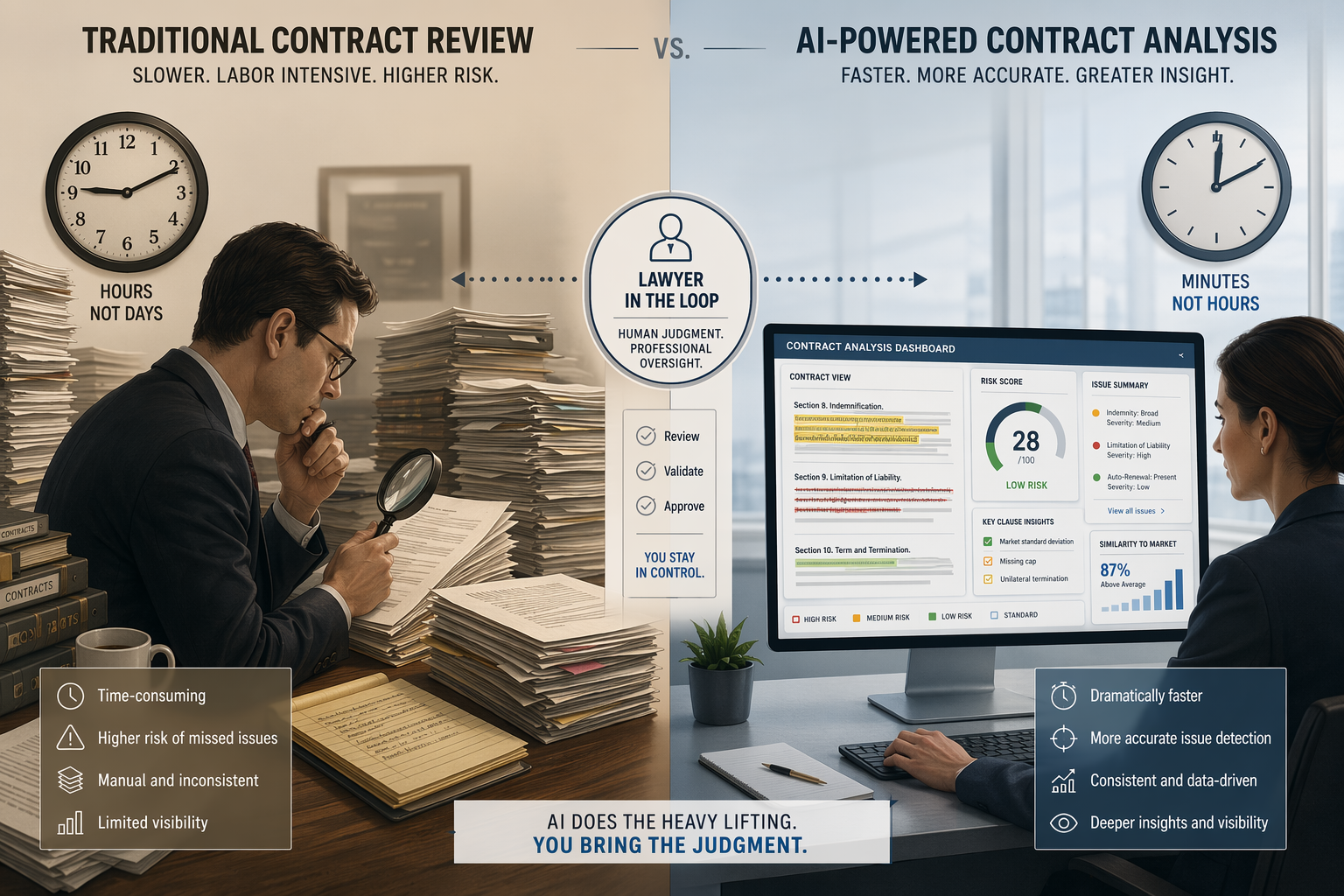
The Ethics Gap: 69% Adoption, 9% Enforcement
The 2026 legal profession presents a paradox: generative AI adoption has more than doubled in a single year, yet the institutional guardrails most firms rely on to manage professional risk remain largely absent. According to the 8am 2026 Legal Industry Report, which surveyed more than 1,300 legal professionals, 69% now use generative AI for work tasks — up from 31% in 2025. Contract analysis is among the most common applications, driven by the promise of 45–90% cycle-time reductions and 63% average time savings, as aggregated by Sirion from industry benchmarks.
But the same survey reveals a stark readiness gap: 54% of firms provide no AI training and have no plans to offer any. Another 43% have no formal AI policy at all. Only 9% of firms have an actively enforced AI policy. These numbers mean that the vast majority of lawyers using AI for contract analysis are doing so without the ethical infrastructure — training, policies, supervision protocols — that professional responsibility rules require.
This gap between adoption and institutional readiness creates real malpractice exposure. When a lawyer relies on an AI tool to extract a liability cap, identify a change-of-control clause, or flag a non-compete provision, the lawyer — not the software vendor — bears the professional responsibility for the accuracy of that work. ABA Formal Opinion 512, issued in July 2024, makes this explicit: existing ethical duties apply fully to AI-assisted legal work. The question is whether most legal teams have operationalized those duties in their tool selection and training processes.
ABA Formal Opinion 512: The Five Ethical Duties That Apply to AI Contract Analysis
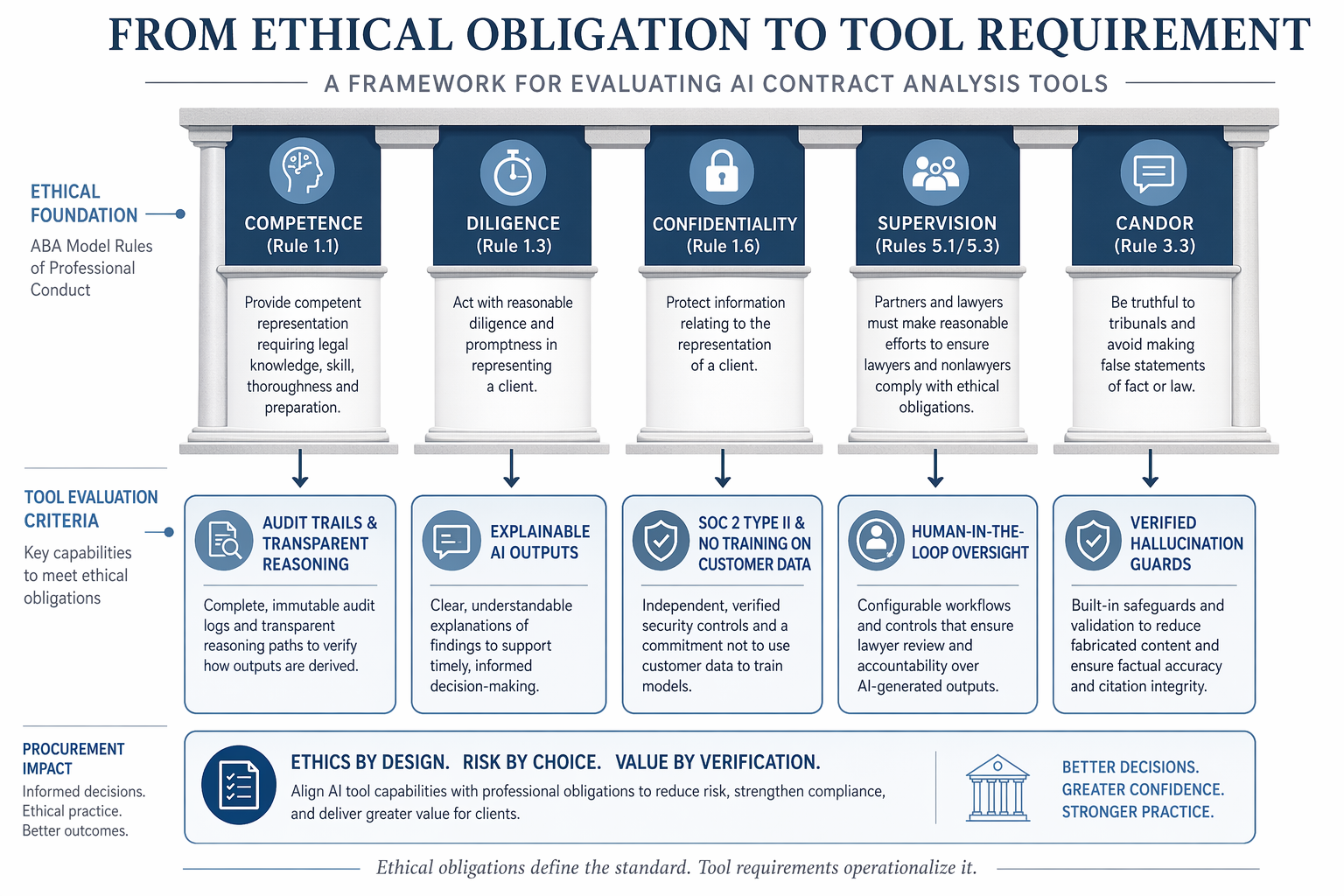
ABA Formal Opinion 512 is the American Bar Association's first formal ethics guidance on generative AI use in legal practice. It does not create new rules. Instead, it confirms that five existing Model Rules apply with full force when lawyers use AI tools — including contract analysis platforms. Understanding each duty in the specific context of contract review is the first step toward responsible tool selection.
Competence (Rule 1.1): Understanding the Tool, Not Just Using It
Rule 1.1 obligates lawyers to provide competent representation, which includes understanding the benefits and risks of the technologies they use. For contract analysis, this means more than knowing how to upload a document and click "analyze." It requires understanding how the AI identifies clauses, what training data it was built on, what its documented error rates are on contract-specific tasks, and where it is likely to fail. A lawyer who cannot explain why the tool flagged a particular provision — or why it missed one — cannot satisfy the competence duty.
For a deeper analysis of how Rule 1.1 applies to AI generally, see our existing article on ABA Model Rule 1.1 and AI: What Competence Requires of Attorneys Using AI Tools. The remainder of this guide focuses specifically on how competence — and the other four duties — translate into contract analysis tool selection.
Diligence (Rule 1.3): Verifying AI Outputs Is Not Optional
Rule 1.3 requires lawyers to act with reasonable diligence and promptness. When an AI tool produces a contract analysis — flagging risky clauses, summarizing obligations, extracting key dates — the lawyer must verify that output before relying on it. A Stanford RegLab study, cited in the LegalOn 2026 buyer's guide, found that generic AI models hallucinate legal information in case law, and that even a 10% hallucination rate is unacceptable in contract review. The diligence duty means that a lawyer cannot treat AI output as presumptively correct; verification is a non-negotiable step in the workflow.
Confidentiality (Rule 1.6): Protecting Contract Data
Contracts contain some of the most sensitive information a client entrusts to a lawyer: pricing terms, trade secrets, employment conditions, merger provisions, and dispute resolution strategies. Rule 1.6 requires lawyers to make reasonable efforts to prevent the inadvertent disclosure of client information. When a contract is uploaded to an AI analysis platform, the lawyer must ensure that the vendor's data handling practices meet this standard. Key questions include whether the vendor trains its models on customer data, whether contracts are deleted after analysis, and whether the platform holds SOC 2 Type II certification.
Supervision (Rules 5.1 and 5.3): Overseeing AI and the People Who Use It
Rule 5.1 requires partners and supervising lawyers to make reasonable efforts to ensure that all lawyers in the firm comply with ethical rules. Rule 5.3 extends this duty to non-lawyer assistants — and the ABA opinion makes clear that AI tools fall within this framework. If a junior associate or paralegal uses an AI contract analysis tool, the supervising lawyer must ensure that the user understands the tool's limitations, that outputs are verified, and that the tool is configured with firm-approved playbooks. This is not merely a technology management issue; it is a supervision obligation.
Candor Toward the Tribunal (Rule 3.3): No False Statements
Rule 3.3 prohibits lawyers from knowingly making false statements to a court. If a contract analysis tool generates a citation or a legal conclusion that a lawyer incorporates into a filing or a negotiation, the lawyer is responsible for its accuracy. The well-documented phenomenon of AI hallucination — fabricating case citations, inventing contract clauses, misstating legal standards — means that candor obligations impose a particularly high verification standard on any AI output that leaves the lawyer's internal workflow and enters the public record.
Translating Ethical Duties into Vendor Evaluation Criteria
The five duties from ABA Formal Opinion 512 are abstract principles. The challenge for legal teams is converting them into concrete, verifiable requirements during the vendor evaluation process. The table below maps each ethical duty to specific evaluation criteria that can be verified through vendor documentation, security certifications, and product demonstrations.
| Ethical Duty | What It Requires in Contract Analysis | Vendor Evaluation Criterion | How to Verify |
|---|---|---|---|
| Competence (Rule 1.1) | Understanding how the AI identifies and classifies clauses | Explainable AI: transparent reasoning for each flag or extraction | Request a demo showing the tool's reasoning trace for a sample contract |
| Diligence (Rule 1.3) | Verifying AI outputs before relying on them | Audit trail: record of every AI decision, confidence score, and source reference | Confirm the platform exports a detailed audit log for each document |
| Confidentiality (Rule 1.6) | Ensuring contract data is not used for model training or exposed to unauthorized parties | SOC 2 Type II certification; contractual guarantee of no training on customer data | Request the vendor's SOC 2 report and review the data processing agreement |
| Supervision (Rules 5.1/5.3) | Overseeing both the AI tool and the personnel using it | Configurable playbooks reviewed by an attorney; role-based access controls | Test the playbook customization workflow and verify access control settings |
| Candor (Rule 3.3) | Ensuring no false statements enter the record | Hallucination guards: citation verification, confidence thresholds, human-review prompts | Ask for the vendor's documented hallucination rate on contract-specific benchmarks |
This framework reveals why purpose-built legal AI tools are structurally better suited to meet these requirements than general-purpose large language models. A tool designed specifically for contract analysis — with attorney-drafted content, clause-specific training data, and built-in verification workflows — can provide the audit trails, explainability, and security guarantees that general-purpose models cannot. For a detailed comparison of the architectural and performance differences, see our existing article on AI Contract Review vs. General-Purpose AI: Why the Gap Persists in 2026.
The Training Imperative: Why 54% of Firms Are at Risk
The 54% of firms providing no AI training represent a direct violation of the competence duty under Rule 1.1. ABA Formal Opinion 512 is clear: lawyers must understand the technology they use. This does not mean every lawyer needs to become a machine learning engineer. It does mean that a lawyer using an AI contract analysis tool must understand what the tool can and cannot do, how it reaches its conclusions, and what verification steps are necessary.
The stakes are particularly high in contract analysis because the margin for error is thin. A missed indemnification cap, an overlooked automatic renewal clause, or a misinterpreted force majeure provision can create liability that far exceeds the cost of the tool. The Stanford RegLab finding that generic AI models hallucinate legal information — and that even a 10% error rate is unacceptable in contract work — underscores why training cannot be limited to a one-hour vendor demo. Lawyers need hands-on practice with the specific tool they will use, including exercises in verifying AI outputs and handling edge cases.
The consequences of failing to verify AI outputs are not theoretical. Courts have sanctioned lawyers for submitting AI-generated citations that did not exist, and the trajectory of these cases is toward increasing judicial scrutiny. For a detailed record of documented AI hallucination incidents and sanctions, see our AI Hallucinations in Legal Practice: The Sanctions Trajectory and the Verification Discipline Every Lawyer Must Adopt.
8 Questions Every Lawyer Should Ask Before Deploying an AI Contract Analysis Tool
The following checklist translates the ethical framework from ABA Formal Opinion 512 into specific questions to ask during vendor evaluation. Each question maps to one or more ethical duties and can be verified through vendor documentation, product demonstrations, or contractual review.
| Question | Ethical Duty | What to Look For |
|---|---|---|
| Does the vendor provide a transparent audit trail of every AI decision, including confidence scores and source references? | Diligence (Rule 1.3), Candor (Rule 3.3) | A detailed log showing which clauses were flagged, why, and with what confidence level |
| Is customer contract data used to train or fine-tune the model? | Confidentiality (Rule 1.6) | A contractual guarantee that customer data is not used for model training, plus SOC 2 Type II certification |
| Can the tool be configured with firm-specific playbooks that have been reviewed and approved by an attorney? | Competence (Rule 1.1), Supervision (Rules 5.1/5.3) | A playbook editor that allows attorneys to define clause priorities, risk thresholds, and custom language |
| What is the tool's documented hallucination or error rate on contract-specific tasks? | Competence (Rule 1.1), Candor (Rule 3.3) | Independent benchmark results or vendor-published accuracy data with clear methodology |
| Does the tool provide explainable reasoning for each clause identification or risk flag? | Competence (Rule 1.1) | The ability to see why a clause was flagged, including the specific language that triggered the alert |
| What verification workflow does the tool require before AI output can be used in a final document? | Diligence (Rule 1.3), Supervision (Rules 5.1/5.3) | A mandatory human-review step before output is marked as final or exported |
| Does the vendor offer training programs for lawyers and staff on how to use the tool ethically and effectively? | Competence (Rule 1.1), Supervision (Rules 5.1/5.3) | Structured training modules covering tool capabilities, limitations, and verification procedures |
| What data retention and deletion policies apply to uploaded contracts after analysis is complete? | Confidentiality (Rule 1.6) | A clear policy specifying when and how contract data is deleted, with options for immediate deletion |
These questions are designed to be used during product demonstrations and security reviews. Document the vendor's responses and compare them across candidates. For a broader market overview and category breakdown of available tools, see our AI Contract Review Software in 2026: A Category-Based Comparison for Legal Teams, and apply the ethics filter from this guide to each candidate.
The Competitive Advantage of Ethical AI Deployment
The instinct to treat ethics compliance as a burden — a cost of doing business that slows down innovation — is understandable but increasingly outdated. The legal AI market is projected to grow from approximately $3.11 billion in 2026 to $10.82 billion by 2030, and the firms that will capture the most value from this growth are those that build their AI workflows on a foundation of professional responsibility.
Gartner projects that 80% of organizations will formalize AI policies by the end of 2026, according to a Jones Walker aggregation of analyst forecasts. This means that the current window — where only 9% of firms have actively enforced policies — is closing rapidly. Early adopters of ethics-compliant AI workflows will have a structural advantage: they will have already trained their lawyers, configured their tools, and established their verification protocols before regulatory and client pressure makes these practices mandatory.
The business case for ethical AI deployment is not separate from the ROI case — it is the same case. The 45–90% cycle-time reductions and 63% average time savings that make AI contract analysis attractive in the first place are only sustainable if the outputs are reliable and the firm is protected from malpractice exposure. A tool that saves time but produces hallucinated clauses or exposes client data creates liability that erases any efficiency gain. For a detailed analysis of the ROI side of this equation, see our AI Contract Review ROI: Building the Business Case for In-House Legal Teams.
The firms that will lead in 2027 and beyond are not necessarily those with the most advanced AI tools. They are the firms that have integrated ethical diligence into their tool selection process, trained their lawyers to understand and verify AI outputs, and built supervision structures that treat AI as a powerful but fallible assistant — not a replacement for professional judgment. ABA Formal Opinion 512 provides the framework. The question is which legal teams will operationalize it before the next ethics opinion, the next sanction, or the next client audit forces the issue.
Chronological incident history
No sanction cases have named this tool in the tracked record set to date. This does not imply the tool is safe — see Risk Digest for ongoing monitoring.
← Compare peer toolsReport a correction or tip
Spotted an outdated figure, a misstated fact, or a ruling this tool profile should reflect? Public comments are disabled for this content given the professional cost of a misreported case outcome, penalty amount, or rule text — use the structured correction channel instead.
Report a correction or tip for this record →