
Purpose-Built Legal AI vs. General Models: What the Accuracy Benchmarks Show
This article compares accuracy benchmarks for purpose-built legal AI and general-purpose models on precision-critical legal document tasks, helping technology officers and risk managers understand the quantified performance gap and its implications for professional responsibility.
- Hallucination rate
- Not measured / undisclosed
Why Accuracy Benchmarks Matter for Professional Responsibility
ABA Formal Opinion 512, issued in July 2024, made explicit what many practitioners had already begun to suspect: the duty of competence under Model Rule 1.1 requires attorneys to understand the capabilities and limitations of the AI tools they use. That understanding cannot come from vendor marketing materials or anecdotal reports from peer firms. It requires evidence — specifically, independent benchmark data that quantifies how a given model performs on the precise legal tasks for which it is being deployed.
The stakes are not theoretical. Between 2023 and mid-2026, documented sanctions for AI-generated citation errors escalated from $5,000 in Mata v. Avianca to $110,000 in Couvrette v. Wisnovsky. The Special Master in Lacey v. State Farm wrote that 'no reasonably competent attorney should outsource research and writing to this technology, particularly without any attempt to verify the accuracy of that material.' These cases share a common thread: attorneys relied on general-purpose AI models without understanding their failure modes on precision-critical legal tasks.
The data now available from multiple independent and vendor-published sources allows technology officers, risk managers, and procurement leads to move beyond general claims and make evidence-based decisions about which AI tools are appropriate for which legal workflows.
The LegalOn 2026 Contract Review Benchmark: Methodology and Scope
The most comprehensive public benchmark comparing purpose-built legal AI against general-purpose models on contract review tasks was published by LegalOn in 2026. The study tested 11 AI models across 3,282 contracts and 21 precision-critical contract guidelines. The guidelines were designed to reflect the types of provisions that practicing attorneys actually flag during review — not simple keyword matches, but nuanced requirements involving numerical thresholds, multi-part conditions, cross-references between clauses, and the absence of required language.
The models tested included purpose-built legal AI systems alongside general-purpose frontier models such as Claude Opus 4.6, GPT-4o, and Gemini Ultra. Each model was evaluated on the same set of contracts and guidelines, with accuracy measured as the proportion of correctly identified issues against a gold-standard human review.
| Benchmark Parameter | Detail |
|---|---|
| Models tested | 11 (purpose-built legal AI + general-purpose frontier models) |
| Contracts reviewed | 3,282 |
| Precision-critical guidelines | 21 |
| Provision types evaluated | Specific clause identification, numerical thresholds, multi-part requirements, cross-references, absence checks |
| Gold standard | Human attorney review |
| Publisher | LegalOn (vendor-published; methodology publicly available) |
Key Findings: Where Purpose-Built AI Excels and General AI Fails
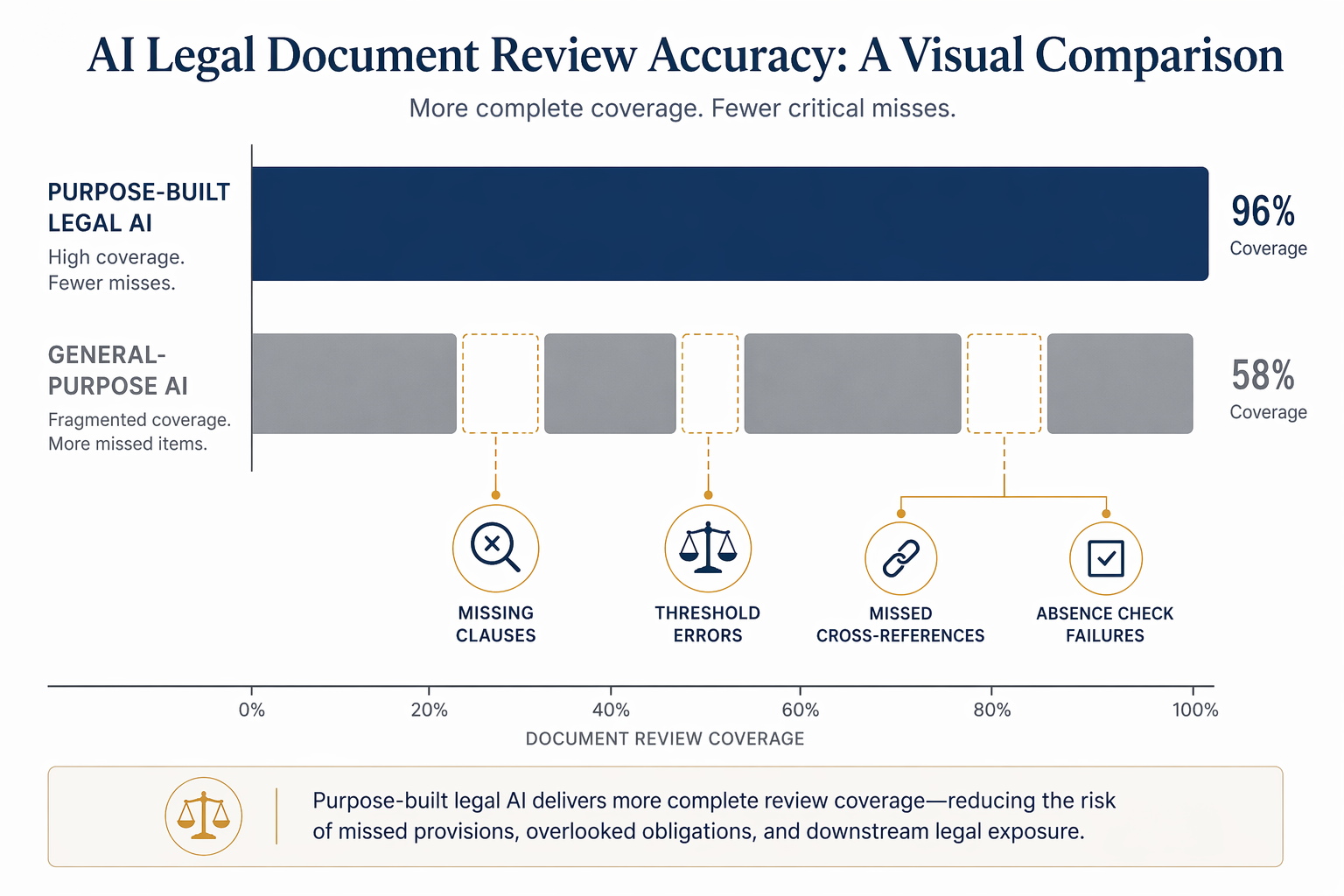
The central finding of the benchmark is unambiguous: purpose-built legal AI ranked first across all 21 provision types tested. General-purpose models, including the strongest frontier systems, exhibited consistent failure patterns on precisely the types of tasks that matter most in legal document review.
The specific failure modes documented in the benchmark map directly to the kinds of errors that can lead to professional liability:
- Specific clause identification: General models frequently misidentified which clause type was present in a given section, confusing indemnification provisions with limitation-of-liability clauses or missing sub-clauses entirely.
- Numerical thresholds: When a guideline required checking whether a dollar amount or time period exceeded a specified threshold, general models made errors at rates far exceeding purpose-built systems. A model might correctly identify a non-compete clause but fail to flag that its 24-month duration exceeded the jurisdiction's 12-month enforceability limit.
- Multi-part requirements: Guidelines requiring simultaneous satisfaction of multiple conditions — for example, 'the contract must include both a governing law clause AND a dispute resolution clause, AND the dispute resolution clause must specify binding arbitration' — caused general models to miss one or more elements.
- Cross-references: When a provision in one section referenced a definition or condition in another section, general models often failed to trace the reference correctly, treating the provision as complete when it depended on language elsewhere in the document.
- Absence checks: Perhaps the most consequential failure mode involved detecting the absence of required language. General models were significantly less reliable at identifying that a contract lacked a mandatory provision — a task that requires the model to know what should be present rather than simply analyzing what is.
Speed Comparison: 17x Faster Than the Strongest General Model
Accuracy is not the only dimension on which purpose-built legal AI outperforms general models. The LegalOn benchmark also measured processing speed and found that purpose-built legal AI completed contract review 17 times faster than Claude Opus 4.6, which was the strongest general-purpose model tested in the study.
This speed differential has practical implications for workflow efficiency and risk exposure. In high-volume document review — due diligence for a merger, lease portfolio review, or regulatory compliance audit — the time required to process each contract compounds across thousands of documents. A general model that takes 17 times longer per contract may create pressure on reviewers to skip verification steps or accept outputs without adequate scrutiny, increasing the risk that errors go undetected.
The speed advantage also affects the economics of AI adoption. LegalOn reports that its AI cuts contract review time by 70–85%. For legal teams spending an average of 3 hours reviewing a single contract — and with 52% of teams actively using or evaluating AI for contract review according to LegalOn's 2026 State of AI for In-House Legal survey — the cumulative time savings from a faster, more accurate tool directly affect both operational costs and the ability to take on additional work without expanding headcount.
Supporting Evidence: Stanford RegLab, LawGeex, and Harvard CLP
The LegalOn benchmark is the most granular public comparison available, but it is not the only data point. Three additional sources provide converging evidence that the accuracy gap between purpose-built and general AI is real, measurable, and professionally significant.
| Source | Key Finding | Year | Independence |
|---|---|---|---|
| Stanford RegLab | Generic AI models hallucinate legal information in case law at 'pervasive' rates | 2025–2026 | Independent academic research |
| LawGeex benchmark | AI achieved 94% accuracy on contract review vs. 85% for human lawyers | 2019 | Independent study (note: data is from 2019) |
| Harvard CLP (AmLaw100 interviews) | AI reduced associate drafting time from 16 hours to 3–4 minutes with increased accuracy | 2025–2026 | Independent qualitative study (10 firms) |
| Thomson Reuters 2025 Future of Professionals Report | 77% of legal professionals using AI use it for document review; 53% report ROI | 2025 | Independent survey (2,275 professionals) |
The Stanford RegLab findings are particularly important because they address the underlying cause of the accuracy gap. General-purpose models are trained on broad internet corpora and optimized for conversational fluency, not for the precise, rule-bound reasoning that legal document review requires. When these models encounter a task that demands exact numerical comparison or multi-condition logic, they default to probabilistic pattern matching — the same mechanism that produces hallucinated case citations.
The LawGeex benchmark, while frequently cited, requires a significant caveat: it was conducted in 2019, before the current generation of large language models existed. The 94% AI accuracy figure compared to 85% for human lawyers reflects the performance of earlier natural language processing systems, not today's frontier models. The landscape has shifted substantially, and the 2019 data should be treated as directional rather than current.
The Harvard CLP study, based on qualitative interviews with COOs and partners from ten AmLaw100 firms, provides the most compelling evidence of real-world impact. One firm reported that an AI system for complaint response reduced associate drafting time from 16 hours to 3–4 minutes — a productivity gain greater than 100x — while simultaneously increasing accuracy. The study notes that 90% of firms expect additional time to improve 'quality of service,' suggesting that the accuracy gains are not merely theoretical but are being observed in practice.
What the Accuracy Gap Means for Tool Selection
The documented accuracy gap between purpose-built legal AI and general-purpose models is not an abstract technical finding. It maps directly to specific categories of professional risk that technology officers and risk managers must address in their procurement decisions.
| Risk Category | How the Accuracy Gap Creates Exposure | Relevant Failure Mode |
|---|---|---|
| Sanctions for citation errors | General models hallucinate case citations at pervasive rates; purpose-built legal AI is trained on verified legal sources | Absence checks, cross-references |
| Malpractice from missed provisions | General models fail to identify missing required clauses or incorrect numerical thresholds | Threshold errors, multi-part requirements |
| Client harm from incorrect contract analysis | General models misidentify clause types or fail to trace cross-references, leading to incorrect legal conclusions | Specific clause identification, cross-references |
| Regulatory non-compliance | General models cannot reliably verify that contracts meet jurisdiction-specific regulatory requirements | Multi-part requirements, absence checks |
| Loss of client trust | Errors discovered post-execution undermine confidence in AI-assisted legal work | All failure modes |
The framework for matching tool choice to task criticality should be straightforward: for low-risk, high-volume tasks where a missed error has minimal consequences — internal document summarization, initial draft generation for review — general-purpose models may be adequate with proper human oversight. For precision-critical tasks where an error could result in sanctions, malpractice liability, or client harm — contract review for regulatory compliance, due diligence for material transactions, citation verification for court filings — purpose-built legal AI with documented accuracy benchmarks is the appropriate choice.
This is not a recommendation to avoid general-purpose models entirely. It is a recommendation to match the tool to the task and to verify the tool's performance on the specific task before deployment. For a detailed framework on evaluating tools across multiple criteria — including accuracy, pricing, integrations, and data privacy — see our AI Contract Review Buyer's Guide.
Verification Protocols That Close the Remaining Gap
Even the most accurate purpose-built legal AI system does not eliminate the need for human verification. ABA Formal Opinion 512 is clear: the duty of competence requires attorneys to verify all AI-generated outputs against primary sources. The question is not whether to verify, but how to verify efficiently and systematically.
The following verification protocols are designed to close the remaining accuracy gap regardless of which tool is selected. They are drawn from the Prompt → Verify → Audit framework developed by GC AI, which has been used by over 6,000 lawyers who have completed CLE-eligible AI ethics courses through the program as of mid-2026.
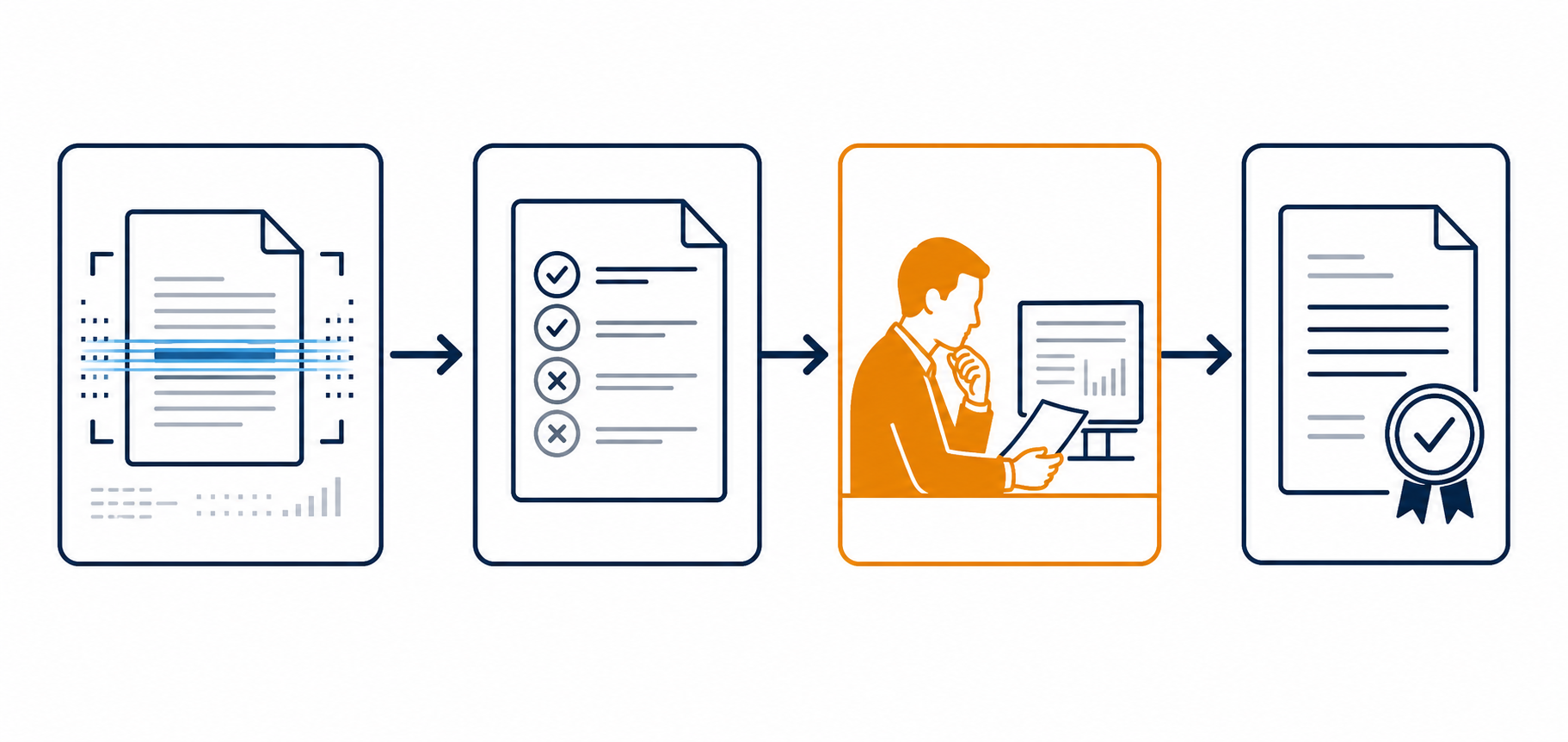
- Pre-deployment benchmarking: Before adopting any AI tool for a precision-critical task, run a blind test using a sample of documents with known correct answers. Measure the tool's accuracy on the specific provision types and failure modes relevant to your practice area. Do not rely on vendor-published benchmarks alone.
- Stratified sampling for verification: Do not verify every AI output with the same intensity. Allocate verification resources based on risk: 100% verification for outputs that will be filed with a court or incorporated into a material agreement; statistical sampling for low-risk internal documents; no verification only for outputs that are explicitly labeled as drafts and will be substantially rewritten.
- Cross-reference verification for citations: For any AI-generated legal citation, verify the cited source directly. This is the single most important verification step, as citation hallucinations are the most common and most easily detected failure mode. A tool that cannot reliably produce verifiable citations should not be used for any task that will be presented to a court.
- Threshold and multi-condition checklists: For contract review tasks involving numerical thresholds or multi-part requirements, create a structured checklist that mirrors the AI's analysis. The reviewer should independently confirm each element rather than reading the AI's conclusion and assessing its plausibility.
- Absence-check protocols: When the AI reports that a required provision is present, the reviewer should independently confirm that the provision exists and is complete. When the AI reports that a provision is absent, the reviewer should confirm the absence by searching for related terms that might indicate the provision appears under a different label.
- Documentation of verification steps: Maintain a record of what was verified, by whom, and what the verification revealed. This documentation serves both professional responsibility purposes (demonstrating competence under Model Rule 1.1) and risk management purposes (providing evidence of reasonable care in the event of a dispute).
These protocols are not theoretical. They reflect the practices that firms are beginning to adopt as the professional responsibility landscape evolves. For a deeper analysis of how the governance gap between AI adoption and institutional readiness is shaping firm behavior, see our coverage of the Legal AI trust and governance gap.
The accuracy gap between purpose-built legal AI and general-purpose models is not a reason to avoid AI in legal practice. It is a reason to be precise about which tool is used for which task, to verify outputs systematically, and to demand evidence — not marketing — when evaluating AI tool claims. The benchmark data now available makes this precision possible. The professional responsibility framework makes it necessary.
Chronological incident history
No sanction cases have named this tool in the tracked record set to date. This does not imply the tool is safe — see Risk Digest for ongoing monitoring.
← Compare peer toolsReport a correction or tip
Spotted an outdated figure, a misstated fact, or a ruling this tool profile should reflect? Public comments are disabled for this content given the professional cost of a misreported case outcome, penalty amount, or rule text — use the structured correction channel instead.
Report a correction or tip for this record →