
The election-law issue that matters most in Jay Feely’s Arizona primary is not a lawsuit against Jay Feely. It is the scale of the ballot-access litigation around him. By the time Arizona’s 2026 primary ballots took shape, 27 lawsuits had targeted 22 candidates, and 12 candidates had been removed from the ballot either by court order or by withdrawal after a challenge was filed.[1]
That is the right starting point for understanding the CD1 race. Signature challenges are often described as technical, and sometimes they are technical in the useful sense: they test whether a campaign collected enough valid support to earn a place on the ballot. But once a challenge wave removes or pressures out a dozen candidates, it is no longer just paperwork. It has changed the competitive field before voters ever receive a ballot.
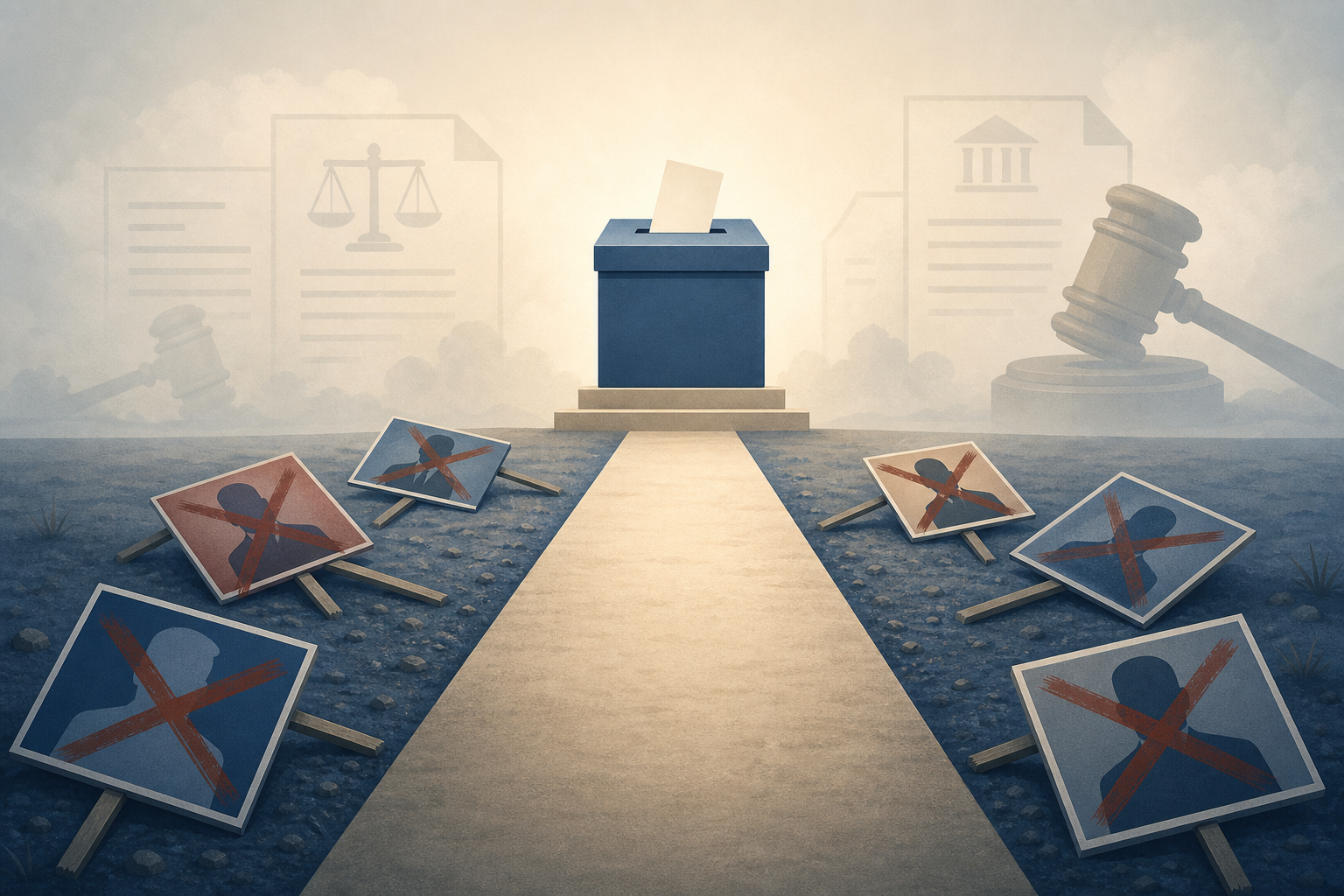
Arizona’s Primary Became a Ballot-Access Event
The Arizona Capitol Times described the 2026 primary cycle as the most litigated in recent memory for candidate challenges: 27 lawsuits, 22 targeted candidates, and 12 removals.[1] Those numbers matter because they show a statewide enforcement environment, not an isolated skirmish in one congressional district.
In CD1, three candidates withdrew after facing signature-based challenges: Christopher Ajluni of No Labels, Democrat Victor Weintraub, and Republican David Redkey.[1] Each withdrawal had its own partisan and practical consequence, but the common feature is more important here: the field was narrowed through petition litigation before the primary electorate made its choice.
| Statewide 2026 primary challenge marker | Reported outcome |
|---|---|
| Candidate lawsuits filed | 27 |
| Candidates targeted | 22 |
| Candidates removed by court order or withdrawal | 12 |
| CD1 candidates who withdrew after signature challenges | Christopher Ajluni, Victor Weintraub, David Redkey |
For Feely, the legally careful formulation is also the most accurate one. He was not sued off the ballot. He was not the target of a ballot-access challenge in the reporting available as of July 22, 2026, one day after the primary. And there is no basis in the available record to say that a court ruling directly protected him from a rival. The narrower point is that his path to the Republican nomination ran through a cycle in which petition vulnerability became electorally consequential.
What the CD1 Withdrawals Changed
A withdrawn candidate is not the same as a defeated candidate. That distinction is easy to lose in post-primary coverage, but it matters in election law. A defeat measures voter preference among the names that appear. A ballot-access withdrawal measures whether the candidate could survive the legal and administrative screening required to get there.
Redkey’s withdrawal was the most directly relevant to Feely’s Republican primary because it removed a same-party competitor after a signature challenge.[1] The record provided does not support a claim that Redkey would have taken a particular share of the vote, changed the ideological balance of the race, or altered the outcome. It does support the simpler and stronger conclusion: Feely faced less intra-party ballot competition than he would have if Redkey had remained.
Ajluni and Weintraub mattered differently. Their withdrawals did not reduce the Republican primary field in the same way, but they still show how CD1 was exposed to the broader challenge wave.[1] The district’s 2026 election environment was not just campaign advertising, endorsements, or turnout operations. It included an early legal filter that decided which candidacies could continue.
So the election-law issue in Feely’s primary is slightly unintuitive. It was not a Feely eligibility case. It was a ballot-access ecosystem that reduced the number of candidates around him.
The Supreme Court Was Not Simply Clearing Everyone Out
The same cycle also produced Arizona Supreme Court clarifications that cut in more than one direction. That matters because it keeps the story from becoming too blunt. The courts were not simply accepting every removal theory placed in front of them.
In Lytle, the court held that using a business address rather than a home address on nomination petitions did not justify removal where voters were not confused.[1] That is a practical election-law line. The address issue may have been imperfect, but the reported holding tied removal to a real ballot-access concern: whether the defect impaired voter understanding.
In Hernandez, the court held that unpaid campaign-finance fines below $1,000 did not disqualify a candidate from the ballot.[1] That ruling also narrowed the reach of disqualification. Campaign-finance compliance still matters, but the reported holding did not permit every unpaid fine to become a ballot-ending defect.
Rose also formed part of the same cycle’s eligibility clarification, involving civil-rights restoration for candidate eligibility.[1] The available material supports only brief treatment here, but its presence reinforces the larger point: Arizona’s 2026 primary was shaped by appellate rulings about who could stay on the ballot and why.
Where Signature Sufficiency Still Did the Work
The limits recognized in Lytle and Hernandez did not make petition challenges toothless. Jerone Davison, a Republican candidate in CD4, was disqualified after failing to collect the required 1,430 minimum signatures.[1] That is the core ballot-access function at its cleanest: a candidate either meets the minimum valid-signature threshold or does not.
This contrast is useful for CD1 because it separates two things that often get collapsed. Some challenges fail when the asserted defect does not justify removal. Some succeed when the petition record cannot support ballot placement. And some candidates withdraw after a challenge is filed, which may leave less public judicial analysis but still produces the same practical result for the ballot: the name is gone.
For election administrators, those categories are not academic. They determine what must be printed, what must be corrected, what must be defended in court, and how quickly a county or state office can move from candidate filing chaos to a legally usable ballot. Campaigns experience these disputes as strategy. Administrators experience them as a deadline problem with legal consequences.
What Should Not Be Loaded Onto Feely’s Case
The available record does not show that Feely orchestrated the CD1 challenges, legally caused the withdrawals, or received a court-created advantage unique to him. Those claims would require evidence not contained in the current source material. Election-law analysis gets weaker, not stronger, when it turns an indirect advantage into an unsupported accusation.
The opposite claim is also too neat. Saying Feely faced no ballot-access litigation does not mean ballot-access litigation had nothing to do with his path. In a district where three candidates withdrew after signature challenges, the legal environment is part of the race architecture.[1] It helped define the set of candidates available to voters and, in Redkey’s case, the set of Republicans competing against Feely.
That distinction is especially important because CD1 also generated other election-law headlines. The Chaplik AI deepfake lawsuit belongs in the separate category of campaign-speech and emerging-technology litigation, and prior coverage of the Arizona congressional primary AI deepfake law dispute covers that lane. Maricopa County administration issues, including the Heap v. Galvin settlement, are better treated through the broader legal implications of Arizona’s 2026 primary election results and the specific Heap v. Galvin settlement analysis. They are related to the same election season, but they are not the ballot-access mechanism that narrowed CD1.
The Post-Primary Record
As of July 22, 2026, the record is necessarily post-primary and provisional as to anything that might happen later in the general election. No later general-election litigation related to Feely’s race can be assumed from the materials available now.
What can be said is narrower and more durable. Arizona’s 2026 primary challenge wave removed or pressured out 12 candidates statewide, produced three state Supreme Court clarifications, and reached CD1 through the withdrawals of Ajluni, Weintraub, and Redkey.[1] Feely was not directly sued, but the field he faced was shaped by a litigation culture in which signature defects became a practical route to reducing competition. That is the notable election-law feature of Feely’s CD1 path: not a case against him, but a field-clearing ballot-access wave around him.
References
- Challenges to primary election candidates oust 12, 10 survive, Arizona Capitol Times, May 6, 2026
Comments
Join the discussion with an anonymous comment.