
The hard question in the Coca-Cola Fairlife ransomware disclosure is not whether a public company should say something when production stops. It is what the company can responsibly say before the facts that usually drive securities-law materiality — duration, scope, data access, customer impact, financial loss — have hardened enough to support a conclusion.
That is why the July 16, 2026 Form 8-K matters. Coca-Cola disclosed that an unauthorized third party had accessed production systems connected with Fairlife operations, that the incident had a ransomware nexus, and that U.S. Fairlife operations were suspended. It also said Canadian operations were isolated and unaffected, product quality and safety were not impacted, personal data access had not yet been confirmed, and materiality had not yet been determined.[1]

For legal teams assessing the coca cola fairlife ransomware attack legal implications, the filing is useful because it does not pretend the uncomfortable middle period does not exist. It gives investors operational facts that had already become concrete, while declining to turn an incomplete incident record into a premature Item 1.05 materiality admission.
The Four-Day Clock Starts Later Than the Crisis
The SEC’s cybersecurity disclosure rule is often discussed as if it creates a four-business-day countdown from intrusion discovery. That shorthand is imprecise in the place where it matters most. Item 1.05 requires disclosure within four business days after the registrant determines that a cybersecurity incident is material. Item 8.01 remains available for voluntary disclosure of other events the company chooses to report.
In a clean data-breach scenario, the materiality analysis can still be difficult. In a manufacturing disruption, it can be worse. The legal team may know that a plant, line, or production environment is down before it knows whether the interruption will be measured in hours, days, or longer. It may know that systems were accessed before it knows what the actor reached. It may know that customers will ask about supply and safety before finance can quantify the effect.
The materiality standard associated with TSC Industries and Basic is fact-specific. It asks, in substance, whether there is a substantial likelihood that a reasonable investor would consider the information important, with probability and magnitude doing real work where contingencies remain unresolved. That does not excuse delay when facts are known. It does mean a disclosure committee should be careful about confusing a serious operational incident with a completed materiality determination.
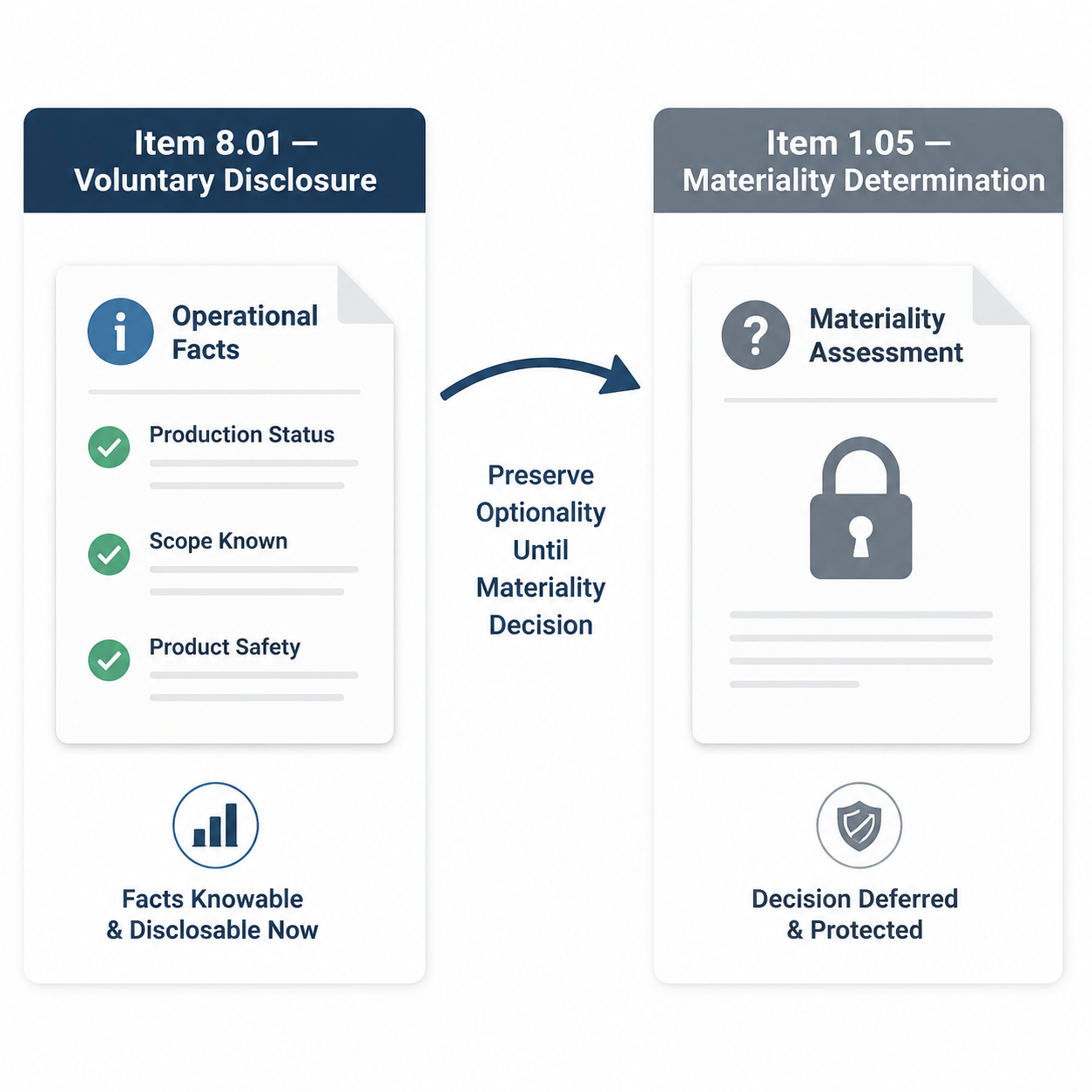
Coca-Cola’s initial filing appears to occupy that middle lane. ComplianceHub.wiki read the filing as an optionality-preserving disclosure: Coca-Cola addressed verified operational disruption and the food-sector-specific safety concern, while leaving open the data theft, downtime, and materiality questions that the company had not yet resolved.[2]
What Coca-Cola Actually Disclosed
The strongest part of the July 16 filing is its separation of known facts from open questions. It did not merely say there had been a cybersecurity incident. It identified an unauthorized third-party access event involving production systems connected with Fairlife, tied the incident to ransomware, and named the operational consequence: U.S. Fairlife operations were suspended.[1]
That matters because “production systems” is not a decorative phrase. In a public manufacturer’s 8-K, it tells investors that the incident is not confined to an email inbox, a back-office application, or a vendor notification letter. It points toward the part of the business that makes product, schedules output, and creates revenue risk if the interruption persists.
Coca-Cola also narrowed the operational perimeter where it could. The filing said Canadian operations were isolated and unaffected.[1] That sentence does more than reassure. It gives investors a boundary, and it gives later reviewers something testable. If subsequent facts show a different operational footprint, the record will have to account for that. If they do not, the sentence will have helped prevent the incident from being read more broadly than the company’s verified facts supported.
The product-quality statement is equally important. Coca-Cola said product quality and safety were not impacted.[1] In a food and beverage incident, that is one of the first sector-specific questions investors, regulators, retailers, and customers will ask. A generic cyber disclosure would not have answered it. A disclosure that said only “operations were disrupted” would have left the most obvious food-sector concern dangling.
The filing then stopped where the facts stopped. Personal data access had not yet been confirmed, and materiality had not yet been determined.[1] That phrasing is not a magic shield. But it is materially different from the evasive style that says very little in many words. The company told the market what was down, what was not down, what safety issue it believed was not implicated, and what remained under investigation.
| Disclosure Point | Legal Significance |
|---|---|
| Unauthorized third party accessed production systems connected with Fairlife | Identifies the incident as operational rather than merely administrative |
| Ransomware nexus | Signals a disruption and extortion pattern without speculating beyond the filing |
| U.S. Fairlife operations suspended | Names the concrete business interruption investors need to evaluate |
| Canadian operations isolated and unaffected | Sets a boundary around the known operational footprint |
| Product quality and safety not impacted | Addresses the food-sector concern most likely to matter immediately |
| Personal data access not yet confirmed | Preserves the distinction between system access and confirmed data compromise |
| Materiality not yet determined | Avoids converting preliminary operational facts into an Item 1.05 conclusion |
Why Item 8.01 Was Doing Real Work
The Item 8.01 posture is the legal hinge. If a company has determined that a cybersecurity incident is material, Item 1.05 is the required channel. If it has not made that determination but believes the market should receive verified information, Item 8.01 gives the company a voluntary disclosure path.
That path is not cost-free. A voluntary 8-K still creates a public record. Every word can return later in investor litigation, SEC correspondence, customer negotiations, insurance discussions, and earnings-call questions. A company that uses Item 8.01 loosely may find that its early language becomes more durable than its early understanding deserved.
But the alternative is not attractive either. Waiting silently until every forensic question is closed can leave investors without the operational facts they plainly need. That is especially true where production has already stopped. In that setting, the better discipline is not silence; it is precision.
ComplianceHub.wiki’s reading of the Coca-Cola filing is persuasive on this point because it focuses on design rather than tone. The filing preserved optionality on unresolved questions, but it did not avoid the facts that would matter to the sector. In particular, it addressed product quality and safety while leaving materiality open.[2]
That is the difference between careful disclosure and defensive fog. A disclosure committee should not concede materiality before it has reached that judgment. It also should not hide behind uncertainty when operational facts are already verified.
The Stock Move Belongs in the Record, Not at the Center
Coca-Cola’s stock fell 4.02% on July 17, 2026, the day after the Fairlife disclosure.[3] That fact belongs in the chronology. It should not be asked to carry the legal analysis by itself.
Single-day stock movement is noisy even in cleaner circumstances. Here, the broader market context also matters: the S&P 500 was down that day, so the KO decline cannot be read as a neat referendum on cyber materiality.[3] A plaintiff may cite the movement. A regulator may ask about it. A disclosure committee should preserve the data point. But treating it as a self-contained materiality verdict would be too blunt.
The better question is how the initial market reaction compares with recent cybersecurity 8-K practice, and whether later operational or financial disclosures confirm that investors were missing something important at the time of the first filing.
How Fairlife Compares With Recent Cyber 8-Ks
Cherry Hill Advisory’s review of 78 cybersecurity 8-K filings over two years gives the Fairlife filing a useful, if imperfect, comparator. The dataset found that diversified large-cap companies absorbed cyber disclosures at roughly flat day-after stock movement, with an average move of -0.1%.[4]
That benchmark counsels against overreading the July 17 KO decline. It also counsels against underreading the operational disruption. The Cherry Hill review noted that some impacts surfaced later rather than in the initial market response. Johnson Controls, for example, later disclosed material financial effects in quarterly earnings, even though the initial disclosure did not itself tell the full financial story.[4]
Other companies moved faster to a materiality conclusion. Cherry Hill identified Halliburton as making a materiality determination within 2 days and UnitedHealth within 1 day.[4] Those examples show that rapid determinations are possible in some incidents. They do not prove they are always responsible in an OT manufacturing event where downtime, restoration path, product implications, and data access may be developing on different timelines.
The limitation is important. Cherry Hill’s 78-filing review includes a mix of incident types, and OT-specific ransomware incidents are not the whole dataset.[4] A large-cap benchmark is useful because disclosure committees need some market context. It is not a clean control group for a production-halting attack involving cyber-physical operations.
This is where the Fairlife filing becomes more interesting than a routine breach notice. If later filings show limited downtime, no confirmed personal data compromise, and immaterial financial impact, the July 16 Item 8.01 approach will look measured. If later disclosures show extended production losses, significant cost, supply disruption, or confirmed data exposure, the adequacy of the initial framing will be judged against what Coca-Cola knew and when it knew it.
OT Ransomware Creates a Different Disclosure Problem
Manufacturing ransomware is not just a data-breach fact pattern with louder machinery. Operational technology environments can make the initial scope question harder because production systems, vendors, maintenance access, plant networks, and business systems may be connected in ways the legal team does not fully understand on day one.
Claroty’s 2024 survey data helps explain why this uncertainty is not exotic. About 90% of respondents reported attacks originating from third-party supplier access to cyber-physical systems environments, and 57% admitted only partial or no understanding of third-party connectivity to their OT environment.[5]
Those figures should not be stretched into a conclusion about what happened at Fairlife. Coca-Cola’s filing did not publicly identify the threat actor, the access path, or the final scope.[1] The point is narrower: in OT environments, uncertainty about connectivity and operational blast radius can be genuine, not merely lawyerly caution.
That distinction affects the disclosure sequence. In a traditional personal-data breach, the public narrative often turns quickly on categories of information, population counts, and notification duties. In an OT ransomware incident, investors may first need to know whether production stopped, whether product quality is implicated, whether other facilities are isolated, and whether the company can continue supplying customers.
Those questions also spill into other legal channels. Supply contracts, customer commitments, insurance coverage, food safety obligations, and vendor disputes may all develop alongside SEC disclosure. For a broader treatment of those channels, see Three Legal Exposure Channels After a Supply Chain Cyberattack.
A Disclosure Committee Framework for the Next OT Incident
The lesson from the Fairlife filing is not that every manufacturer should file an Item 8.01 whenever ransomware touches production. The lesson is narrower and more useful: when operational facts are verified but materiality remains unresolved, the committee needs a disciplined way to disclose without over-deciding.
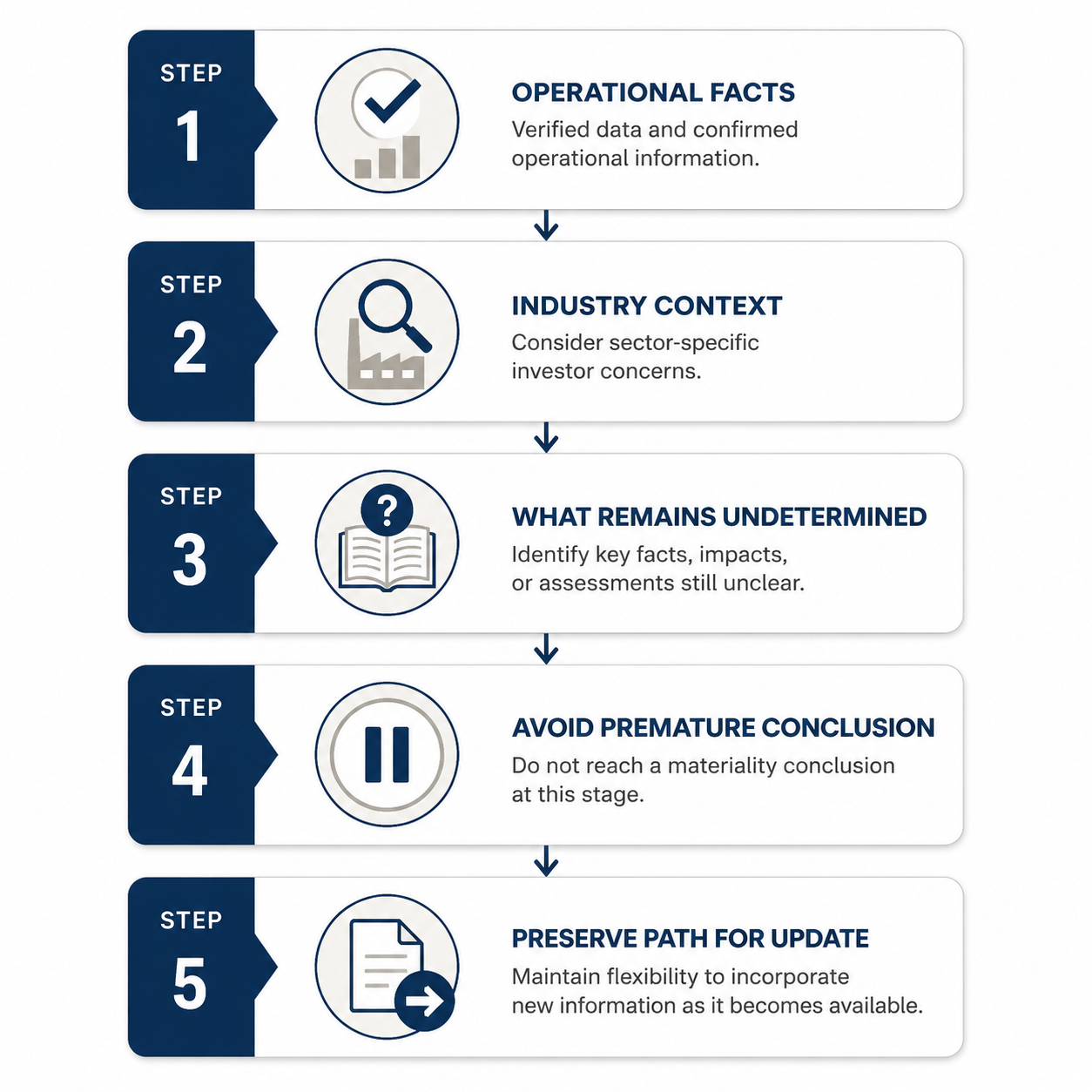
- Start with verified operational facts: which systems or operations are affected, what has stopped, what continues, and what boundaries have been confirmed.
- Identify the sector-specific investor concern: in food and beverage, product quality and safety may need to be addressed before data categories are fully known.
- State unresolved items plainly: data access, downtime duration, restoration timing, financial impact, customer effects, and materiality should not be implied if they have not been determined.
- Avoid accidental Item 1.05 language: do not call an incident material, significant, or financially consequential unless the committee is prepared to support that conclusion.
- Preserve the update path: document what was known at filing time and be ready for an Item 1.05 amendment, periodic-report disclosure, or earnings discussion if later facts change the analysis.
The sequence matters. A committee that begins with legal adjectives will struggle. A committee that begins with operations can make cleaner decisions: plant status, product status, geography, customer-facing consequences, data access, restoration assumptions, and financial exposure. The legal conclusion should come after that record, not before it.
The earlier analysis in Coca-Cola's Fairlife Breach Tests the SEC Materiality Clock covers disclosure readiness at a broader level. The Fairlife filing now gives legal teams a more granular drafting problem: how to make a public statement useful enough for investors without collapsing unresolved facts into a securities-law conclusion.
What Would Make the Initial Filing Look Better or Worse
Because the incident is still unfolding as of July 19, 2026, the July 16 filing should be treated as preliminary. Its value as a template depends on later facts.
The initial approach will look stronger if subsequent disclosures confirm that the company accurately bounded the affected operations, that product quality and safety were not affected, that personal data access was not confirmed or was limited, and that financial impact did not rise to a material level. It will also look stronger if Coca-Cola updates the market promptly if any of those assumptions change.
It will look weaker if later facts show that the production halt lasted long enough, cost enough, or disrupted supply enough that the company should reasonably have reached a materiality determination earlier. It will also look weaker if the “not yet confirmed” data-access language becomes a placeholder for facts that were already substantially known.
That is the burden of an optionality-preserving filing. It buys time only for facts that are genuinely unresolved. It does not buy immunity from the timeline.
Based on the initial July 16 filing, Coca-Cola’s Fairlife disclosure is a credible template for large-cap manufacturers facing OT ransomware with uncertain scope. It disclosed the operational condition, addressed the food-sector concern investors would ask first, and left materiality where it belonged: undecided until the company had enough facts to decide it. Its ultimate significance will depend on what subsequent forensic, operational, and financial disclosures reveal.
References
- The Coca-Cola Company Announces Technology Disruption Involving fairlife Operations, The Coca-Cola Company, July 16, 2026.
- Coca-Cola Fairlife Ransomware Production Halt 2026, ComplianceHub.wiki.
- Why Coca-Cola Stock Flopped on Friday, The Motley Fool, July 17, 2026.
- SEC Cybersecurity Disclosure Rule Two-Year Review, Cherry Hill Advisory.
- Claroty 2024 Survey on Third-Party Connectivity to OT and CPS Environments, Claroty, 2024.
Comments
Join the discussion with an anonymous comment.