
The first legal fork after a boating death usually appears before anyone has a complete theory of the accident. A practitioner may be dealing, in the same week, with casualty reporting, evidence preservation, Coast Guard or local agency contact, family counsel, insurer demands, and possible criminal exposure. The phrase "boat death investigation legal proceedings" sounds singular. In practice, it is plural from the start.
That matters in 2026 because the active and recently adjudicated cases do not move along one master timeline. The Bayesian superyacht sinking has Italian prosecutors, a delayed UK inquest, marine-safety reporting, and civil litigation moving around one another. The George Pino prosecution in Florida turned on proof problems that were not cured by civil settlement pressure. The Conception dive-boat case shows how a federal maritime manslaughter statute can use a negligence threshold lower than many lawyers expect. Smith Lake and Nolan Wells sit at earlier points, where grand jury activity is easy to overread if the file is still incomplete.
This article is a 2026 news-and-analysis roadmap, not legal advice. Its narrower point is procedural: after a fatal boating incident, competent monitoring requires separate calendars for investigative, criminal, foreign, coroner, grand jury, and civil tracks, each with its own authority and standard.
The Tracks Do Not Wait for Each Other
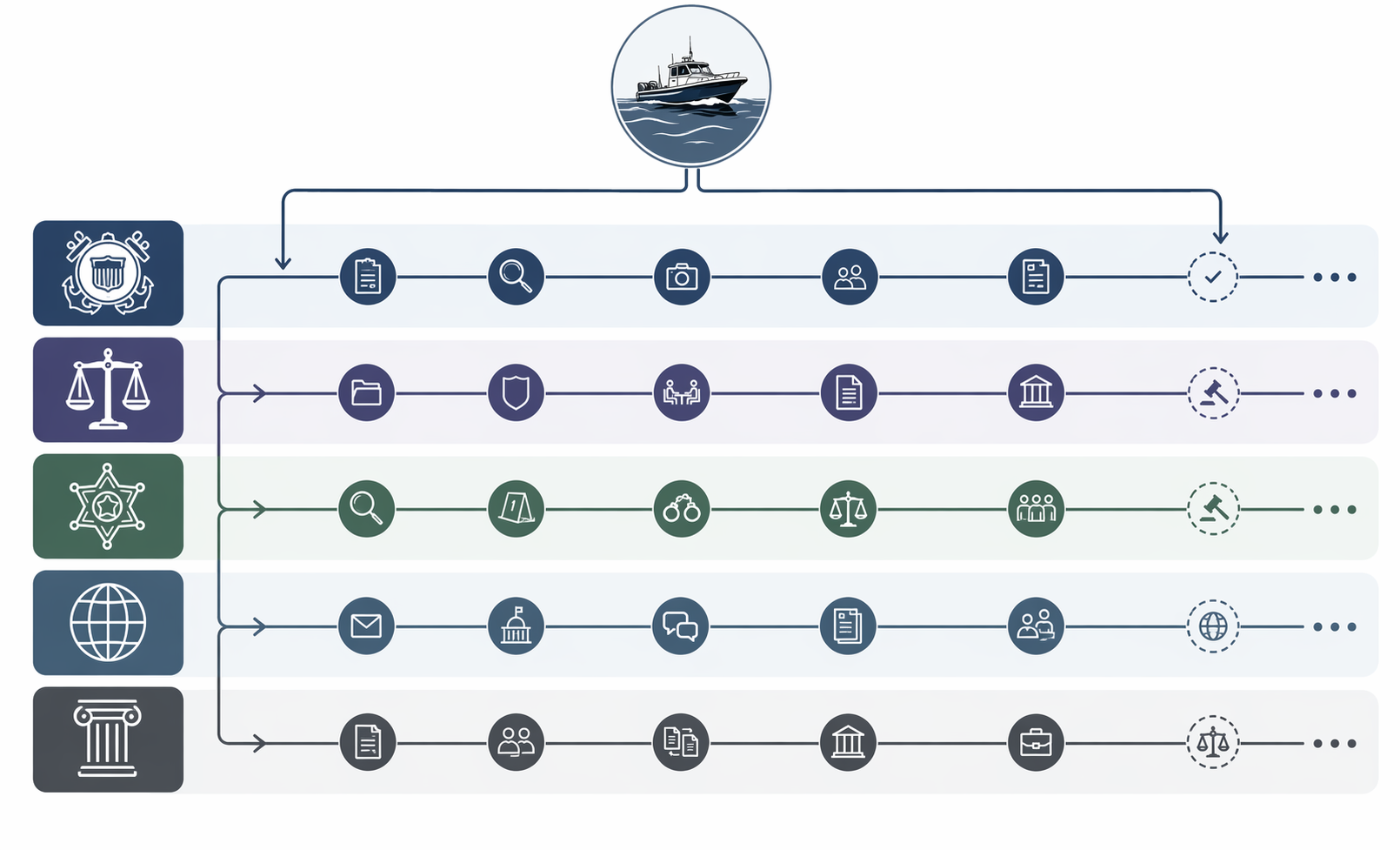
A useful first map separates the proceedings by the question each forum is allowed to ask. One file may ask why the vessel was lost. Another asks whether a person committed a crime. A third asks whether a death certificate or inquest can be completed. A fourth asks who pays, under what limitation regime, settlement, insurance tower, or wrongful-death theory. Those questions overlap factually, but they are not the same question.
| Track | Core question | Practical consequence |
|---|---|---|
| Marine casualty investigation | What happened to the vessel, crew, passengers, and safety systems? | Evidence collection and safety findings may proceed before criminal liability is resolved. |
| Criminal investigation or referral | Did conduct satisfy a state or federal criminal standard? | Statements, toxicology, electronics, body-camera footage, and expert reconstruction become litigation terrain. |
| State or federal charging | Which statute applies, and what mental state or negligence standard must be proved? | A case may turn less on public blame than on the precise statutory threshold. |
| Foreign or coroner proceeding | Which sovereign or death-investigation authority controls the next formal step? | Domestic families and lawyers may wait while foreign prosecutors move first. |
| Civil litigation | Who bears financial responsibility, and can liability be limited or shifted? | Settlement, limitation actions, and insurer strategy may mature before any verdict. |
Operator status can decide which of these lanes becomes dominant. A commercial passenger vessel, a recreational operator, a charter, a tournament competitor, and a crewmember on a foreign-flagged yacht do not enter the same legal architecture. That distinction is also why operator classification deserves early attention in any linked maritime-liability analysis, including commercial versus recreational operator liability frameworks.
Bayesian Shows Why a Single Timeline Misleads
The Bayesian sinking remains the cleanest warning against treating a fatal marine casualty as one case. The superyacht sank off Sicily in August 2024. Reporting from the UK inquest described Italian criminal inquiries into the deaths as a reason the inquest would be delayed; Reuters separately reported that the inquest into Mike Lynch's death would take "many months" while criminal investigations continued abroad.[1][2]
The legal posture matters as much as the geography. Three crew members have been reported as under Italian criminal investigation for manslaughter and shipwreck, but the available reporting does not support saying they have been formally charged. Under that posture, a lawyer should label the matter as an investigation, not a prosecution, and should resist importing common-law assumptions about what an investigative status means.[1]
The UK inquest track answers a different question. A coroner does not become a substitute prosecutor simply because families are waiting for public findings. If the coroner pauses while foreign criminal authorities work, the family experiences that as delay, but the institutional reason is not mysterious: a death-investigation forum can be constrained by another sovereign's criminal process. The record is not late in the same way in every forum; it is being held by different authorities for different purposes.[1][2]
Marine-safety reporting adds another layer. Available reporting indicates that interim findings discussed stability-booklet issues while also pointing to a violent downdraft as part of the casualty context. That is exactly the kind of mixed material that can be mishandled in public discussion. A safety observation is not a conviction. A weather event is not a complete defense. A gap in vessel documentation may matter differently to a marine investigator, a prosecutor, a civil claimant, and an insurer.
Civil litigation then changes the incentives before the public has a final criminal or inquest answer. The reported civil claim by Italian Sea Group against the owner, captain, and crew has been described at €456 million. That figure should not be mistaken for adjudicated liability. It does, however, show why counsel cannot afford to wait for a final inquest before thinking about preservation, privilege, insurance notice, jurisdiction, indemnity, and party alignment.
Bayesian therefore resists the domestic accident-story template. The Italian criminal inquiry may move on one timetable. The UK inquest may wait. Marine-safety findings may emerge in interim form. Civil pleadings may be filed while core liability questions remain open. The more forums appear, the more dangerous it becomes to use one procedural event as shorthand for the entire case.
Evidence Failures Can Decide the Criminal Case Before the Merits Feel Settled
The Florida prosecution of George Pino is useful because it frustrates the common assumption that a severe fatality and a civil settlement will produce criminal accountability on the same factual theory. In June 2026, a jury found Pino not guilty after a boat crash that killed a teenager. Press reports emphasized that no breath alcohol test was administered, that body-camera footage had been deleted by Florida Fish and Wildlife Conservation Commission officers, and that the jury deliberated for about two hours.[3][4]
Those facts are not just trial color. Missing toxicology and deleted law-enforcement footage can alter the proof environment itself. A prosecutor may still have witnesses, crash reconstruction, photographs, medical evidence, and admissions. But the defense can point to absent or mishandled evidence not merely to dispute one fact, but to attack the reliability of the state's investigation. In a boating-death prosecution, that can be decisive because water, darkness, alcohol allegations, speed, vessel handling, and post-crash conduct often need careful reconstruction.
The reported $16 million civil settlement before the criminal verdict sharpens the distinction between tracks rather than blurring it.[3] A civil resolution may reflect litigation risk, insurance economics, family needs, or strategic closure. It does not supply proof beyond a reasonable doubt. Nor does it repair investigative omissions. The criminal jury is not asked whether the civil case was serious; it is asked whether the charged offense was proved under the governing criminal standard.
For lawyers used to vehicle cases, Pino also belongs beside broader evidence-integrity concerns in fatal accident litigation. Breath testing, body-camera retention, GPS data, electronic vessel records, phone evidence, and expert models are only useful if the chain of collection and explanation survives attack. Similar issues arise in other fatal accident prosecutions involving technical proof, including AI evidence and fatal reckless-driving charges.
Boylan Changes the Culpability Conversation
The federal Conception dive-boat prosecution occupies a different legal category. Jerry Boylan, captain of the Conception, was convicted after the 2019 fire that killed 34 people. In March 2026, the Ninth Circuit upheld the conviction and rejected the argument that the Seaman's Manslaughter Statute required gross negligence rather than simple negligence.[5][6]
That holding is not a boating-safety slogan; it is a charging-standard warning. Under 18 U.S.C. § 1115 as described in the appellate coverage, the government did not have to prove the same culpability level that many lawyers associate with common-law manslaughter.[5] For a commercial-vessel casualty, the statute can lower the mental-state fight into a negligence inquiry that looks hard at watchstanding, training, emergency procedures, fire risk, and the captain's duties.
The reported four-year sentence is therefore only part of the story.[5] The more durable point is that federal maritime criminal exposure may attach through a specialized statute whose elements do not mirror state homicide law. A defense lawyer who assumes gross negligence is required may spend too much time fighting the wrong threshold. A prosecutor who charges under the statute still has to prove the required breach and causal connection, but the statutory floor is different.
Boylan also separates casualty investigation from criminal culpability. A marine casualty file can contain operational failures that are important for safety recommendations but insufficient for a criminal conviction under one statute, while being sufficient under another. The relevant question is not whether the conduct sounds bad in a report. It is which legal standard the charging authority selected and what proof fits that standard.
Grand Jury Activity Is a Stage, Not a Verdict
The Smith Lake tournament crash and the Nolan Wells investigation show two different points on the grand jury spectrum. In Alabama, a grand jury indicted professional angler Flint Davis in October 2025 on three counts of reckless manslaughter after a Smith Lake fishing tournament crash. AL.com reported that the boat was traveling 67 mph, that no alcohol was involved, that Major League Fishing was named in civil suits, and that the grand jury recommended safety-certification requirements for tournaments.[7]
An indictment is a charging event, not an adjudication. Davis is presumed innocent, and available reporting does not identify a trial date. Still, the case matters procedurally because it shows how a grand jury can do more than vote on charges. Its safety-certification recommendation sits awkwardly beside the criminal indictment: one is directed at future tournament structure, the other at alleged past criminal conduct. Civil suits naming a tournament organizer add yet another institutional question about event rules, supervision, and risk allocation.[7]
Nolan Wells is earlier and more unsettled. Reporting in July 2026 said the district attorney would present findings to a grand jury, while the family attorney stated that grand jury proceedings had not concluded. The same reporting environment emphasized that the cause of death had not yet been officially determined and that an independent autopsy was pending.[8][9]
That posture requires restraint. A referral to a grand jury is not a charge. A meeting with prosecutors is not a completed investigation. New audio or witness accounts may illuminate the sequence, but they do not substitute for an official cause-of-death determination or a charging instrument.[9] For counsel, the practical task is to mark Nolan Wells as active and unresolved, not to place it in the same procedural box as an indictment or verdict.

Civil Proceedings Create Their Own Pressure
Civil litigation after a boating death often begins before the criminal track is finished because civil parties cannot always afford to wait. Evidence may disappear, limitation deadlines may run, insurers may demand notice, and families may need a forum that is not controlled by a prosecutor. That does not mean the civil case answers the criminal question. It means the civil system has its own clock.
Pino illustrates the point from one side: a large civil settlement preceded an acquittal.[3] Smith Lake illustrates it from another: civil suits naming Major League Fishing were reported while the criminal indictment against Davis remained pending.[7] Bayesian adds a foreign and commercial layer, with a major civil claim reported while criminal and inquest processes remained unresolved. None of these civil events should be treated as a proxy verdict.
Civil pleadings also reshape incentives. A defendant may preserve arguments for limitation, indemnity, comparative fault, jurisdiction, and insurance coverage. Families may pursue discovery that a criminal process would not give them. Corporate defendants may have document-retention duties that begin before any public agency has issued a final report. Counsel who waits for "the investigation" to end may miss the moment when the civil record is actually being built.
What to Track in 2026
The workable approach is a live matrix, not a narrative chronology. Each row should identify the forum, authority, present status, next known procedural event, evidence dependencies, standard of proof, and uncertainty label. A criminal referral, an indictment, an inquest delay, a civil settlement, and an interim safety finding should not share the same status column.
- For Bayesian, the current label should preserve the distinction among Italian criminal investigation, delayed UK inquest, interim safety material, and civil litigation.
- For Pino, the acquittal should be read with attention to evidence collection and retention failures, not treated as a broad finding about every civil or moral question.
- For Boylan, the federal statutory standard should be tracked separately from state homicide concepts and ordinary negligence language.
- For Davis, the indictment and grand jury safety recommendation should be separated from any later trial proof.
- For Nolan Wells, the file should remain marked active and unresolved until cause-of-death and grand jury developments are officially reported.
Different forums do not ask the same question, move on the same schedule, or require the same proof. That is the procedural fact that fatal boating coverage most often flattens. In 2026, monitoring a boating death means tracking the casualty inquiry, criminal exposure, foreign or coroner proceedings, grand jury posture, charging standard, and civil litigation at the same time, with explicit uncertainty labels where the record is still open. This article identifies the proceedings practitioners may need to watch; it does not predict liability or advise any party.
References
- Criminal inquiries into Bayesian yacht deaths delays UK inquest, BBC.
- Inquest into death of tech tycoon Mike Lynch in yacht sinking will take many months, Reuters, April 15, 2025.
- Boat crash victim's family dismayed as driver George Pino found not guilty, The Guardian, June 23, 2026.
- Boat driver found not guilty in Florida crash that killed teen, ABC News.
- Ninth Circuit upholds manslaughter conviction for captain in deadly boat fire, Courthouse News.
- Captain's conviction upheld in Conception dive boat tragedy that killed 34, Los Angeles Times, March 3, 2026.
- Pro angler indicted in 3 boat crash deaths during Smith Lake fishing tournament, AL.com, October 2025.
- DA to Present Nolan Wells Investigation Findings to Grand Jury, Mississippi Free Press.
- New audio sheds light on Nolan Wells' friends' boat malfunction, NBC News.
Comments
Join the discussion with an anonymous comment.