
Iran’s direct claim of responsibility for the July 17, 2026, ballistic-missile and drone strike on Muwaffaq Salti Air Base in Jordan changes the legal analysis in one important respect: the first question is no longer whether a proxy attack can be legally attributed to Tehran. The Islamic Revolutionary Guard Corps claimed the strike, and that matters because the act of a state organ is treated differently from the act of a militia whose relationship to the state must be proved through control, direction, or adoption theories.[1]
That clarity should not be mistaken for remedial simplicity. The attack was only days old as of July 21, 2026, and casualty figures, retaliatory measures, and the public record may still change. Current reporting says the July 17 attack killed two U.S. soldiers, while broader July 18 war reporting placed U.S. military deaths in the Iran war at 17, with hundreds injured.[2][3] Those numbers are not ornamental. They explain why the legal questions are not academic, but they do not answer them.
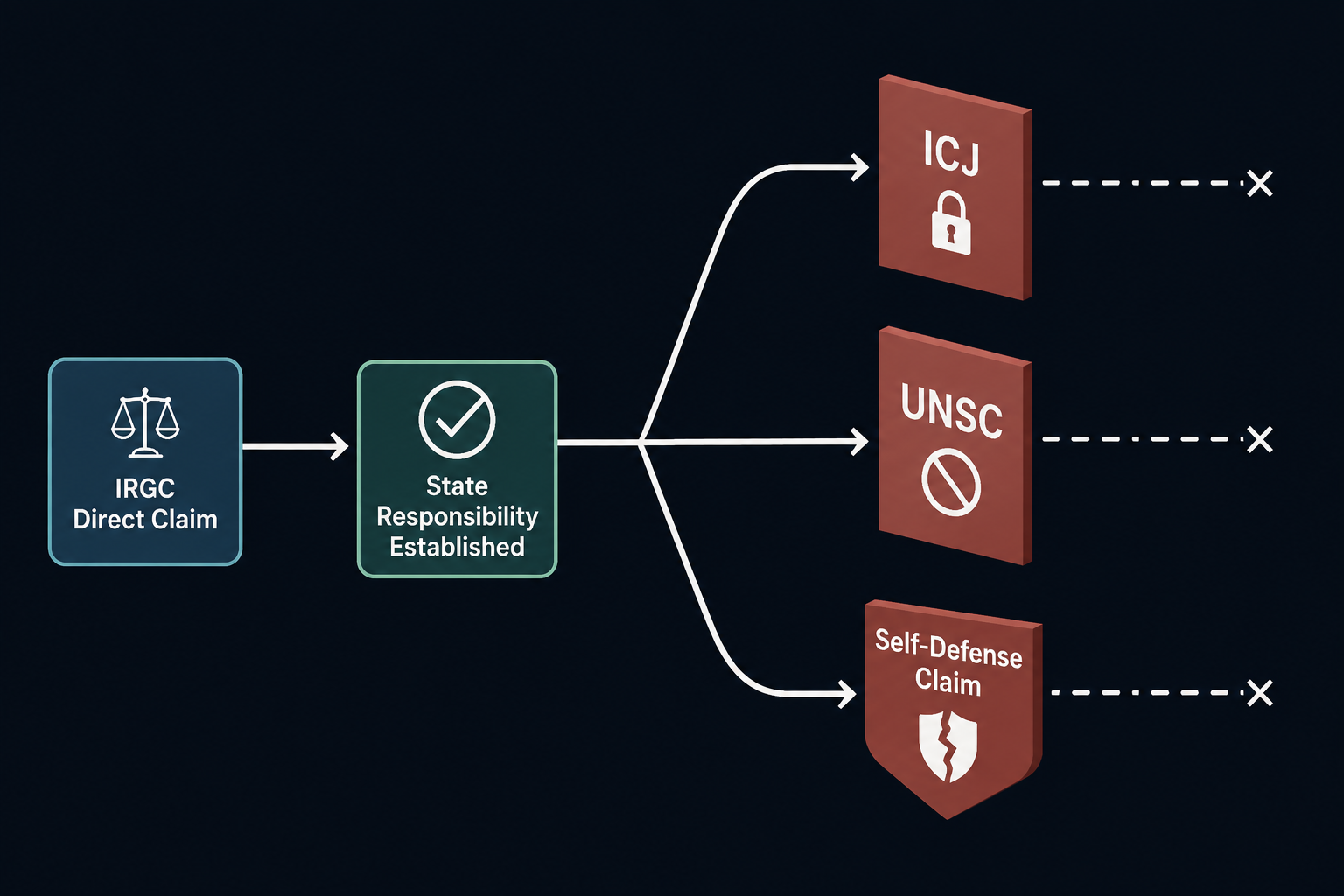
What the IRGC claim changes
The cleanest legal consequence of the IRGC claim is attribution. Under the ILC Articles on State Responsibility, conduct by a state organ is attributable to the state. That is the basic move here: if the IRGC carried out and claimed the strike, the analysis begins with Iran’s own conduct, not with the more difficult question whether Iran exercised the required level of control over a non-state armed group.[4]
That distinction is not a technicality. In proxy cases, lawyers usually have to work through the distance between material support, operational direction, effective control, overall control, and public political endorsement. Those are not interchangeable concepts. A state may arm, finance, encourage, or tolerate a group without every later act of that group automatically becoming the state’s own act for purposes of international responsibility. The doctrinal fight is often about whether the factual record crosses that attribution threshold.
The July 17 strike does not require the same detour if the IRGC claim is accepted as authentic and complete. The relevant act is no longer “an Iran-backed group attacked U.S. forces in Jordan.” It is “an Iranian state organ attacked a base in Jordan hosting U.S. forces.” That formulation does not settle every issue, but it moves the analysis past one of the usual bottlenecks.
The contrast with Tower 22 is useful precisely because it should be kept narrow. After the January 2024 attack in Jordan, the Biden administration’s legal explanation moved through domestic Article II authority and, in Lawfare’s account, an “ancillary self-defense” theory tied to the 2001 and 2002 AUMFs.[5] That earlier episode required attention to armed groups, statutory predicates, and the U.S. government’s claimed authority to respond. The July 2026 strike presents a different first-order international law problem: direct Iranian responsibility is much easier to state.
State responsibility is the beginning of the map, not the destination
Once conduct is attributable to Iran, the next question is whether the conduct breaches an international obligation. The obvious candidates are the prohibition on the use of force under Article 2(4) of the UN Charter, obligations owed to Jordan as the territorial state, and obligations implicated by the killing and injuring of U.S. service members. The analysis may also involve international humanitarian law if the attack is treated as part of an international armed conflict, though that classification is itself contested in the current U.S.-Iran frame.
The ILC framework then asks what follows from an internationally wrongful act. In ordinary terms, responsibility can entail cessation, assurances of non-repetition, and reparation. But the ILC Articles do not themselves create a court with compulsory jurisdiction, a police force, or a veto-proof enforcement mechanism. They tell lawyers how to characterize responsibility and consequences. They do not guarantee a forum capable of delivering them.
| Legal question | Effect of direct IRGC responsibility | Main constraint |
|---|---|---|
| Attribution | Much cleaner: the alleged actor is a state organ, not merely a proxy force. | Depends on the factual reliability and scope of the public claim. |
| Breach | Supports a direct use-of-force analysis against Jordan’s territory and U.S. forces. | Iran may argue self-defense within a continuing conflict theory. |
| ICJ proceedings | A clearer claim does not by itself create jurisdiction. | The United States’ 2018 withdrawal from the Optional Protocol sharply limits a direct U.S. route. |
| Security Council action | The facts may support condemnation or measures in legal terms. | Permanent-member veto politics can prevent meaningful Council action. |
| Unilateral response | The United States may invoke self-defense, countermeasures, sanctions, or domestic authorities. | Each route has separate limits under the UN Charter, domestic war powers, and sanctions law. |
This is where public discussion often skips a step. A state can commit a legal wrong without the injured state having a neat litigation pathway. The gap is not a defect in the July 17 fact pattern. It is a familiar feature of international law, especially where the alleged wrong involves armed force by a state that is unlikely to consent to adjudication.
The ICJ problem is jurisdiction, not just proof
A direct Iranian claim makes a merits case easier to describe. It does not make the International Court of Justice available on demand. For the United States, the structural problem is the 2018 withdrawal from the Optional Protocol to the Vienna Convention on Diplomatic Relations, which had previously served as a jurisdictional route in certain Iran-related disputes. Without a jurisdictional hook, the ICJ cannot simply hear a case because the facts are grave or the attribution record is unusually clean.
Jordan’s position is analytically different because the strike occurred on Jordanian territory, but that does not automatically solve the forum problem either. A state injured by a use of force can protest, seek diplomatic remedies, invoke responsibility, and potentially support collective action. Bringing a contentious ICJ case still requires jurisdiction. Consent remains the gatekeeper.
For lawyers advising institutions exposed to the conflict, this distinction matters. A clear attribution record may support sanctions analysis, contractual risk assessments, force majeure notices, political-risk reporting, or pleadings in domestic litigation. It does not mean an ICJ merits judgment is likely to appear as the central accountability mechanism.
The Security Council route runs into the veto wall
The UN Security Council is the more obvious institutional venue for an attack that may implicate the prohibition on the use of force and regional peace and security. It can condemn, investigate, impose sanctions, authorize measures, or demand de-escalation. It can also fail to act for reasons that have little to do with the legal strength of the claim.
That is the central enforcement problem. The permanent-five veto structure makes robust Council action improbable in conflicts touching the strategic interests of major powers. A Council meeting, draft resolution, or condemnation effort may still matter politically and legally. It can fix positions, build a record, and shape later sanctions or domestic measures. But it should not be confused with a reliable remedial pathway.
Regional legal characterizations may still influence the record. The Guardian reported that GCC Secretary-General Jasem Mohamed al-Budaiwi described the strikes as “war crimes requiring international accountability.”[1] That statement is not a judicial finding, and it does not substitute for a tribunal’s analysis of the applicable law, protected persons, target status, or intent. It is, however, a contemporaneous regional legal characterization from the neighborhood most immediately exposed to the escalation.
Iran’s likely self-defense theory depends on a disputed U.S. premise
The hard question is not whether Iran will have a legal story. It almost certainly will. The more important question is whether that story can lawfully justify striking U.S. forces on Jordanian territory. The answer depends heavily on whether one accepts the premise that the United States and Iran are already in a single continuing international armed conflict.
The U.S. State Department’s April 21, 2026 legal defense of Operation Epic Fury took the position that the U.S.-Iran conflict should be understood as an “ongoing” international armed conflict dating from June 2025.[6] That official position is operationally consequential. If a conflict is framed as continuing, later uses of force are more easily described as episodes within an existing armed conflict rather than fresh resort-to-force decisions requiring a new Article 51 justification.
But the administration’s theory is sharply contested. Allen Weiner of Stanford Law characterized U.S. strikes on Iran as “clearly illegal,” rejecting the idea that the legal foundation was as straightforward as the government suggested.[7] A Just Security letter signed by more than 100 international law scholars likewise concluded that U.S. strikes violated the UN Charter.[8] Those critiques matter for the July 17 analysis because Iran’s self-defense claim becomes stronger only if the broader U.S. theory of a continuing conflict is accepted. If that premise fails, the Jordan strike looks less like a defensive act within an ongoing war and more like a new use of force on the territory of a third state.
Jordan’s status is not incidental. Adil Haque has argued that targeting third states that have not consented to the use of force against Iran from their territory is unlawful.[9] That analysis is directly relevant to Muwaffaq Salti Air Base because Jordan is not merely a map location where U.S. forces happened to be present. It is the territorial sovereign whose land becomes the legal hinge for both sides’ war narratives.
The June 14, 2026 memorandum of understanding that was nominally in effect when Iran struck adds another layer, though not a simple answer.[3] A ceasefire or de-escalation instrument can shape how states characterize breach, necessity, and good faith. It does not automatically determine whether a use of force is lawful under the Charter, nor does it erase the separate rights of a third-state host.
Jordan is not just the scene of the attack
The legal implications of the Jordan strike are easy to distort if Jordan is treated only as the place where U.S. casualties occurred. The United States has its own injury: its service members were killed and wounded. Jordan has a separate injury: force was used on its territory. Those injuries may overlap in diplomatic presentation, but they are not identical.
That distinction affects the available claims. The United States can speak to the deaths and injuries of its personnel, military necessity as it understands it, and any claimed right of self-defense. Jordan can speak to territorial integrity, consent, neutrality, and the costs of being turned into a battleground by other states’ legal theories. For readers focused on the domestic military-law consequences of the deaths, the related question is addressed in Combat Death in Jordan Triggers Title 10, Not SOFA Criminal Law.
This is also why the self-defense debate cannot be reduced to U.S. and Iranian reciprocal narratives. Even if Iran says it was responding to U.S. operations, and even if the United States says those operations were already part of an armed conflict, the use of force in Jordan raises a separate third-state-territory problem. Consent matters. So does the absence of consent.
Domestic U.S. law is a parallel track, not a substitute remedy
The deaths of U.S. service members predictably pull the analysis toward domestic authority: presidential power, congressional authorization, reporting obligations, and the scope of existing AUMFs. Those questions matter, but they do not answer the international-remedies question. A president may claim domestic authority to respond and still face a separate Charter problem. Conversely, an international-law claim of self-defense does not cure every domestic war-powers defect.
The Tower 22 comparison is again instructive. The 2024 response was analyzed through Article II and AUMF arguments as much as through international self-defense.[5] The July 2026 attack may trigger a different domestic posture because the alleged attacker is Iran itself, not a proxy group. Readers following that constitutional track should keep it separate from the state-responsibility map; the broader war-powers implications are developed in How the Iran War Is Testing Constitutional War Powers.
What lawyers can actually use
For sanctions lawyers, the IRGC claim may be the most operational fact. Direct responsibility by an Iranian state organ can affect risk assessments, transaction screening, contractual representations, insurance analysis, and political-risk clauses. It may also influence how agencies frame designations or enforcement priorities. None of that requires pretending that an international court is about to deliver a comprehensive judgment.
For litigators and counsel advising exposed businesses, the useful work is more modest and more exacting: preserve the date-stamped record, distinguish direct state conduct from proxy conduct, identify which obligations are allegedly breached, and avoid collapsing attribution, breach, jurisdiction, and remedy into a single conclusion. A force majeure notice, sanctions memo, or war-risk analysis does not need a grand theory of accountability. It needs the right legal step in the right box.
For international lawyers, the July 17 attack is a cleaner state-responsibility case than many earlier Iran-linked incidents because the attribution question is less cluttered. That is the point worth keeping. It is also where the victory lap should stop. The ICJ route remains jurisdictionally constrained, the Security Council route remains veto-vulnerable, and Iran’s self-defense argument depends on a broader continuing-conflict premise that significant international-law voices reject.
References
- Iran attacks US allies in Middle East in second week of renewed conflict — The Guardian, July 18, 2026
- Iranian attack kills two US soldiers — The Hill
- 2026 Iran war — Britannica
- Iran and Proxy Attribution — US Naval War College
- Law and the Biden Administration’s Response to the Attack in Jordan — Lawfare
- Operation Epic Fury and International Law — U.S. Department of State Office of the Legal Adviser, April 21, 2026
- Stanford’s Allen Weiner on the Constitutional and International Law Questions Raised by the Iran Attack — Stanford Law, March 3, 2026
- Professors’ Letter on International Law and the Iran War — Just Security
- U.S.-Israel-Iran War: Legal Options — Just Security
Comments
Join the discussion with an anonymous comment.