
Netflix’s August 2025 generative AI production guidelines are best read less as a manifesto than as delivery paperwork. They sit in the Netflix Partner Help Center, address production partners rather than lawmakers or viewers, and organize AI use around five guiding principles plus a Use Case Matrix that sorts activity by risk and approval status.[1] For anyone searching for the legal issues around Netflix movies produced with AI, that placement matters: the operative move is contractual. Netflix is telling producers what they must represent, document, escalate, and avoid before a project reaches the platform.
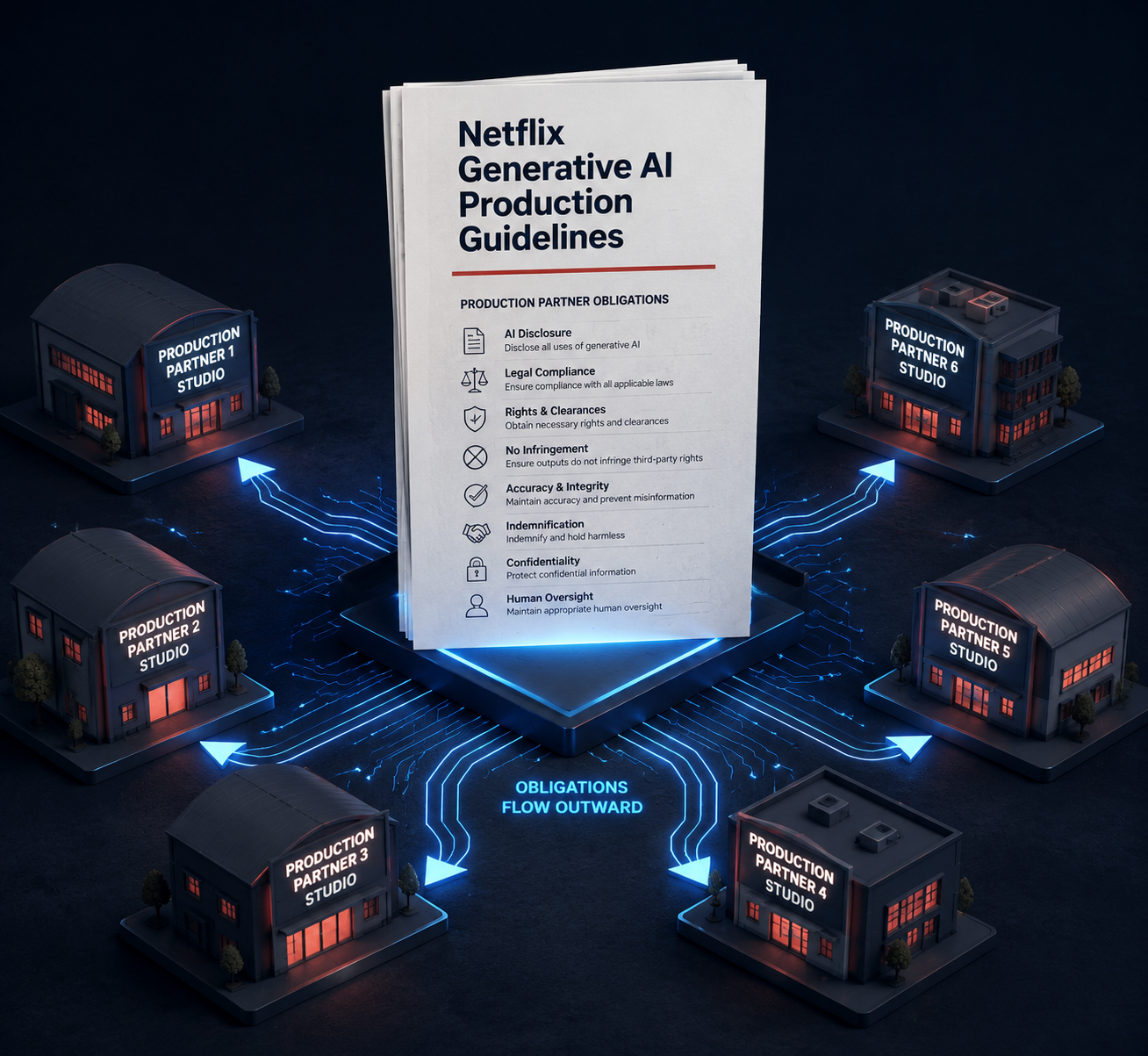
That is not a small distinction. A studio policy can be broader than a statute, faster than a union arbitration, and less forgiving than a court’s eventual fair-use analysis. The Netflix framework does not wait for those external rules to settle. It requires partners to classify the use, track inputs and outputs, obtain approvals where the matrix says approval is needed, and avoid uses that would violate third-party rights, mislead audiences, or materially affect union-represented work.[1]
The burden therefore lands where production risk often lands: on the person who has to sign off before final delivery. A clearance lawyer may have to show where the training or reference material came from. A producer may have to explain why a tool was only used for ideation rather than final imagery. A labor-relations executive may have to defend the conclusion that a use did not replace covered work. Netflix keeps the governance perimeter; the partner carries much of the evidentiary file.
The Framework Works Like a Risk Transfer System
The five principles do several different jobs at once. They require human oversight, respect for intellectual property and personal rights, transparency where disclosure or approval is needed, attention to labor impacts, and recordkeeping sufficient to support the partner’s choices.[1] None of that sounds exotic. The practical effect is sharper: Netflix is building an audit trail before a claimant, performer, guild, or regulator asks for one.
The Use Case Matrix is the more consequential part because it translates broad principles into production behavior. Low-risk uses can include internal ideation, administrative support, or temporary materials that do not become part of the final title. Higher-risk uses involve final visible or audible output, synthetic depictions of real people, copyrighted source material, or workflows that could affect covered labor.[1] The matrix does not need to use courtroom language to change legal exposure. Once a category requires written approval, a partner who skips that step has a contract problem even if the underlying statute remains unsettled.
| Netflix control | Workflow consequence | Legal significance |
|---|---|---|
| Data provenance and rights review | Partner must identify and preserve information about inputs, licenses, and generated outputs | Copyright disputes become document disputes before they become fair-use disputes |
| Written approval for higher-risk uses | Partner must escalate before using certain AI outputs in final production or around talent | Netflix creates a contractual gate broader than many external legal rules |
| Use Case Matrix risk classification | Partner must decide whether a use is low-risk, approval-required, or prohibited | Misclassification can become a delivery breach even without a final court test |
| Labor-impact limitation | Partner must assess whether AI replaces or materially impacts union-represented work | The most contested facts may sit inside guild-covered job functions |
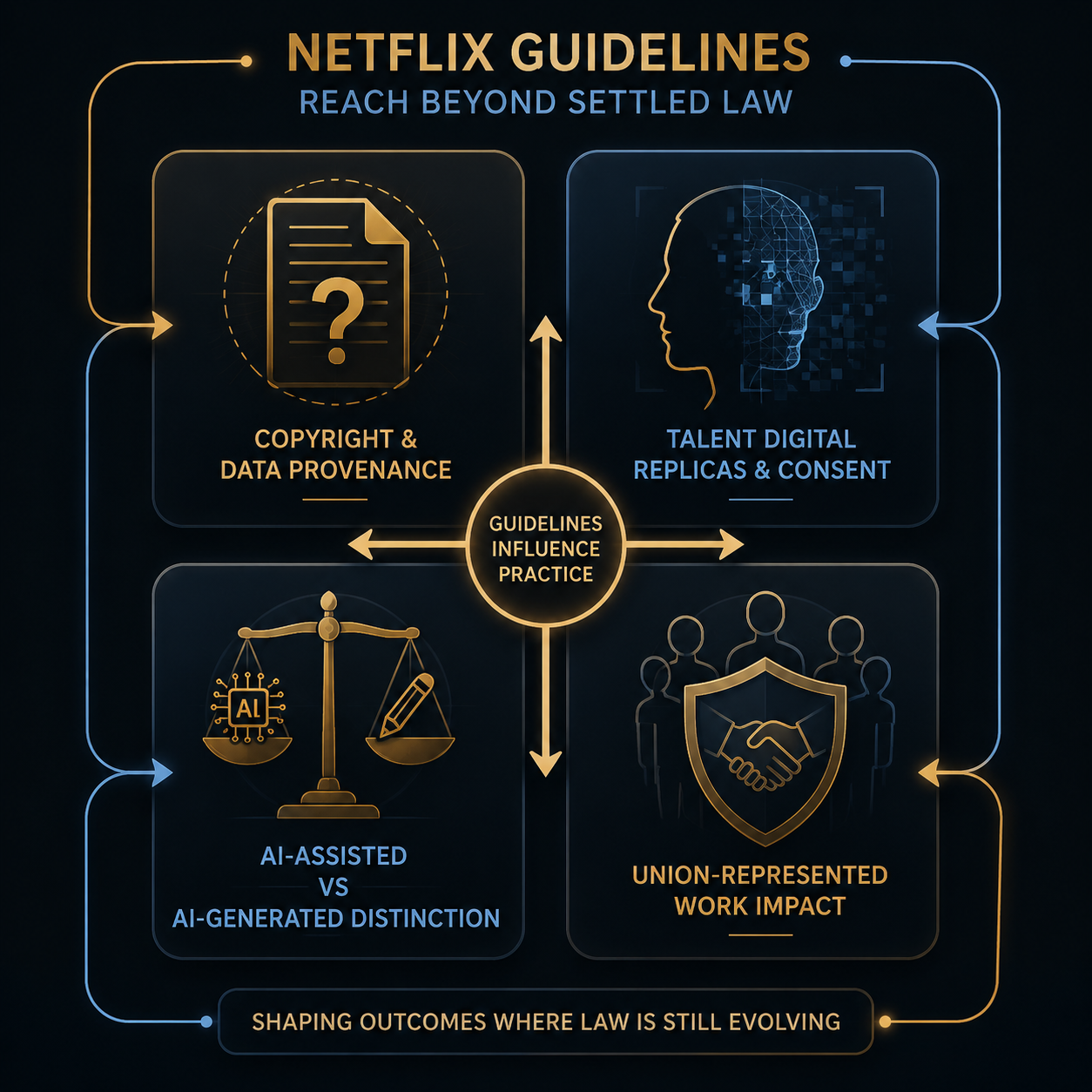
That architecture explains why the document deserves more attention than another executive quote about AI efficiency. Netflix’s rule set does not resolve whether a generated image infringes copyright, whether a performer’s altered face is a statutory digital replica, or whether a previs task belongs to a union employee. It makes the production partner decide early, document the decision, and seek permission when the matrix demands it.
Data Provenance Is the First Legal File
The most ordinary-looking requirement may be the most expensive one to satisfy: know what went into the tool and what came out. Netflix’s guidelines require partners to consider whether AI inputs and outputs are properly authorized and whether the resulting material can be used in the production.[1] That shifts copyright risk into a chain-of-title exercise, even though the law has not supplied a neat safe harbor for production companies using commercial AI systems.
A partner cannot responsibly answer that question with “the vendor said it was fine.” Vendor terms may matter, but they rarely establish the full provenance of model training data, prompts, reference images, voice samples, or generated variants. The production file has to separate several things: licensed materials supplied by the show, public-domain materials, materials copied from third parties, performer-related inputs, temporary outputs, and final deliverables. Those categories may collapse in a demo. They cannot collapse in a delivery binder.
This is where the current fair-use landscape gives counsel little comfort. By mid-2026, major AI copyright cases were pointing in different directions: Thomson Reuters v. ROSS rejected fair use on the facts before that court, while Bartz v. Anthropic and Kadrey v. Meta reached fair-use conclusions favorable to the AI defendants in their respective settings.[2] Those rulings are not interchangeable production clearances. They involve different facts, different uses, and different records. A Netflix partner using AI-generated assets in a film or series still has to decide what evidence it can produce if a claimant challenges either the input material or the output.
For readers tracking the fair-use docket in more detail, the distinction between those cases is better handled through a live case tracker such as AI copyright and fair use research tools. The point for Netflix delivery is narrower: the guidelines assume provenance will matter even when the ultimate legal test remains unsettled.
Written Approval Covers More Than Statutes Currently Do
Talent digital replicas sit in a different legal bucket from copyright. Netflix’s guidelines require written approval for certain uses involving real people, voices, likenesses, or performance-related synthetic material.[1] That approval requirement is contractual. It may overlap with right-of-publicity law, guild agreements, or performer consents, but it is not identical to any one of them.
California AB 2602, effective in 2025, addressed certain digital replica provisions in performer contracts, especially where a contract lacks a reasonably specific description of the intended use and the performer was not represented by counsel or a labor union.[2] The stalled federal NO FAKES Act would have created a broader federal right against unauthorized digital replicas, but as of Q3 2026 it had not become the stable national rule production lawyers could rely on.[2]
Netflix’s approval gate is broader in a practical sense because it can catch uses that may not fit cleanly into those statutory categories. A living performer’s face might be subtly altered for visual ADR, aging, de-aging, continuity repair, or a performance patch. The legal question may not be whether the production created a fully freestanding “digital replica.” The delivery question is whether Netflix required approval and whether the partner obtained it before the material entered the final title.
That distinction matters for contract drafting. A performer consent that only mentions “AI” in a broad release may not satisfy a platform approval process that expects the specific use to be identified. Conversely, a use might be contractually disallowed by Netflix even if outside counsel believes the statutory risk is manageable. Production counsel has to preserve both analyses rather than treating “likeness rights” as a single yes-or-no clearance.
AI-Assisted and AI-Generated Are Not Just Labels
The Use Case Matrix depends on a distinction that now appears across copyright and production governance: AI-assisted work is not treated the same as AI-generated final material.[1] The U.S. Copyright Office’s May 2025 report likewise focused on the difference between human-authored works that use AI as a tool and outputs where expressive elements are generated by the system rather than controlled by a human author.[2]
That distinction is sensible, but it is not self-executing. A mood-board prompt, a temp creature design, a clean-up pass, a synthetic background extra, and a final shot can all involve different levels of human control. The legal and contractual consequences change when the output moves from internal development into the finished work. Netflix’s matrix tries to force that moment into the open.
The hard question is evidentiary. If a partner says the work was merely AI-assisted, what proves it? Version histories, prompt logs, human edit records, vendor invoices, shot notes, and before-and-after files may become more useful than a polished explanation drafted after controversy starts. The Copyright Office can describe the authorship line in institutional terms; a production partner has to show where that line was in a particular asset.
This is also why the fair-use cases cannot be imported wholesale into Netflix production decisions. A court assessing copied legal headnotes, books used for model training, or training-related datasets is not deciding whether a series may deliver a final AI-assisted visual effect without additional approval. For a closer look at the ROSS posture specifically, see the Thomson Reuters v. ROSS case status. The Netflix question remains a delivery question first: what did the partner use, where did it appear, and which approval path applied?
The Public Incidents Explain the Rule Design
The 2024 backlash over What Jennifer Did shows why disclosure and authenticity controls could not be left to informal judgment. Viewers and journalists criticized the documentary after apparently AI-altered or AI-generated archival-style images were identified, with particular concern that the images were not disclosed as synthetic or manipulated within a true-crime documentary format.[3][4] The legal issue was not neatly captured by a single federal statute. The pressure came from authenticity expectations, documentary ethics, publicity concerns, and the risk that viewers would treat synthetic material as evidence.
That is exactly the sort of problem a partner-facing matrix can address before the law does. If an archival-style image is synthetic, the key questions are not only whether someone owns a copyright in a source photo. They are whether the image depicts a real person, whether the alteration changes factual meaning, whether disclosure is required, and who approved the use. In documentary delivery, a failure to disclose can become the controversy even when the statutory claim is uncertain.
The Eternaut sits at the other end of the spectrum. In 2025, Netflix executives and trade coverage pointed to AI-assisted visual effects in the Argentine series as an example of how the technology could reduce time and cost for complex imagery.[5][6] That use is operationally easier to understand than a fake archival photograph: a production needs a shot, a tool helps make the shot, and the audience is not being asked to treat the output as documentary evidence.
Easier does not mean risk-free. A VFX use still raises input provenance, output ownership, vendor indemnity, guild coverage, and credit questions. But The Eternaut helps explain why Netflix did not simply prohibit production AI. The business case is strongest in precisely the areas smaller productions struggle to afford: previs, VFX iteration, localization, restoration, and archival treatment. The guidelines try to preserve those efficiencies while making someone outside Netflix maintain the file.
Union Impact Is the Clause to Watch
Netflix’s requirement that AI must not replace or materially impact union-represented work is likely to become the hardest clause to administer.[1] Copyright provenance can at least be documented. Performer consent can be papered, even if imperfectly. Labor impact requires a factual comparison against work that someone might otherwise have performed under a collective bargaining agreement.
The 2023 SAG-AFTRA and WGA agreements added AI-related protections after the strikes, but the precise boundaries of those protections have not been fully tested through arbitration across the range of production uses Netflix’s matrix contemplates.[2] A tool that generates temp dialogue, cleans a performance, creates background crowd elements, drafts marketing copy, or accelerates a VFX pass may affect different bargaining units in different ways. The legal question is not “did AI appear?” It is whose covered work changed.
Ted Sarandos made the economic stakes plain in April 2025 when he told Deadline that AI could help make films “10 percent better” and compared the entire budget of Pedro Páramo to the VFX cost of The Irishman.[5] The comment is useful not because it proves a legal conclusion, but because it identifies the pressure point. If AI is being adopted to make shots cheaper, faster, or more ambitious, unions will ask whether the savings came from tools replacing bargaining-unit labor, compressing covered work, or changing staffing assumptions.
That inquiry will be production-specific. A show that uses AI to generate internal concept variations under human art-department supervision presents one record. A show that uses AI to replace a voice session, avoid a background performer call, or reduce a writing-room function presents another. Netflix’s guidelines do not supply the arbitration test. They require the partner to make and defend the labor-impact assessment before the dispute matures.
External Law Still Leaves Gaps
The broader legal environment is moving, but unevenly. The TAKE IT DOWN Act, enacted in May 2025, targets nonconsensual intimate imagery, including AI-generated intimate imagery, and creates takedown obligations for covered platforms.[2] That is important law, but it does not answer most production-delivery questions about synthetic archival images, de-aging, VFX elements, or licensed AI tools.
California’s AB 2602 is more directly relevant to performer contracts, but it still does not cover every living-performer manipulation a production might attempt.[2] A federal digital-replica regime could eventually narrow the variance across states, but the NO FAKES Act remained stalled as of Q3 2026.[2] International productions add another layer because a Netflix title may be made under local law, cleared under U.S.-style delivery expectations, and distributed globally. Comparative developments, including non-U.S. copyright approaches, belong in a separate analysis such as Australia’s AI copyright protections for creatives, not inside a single Netflix approval form.
The mismatch between policy and law is not a defect in Netflix’s framework. It is the reason the framework exists. Courts, legislatures, unions, and agencies are moving at different speeds. A platform with a global release schedule cannot wait for a uniform answer before deciding what it will accept from partners.
What Production Partners Should Treat as the Real Deliverable
The deliverable is no longer only the finished file. For AI-assisted production, the deliverable is also the record that explains the file. That record should show what tool was used, what materials were supplied, what rights covered those materials, whether any real person’s likeness or voice was implicated, whether the use entered final picture or sound, whether Netflix approval was required, and how labor impact was assessed.
The same record should preserve negative answers. If AI was used only for internal brainstorming, say so and keep support for that classification. If a generated output was discarded, note that it did not enter the final work. If a vendor provided warranties, keep them, but do not mistake them for the full provenance file. If a performer consent covered a specific synthetic use, tie that consent to the shot, scene, or audio element it authorized.
Netflix has not solved the legal uncertainty around AI production. It has done something more immediate: it has made production partners responsible for documenting, approving, and defending AI choices before courts, unions, and lawmakers have supplied stable tests. That may become the working model for streaming production because it is administrable. It is also why the people signing delivery representations should treat the guidelines as contract architecture, not platform advice.
References
- Generative AI Guidelines — Netflix Partner Help Center, August 2025.
- AI Update: New California and Federal Laws, U.S. Copyright Office Report, and Recent Fair Use Rulings — Greenberg Glusker, November 2025.
- What Jennifer Did AI images coverage — Mashable, 2024.
- What Jennifer Did AI images coverage — The Independent, 2024.
- Netflix’s Ted Sarandos Talks AI, The Eternaut, Pedro Páramo and The Irishman VFX Costs — Deadline, April 2025.
- Netflix rolls out generative AI production guidelines — Screen Daily, 2025.
Comments
Join the discussion with an anonymous comment.