
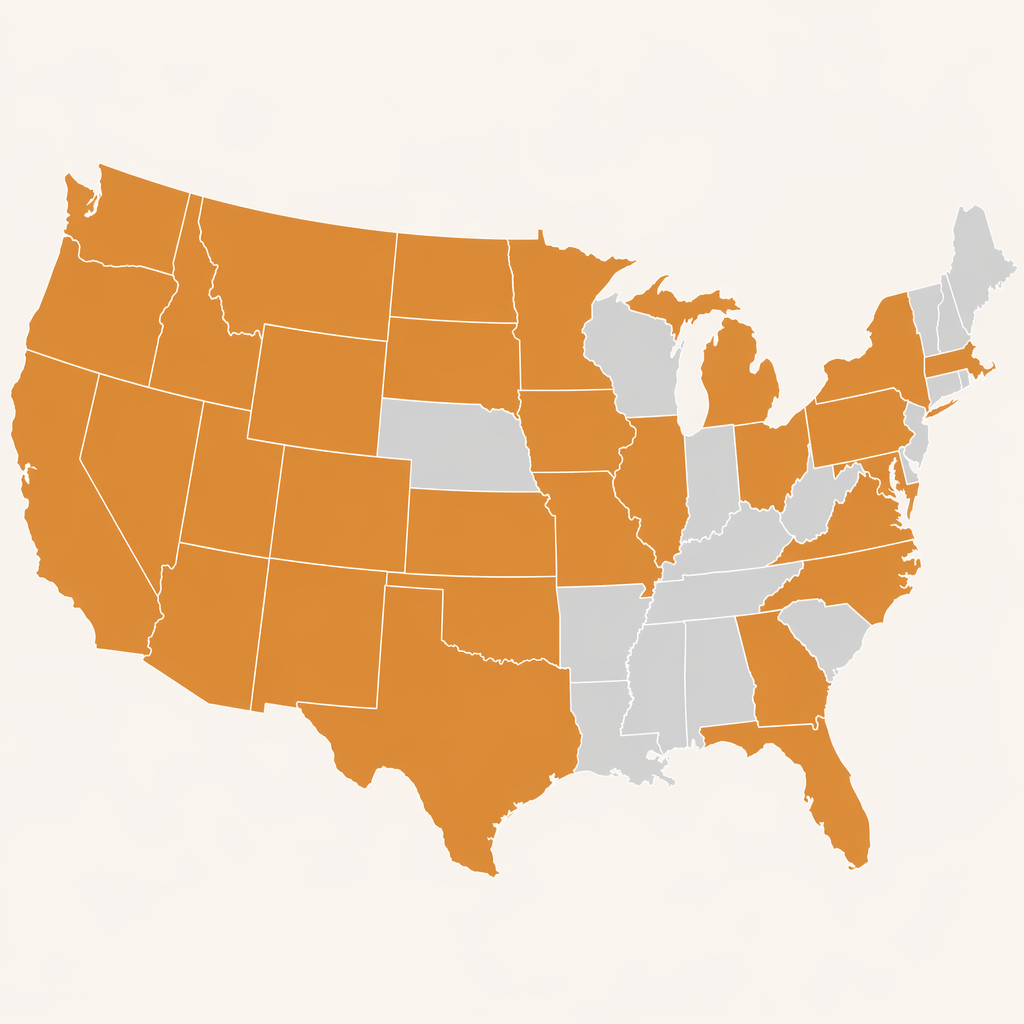
The practical implication of the Trump AI Action Plan for law firms in 2026 is not simplification. It is a two-track file: federal policy is pushing toward deregulation and preemption, while state law is producing live obligations that still have to be read, scoped, and staffed. In the first half of 2026, 29 states enacted 109 AI laws, according to the NYU Center on Technology Policy and the Transparency Coalition AI tracker, with the usual caveat that counts depend on how broadly a tracker defines an “AI law.”[1]

That number is the part that changes the risk conversation. A partner can read the July 2025 AI Action Plan and see a federal government trying to clear regulatory obstacles for AI development. A conflicts lawyer or client intake team has to ask a less elegant question: which state law applies to this product, this employer, this consumer interaction, this model provider, or this health insurer workflow today?
The Action Plan matters. So do the December 2025 executive order targeting state AI laws, the March 2026 National Policy Framework, and the June 2026 executive order on frontier model security and federal AI use.[2][3][4][5] But none of those materials, standing alone, gives a law firm a safe basis to tell a national client that state AI compliance can wait.
Federal Direction Is Not the Same Thing as Displacement
The July 2025 Action Plan put federal policy behind AI development, reduced regulatory friction, accelerated infrastructure, export competitiveness, and pressure against state rules viewed as burdensome or inconsistent.[2][6][7] For companies looking for a federal deregulatory signal, it supplied one.
A legal advice memo has to do more work. The Action Plan was policy direction, not a blanket statutory preemption provision. Its references to limiting state interference also sat beside language acknowledging room for “prudent laws,” a phrase that left states with room to characterize their measures as child safety, consumer protection, health, fraud prevention, pricing transparency, or other traditional police-power regulation.[2][3][7]
That distinction is not academic. It determines whether a lawyer treats a state requirement as an operational obligation or as a footnote in a federal policy trend. Unless a statute is invalidated, enjoined, preempted by binding federal law, or otherwise made unenforceable, the client still needs an answer for it.
The common mistake is to let the federal signal do the work of a legal conclusion. “The administration wants uniformity” is a useful sentence in a board update. It is not a substitute for determining whether a hiring tool, chatbot, pricing model, insurance review system, or frontier model deployment triggers a specific state-law duty.
The State-Law Workload Is No Longer a Loose Patchwork Complaint
For years, “patchwork” was an easy word to overuse. In 2026, the workload is more concrete. The mid-year state AI legislation review reported 109 enacted AI laws across 29 states in the first half of the year; a related Transparency Coalition count cited by TechPolicy.Press described 84 AI-related laws across 27 states, covering areas such as companion chatbots, health insurer AI use, dynamic pricing, and data center regulation.[1]
Those categories do not create one clean compliance program. They create different trigger questions. A companion chatbot statute may turn on user vulnerability, disclosures, therapeutic simulation, or minor access. A health insurer rule may focus on claims review or utilization management. A pricing law may care about individualized data, consumer notice, or prohibited discrimination. A data center law may sit closer to energy, infrastructure, and permitting than to model governance.
Colorado’s AI Act, effective in January 2026, belongs in the same practical category: not because every client will be covered, but because a national review can no longer assume that state AI duties are future-tense or merely thematic.
That is why the first law-firm task is classification, not prediction. Before anyone argues about whether a state law will survive a federal challenge, someone has to identify whether the client is a deployer, developer, employer, insurer, platform, vendor, or regulated entity under the law at issue. Federal policy cannot answer that threshold question.
Internal governance articles often discuss AI ethics and firm policy at a high level, and that work has value; the parallel ethics layer is a separate problem from state-law scoping. For that broader governance dimension, see The AI Ethics Stack Every Lawyer Needs in 2026. The present problem is narrower and less forgiving: which enforceable rule applies to which client conduct this quarter?
Illinois Shows Why the State Trend Cannot Be Treated as Symbolic
Illinois SB 315 is the kind of development that changes a matter plan. Signed in July 2026, it made Illinois the first U.S. state to mandate third-party audits for frontier AI developers, and Latham & Watkins described it as setting a regulatory floor beyond California’s and New York’s 2025 frontier AI frameworks.[8]
A third-party audit mandate is not a policy mood. It raises vendor selection questions, evidence-preservation questions, privilege questions, contracting questions, timing questions, and board-reporting questions. If a client’s product roadmap touches Illinois and the statute applies, the firm cannot dispose of the issue by saying Washington prefers a lighter approach.
The audit example also illustrates why national launch advice becomes difficult. A firm may be asked whether one control environment can satisfy several state regimes. Sometimes the answer may be yes as a practical matter. But the analysis still has to begin with the strictest applicable obligation, the client’s role in the AI supply chain, and the documents the client can produce if a regulator, insurer, investor, or customer asks how the company reached its compliance position.
The same pattern appears in narrower fields. Election-related AI laws, credit scoring rules, and insurance AI measures do not always announce themselves as general AI governance laws. They arrive as domain-specific obligations. That is why multi-jurisdictional analysis increasingly looks like the work described in AI Election Laws Create a Compliance Maze for Primary Polling in 2026 and Three Regulatory Regimes for Samsung Galaxy Card AI Credit Scoring: the legal category matters as much as the technology label.
The AI Litigation Task Force Creates Uncertainty, Not a Compliance Holiday
The December 2025 executive order is important because it moved beyond rhetoric. It created an AI Litigation Task Force to challenge state AI laws and seek more uniform federal standards.[4] That development belongs in every serious 2026 preemption analysis.
It still does not answer the operational question. As of July 22, 2026, the research materials identify no major preemption lawsuit that has resolved the field. The Task Force therefore changes how advice should be caveated, not whether existing state laws can be ignored.
For a law-firm general counsel reviewing a client alert, that distinction should affect the verbs. “Will preempt” is too strong unless the legal basis is specific and binding. “May be challenged,” “could affect enforcement,” or “creates preemption uncertainty” may be more accurate, depending on the statute and the federal instrument being discussed. The point is not to make every sentence timid. It is to avoid converting litigation intent into legal outcome.
Executives may hear the Task Force as permission to wait. Lawyers should hear it as a reason to document assumptions. If a client chooses to defer a control, audit, disclosure, or vendor review because it believes a state law is vulnerable, that position should be tied to a stated legal theory, a monitoring plan, and a trigger for reconsideration. Silence is the weak version of risk tolerance.
Why “Prudent Laws” Became the Hinge
The Action Plan’s allowance for “prudent laws” matters because it gave states a drafting lane. Latham’s analysis of the December 2025 executive order noted that federal preemption pressure may have shifted state-law substance toward categories such as child safety and consumer protection, rather than reducing the volume of legislation.[4]
That is a familiar compliance result. When a federal policy attacks broad AI regulation, states do not necessarily stop regulating. They may narrow the stated purpose, attach the rule to a traditional consumer-protection frame, or regulate a high-salience use case rather than the model in the abstract. The legal fight then moves from “AI regulation” to the more difficult question of whether a particular state measure obstructs federal objectives or falls within preserved state authority.
Law firms should be careful with source quality here. Vendor disclosures, trade association summaries, law-firm alerts, academic trackers, and agency statements do different jobs. A state-law count helps size the workload. A client alert helps identify likely issues. Neither is a judicial holding. A policy framework signals direction. It does not, by itself, repeal a state statute.
How the Analysis Changes on a Real Client File
A national AI product review in Q3 2026 should not start with the Action Plan and end with a conclusion about deregulation. It should put federal policy, state enactments, and litigation uncertainty side by side, because each answers a different question.
| Question | What It Determines | Why It Matters in 2026 |
|---|---|---|
| What federal policy says | The administration’s enforcement posture, litigation priorities, and preferred national framework | It may shape agency behavior, federal procurement, and preemption arguments |
| What state law requires | The client’s current duties by jurisdiction, role, sector, and use case | These obligations may be enforceable now unless displaced or enjoined |
| What litigation has resolved | Whether a specific state rule has been narrowed, blocked, upheld, or preempted | The AI Litigation Task Force creates uncertainty, but unresolved uncertainty is not the same as relief |
| What the client can document | The factual and legal basis for the compliance position | Documentation matters if regulators, counterparties, insurers, or courts later ask what the company knew |
This is not a checklist for compliance advice. It is a way to keep categories from collapsing into one another. Federal deregulatory policy belongs in the file. State-law triggers belong in the file. Preemption uncertainty belongs in the file. They should not be merged into one reassuring sentence.
The same discipline applies inside the firm. If a practice group wants to deploy or advise on AI tools, firm governance should connect technology approval, privacy review, vendor diligence, professional responsibility, and incident response. The governance issues discussed in Law Firm AI Governance After the OpenAI–Hugging Face Breach sit beside, rather than replace, the state-law compliance analysis.
The June 2026 Order Adds Another Federal Layer
The June 2026 executive order added federal attention to frontier model security, early government access, and AI-enabled cyber defense.[5] Because it is recent, its implementation consequences are still developing. For now, it reinforces the point that federal AI policy is becoming more active, not that state law has become irrelevant.
A firm advising an AI developer may need to track federal security expectations and state audit or disclosure duties at the same time. A firm advising a regulated buyer may need to ask whether federal procurement or cybersecurity expectations affect vendor selection, even while state consumer or employment laws control a separate part of the deployment. The hard part is not finding enough law to cite. The hard part is keeping the obligations separated long enough to give usable advice.
What Law Firms Can Safely Say in Q3 2026
A careful client-facing position can say that the Trump administration is pursuing a more permissive national AI policy and has signaled hostility toward certain state AI laws. It can say that preemption challenges may alter the compliance landscape. It can say that the Action Plan, the December 2025 executive order, the March 2026 framework, and the June 2026 order should be monitored together.
It should not say that the Action Plan has simplified law-firm compliance across the United States. The available materials support a narrower and more useful conclusion: federal policy may shape future litigation, agency posture, and national standards, while state AI laws remain numerous, active, and immediately relevant to cross-border legal work.
For law firms, the safer operating model is a documented hybrid analysis. Separate policy signals from enforceable duties. Identify state-specific triggers. Flag preemption uncertainty without overstating it. Record the assumptions behind any decision to comply, defer, narrow, or challenge. Update the file when litigation, executive implementation, or state amendments change the answer.
That is less tidy than a deregulation headline. It is also closer to the work lawyers have to sign off on today.
References
- Where State AI Legislation Stands Half Way Into 2026 — TechPolicy.Press / NYU Center on Technology Policy
- White House Releases AI Action Plan: Key Legal and Strategic Takeaways for Industry — Skadden, July 2025
- President Trump AI Action Plan Key Insights — Latham & Watkins, July 2025
- AI Executive Order Targets State Laws and Seeks Uniform Federal Standards — Latham & Watkins, December 2025
- New AI Executive Order Calls for Frontier Model Security, Early Government Access and AI-Enabled Cyber Defense — Skadden, June 2026
- America's AI Action Plan: Key Legal Takeaways for Businesses and Stakeholders — Taft Law, July 2025
- A Call to Action: President Trump's Policy Blueprint for AI Development and Innovation — MoFo, July 2025
- Illinois Joins Growing State-Level Effort to Regulate Frontier AI With New Safety Measures Act — Latham & Watkins, July 2026
Comments
Join the discussion with an anonymous comment.