
After Fetterman, the Filibuster Remains a Regulatory Barrier
- Authority
- U.S. Senate
- Rule type
- standing order
- Jurisdiction scope
- US federal
- Source text
- Read primary rule text ↗
Requires 60 votes to invoke cloture on most legislation.
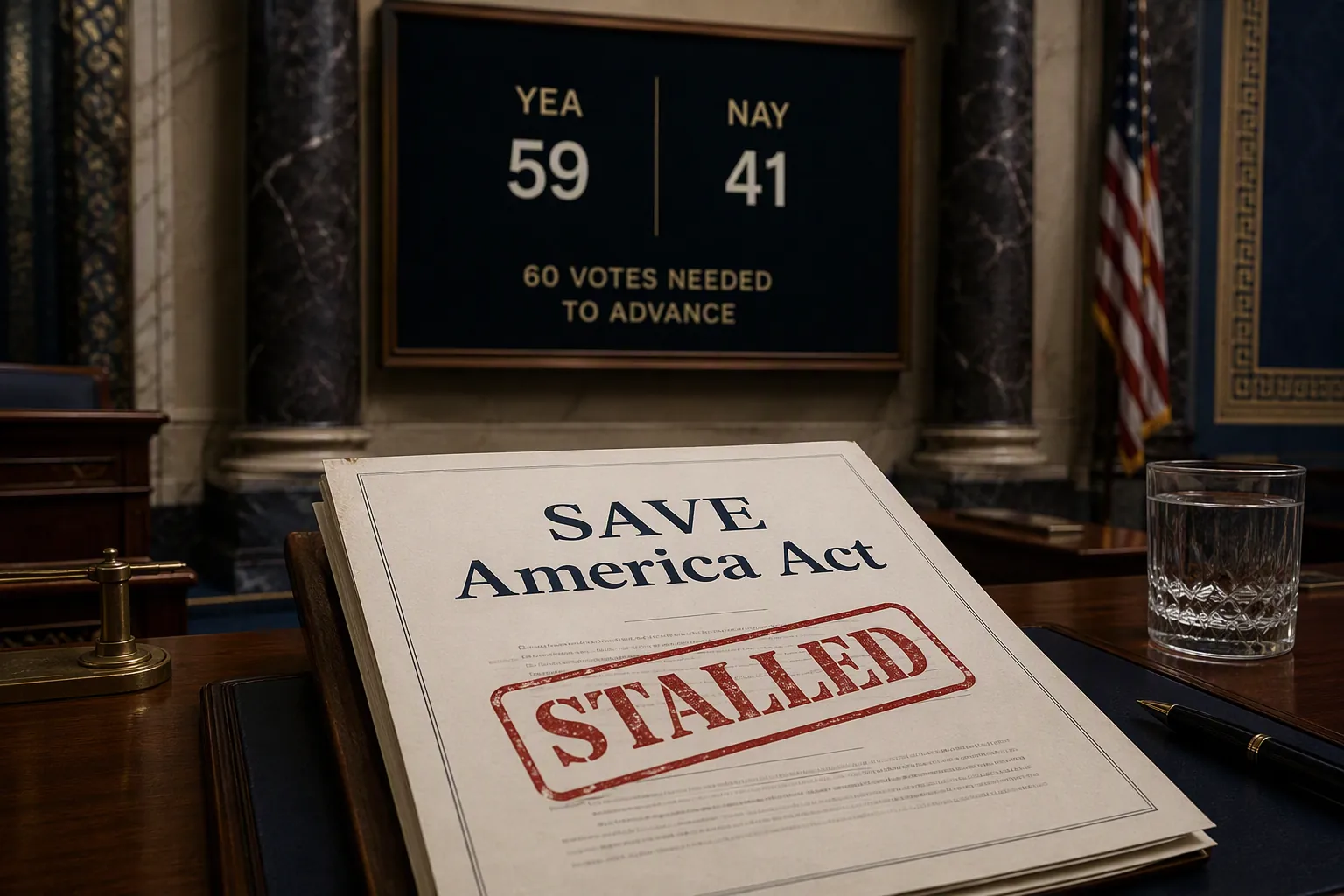
As of July 29, 2026, Senator John Fetterman’s filibuster defense after his flip does not make major federal regulatory legislation easier to pass. It does the opposite for near-term forecasting: it confirms that the 60-vote Senate threshold remains the operative barrier for bills that would otherwise move through a simple partisan majority. The live example is the SAVE America Act, which Fetterman named as a bill he opposes and said would become law if the filibuster disappeared.[1]
That matters because the SAVE America Act is not just election-law theater. The bill would require documentary proof of citizenship for voter registration and photo identification at the polls, and President Trump has been pressing Senate Republicans to “terminate” the filibuster so it can advance.[2] If the filibuster holds against that pressure campaign, it remains the same procedural choke point for other high-stakes federal fights: abortion restrictions, administrative deregulation, AI legislation, and any other bill that can pass the House but cannot assemble 60 senators.

The SAVE America Act Is the Useful Test Case
For legal and compliance teams, the question is not whether Fetterman’s position is ideologically tidy. The question is whether his position changes the probability that a stalled bill becomes law. On the present facts, it does not increase that probability. Fetterman has moved from supporting abolition to defending the rule, and he has done so while pointing to a live bill that Republicans want and Democrats largely oppose.[1]
The Senate’s cloture rule is the mechanism doing the work. Senate Rule XXII generally requires three-fifths of senators duly chosen and sworn to invoke cloture on most legislation, which means 60 votes when the Senate has its full 100 members.[3] A House-passed bill with majority support in the Senate can still sit short of enactment if it cannot clear that threshold.
That is the SAVE America Act’s significance for regulatory forecasting. It turns an abstract procedural debate into an operating assumption: a bill with direct compliance consequences can be blocked not because no party wants it, and not because courts have already ruled on it, but because Senate procedure forces the majority to find additional votes or change the rule.
Readers who want the vote-count modeling around Fetterman’s reversal can compare the companion analysis, Fetterman’s Filibuster Reversal Reshapes the Legal Risk Calculus. This analysis uses the SAVE America Act for a narrower purpose: to identify what compliance professionals should assume when a majority-backed bill remains below the Senate’s effective enactment threshold.
What Changed After Fetterman
Fetterman’s timeline is short enough to state without turning it into a profile. His 2022 campaign position supported eliminating the filibuster. On June 2, 2026, he said on The Katie Miller Podcast that he had been “absolutely wrong” and that Democrats were “horribly wrong” to seek abolition. On July 27, 2026, he elaborated in an op-ed defending the filibuster and identifying the SAVE America Act as one of the bills the rule is blocking.[1][4]
The practical effect is modest but real. One Democratic senator who once belonged in a potential abolition column no longer belongs there. More importantly, he has made that position harder to treat as temporary messaging by tying it to a concrete legislative consequence he supports: keeping a Republican election bill from becoming law.
That is why the word “flip” can mislead if it is treated as the main event. The main event is not personal inconsistency. It is coalition math. A senator who once might have helped change the rule is now publicly defending the rule at the very moment a president from the other party is urging Republicans to abandon it.
The Binding Constraint Is Political, Not Procedural
Nothing about the filibuster is legally immune from Senate action. Article I gives each chamber power to determine its rules, and modern Senate precedent already includes rule-changing maneuvers for nominations. The harder question is not whether a determined majority can force a precedent change. It is whether enough senators are willing to vote for one.
On that point, the most useful current fact is not Trump’s demand. It is Senate Majority Leader John Thune’s reported whip-count snapshot. According to The Hill, Trump administration officials met with roughly 20 GOP senators about ending the filibuster, and Thune said 15 of those senators opposed doing so.[2]
That is the number compliance teams should care about. The nuclear option is available as a procedural pathway, but it still requires senators to take responsibility for using it. If most of the senators needed for that move are saying no, the practical barrier remains in place even though the theoretical tool exists.
| Question for risk forecasting | Current answer as of July 29, 2026 |
|---|---|
| Can the Senate change filibuster practice by precedent? | Yes, recent nomination precedents show the chamber can alter practice through majority-backed procedural moves. |
| Is there current evidence of enough support to do that for legislation? | No. Thune’s reported 15-of-20 GOP opposition count points the other way. |
| Does Fetterman’s reversal increase abolition odds? | No. It removes one senator from a future abolition coalition. |
| Does the filibuster make enactment impossible? | No. It makes enactment contingent on 60 votes, a successful workaround, or a rule-changing vote. |
The Choke Point Is Real, Even If the Institution Is Contested
The filibuster’s effect on legislation is not imaginary. The Brennan Center, arguing against the modern filibuster, reported that the 110th Senate from 2007 to 2009 passed 2.8% of bills introduced, a 66% decrease from 2005–2006 and a 90% decrease from 1955–1956.[5] Those figures do not prove that every stalled bill failed because of the filibuster, but they do describe a chamber where the path from introduction to enactment narrowed sharply.
Compliance readers should not convert that data into a moral conclusion by itself. The filibuster also has institutional defenders. Yuval Levin, writing for AEI, argues that the filibuster protects the Senate from becoming a smaller version of the House and forces broader agreement before durable national policy is imposed.[6] That defense is not a compliance forecast either, but it explains why senators who would benefit from passing today’s bill may still hesitate to destroy tomorrow’s blocking tool.
For in-house counsel, both accounts lead to the same operational point. Whether viewed as obstruction or institutional design, the filibuster makes many federal statutory changes less likely in the near term unless the proposing coalition can reach 60 votes or find a valid bypass.
Why the Nuclear Option Does Not Solve the Forecasting Problem
The nuclear option is the reason no responsible analysis should call the filibuster legally fixed. The term is commonly traced to Senator Trent Lott in 2003. Senate Democrats under Harry Reid used a majority-backed rules maneuver in 2013 for lower-court and executive nominations, and Senate Republicans under Mitch McConnell extended the approach to Supreme Court nominations in 2017. No Labels also describes Thune’s 2025 en bloc proposal in the same family of procedural escalation.[7]
Those precedents matter because they show the Senate has already changed the consequences of obstruction in high-value categories. They do not show that the same coalition exists for ordinary legislation. Nominations and legislation carry different political incentives: nominations confirm personnel; legislation rewrites obligations for regulated actors, voters, employers, agencies, states, and courts.
That distinction is the center of the legal analysis. The filibuster is vulnerable to Senate choice, not to an obvious missing procedural lever. If the votes to change the rule appear, the barrier can fall quickly. If they do not, the rule continues to shape the risk calendar even while commentators argue about its legitimacy.
The constitutional literature reinforces that contingency rather than eliminating it. Catherine Fisk and Erwin Chemerinsky’s Duke Law article examines the filibuster in relation to the Senate’s rulemaking authority and constitutional structure.[8] The compliance takeaway is narrower than the academic debate: the filibuster’s durability depends less on judicial finality than on whether current and future Senate majorities choose to preserve or override it.
Workarounds Still Need Their Own Legal Analysis
A blocked bill does not disappear from a risk register simply because it lacks 60 votes. Sponsors can try to attach provisions to must-pass legislation, rewrite the measure, pressure Senate officers, pursue budget reconciliation, or wait for a more favorable Congress. Each route has its own constraint.
For the SAVE America Act, the reconciliation route raises its own Byrd Rule problem. The separate analysis of why the Byrd Rule blocks Thune’s SAVE Act reconciliation strategy addresses that bypass question directly. The point here is simpler: a workaround is not the same thing as enactment risk becoming high.
Substantive vulnerability also remains separate from procedural blockage. The site’s analysis of the SAVE Act’s proof-of-citizenship requirement evaluates the constitutional risk if the bill were enacted. That inquiry matters, but it comes after a different threshold question: can the bill get through the Senate at all?
The same separation applies to pressure campaigns around Senate procedure. A president can pressure senators, party leaders, and parliamentary actors. Those efforts belong in the forecast, but they do not become law unless they change votes or recognized procedure. For the adjacent procedural-risk issue, see the analysis of constitutional risks in Trump’s parliamentarian pressure.
Near-Term Compliance Posture
For board memos, procurement risk notes, client alerts, and compliance calendars, the current assumption should be bounded rather than dramatic: major legislation that cannot reach 60 votes remains unlikely to clear the current Senate absent a successful nuclear-option move or another valid procedural bypass.
- Treat the filibuster as an active barrier for ordinary legislation, not as a background civics issue.
- Separate enactment probability from substantive legal exposure; a constitutionally vulnerable bill may still matter if its procedural path improves.
- Track whip-count evidence more heavily than presidential demands, because senators must supply the votes for a rule-changing move.
- Flag reconciliation, attachments to must-pass bills, and nuclear-option pressure as separate pathways, each requiring its own probability assessment.
- Avoid treating Fetterman’s reversal as a general prediction about future Senates; it is evidence about the current abolition coalition.
The SAVE America Act illustrates the present operating rule. A bill can be politically urgent, House-passed, presidentially endorsed, and still remain stalled because the Senate majority lacks either 60 votes or the will to change the rule. Fetterman’s defense after his flip makes that barrier more credible for near-term legal forecasting, not permanent. Its stability lasts only so long as enough senators continue to value the filibuster more than the bills it prevents them from enacting.
References
- Why I Changed My Mind About the Filibuster, The Washington Post, July 27, 2026.
- Trump urges GOP to ‘terminate’ filibuster to pass SAVE Act, The Hill.
- About Filibusters and Cloture, United States Senate.
- Pennsylvania Sen. John Fetterman flip-flops on eliminating Senate filibuster, USA Today.
- The Case Against the Filibuster, Brennan Center for Justice.
- The Filibuster Saves the Senate from Itself, American Enterprise Institute.
- The Nuclear Option Explained: From Reid to McConnell to Thune, No Labels.
- The Filibuster, Duke Law Faculty Scholarship.
Operationalizing workflow
No workflow has been explicitly linked to this obligation yet. See Workflows generally.
Illustrative cases
No illustrative case is currently tracked for this obligation. See Risk Digest for documented incidents generally.
← Back to RegulationReport a correction or tip
Spotted an outdated figure, a misstated fact, or a ruling this regulation entry should reflect? Public comments are disabled for this content given the professional cost of a misreported case outcome, penalty amount, or rule text — use the structured correction channel instead.
Report a correction or tip for this record →