
COVID Origins Dispute Behind Fauci's Fifth Amendment Fight
- Authority
- U.S. Congress
- Rule type
- statute
- Jurisdiction scope
- US federal
- Source text
- Read primary rule text ↗
Sets the immunity procedure that may compel testimony after a Fifth Amendment claim.
Regulation & Ethics record. Last verified: August 2, 2026, 00:00 UTC. Legal-background review: Regulation & Ethics desk review; no individualized legal advice. Source map: ODNI’s June 2023 declassified origins assessment, WHO’s 2025 advisory-group position, the CIA’s January 2025 low-confidence assessment, the House Select Subcommittee’s December 2024 final report, Sen. Rand Paul’s diary package, and the relevant congressional hearing records.
The Fauci Fifth Amendment fight and the COVID-origins record need to be read on different tracks. The legal fight is about testimony risk, privilege, pardon scope, possible contempt, and what Congress may infer from a witness refusing to answer. The origins record is about a separate evidentiary question: whether SARS-CoV-2 most likely emerged through natural spillover or a lab-associated incident. Those tracks touch each other politically. They do not merge legally or scientifically just because the same hearing used the words “lab leak,” “gain of function,” and “Fifth Amendment.”

The official origins record is split, not settled
The cleanest starting point is not the diary release or the Fifth Amendment invocation count. It is the ledger of institutional conclusions. On that ledger, no single public record converts the origins question into a settled finding.
| Record | What it says | What it does not do |
|---|---|---|
| ODNI declassified report, June 2023 | The National Intelligence Council and four intelligence-community elements assessed that initial human infection was most likely caused by natural exposure to an infected animal or close progenitor virus, while the Department of Energy and FBI assessed a laboratory-associated incident as most likely. [1] | It did not present a unified intelligence-community conclusion. |
| CIA assessment, January 2025 | The CIA later moved to a lab-leak assessment, but that assessment was described as low confidence. | A low-confidence assessment is still an assessment; it is not the same thing as a proved finding. |
| WHO advisory-group position, 2025 | WHO’s 2025 advisory-group position called natural spillover the best-supported hypothesis while still treating the question as inconclusive because China had not provided needed information. | That position does not rule out a lab-associated incident. |
| House Select Subcommittee final report, December 2024 | The House GOP-led final report favored a lab-leak conclusion in its after-action review of the pandemic. [2] | AP separately characterized the report as not finding evidence linking Fauci to wrongdoing. |
The ODNI report is useful because it refuses the shortcut that later argument often takes. It separated agencies by assessment rather than forcing a synthetic consensus. The same declassified report also treated the Wuhan Institute of Virology question as a potential link to be assessed, not as a courtroom-style fact already found beyond dispute. That distinction matters because a later legal argument can borrow the institutional weight of “intelligence” while leaving behind the report’s actual split language.
The House report belongs in the ledger too. It is a congressional document, not an intelligence-community estimate or a WHO scientific advisory conclusion. Its judgment that a lab leak was most likely is real and politically consequential. It also sits in a different evidentiary category from a finding that a named witness committed misconduct. Treating those as the same conclusion is where many summaries become unreliable.
That is the practical answer behind the Fauci Fifth Amendment fight: the origins record is not a single official finding that Fauci then refused to admit. It is a contested official record, with agencies and institutions assigning different weight to natural-spillover and lab-associated explanations.
Why the diary package mattered
The diary release mattered because it gave critics something more concrete than a reconstructed email chain or a press-conference clip. Sen. Paul’s posted package is identified as “Tony’s Diary Package,” and the main diary release has been described as 1,141 pages covering December 2019 through December 2022, with some outlets using the less exact description “more than 1,100.” [3]
The release was also procedurally messy in ways that reasonably attract attention. News accounts described the files as posted, taken down on a Monday evening, and reposted with redactions. They also reported HHS Secretary Robert F. Kennedy Jr.’s claim that the files came from 11 government servers over eight months. Those claims should be treated as claims about provenance and publication history, not silently converted into proof of what the diary entries mean.
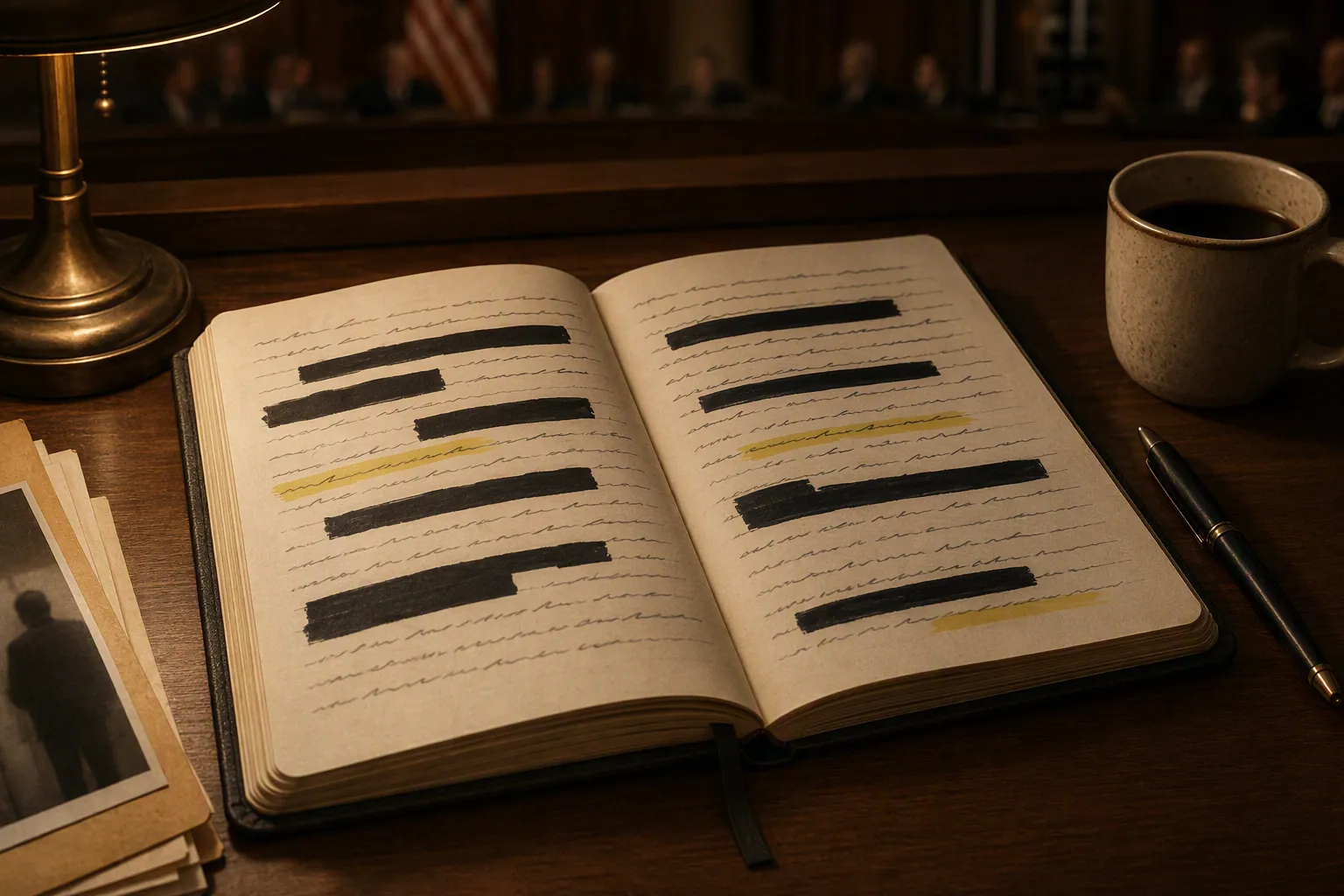
The January 26, 2020 entry is the one that does the most work in public argument. Critics have focused on Fauci’s note: “Now we know the market was not the source, it was the amplifier.” [3] Read literally, the entry is important. It records a contemporaneous view that the Wuhan market may not have been the original source. It does not, by itself, identify the laboratory as the source, establish concealment, or resolve the later split among intelligence and scientific bodies.
The February 1, 2020 scientist call is similarly significant but limited. The diary package places Fauci inside early discussions when scientists were examining unusual features and possible origins. [3] That helps explain why congressional investigators wanted his testimony and why critics read the entries as more than ordinary scheduling notes. It still leaves the interpretive step exposed: a record that scientists discussed a possibility is not the same as a finding that the possibility was true, and it is not the same as proof that a public official later lied about it.
The diary package also contains later entries that news accounts described as expressing near-certainty of natural origin while keeping an open mind. Fauci’s representative told news outlets that the diary entries were consistent with his contemporaneous public statements. That response does not end the dispute. It does identify the dispute correctly: readers are being asked to decide what inferences can fairly be drawn from private notes across time, not to accept that the January 26 sentence alone decided the origin of the pandemic.
The hearing used the diary entries; it did not make them an origins finding
The relevant hearing record places the diary package into a testimony dispute. Fauci appeared before Congress in prior pandemic-related proceedings, including the June 3, 2024 House hearing, and the July 2026 Senate proceeding then became the setting for the Fifth Amendment confrontation. [4][5]
Even the counting of refusals is not uniform across press accounts. The Hill reported 111 Fifth Amendment invocations; AP, CNN, Al Jazeera, and BMJ used “more than 100”; and Reuters reported 15 declined Paul-specific questions. Those figures are not necessarily contradictory; they may be counting different universes of questions. But they should not be flattened into a single number without saying whose count is being used.
That same care applies to legal meaning. Invoking the Fifth Amendment is not an admission that the lab-leak theory is true. It is also not a declaration that the witness has committed the specific wrongdoing being suggested in a question. In this setting, the more modest and more accurate statement is that Fauci’s refusal to answer created a separate legal and political controversy over testimony risk, congressional compulsion, and possible inferences.
The pardon layer belongs in that legal track. The adjacent legal record includes a DOJ pardon document, the Supreme Court’s decision in Brown v. Walker, and the congressional immunity statute, 18 U.S.C. § 6005. [6][7][8] Those sources are relevant to whether a pardoned or immunized witness may still claim a privilege against self-incrimination, and under what remaining risks. They do not answer whether SARS-CoV-2 originated in nature or in a laboratory.
For the legal mechanics, the site’s separate records on whether Fauci can plead the Fifth despite a presidential pardon, the Fauci contempt vote and legal exposure, and the perjury-trap theory after pardon are the better place to do the Fifth Amendment work. This record is narrower: it keeps that legal layer from being mistaken for an origins determination.
Funding, gain-of-function, and Morens are context, not a shortcut
The funding record is part of the surrounding oversight environment. NIH grants to EcoHealth Alliance, disputes over what did or did not meet the operative definition of gain-of-function research, and the later policy fight over federal funding rules all explain why congressional investigators treated the origins question as inseparable from oversight of research-risk governance.
But those subjects still require category discipline. “NIH funded EcoHealth” is not the same proposition as “NIH funded the origin event.” “Gain of function” is not a single self-executing legal label unless the speaker specifies the definition being used. A dispute over whether an experiment fit an agency definition does not, without more, establish that the pandemic began from that experiment.
The surrounding record also places former Fauci adviser David Morens in the legal environment, noting that Morens was charged in April 2026 while Fauci was not. That is a real distinction. A charge against an adviser may be relevant to oversight questions about communications, records, or agency culture. It is not a charge against Fauci unless prosecutors make it one, and the available record does not say they did.
The Trump administration’s July 28, 2026 gain-of-function funding policy is likewise best read as a governance response to a contested risk domain. It may reflect a policy judgment that the prior research-oversight system needed stronger controls. It does not retroactively decide the factual origin of SARS-CoV-2, and it does not convert every earlier definitional dispute into a finding of misconduct.

What can be said without overstating the record
Several propositions are supported by the available record. First, the official COVID-origins record is genuinely divided. ODNI publicly reported a split among intelligence elements in June 2023. [1] The CIA later moved toward a lab-leak assessment, but that move was described as low confidence. WHO’s 2025 advisory-group position kept natural spillover as best supported while still calling the question inconclusive.
Second, the House GOP report matters but must be described at its own level of authority. It favored a lab-leak conclusion in a congressional after-action review. [2] AP also characterized that investigation as not finding evidence linking Fauci to wrongdoing. Those are not interchangeable propositions.
Third, the diary entries help explain the hearing. The January 26, 2020 “market was not the source” entry and the February 1 scientist-call entry are exactly the kind of contemporaneous material investigators would use to press a witness. [3] They show why critics were not inventing the dispute out of nothing. They do not, standing alone, settle the scientific or intelligence question.
Fourth, the Fifth Amendment fight remains a legal-procedure dispute even when the questions are about origins. A refusal to answer may affect congressional strategy, contempt politics, and public perception. It does not transform a contested origins record into a legal finding that Fauci knew the answer and concealed it.
The record stops there. The origins question remains officially contested and inconclusive. The diary release helps explain why the hearing happened. It does not settle whether COVID-19 began through natural spillover or a lab-associated incident, and it does not by itself establish Fauci wrongdoing.
References
- Report on Potential Links Between the Wuhan Institute of Virology and the Origins of COVID-19, Office of the Director of National Intelligence, June 2023.
- After Action Review of the COVID-19 Pandemic, House Select Subcommittee on the Coronavirus Pandemic, December 2024.
- Tony’s Diary Package, Office of Sen. Rand Paul, July 24, 2026.
- Dr. Anthony Fauci Testifies on the COVID-19 Pandemic, C-SPAN.
- June 3, 2024 House hearing transcript, Congress.gov, June 3, 2024.
- Pardon document, U.S. Department of Justice.
- Brown v. Walker, 161 U.S. 591, Justia.
- 18 U.S.C. § 6005, U.S. Code.
Operationalizing workflow
No workflow has been explicitly linked to this obligation yet. See Workflows generally.
Illustrative cases
No illustrative case is currently tracked for this obligation. See Risk Digest for documented incidents generally.
← Back to RegulationReport a correction or tip
Spotted an outdated figure, a misstated fact, or a ruling this regulation entry should reflect? Public comments are disabled for this content given the professional cost of a misreported case outcome, penalty amount, or rule text — use the structured correction channel instead.
Report a correction or tip for this record →