
Domestic violence protective order violation consequences
- Authority
- U.S. Congress
- Rule type
- statute
- Jurisdiction scope
- US federal, US state
- Source text
- Read primary rule text ↗
Verify the exact order, state statute, federal interstate elements, firearm criteria, and noncitizen removal ground before advising.

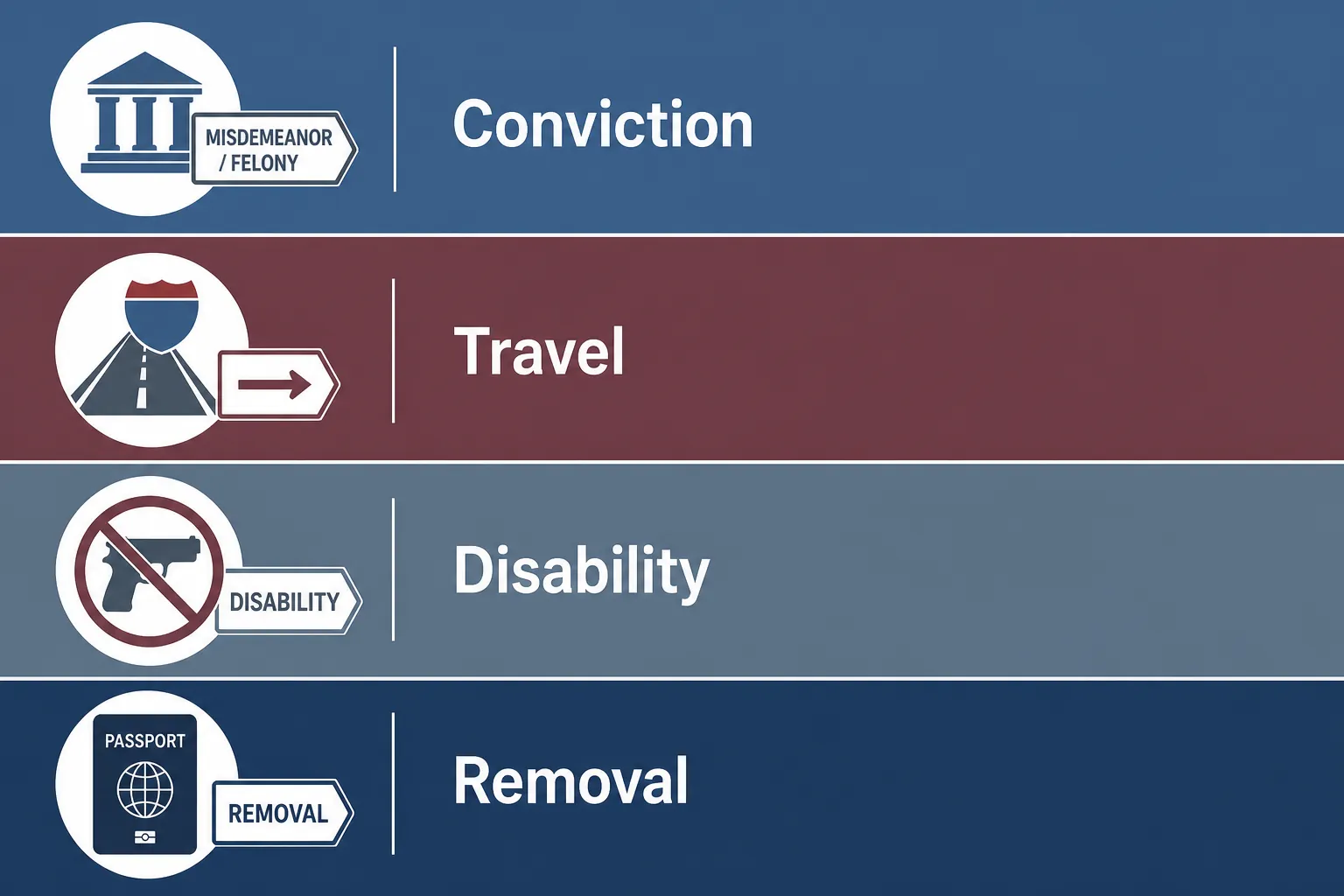
There is no single penalty for violating a domestic violence protective order. The useful answer is a stack: state criminal exposure, possible federal interstate prosecution, a federal firearm disability, and — if the respondent is a noncitizen — a removal ground that may not require any criminal conviction at all.
This is a Regulation & Ethics consequence record, not legal advice. It is written for source-checking and issue-spotting. Legal-background review: protective-order violation consequences, primary-source priority, United States federal law, and selected official state examples. Record last verified: August 2, 2026. A lawyer advising a party still has to check the exact order, the issuing court, the governing state statute, current amendments, federal jurisdictional facts, firearm status, and immigration status.
| Layer | What must be checked first | Why a single penalty figure fails | Last verified |
|---|---|---|---|
| State criminal enforcement | State, order type, violation conduct, prior violations, injury, and any mandatory minimums | States use different terminology and escalation rules; even one state can treat first, second, and third violations differently | August 2, 2026 |
| Federal interstate prosecution | Interstate travel or causing the protected person to travel, followed by violating conduct | 18 U.S.C. § 2262 is not a general federal penalty for every protective-order violation | August 2, 2026 |
| Federal firearm disability | Whether the order satisfies 18 U.S.C. § 922(g)(8)’s statutory conditions | The disability can arise from the qualifying order itself, not only from a violation conviction | August 2, 2026 |
| Immigration removal ground | Whether the respondent is a noncitizen and whether the violation concerns protection-relevant parts of the order | The removal ground can apply without a criminal conviction | August 2, 2026 |
Start with the state order, not with a penalty table
Most protective-order violation cases begin in state court. That does not make the state consequence simple. The first question is not “misdemeanor or felony?” It is: what order was entered, what did it prohibit, what conduct allegedly violated it, what state statute converts that conduct into an offense, and whether the statute escalates based on prior violations, violence, injury, timing, or weapon use.
Virginia is a good example of why current statutory checking matters. Under Va. Code § 18.2-60.4, a first offense for violating specified protective-order provisions is a Class 1 misdemeanor. A second offense within five years, when the offense is based on an act or threat of violence, carries a 60-day mandatory minimum term of confinement. A third or subsequent offense within 20 years is a Class 6 felony and carries a six-month mandatory minimum term of confinement, to be served consecutively with any other sentence. The statute also reflects amendment activity through 2025, which is exactly why a stale “state penalty” summary is a poor source for advice in 2026.[1]
Massachusetts illustrates a different kind of official warning: enforcement mechanics and collateral consequences are presented together. Mass.gov states that if police have probable cause to believe a defendant violated an abuse prevention order, they must arrest the defendant. It also states that violation can be punished by a fine, imprisonment for up to 2.5 years in the house of correction, or both, and warns that a conviction — including a continuance without a finding — can affect employment, public housing, and citizenship.[2]
Those two examples are enough to show the problem. Virginia’s statute makes prior timing and violence-based conduct central. Massachusetts’ official page foregrounds mandatory arrest and collateral effects. Neither example should be treated as a national rule, and neither should be blended into a generic claim that “violating a restraining order means up to X years.”
For fee and representation planning, the same verification habit applies. A protective-order violation can change the scope of work from a hearing appearance to criminal defense, firearm counseling, and immigration screening. That is why cost discussions should be tied to the actual docket and exposure layers rather than a flat consumer estimate; see this related guide on how to verify domestic violence lawyer costs and fees.
The federal interstate offense is narrower than many summaries make it sound
The federal statute most often misquoted in this area is 18 U.S.C. § 2262. Its penalty range is serious, but the statute is not a general federal punishment for any violation of any domestic violence protective order. The gateway is jurisdictional: the statute reaches interstate or foreign travel, crossing a state line or entering or leaving Indian country, or causing the protected person to travel, followed by conduct that violates the protective order.[3]
| Federal consequence under 18 U.S.C. § 2262 | Penalty stated in the statute | Practical verification point |
|---|---|---|
| Death results | Imprisonment for any term of years or life, or fines, or both | Do not cite this range unless the death-result provision and federal jurisdictional elements are actually in play |
| Permanent disfigurement or life-threatening bodily injury results | Up to 20 years, or fines, or both | The injury category matters; it is not interchangeable with a simple-contact violation |
| Serious bodily injury results, or a dangerous weapon is used | Up to 10 years, or fines, or both | The weapon or serious-bodily-injury element must be supported |
| Otherwise | Up to 5 years, or fines, or both | Even the “otherwise” category still depends on § 2262’s interstate or travel-related gateway |
The phrase “up to five years” is therefore incomplete unless it is tied to the federal elements. If a respondent violates an order without the interstate or travel-related facts required by § 2262, the federal statute is not automatically available just because the underlying order concerns domestic violence. State prosecution may still be available; that is a different layer.
A qualifying protective order can trigger a firearm disability before any violation conviction
Firearms are often discussed as if they matter only after a violation arrest. Federal law is broader than that. Under 18 U.S.C. § 922(g)(8), a person subject to a qualifying court order may not possess firearms or ammunition if the statutory conditions are met. The order must have been issued after a hearing of which the person had actual notice and an opportunity to participate, must restrain the person from harassing, stalking, or threatening an intimate partner or child of an intimate partner, or engaging in other conduct that would place that person in reasonable fear of bodily injury, and must include the required finding of credible threat or explicit prohibition on force-related conduct.[4]
That is a different consequence from a state misdemeanor sentence. It can arise from the existence of the qualifying order itself. A lawyer who focuses only on whether the prosecutor will charge a violation may miss the immediate possession problem, the transfer problem, and the risk that any later contact with law enforcement exposes the firearm issue.
The post-2024 constitutional context also matters, but it should not swallow the operational question. In United States v. Rahimi, the Supreme Court upheld the application of § 922(g)(8) to a person found by a court to pose a credible threat to the physical safety of another, placing the provision on firmer footing after earlier Second Amendment challenges.[5]
For noncitizens, dismissal of the criminal case may not end the removal risk
The immigration layer is the one most likely to be missed when the criminal docket looks small. Under 8 U.S.C. § 1227(a)(2)(E)(ii), a noncitizen is deportable if a court determines that the person violated the portion of a protection order that involves protection against credible threats of violence, repeated harassment, or bodily injury to the protected person or persons. The statute is not written as a conviction ground; it turns on a court determination of violation.[6]
That does not mean every missed payment, scheduling dispute, or administrative noncompliance provision becomes a removal ground. In Matter of Obshatko, the Board of Immigration Appeals treated the ground as limited to protection-relevant parts of the order, excluding provisions such as support obligations that do not protect against threats, harassment, or bodily injury. The decision also confirms the practical danger: the removal inquiry is not confined to the label or final result of a criminal prosecution.[7]
Szalai v. Holder shows how small the underlying conduct can look from a criminal-defense distance. The Ninth Circuit addressed a lawful permanent resident who was found deportable after violating a 100-yard stay-away provision by walking his child partway up a driveway. The point is not that every driveway fact pattern will produce the same immigration result; it is that counsel cannot treat “minor contact” or “no conviction” as a safe stopping point when the respondent is a noncitizen.[8]
UNC School of Government’s 2024 analysis makes the same screening point for practitioners: the protection-order removal ground can be triggered without a criminal conviction, so a dismissal, deferred disposition, or nonconviction outcome may leave a noncitizen exposed if a court has made the relevant violation determination.[9]
This immigration layer is also where terminology mistakes become expensive. “Restraining order,” “protective order,” “order of protection,” and “abuse prevention order” can describe different state instruments. The federal removal question is not solved by the state label. It requires reading the order, identifying the protected persons, isolating the violated provision, and asking whether the court determination concerns threats, repeated harassment, or bodily injury protection.
For a separate immigration-law reference point, see this coverage of DACA-related legal implications. The doctrines differ, but the caution is familiar: immigration consequences often turn on federal classifications that do not track the criminal docket in the way a non-immigration lawyer expects.
Enforcement mechanics matter to the protected party too
The protected party is not served by a penalty summary that sounds severe but cannot be enforced on the facts. If the order is valid and enforceable, the practical questions are immediate: can police arrest on probable cause, must they arrest, what conduct counts as a violation, whether the order is enforceable outside the issuing state, and how quickly the court can respond.
Massachusetts’ official guidance is direct on one of those questions: probable cause to believe an abuse prevention order was violated requires arrest.[2] That kind of enforcement rule matters more to a protected person than an abstract maximum sentence. A maximum does not answer whether the respondent is removed from the scene that night, whether a violation creates a new criminal case, or whether the protected party has to wait for a later hearing.
Interstate enforceability is a related verification issue. Federal victim-services materials have long warned that enforcement procedures and state terminology vary across jurisdictions; the Office for Victims of Crime’s Legal Series Bulletin #4 is useful as a dated 2002 signal of cross-state variation, not as a current penalty chart for 2026 unless each cited state example has been rechecked against current law.[10]
Live docket coverage often shows how these mechanics become real-world consequences before anyone writes an appellate opinion. For examples of domestic-violence enforcement issues in active risk reporting, see the records on AI evidence risk in a domestic-violence-related matter and the Kentucky Powerball winner domestic violence case.
What to verify before advising on consequences
A protective-order violation analysis should move in this order, because each layer has its own trigger and its own source of law.
- Identify the order. Confirm the state, issuing court, order type, protected persons, service or notice facts, hearing history, expiration date, and the exact terms allegedly violated.
- Check the current state statute. Do not rely on a generic “restraining order violation” number. Look for first-offense classification, repeat-offense escalation, injury or weapon enhancements, mandatory minimums, consecutive-sentence rules, and arrest requirements.
- Ask whether federal interstate facts exist. Do not cite 18 U.S.C. § 2262’s penalties unless the travel, crossing, Indian country, or caused-travel elements are actually supported.
- Test the firearm-disability criteria. Read 18 U.S.C. § 922(g)(8) against the order itself: hearing, notice, opportunity to participate, covered relationship, restraint language, and credible-threat or force-prohibition findings.
- Screen for noncitizenship. If the respondent is not a U.S. citizen, identify whether any court has determined a violation of a protection-relevant provision. Do not assume that no conviction means no removal exposure.
- Date-stamp every authority. Protective-order statutes change, and secondary penalty summaries often lag. Keep the statute, official court page, or agency source with the date checked.
That protocol is slower than quoting one maximum sentence. It is also the difference between describing the misdemeanor docket and advising on the actual legal consequences of violating a domestic violence protective order.
References
- Violation of protective orders; penalty. Virginia Law, amended through 2025. https://law.lis.virginia.gov/vacode/title18.2/chapter4/section18.2-60.4/
- What happens if the defendant violates an abuse prevention order? Mass.gov. https://www.mass.gov/info-details/what-happens-if-the-defendant-violates-an-abuse-prevention-order
- 18 U.S. Code § 2262 - Interstate violation of protection order. Legal Information Institute. https://www.law.cornell.edu/uscode/text/18/2262
- 18 U.S. Code § 922 - Unlawful acts. Legal Information Institute. https://www.law.cornell.edu/uscode/text/18/922
- United States v. Rahimi: Does a law prohibiting a person subject to a domestic violence restraining order from possessing a firearm violate the Second Amendment? Constitution Annotated, Congressional Research Service. https://constitution.congress.gov/browse/essay/amdt2-4/ALDE_00013262/
- 8 U.S. Code § 1227 - Deportable aliens. Legal Information Institute. https://www.law.cornell.edu/uscode/text/8/1227
- Matter of Obshatko. Board of Immigration Appeals, 2017. https://www.justice.gov/eoir/page/file/1005371/dl
- Szalai v. Holder, 572 F.3d 975. U.S. Court of Appeals for the Ninth Circuit, 2009. https://casetext.com/case/szalai-v-holder
- Immigration Consequences of Violating a Domestic Violence Protective Order. UNC School of Government, 2024. https://www.sog.unc.edu/
- Enforcement of Protective Orders. Office for Victims of Crime Legal Series Bulletin #4, January 2002. https://ovc.ojp.gov/
Operationalizing workflow
No workflow has been explicitly linked to this obligation yet. See Workflows generally.
Illustrative cases
No illustrative case is currently tracked for this obligation. See Risk Digest for documented incidents generally.
← Back to RegulationReport a correction or tip
Spotted an outdated figure, a misstated fact, or a ruling this regulation entry should reflect? Public comments are disabled for this content given the professional cost of a misreported case outcome, penalty amount, or rule text — use the structured correction channel instead.
Report a correction or tip for this record →