
What Jessica Treviño's DACA lawsuit means for removal law
A verified, source-linked record of Treviño Villegas v. Mullin (S.D. Tex.) for practitioners assessing removal-enforcement risk: docket status, the unauthorized-travel termination theory, controlling precedent, and the mandamus and habeas claims, each flagged confirmed-or-reported with a last-verified date.
- Jurisdiction
- United States (Fifth Circuit)
- Court
- U.S. District Court, Southern District of Texas, Brownsville Division
- AI tool named
- No AI tool implicated
- Ruling date
- Jul 29, 2026
- Source document
- View primary court order ↗
- Last verified
- Aug 1, 2026
Lex Machina Review is an independent risk-tracking and reference resource. Nothing on this site is legal advice, and using it does not create an attorney-client relationship. Every record is reviewed against primary sources but may not reflect the most current status of a matter — always verify directly against the cited court order, rule text, or a licensed attorney before relying on it.
Companion explanation — secondary to the source document above
Last verified: Aug. 1, 2026. The public docket record for Trevino Villegas v. MULLIN et al., No. 1:26-cv-00832, places the case in the Southern District of Texas, Brownsville Division, filed July 29, 2026, with cause listed as 28:1361 Petition for Writ of Mandamus and nature of suit 540, habeas corpus/mandamus. No public complaint, court order, or assigned-judge information was available in the verified source set as of Aug. 1, 2026.[1]
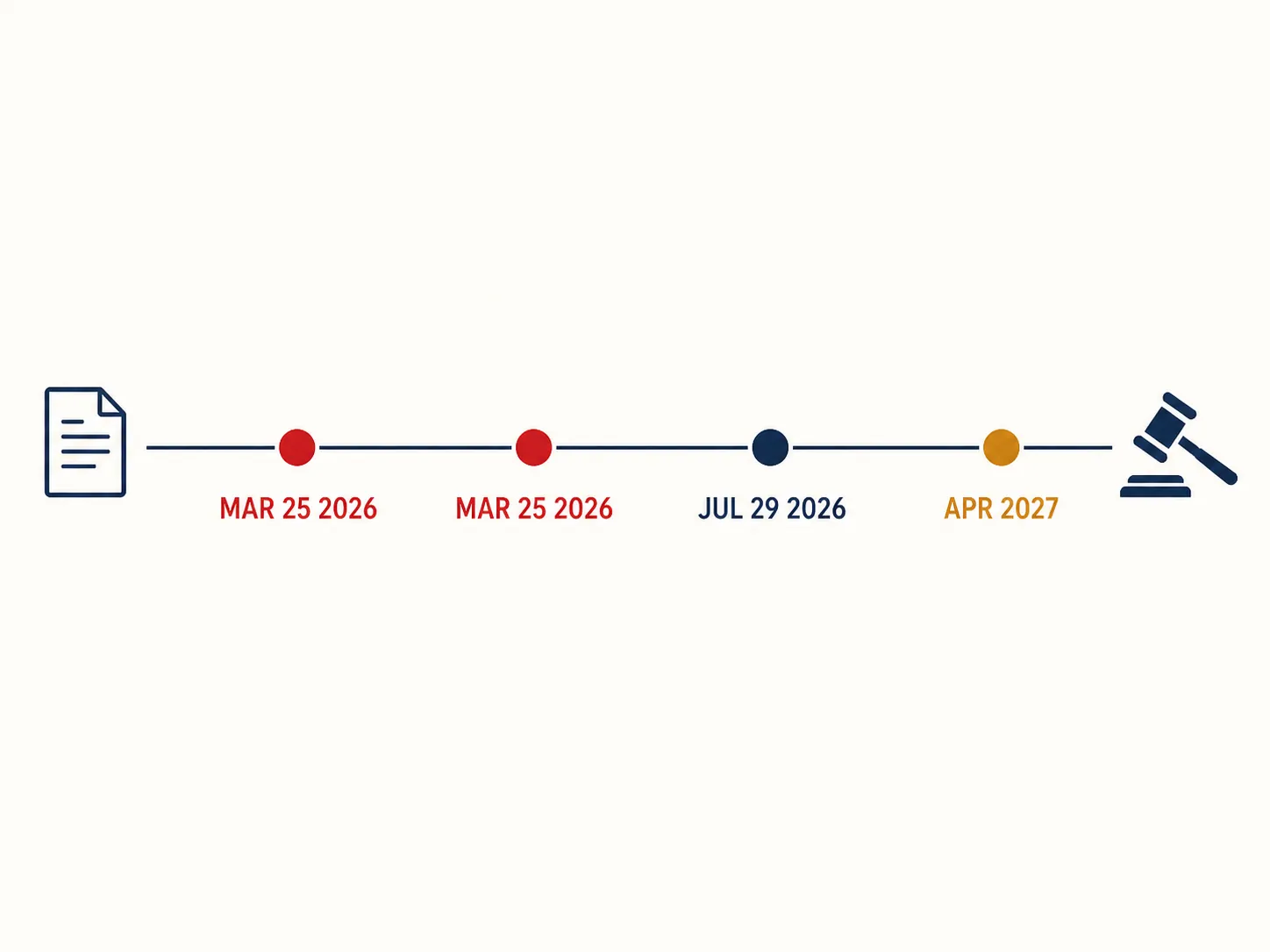
That posture matters more than the headline. The legal implications of the Jessica Trevino DACA lawsuit begin with a narrow, dated collision: Jessica Treviño Villegas was reported to have DACA and work authorization valid through April 2027; she was reported removed on March 25, 2026; and USCIS was reported to have issued a notice of intent to terminate her DACA for “unauthorized travel outside of the United States on or about March 25, 2026.”[2] The allegation is not that she took a trip and then lost protection. The allegation is that the government’s own removal act is being treated as the travel event used to cancel the protection.
This is not an AI-sanction, fake-citation, or hallucinated-filing incident. It belongs in a removal-risk record because the docket is real, the reported termination theory is concrete, and the remedy question may affect how lawyers advise DACA clients facing ICE contact or removal execution before their DACA period expires.
Record status and verification flags
| Record item | Status | Source posture | Last verified |
|---|---|---|---|
| Case name and docket: Trevino Villegas v. MULLIN et al., No. 1:26-cv-00832 | Confirmed | Public docket metadata | Aug. 1, 2026 [1] |
| Court: U.S. District Court, Southern District of Texas, Brownsville Division | Confirmed | Public docket metadata | Aug. 1, 2026 [1] |
| Filed: July 29, 2026; cause: 28:1361 Petition for Writ of Mandamus; nature of suit: 540 | Confirmed | Public docket metadata | Aug. 1, 2026 [1] |
| DACA grant and work authorization reportedly valid through April 2027 | Reported | Press report; not yet checked against the nonpublic immigration file | Aug. 1, 2026 [2] |
| Removal reportedly occurred March 25, 2026 | Reported | Press report; not yet confirmed by public removal order or flight record | Aug. 1, 2026 [2] |
| USCIS NOIT reportedly cites unauthorized travel outside the United States on or about March 25, 2026 | Reported | Press report describing the notice; the notice itself is not public in this source set | Aug. 1, 2026 [2] |
| Complaint, TRO motion, NOIT response, DHS opposition, and any order | Not publicly available in verified source set | Refresh required before citing claims or relief as filed text | Aug. 1, 2026 |
Two naming cautions belong at the top of the file. First, the docket uses the unaccented legal form “Trevino Villegas,” while public coverage uses Jessica Treviño Villegas. Second, the respondent name “MULLIN” should not be assumed to identify the same party, office, or legal issue as the separate TPS-related Mullin v. Doe record. The shared surname is not a bridge between the cases.
The timeline is the legal problem
The Treviño record is not hard to understand because DACA law is obscure. It is hard because the administrative sequence appears to fold back on itself. If the reported dates are accurate, the relevant order is: DACA and work authorization remained valid into April 2027; removal occurred on March 25, 2026; USCIS then invoked travel “on or about” that same date as the basis for a notice of intent to terminate DACA; the federal mandamus/habeas docket opened on July 29, 2026.[1][2]
That sequence is why the case should not be briefed as a general DACA-removal story. The useful question is narrower: can the government remove a person while a DACA grant and employment authorization are reportedly still active, and then use the resulting departure as “unauthorized travel” to terminate the same DACA grant?
The public docket does not yet answer that question. It only confirms that Treviño Villegas filed a mandamus action in the Brownsville Division. The reported NOIT supplies the catch-22; the missing complaint and any missing emergency-motion papers will determine how the plaintiff framed the duty, the custody theory, the requested return remedy, and the status-restoration remedy.
How the USCIS travel rule is being invoked
USCIS’s public DACA guidance says that travel outside the United States after DACA approval without advance parole may affect continuous residence and that USCIS may terminate DACA through a notice of intent to terminate, with an opportunity to respond.[3] On an ordinary travel-risk intake, that rule sends counsel directly to dates, advance-parole approval, departure and return records, and whether the person left after DACA was granted.
Treviño’s reported facts do not fit the ordinary intake pattern. The reported departure was not a vacation, work trip, emergency family visit, or self-directed border crossing. Public coverage says DHS removed her on March 25, 2026, and USCIS later cited unauthorized travel outside the United States “on or about” that date.[2] Advocacy-side coverage frames the theory more sharply: the government deported her despite valid DACA and is now trying to strip that same protection based on the deportation.[4]
That last proposition should be attributed, not upgraded. As of Aug. 1, 2026, no court in this case has held that USCIS violated DACA procedures, mischaracterized removal as travel, or must restore Treviño Villegas to the United States. The argument is powerful because of the dates. It is still an argument.
For DACA clients facing travel or enforcement questions, the distinction is operational. A voluntary departure after DACA approval without advance parole is one kind of risk file. A removal carried out by DHS while the person’s DACA grant is reportedly valid is a different file. The same USCIS travel vocabulary may appear in both, but the actor, coercion, and remedy posture are different. Intake should separate those categories before anyone gives advice. For a broader pre-travel checklist, use the site’s noncitizen air-travel verification workflow; for ICE contact before travel or at an airport, pair it with the ICE detention and airport-rights checklist.
Estrada Juárez is the closest return-order comparison, not a result
The case most likely to appear in briefing is Estrada Juárez v. DHS from the Eastern District of California. In that case, Judge Dena Coggins granted a temporary restraining order after the removal of an active DACA recipient, called the removal a “flagrant violation” of DACA regulatory protections and due process, ordered the government to facilitate return within seven days, and required restoration “as if her February 19, 2026, removal never occurred.”[5]
Estrada Juárez matters because it treats return and restoration as practical remedies, not just after-the-fact declarations. It also matters because the order looked at active DACA protection as something the government could not ignore at the removal-execution stage. If Treviño Villegas’s public chronology holds, the factual overlap is obvious: an active DACA recipient, removal, and a later need for return or restoration.
But Estrada Juárez does not decide the Treviño docket. It is an Eastern District of California TRO, not a Fifth Circuit ruling and not an order from the Southern District of Texas. The Treviño docket also appears as a §1361 mandamus filing with habeas/mandamus nature-of-suit coding, and the public file has not yet shown the complaint, the requested TRO terms, or the government’s jurisdictional objections.[1] The comparison is serious. It is not automatic.
What mandamus and habeas can carry at this stage
The docket’s cause code points to 28 U.S.C. §1361, the federal mandamus statute.[1] In practical terms, that means the plaintiff is trying to frame at least part of the case around a duty a federal officer or agency must perform, not merely around a request for discretionary mercy. Without the complaint, the exact duty theory cannot be quoted. The likely pressure points are the alleged obligation not to remove someone in active DACA posture, the obligation not to terminate DACA through a premise created by the government’s own removal, and the obligation to restore the position that existed before the removal.
The nature-of-suit code also places the case in habeas/mandamus territory.[1] That matters because return litigation after removal often has to deal with custody, jurisdiction, finality, and the government’s argument that the person is already outside the United States. The public docket alone does not tell us whether Treviño Villegas seeks a temporary restraining order, parole into the United States, return transportation, DACA restoration, employment-authorization restoration, a stay of termination, or some combination of those forms of relief.
The legal implications therefore sit in two layers. The first is the USCIS layer: whether a NOIT can rest on “travel” that was allegedly compelled by DHS removal. The second is the remedial layer: whether a district court in the Fifth Circuit will use mandamus, habeas, or emergency equitable relief to order return or status restoration after removal. A win on the first layer would not necessarily dictate the exact remedy. A jurisdictional loss on the second layer could leave the travel characterization unresolved.
Enforcement context, with the numbers kept in their lane
DACA removal risk is not hypothetical. In a February 2026 oversight release, Senators Dick Durbin, Alex Padilla, and Mark Kelly cited DHS figures stating that 261 DACA recipients had been arrested and 86 removed between Jan. 1, 2025, and Nov. 19, 2025; the same release said 241 of the arrested DACA recipients, or 92%, had no criminal record.[6] Those figures are useful as dated attribution, not as a clean trendline. The broader source record flags inconsistent DHS numbers given in other congressional contexts, so the safer use is to say DHS has acknowledged DACA arrests and removals during that period, while treating any precise total as source- and date-bound.
One additional pattern deserves notice but not overuse. Texas Tribune coverage of José Contreras Díaz reported that he returned to the United States and was re-detained on April 29, 2026.[7] That example is not Treviño’s case, and it does not prove what will happen if any return order issues in Brownsville. It does warn lawyers that a return remedy may not end the custody-risk analysis. Return, parole, detention authority, reporting conditions, and employment authorization may all have to be separated in the proposed order.
For broader removal-timeline triage, this record can be read alongside the site’s deportation-proceedings timeline for green-card holders and the Daniel Adongo removal-risk record. The categories are different, but the same verification habit applies: identify the operative order, the custody status, the forum, the deadline, and the remedy actually requested.
Citation risks in the current Treviño file
- Do not say a court has ruled that DHS or USCIS violated DACA rules in Treviño Villegas. As of Aug. 1, 2026, no order is public in the verified source set.
- Do not quote the complaint unless the complaint is obtained. The docket confirms the filing and coding; it does not supply the factual allegations or prayer for relief.[1]
- Do not collapse attorney identity into a single confirmed name. Public coverage is not stable enough on counsel attribution to make counsel identity a load-bearing fact.
- Do not identify “MULLIN” beyond the public docket unless a complaint, summons, appearance, or court order confirms the respondent’s role.
- Do not treat Estrada Juárez as binding in the Southern District of Texas. It is the closest return-order comparison in the source set, but it remains a separate district-court TRO.[5]
- Do not label this as an AI-risk matter. The verified risk is immigration-enforcement sequencing, not machine-generated filing misconduct.
Where the record stands on Aug. 1, 2026
As of Aug. 1, 2026, the Treviño Villegas docket is newly filed. The public record confirms the forum, docket number, filing date, mandamus cause code, and habeas/mandamus nature-of-suit classification.[1] The reported facts create the legal issue: active DACA and work authorization through April 2027, removal on March 25, 2026, and a USCIS NOIT using unauthorized travel on or about that same date.[2]
The next verification points are the complaint, the NOIT response, any TRO or habeas motion, DHS’s first jurisdictional position, respondent identification, judge assignment, and any order on return or status restoration. Until those documents are public, the safest formulation is this: Treviño Villegas is testing whether the Estrada Juárez return-and-restoration logic can be enforced through a §1361 mandamus and habeas posture in the Fifth Circuit when the alleged DACA-terminating travel was the government’s own removal.
References
- Trevino Villegas v. MULLIN et al, PacerMonitor, filed July 29, 2026
- Texas mother DACA recipient deportation lawsuit, The Texas Tribune / Associated Press, July 30, 2026
- Consideration of Deferred Action for Childhood Arrivals (DACA), USCIS
- The Government Deported Jessica Treviño Villegas Despite Having a Valid DACA. Now It Is Trying to Strip Her Status., FWD.us
- Estrada Juárez v. DHS, Order Granting Temporary Restraining Order, U.S. District Court for the Eastern District of California
- Durbin, Padilla, Kelly Blast DHS for Wrongfully Targeting and Removing DACA Recipients, U.S. Senator Dick Durbin, February 2026
- Texas DACA recipient immigration deportation detainment release, The Texas Tribune, May 7, 2026
Related records
Tool profile
How Meta's AI Spending Reshapes Law Firm ProfitabilityGoverning regulation
Browse the obligations tracker →Preventive workflow
Browse verification workflows →
Report a correction or tip
Spotted an outdated figure, a misstated fact, or a ruling this case record should reflect? Public comments are disabled for this content given the professional cost of a misreported case outcome, penalty amount, or rule text — use the structured correction channel instead.
Report a correction or tip for this record →