
Where Genetic Genealogy Cold Cases Face Legal Implications
- Authority
- U.S. Department of Justice
- Rule type
- regulation
- Jurisdiction scope
- US federal
- Effective date
- Nov 1, 2019
- Source text
- Read primary rule text ↗
Federal agencies and DOJ-funded activity must follow the DOJ Interim Policy on forensic genetic genealogy searching; it is not a universal rule for state or local IGG use.
Regulation & Ethics tracker. Legal information only, not legal advice. Last verified: August 1, 2026. Legal-background review status: named reviewer pending. Source note: the Kohberger suppression order and the October 25, 2023 IGG discovery order should be re-checked against the primary PDFs before publication; this tracker relies on the Forensics TTA repository summary and NBC’s contemporaneous report for those order details. [1][2]
The legal exposure is not the family tree
When investigative genetic genealogy produces a cold-case identification, the first legal question is usually misstated. The current federal Fourth Amendment exposure is not, as of mid-2026, a published appellate holding that a warrantless search of a consumer genealogy database is itself a search. The reported suppression record has instead left genealogy-database challenges standing on abandonment and third-party-doctrine reasoning, while the more demonstrated suppression danger has appeared later: when investigators collect the suspect’s confirmatory DNA sample.
That distinction matters at a suppression hearing. A defense lawyer who treats the GEDmatch or FamilyTreeDNA step, the trash pull, and the buccal swab as one privacy event risks losing the step-by-step record. A prosecutor who assumes the database-search cases make the later sample collection safe is reading the record too broadly.

The scale is large enough to make these disputes recurring, but the public tallies are not interchangeable. One compiled count cited 651 criminal cases and 464 decedent identifications as of December 2023; a later CBC report described a New York Times tally of more than 1,400 cases by December 2025. [3][4] Those numbers should be used as dated reference points, not combined into a single consensus figure.
The suppression record, case by case
The useful map is jurisdictional. The same IGG-generated lead can encounter different rules depending on whether the challenged step is the database search, the shed-DNA sample, a trash pull, a buccal swab, or a state statute.
| Case | Court and ruling date | Challenged step | Rationale tracked here | Result |
|---|---|---|---|---|
| State v. Burns | Iowa Supreme Court, 2023 | Analysis of DNA voluntarily abandoned in public | No search under the United States or Iowa Constitution when police analyzed voluntarily abandoned DNA | Suppression denied; abandonment rationale carried the ruling. [5] |
| State v. Hartman | Washington Court of Appeals, 2023 | IGG-related investigative use and later DNA evidence | Challenge did not produce an appellate holding that the genealogy-database search itself was a Fourth Amendment search | Suppression challenge failed in the reported appellate record. [6] |
| State v. Carbo | Minnesota Supreme Court, 2024 | IGG database work and subsequent DNA evidence | Court treated the genealogy profile and third-party platform exposure as outside the defendant’s reasonable expectation of privacy on the suppression theory presented | Suppression denied. [7] |
| State v. Westrom | Minnesota Supreme Court, 2024 | IGG lead development and confirmatory DNA evidence | Companion Minnesota treatment relied on third-party and abandonment concepts rather than recognizing the database search as a Fourth Amendment search | Suppression denied in the reported appellate record. [8] |
| State of Idaho v. Bryan Kohberger | Idaho trial court order, February 19, 2025 | Genetic information, crime-scene DNA, trash-pull DNA, and Franks request | Order denied suppression based on crime-scene DNA abandonment and a lawful trash pull; the court also denied a Franks hearing | Suppression denied; trial-level order, not appellate IGG doctrine. Primary orders should be re-checked before publication. [1][2] |
| State v. Dalrymple | Idaho trial court ruling, May 3, 2024 | IGG-related suppression challenge | Trial-level treatment of IGG-generated identification rather than an appellate rule for database searches | Suppression denied in the repository ruling summary. [9] |
| State v. Steeprock | Minnesota Supreme Court, 2025 Minn. LEXIS 683 | Buccal swab obtained under a discovery order rather than a warrant | Warrantless buccal swab violated the Fourth Amendment; court also overruled prior inevitable-discovery precedent as described in the reported account | Suppression granted as to the confirmatory sample. This is the cleanest warning signal in the current record. [10] |
Burns is not an IGG-database case in the narrowest sense, but it matters because it shows why shed-DNA arguments have been hard to suppress: once the court accepts voluntary abandonment, the later laboratory analysis is not treated as a constitutional intrusion. Carbo and Westrom are more directly useful for genealogy-platform litigation because they show Minnesota’s 2024 appellate posture before Steeprock. They do not make every IGG step safe in Minnesota; they show where the vulnerability moved.
Kohberger deserves narrower use than it often receives. The February 19, 2025 order is important to trial courts and briefing strategy, but it is not a published appellate settlement of IGG doctrine. This site’s single-case treatment is available at How the Kohberger DNA Ruling Signals Risk for IGG Cases, and the post-plea procedural residue is tracked separately in The Legal Unknowns That Outlasted Kohberger's Guilty Plea. This article uses Kohberger only as one entry in the multi-jurisdiction exposure map.
State statutes create duties even where federal doctrine has not supplied suppression
Federal Fourth Amendment doctrine is not the only rule in the room. State genetic-privacy statutes can impose warrant, court-order, consent, or access duties that do not depend on persuading a federal court to abandon third-party doctrine for genealogy databases. Those statutes should be treated as separate compliance signals, not as proof of a national constitutional rule.
| State | Authority identified in the research record | Compliance signal |
|---|---|---|
| Maryland | Md. Code Crim. Proc. § 17-101 et seq. | Maryland was identified by EFF as one of the first states to restrict law-enforcement access to genetic genealogy searching; treat Maryland IGG use as a statute-first review before reaching federal doctrine. [11] |
| Montana | Mont. Code Ann. § 44-6-104 | Montana was identified alongside Maryland in EFF’s 2021 account of first-in-the-nation restrictions; the state-law access question is distinct from whether the Fourth Amendment independently requires a warrant. [11] |
| Utah | Utah Code § 53-10-403.7 | CRS identifies Utah among the state-law frameworks relevant to law-enforcement genetic genealogy access; the obligation should be checked against the current statutory text before use in a motion or agency protocol. [12] |
| Minnesota | Minn. Stat. § 325F.995 | Minnesota appears in the state-obligations lane separate from Carbo, Westrom, and Steeprock; counsel should not infer that a federal suppression loss resolves every state-law genetic-data issue. [12] |
| California | Cal. Civ. Code § 56.181 | California’s genetic-privacy statute is a separate statutory compliance checkpoint; it is not the same question as whether a genealogy-platform upload defeats a federal reasonable-expectation-of-privacy claim. [12] |
This is where briefing often becomes imprecise. A state statute may regulate access, consent, use, disclosure, or authorization without automatically creating the same remedy in every criminal case. The first question is therefore not simply “was IGG used?” but “which statute governed the exact access path, and what remedy does that jurisdiction attach to the violation?”
Federal policy is a floor for some agencies, not Fourth Amendment doctrine
The Department of Justice Interim Policy on Forensic Genetic Genealogical DNA Analysis and Searching was issued in November 2019, with the DOJ release page updated February 5, 2025. [13] The policy matters for federal agencies and DOJ-funded activity, but it is not a Supreme Court holding and it does not automatically govern every state or local IGG use.
The Congressional Research Service’s July 11, 2025 update described the Carla Walker Act, H.R. 3591/S. 1890, as pending at that time. [12] Because this article is being verified in Q3 2026, both the bill status and any current DOJ-policy updates should be re-verified against primary federal sources before publication.

Chatrie is pressure on third-party doctrine, not an IGG holding
Chatrie v. United States changes the atmosphere around third-party doctrine, but it should not be cited as though it decided genealogy-database searching. The Supreme Court decided Chatrie on June 29, 2026; the reported decision was 6-3, with Justice Kagan writing for the Court, and it treated geofence location-data access as a Fourth Amendment search rather than allowing the government to rely on ordinary third-party-doctrine reasoning. [14][15]
That signal is hard to ignore because IGG defenses often meet the same government instinct: the user exposed information to a third-party platform, so the Fourth Amendment has nothing to say. Chatrie makes that instinct less comfortable for sensitive digital data. It does not answer whether a distant relative’s genealogy upload, a platform’s terms of service, a law-enforcement kit, or a forensic profile creates a search in the constitutional sense.
For this site’s separate treatment of Chatrie in another surveillance setting, see Autonomous Police Drones Create a Fourth Amendment Vacuum. The IGG relevance is narrower: Chatrie supplies trajectory, not a controlling genealogy rule.
Suppression risk by investigative step
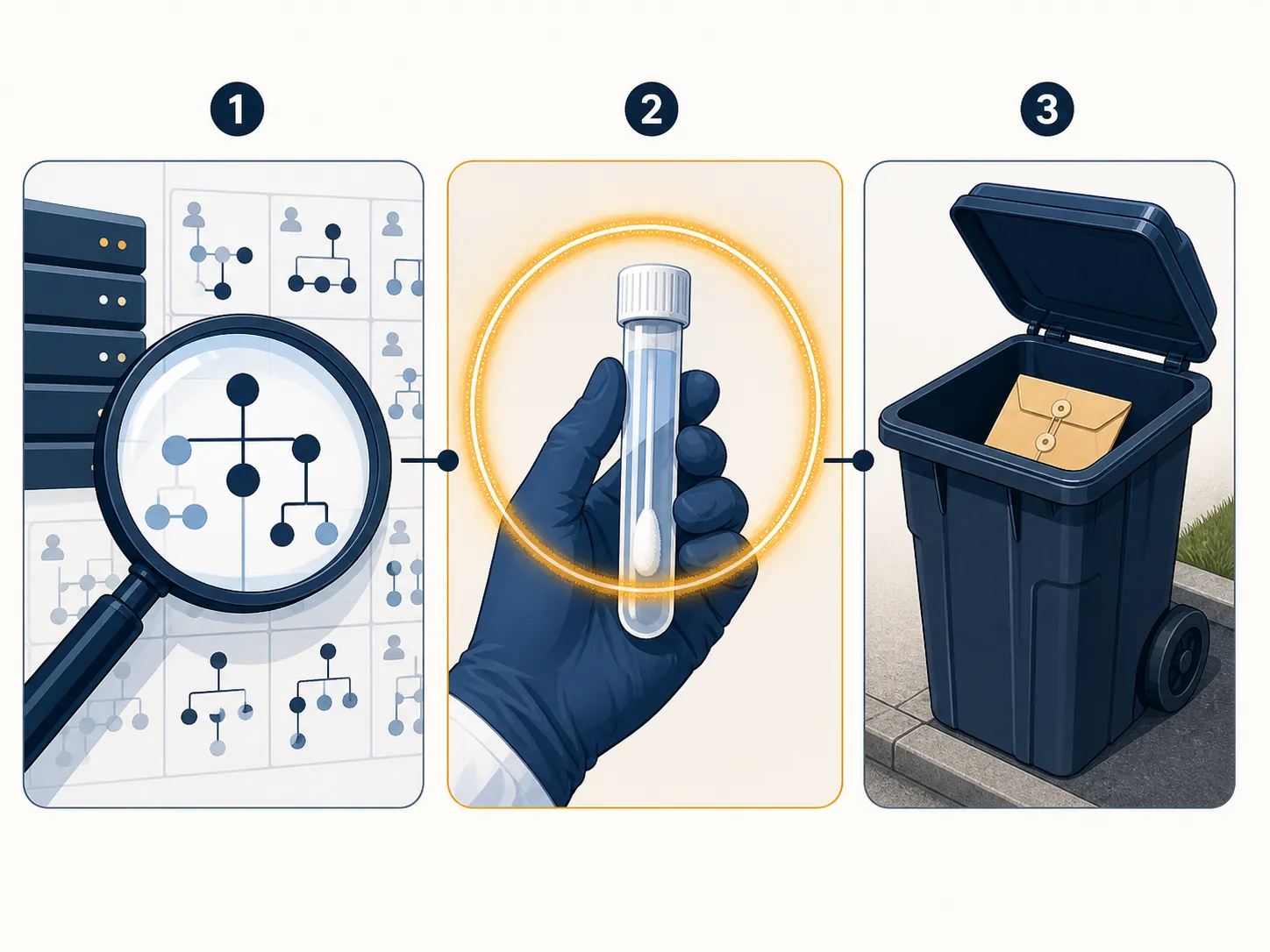
The cleanest way to brief or audit an IGG identification is to separate the lead-generation step from the evidence-generation step. A family tree may explain why police focused on a suspect; it does not, by itself, prove that the later evidence was collected lawfully.
| Step | Current exposure signal | Questions that matter |
|---|---|---|
| Consumer genealogy database search | No published appellate decision in the tracked record has held that the warrantless database search itself is a Fourth Amendment search; Carbo and Westrom remain important defense obstacles, while Chatrie adds pressure but not a genealogy holding. | Which platform was used? Was the profile uploaded by law enforcement or matched through an existing user? What did the platform terms and opt-in rules allow? Is there a state statute requiring a warrant, court order, or consent? |
| Confirmatory DNA sample | Highest demonstrated suppression risk after Steeprock, especially when the sample is obtained through a procedurally defective route rather than a warrant. | Was the sample a buccal swab, abandoned DNA, or another collection method? What judicial authorization existed? Was the state relying on inevitable discovery, and is that doctrine still available in the jurisdiction? |
| Trash pull or shed-DNA collection | Often defended through abandonment doctrine; Burns and Kohberger show why the government may prefer this path, but the details still matter. | Where was the item located? Was it truly abandoned under state and federal law? Did officers comply with state constitutional rules, local procedure, and any genetic-privacy statute that applies after collection? |
A useful verification file should therefore preserve the sequence: crime-scene profile, database upload or search, candidate-tree work, lead selection, surveillance or trash collection, confirmatory sample, laboratory comparison, warrant affidavits, discovery disclosures, and any statutory authorization. The site’s Fourth Amendment verification workflow uses a different evidence setting, but the same discipline applies: isolate the searched thing, the seized thing, the legal authority, and the remedy.
For defense counsel, the strongest first looks are state genetic-privacy obligations and the confirmatory-sample record. For prosecutors and agency counsel, the reported appellate losses on database-search suppression should not be mistaken for a permanent safe harbor. The current asymmetry is real: IGG database searches have survived under existing published appellate doctrine, while the weak points are moving outward through state statutes, sample-collection procedure, and post-Chatrie pressure on the assumptions that made third-party doctrine feel settled.
References
- Order on Defendant’s Motion to Suppress Re: Genetic Information State of Idaho v. Bryan Kohberger — Forensics TTA, February 19, 2025
- Judge denies Bryan Kohberger motions to exclude key DNA evidence from trial — NBC News, February 20, 2025
- Investigative genetic genealogy — Wikipedia
- Genetic genealogy police ban — CBC News, January 28, 2026
- Analyzing DNA Voluntarily Abandoned in Public Is Not a Search Under the United States or Iowa Constitution, According to the Iowa Supreme Court — Iowa Appeals, 2023
- State v. Hartman, 534 P.3d 423 — Washington Court of Appeals, 2023
- State v. Carbo — FindLaw, Minnesota Supreme Court, 2024
- State v. Westrom, 6 N.W.3d 145 — Minnesota Supreme Court, 2024
- Court’s Ruling on Defense Motion to Suppress State of Idaho v. David Dalrymple — Forensics TTA, May 3, 2024
- Minnesota Supreme Court Announces Warrantless Buccal Swab Pursuant to Discovery Order Violates Fourth Amendment, Overrules Inevitable Discovery Precedent, and Clarifies Accomplice Corroboration Statute Applies Only to Sworn Testimony — Criminal Legal News, December 15, 2025
- Maryland and Montana Pass the Nation’s First Laws Restricting Law Enforcement Access to Genetic Genealogy Databases — Electronic Frontier Foundation, June 2021
- The Fourth Amendment and Law Enforcement Use of Genetic Genealogy Databases — Congressional Research Service, updated July 11, 2025
- Interim Policy Forensic Genetic Genealogical DNA Analysis and Searching — U.S. Department of Justice, November 2019; release updated February 5, 2025
- Chatrie v. United States — SCOTUSblog
- Supreme Court Rules Geofence Warrants Are Fourth Amendment Searches — FMG, 2026
Operationalizing workflow
No workflow has been explicitly linked to this obligation yet. See Workflows generally.
Illustrative cases
No illustrative case is currently tracked for this obligation. See Risk Digest for documented incidents generally.
← Back to RegulationReport a correction or tip
Spotted an outdated figure, a misstated fact, or a ruling this regulation entry should reflect? Public comments are disabled for this content given the professional cost of a misreported case outcome, penalty amount, or rule text — use the structured correction channel instead.
Report a correction or tip for this record →