
What Remains of Trump's H-1B Fee After the Court Defeat?
- Authority
- U.S. District Court for the District of Massachusetts
- Rule type
- regulation
- Jurisdiction scope
- US federal
- Effective date
- Jun 8, 2026
- Source text
- Read primary rule text ↗
Do not collect or submit the $100,000 H-1B proclamation fee while the court vacatur stands; no refund process was ordered.
Status readout last verified Aug. 25, 2026
As of Aug. 25, 2026, the $100,000 H-1B fee is not collectable. The controlling chain is the District of Massachusetts’s June 8, 2026 vacatur, the First Circuit’s July 24, 2026 refusal to stay that vacatur, and USCIS’s July 28, 2026 FAQ update confirming the agency’s operating position after the stay denial. [1][2][3] That answer does not erase Proclamation 10973, which remains the presidential text that created the 12-month restriction, and it does not close off future return paths before or after the proclamation’s stated September 2026 endpoint. [4]
This article is legal information for status tracking and briefing. It is not legal advice for a particular petition, traveler, employer, or refund claim.
| Issue | Status as of Aug. 25, 2026 | Practical filing consequence |
|---|---|---|
| $100,000 H-1B payment | Not collectable under the current court-and-agency posture. [1][2][3] | Do not build today’s filing instructions around paying or collecting the $100,000 charge. |
| Proclamation 10973 | Still exists as text; the Massachusetts order vacated the fee policy’s operation, not the proclamation itself. [1][4] | Do not tell business teams that the proclamation has been wiped from the books. |
| Appeal | The government lost its request for a stay pending appeal; the merits appeal is not over. [2] | Use “not enforceable now,” not “permanently gone.” |
| Expiration or extension | The proclamation described a 12-month restriction beginning Sept. 21, 2025, which places the practical cliff at Sept. 20, 2026 absent an extension or replacement. [4] | Calendar the September date, but do not assume it will be the last word. |
| Refunds | No refund mechanism was ordered in the June 8 vacatur. [1] | Do not promise automatic refunds to anyone who previously paid. |
Why the court defeat is real
The enforceability answer changed because the Massachusetts court did more than criticize the policy. It vacated the fee policy after concluding that the $100,000 charge exceeded delegated authority. The sentence that matters for a filing calendar is direct: “The Court finds that the Policy imposes a tax on H-1B petitions without the requisite delegation by Congress.” [1]
That holding matters because immigration fees are not collected by atmosphere. A petitioner either has a required payment instruction or it does not. Once the district court vacated the policy, the government needed appellate relief to keep collection alive while the appeal proceeded. On July 24, the First Circuit denied that relief under the stay-pending-appeal framework associated with Nken, leaving the vacatur in place while the case continues. [2]
USCIS’s FAQ is not the legal source that defeated the fee. It is the practical source that tells filing teams how the agency is operating after the court orders. That distinction is worth preserving: the court orders explain why the agency cannot collect; the FAQ confirms what a petitioner should expect at the agency counter today. [3]
Why the defeat is narrow
The Massachusetts order did not turn the proclamation into a nullity for all future purposes. It vacated the challenged fee policy after finding, among other things, that the charge functioned as an unauthorized tax. [1] The presidential proclamation remains part of the record, including its stated 12-month restriction structure and its September 2025 effective sequence. [4]
That is the source of the awkward but accurate answer: the $100,000 payment is not collectable now, while the administration still has procedural ways to try to restore, extend, or replace the policy. For employers and counsel, that difference changes the wording of advice. A client can be told that the fee should not be paid on a current filing under the present posture. The same client should not be told that the administration has no remaining path to bring back a similar charge.
The caption has also shifted as DHS leadership changed, but the stable litigation identifiers are the useful items: District of Massachusetts No. 1:25-cv-13829 and First Circuit No. 26-1699. [1][2] For a one-page internal memo, those identifiers are more reliable than a party-name shorthand that may lag the docket.
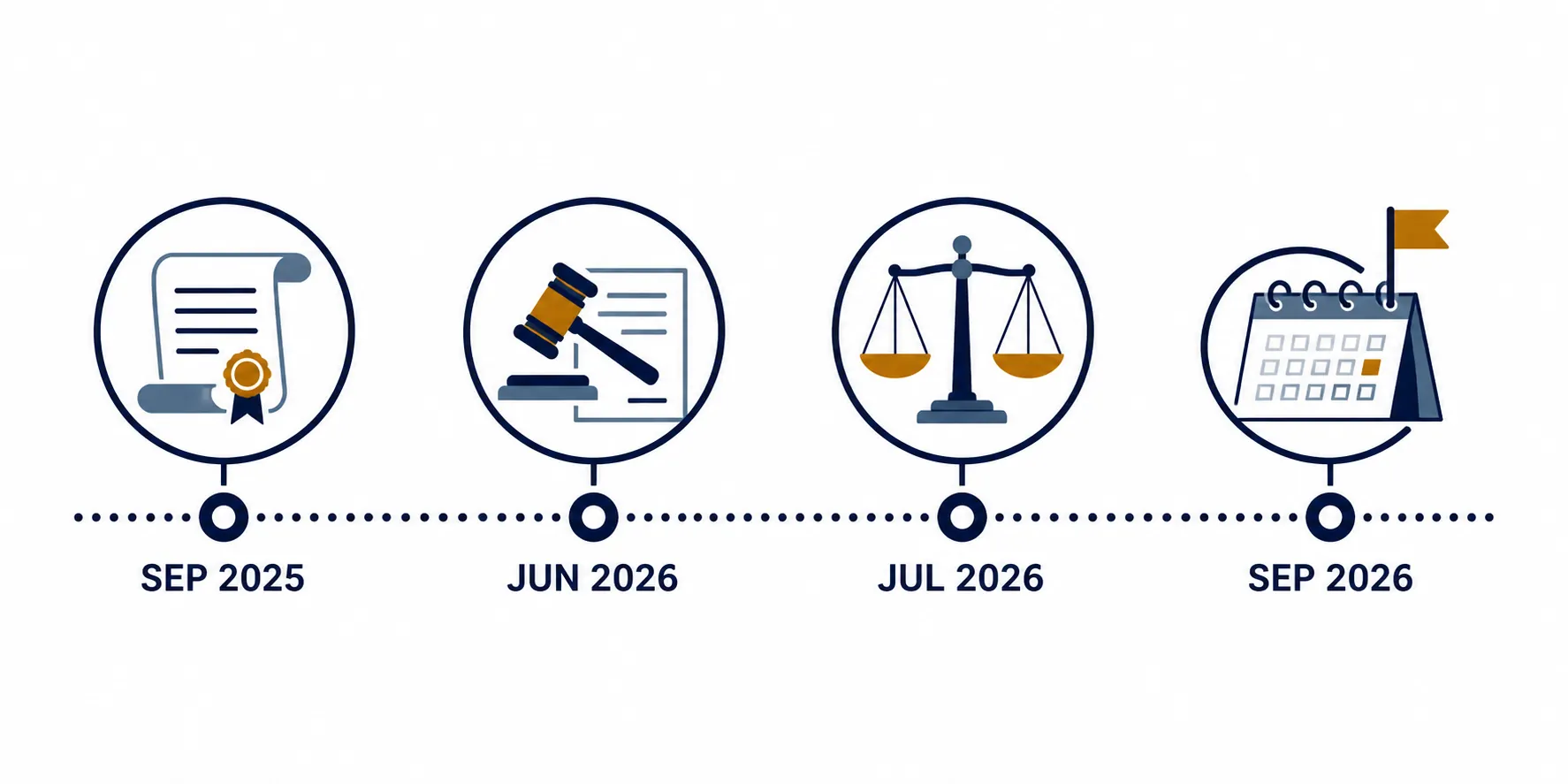
The short timeline that controls today’s answer
Proclamation 10973 was issued on Sept. 19, 2025 and described a restriction tied to H-1B entry and petitions, with an effective date of Sept. 21, 2025 and a 12-month duration unless extended. [4] The fee then faced multiple challenges, but today’s collection status turns on the Massachusetts case.
- Sept. 19, 2025: Proclamation 10973 is issued, setting up the $100,000 H-1B restriction structure and a 12-month window tied to the Sept. 21, 2025 effective date. [4]
- June 8, 2026: The District of Massachusetts vacates the fee policy in State of California v. Noem, holding that the policy imposed an unauthorized tax on H-1B petitions. [1]
- July 24, 2026: The First Circuit denies the government’s request to stay the vacatur pending appeal in State of California v. Mullin. [2]
- July 28, 2026: USCIS updates its H-1B FAQ, making the agency’s operating position visible after the stay denial. [3]
- Sept. 20, 2026: The practical end of the proclamation’s 12-month period arrives unless the administration extends, replaces, or otherwise revives the restriction through a legally effective path. [4]
That is enough chronology for the current filing question. Broader litigation trackers remain useful, especially where separate cases are moving on different records, but they do not displace the current Massachusetts vacatur plus First Circuit stay-denial posture. For the litigation split, see why the fee survived in D.C. but lost in Massachusetts; for a broader case inventory, see the H-1B visa-ban lawsuits tracker.
What a petitioner should and should not do now
For a current H-1B filing, the clean instruction is that the $100,000 proclamation fee is not required under the present posture. The better record entry is not “fee defeated” in isolation; it is “not collectable as of Aug. 25, 2026, based on D. Mass. vacatur, First Circuit stay denial, and USCIS FAQ.” [1][2][3]
The same file note should leave ordinary filing fees alone. The court defeat discussed here concerns the $100,000 proclamation-linked charge, not the regular petition fees that apply under the usual USCIS filing rules. If the question is whether a particular cap-exempt, OPT-related, current-holder, amendment, extension, or consular scenario was ever within the proclamation’s intended reach, do not solve that from the headline. Use the agency FAQ and the relevant scope analysis.
For narrower scope questions, see which filings were never in scope, current H-1B holder eligibility, and the separate proposed-fee status page.
What is still unresolved
The appeal can still change the instruction
The First Circuit denied a stay; it did not issue the final merits decision. [2] That difference matters. A denied stay means the government did not get permission to keep collecting while it appeals. It does not mean the court of appeals has permanently foreclosed every argument the government may make later.
There is also the ordinary possibility of emergency Supreme Court activity if the government seeks it. The current record does not allow a promise that no higher-court order will issue. It does allow the narrower instruction that no such relief has restored the $100,000 collection requirement as of Aug. 25, 2026.
September 20 is a calendar risk, not a refund date
Because Proclamation 10973 used a 12-month frame beginning from its September 2025 effective sequence, Sept. 20, 2026 is the date to keep on the calendar absent an extension. [4] It should not be described as a guaranteed end to the controversy. The administration may try to extend the proclamation, replace it, or rely on a different legal mechanism.
Nor should September be treated as a refund trigger. The June 8 order vacated the fee policy, but it did not create an administrative refund process or direct USCIS to issue refunds. [1] Any refund assessment should be handled as a separate claim analysis, not as a byproduct of the status table.
DHS’s proposed replacement fee is not today’s payment duty
The separate late-August DHS rulemaking path is a different issue from the vacated proclamation fee. Available public-inspection material identifies a proposed replacement fee of $103,265, but that is a proposal, not a current H-1B petition payment obligation. [5]
For counsel and mobility teams, the rulemaking file belongs on the watch list, not in today’s filing-fee calculation. Calendar the comment period from the Federal Register notice itself, not from a client alert or a rounded internal estimate. If the proposal is finalized, the next question will be its effective date, statutory basis, scope, and whether it inherits any of the defects that defeated the $100,000 policy.
A separate D.C. Circuit matter also remains part of the landscape, but it should not be used to override the current Massachusetts-driven filing answer unless it produces operative relief that changes collection. For legislative rather than administrative paths, see the 2025–2026 H-1B green-card and visa pathway bill tracker.
The briefing language to use
A defensible one-page update can say this: “As of Aug. 25, 2026, the $100,000 H-1B proclamation fee is not collectable. The District of Massachusetts vacated the fee policy on June 8, the First Circuit denied the government’s stay request on July 24, and USCIS updated its FAQ on July 28 to reflect the current agency posture. The proclamation itself was not vacated, no refund process was ordered, and the policy may still return through appellate relief, extension, or a separate DHS rulemaking.” [1][2][3][4][5]
That wording gives business teams the instruction they need without promising more than the record supports. Do not collect or submit the $100,000 payment under the current posture. Do not tell workers, clients, or executives that the policy is permanently gone.
References
- Memorandum and Order, State of California v. Noem, No. 1:25-cv-13829 — U.S. District Court for the District of Massachusetts, June 8, 2026
- Order Denying Stay, State of California v. Mullin, No. 26-1699 — U.S. Court of Appeals for the First Circuit, July 24, 2026
- H-1B FAQ — U.S. Citizenship and Immigration Services, July 28, 2026
- Restriction on Entry of Certain Nonimmigrant Workers — The White House, Sept. 19, 2025
- Public Inspection Document 2026-17324 — Federal Register, Aug. 25, 2026
Operationalizing workflow
No workflow has been explicitly linked to this obligation yet. See Workflows generally.
Illustrative cases
No illustrative case is currently tracked for this obligation. See Risk Digest for documented incidents generally.
← Back to RegulationReport a correction or tip
Spotted an outdated figure, a misstated fact, or a ruling this regulation entry should reflect? Public comments are disabled for this content given the professional cost of a misreported case outcome, penalty amount, or rule text — use the structured correction channel instead.
Report a correction or tip for this record →