
What legal basis supports Italy's Schengen suspension?
- Authority
- European Parliament and Council of the European Union
- Rule type
- regulation
- Jurisdiction scope
- EU
- Effective date
- Aug 1, 2026
- Source text
- Read primary rule text ↗
Italy must justify temporary internal border checks under the amended Schengen Borders Code and notify the European Parliament, Council, Commission, and Member States.
Verification answer
Italy’s reported one-month air and sea checks on arrivals from Spain are not supported by a free-standing legal category called a “Schengen suspension with Spain.” The legal basis, if the measure is validly introduced, is the amended Schengen Borders Code: Article 25(1)(c) for the asserted serious threat, Article 25a for the unforeseeable-threat route, Article 26 for necessity and proportionality, Articles 25a(2) and 27(1) for notification, and Article 27a for Commission scrutiny and consultation. Article 25a gives an initial maximum of one month for an unforeseeable serious threat, with a three-month total ceiling for the same threat; the longer foreseeable-threat route is a different track with different timing. [1][2]
That answers only the route. It does not yet prove compliance. Reuters reported that Italy would apply the checks from 1 August 2026 for one month in response to the Ceuta crisis. [3] As of the 1 August 2026 verification point, the Commission registry did not list a new Italy–Spain temporary reintroduction entry, and the Guardian reported the Commission’s position that Italy had not yet notified the measure. [4][5] Until Italy’s Article 25a/Article 27 notification and Article 26 assessment are public or otherwise confirmed, the measure remains a reported Italian measure rather than a confirmed legal filing.
| Record field | Verification status |
|---|---|
| Authority invoked | Amended Schengen Borders Code; likely Article 25a unforeseeable-threat track linked to Article 25(1)(c), but the article Italy formally invoked was not confirmed in the public record as of 1 August 2026. [1][2][5] |
| Rule type | Temporary reintroduction of internal border control, not termination of Schengen free movement generally. [1] |
| Jurisdiction scope | Italy’s checks on arrivals from Spain, reported in the air and sea context. [3] |
| Measure scope | Reported as targeted/selective checks on third-country nationals arriving from Spain; traveler-document consequences are treated separately in the site’s travel-scope record. [3] |
| Effective date and stated duration | Reported start: 1 August 2026; stated duration: one month. [3] |
| Last verified publication status | No corresponding Italy–Spain entry appeared in the Commission temporary-reintroduction registry at the 1 August verification point; the Commission’s not-yet-notified position was reported, not adjudicated. [4][5] |
| Use of this record | Legal-basis verification for reporting, briefing, and knowledge-management purposes; not legal advice. |

For the baseline amended-Code framework, see What Rules and Conditions Govern Schengen Suspension? This record applies that framework to the live Italy–Spain measure and the Ceuta/Melilla trigger problem.
How the amended Code maps onto Italy’s reported measure
The useful way to read the measure is article by article, because each article answers a different compliance question. Article 25(1)(c) is the possible trigger. Article 25a supplies the emergency clock. Article 26 asks whether the check is a last-resort and proportionate response. Articles 25a(2) and 27(1) determine what must be notified and to whom. Article 27a is where Commission scrutiny and consultations enter. [1][2]
| Provision | Function in the Italy measure | What must be visible for compliance |
|---|---|---|
| Article 25(1)(c) | Possible public-policy/internal-security trigger based on sudden large-scale unauthorized movements of third-country nationals between Member States. | Italy would need to identify the serious threat and explain why the Ceuta-related movement qualifies as movement between Member States despite the Ceuta/Melilla special regime. [1] |
| Article 25a(1)–(4) | Unforeseeable-threat route for immediate reintroduction of internal border control. | A one-month initial period fits this route’s first cap; renewals for the same threat cannot exceed the three-month total ceiling. [1][2] |
| Article 25a(5)–(6) | Separate foreseeable-threat route. | Not the natural route for a measure reported as an urgent one-month response. The foreseeable route can run longer, up to two years, and only in a major exceptional situation may it reach three years. [1][2] |
| Article 26 | Necessity, proportionality, last-resort assessment. | Italy must show why internal border checks are appropriate and necessary, and why less intrusive tools are insufficient, including police checks under Article 23, the Article 23a transfer procedure, and Article 21a travel-restriction tools where relevant. [1] |
| Articles 25a(2) and 27(1) | Notification architecture. | Italy must notify the European Parliament, Council, Commission, and other Member States at the relevant time and include the reasons, scope, crossing points, date, duration, and any expected measures by other Member States. [1][2] |
| Article 27a | Scrutiny and consultation mechanism. | The Commission may issue an opinion, and consultations become mandatory in the circumstances set out by the Code, including where the directly affected Member State requests them. [1][2] |
The one-month duration is the cleanest part of the reported measure. If Italy is using the unforeseeable-threat route, Article 25a permits a first period of no more than one month. That does not make the measure lawful by itself; it merely means the reported duration is not facially outside the emergency clock. The hard question is whether the same threat can lawfully be characterized under Article 25(1)(c) and whether the Article 26 assessment can carry the weight.
The difference between the one-month emergency route and the foreseeable-threat route matters because the Code does not treat all internal border controls as one renewable pool. A state facing an unforeseeable serious threat may move quickly, but the same urgency shortens the permissible period. A state relying on a foreseeable threat has more time available only because it must follow the longer-notice architecture attached to that route. [1][2]
For Italy, Article 26 is where the paperwork should become specific. A compliant assessment would not simply say that the Ceuta event was grave. It would have to explain why checks on air and sea arrivals from Spain are suitable to address the identified threat, why the territorial and personal scope is no broader than necessary, what effects the checks have on movement within the area without internal border control, and why the Code’s other tools would not adequately address the same risk. [1]
That is also why the notification gap is not clerical trivia. Article 27(1) is the public record’s handle on the state’s legal theory: the reasons, the internal-border sections affected, crossing points, dates, duration, and any measures expected of other Member States. Without that filing, a reader can see a reported policy and the Code provisions that might support it, but cannot verify which provision Italy actually invoked or how Italy satisfied the necessity-and-proportionality test. [1][4][5]
For the operational traveler-facing scope of the reported checks, including who is likely to be checked and what documents matter at air and sea arrival points, see What Italy’s Schengen Suspension Means for Travel to Spain. This record stays with the legal basis and notification status.
The Ceuta/Melilla problem with Article 25(1)(c)
The weak point is not that Italy acted for one month. The weak point is whether Article 25(1)(c) is available at all on the reported facts. That provision is framed around sudden large-scale unauthorized movements of third-country nationals between Member States. Ceuta and Melilla make that phrase do more work than it would in an ordinary internal-border case.
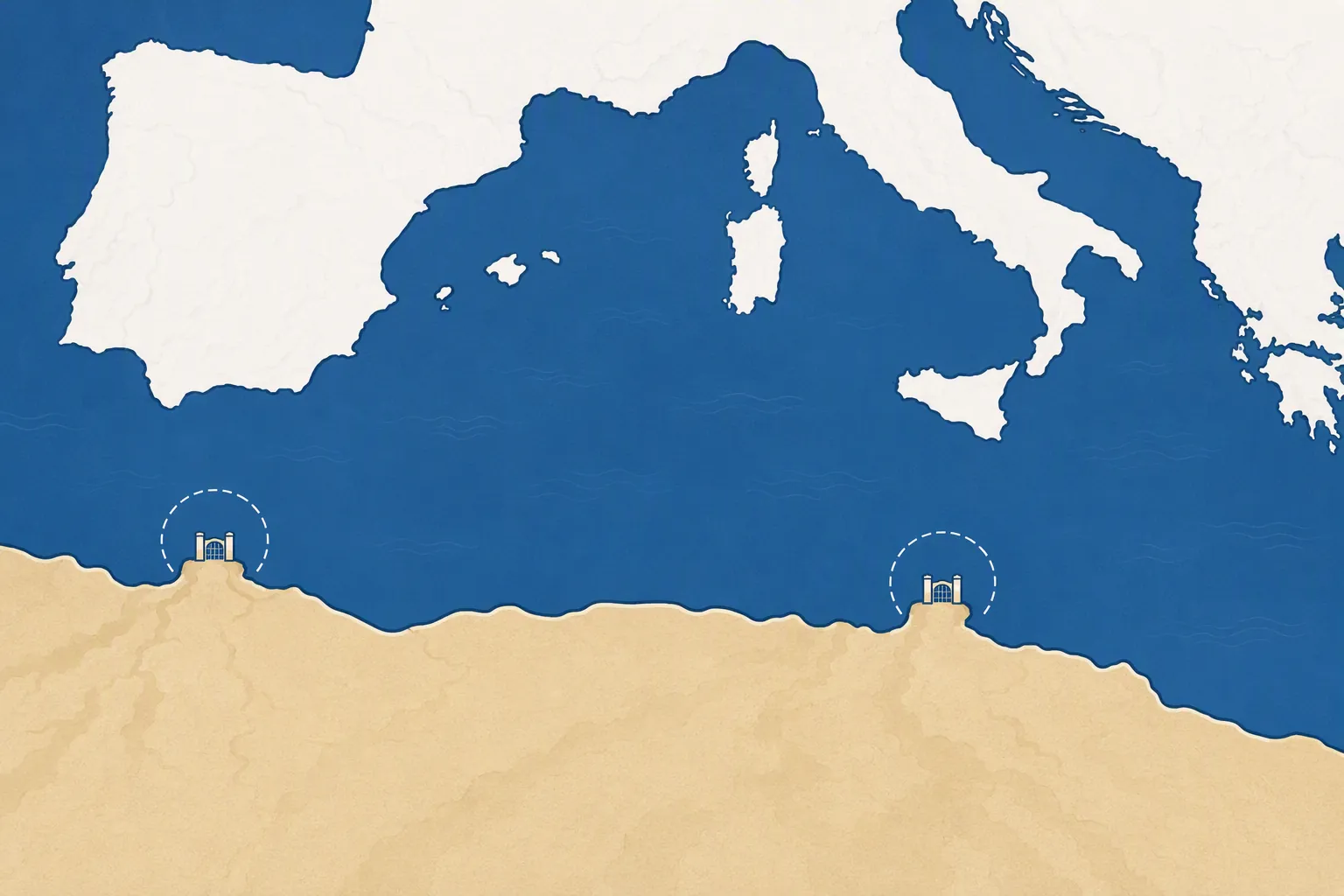
Article 41 preserves Spain’s special rules for Ceuta and Melilla. The practical point, as reported from the Commission spokesperson, is that “there is border control between Ceuta and Melilla and the rest of the Schengen area.” [5] That statement is not a court ruling, but it aligns with the text of the special-regime provision: the enclaves are not treated as ordinary points inside the Schengen free-movement space for third-country nationals in the same way as mainland Spain. [1]
That matters for Italy’s trigger. If the immediate movement was from Morocco into Spanish enclaves, and movement from those enclaves to mainland Spain remains subject to control, Italy has to bridge a legal gap before it can describe the situation as sudden large-scale unauthorized movements between Member States. It may point to an onward-travel risk through Spanish air or sea routes, but that is the kind of bridge the Article 26 assessment and Article 27 notification should make visible.
The crisis figures explain the political urgency, not the legal hook. Reuters reported Spanish Interior Ministry figures of 49,000 people crossing in a day, while Le Monde reported European leaders reacting after 60,000 migrants crossed into the enclave. [6][7] Reported death tolls also varied across coverage. Those conflicts should not be ironed into a single neat number for the legal record; the compliance issue is whether the Code’s trigger and assessment requirements are met.
For the underlying domestic trigger event and enforcement vacuum, see How a Supreme Court ruling triggered the Ceuta border crisis. The present question is narrower: whether that event can support Italy’s internal-border-control route under the amended Code.
What Italy’s filing would need to show
A confirmed filing would not need to persuade every later reviewer in advance. It would need to make the statutory sequence traceable. On the present record, these are the items that would matter most:
- The article invoked: whether Italy expressly relies on Article 25(1)(c), and whether it frames the measure under Article 25a’s unforeseeable-threat route rather than the foreseeable-threat route.
- The threat narrative: why the Ceuta-related situation is said to create a serious threat to public policy or internal security in Italy, not only in Spain or at the external border.
- The Article 41 bridge: how Italy treats the Ceuta/Melilla special regime and the Commission’s reported position that controls remain between the enclaves and the rest of the Schengen area.
- The Article 26 assessment: why targeted air and sea checks are necessary and proportionate, and why police checks, transfer tools, travel-restriction tools, or cooperation with Spain would not sufficiently address the same risk.
- The scope: which arrival routes, ports, airports, categories of travelers, and time period are covered, and why those choices are no broader than necessary.
- The notification path: simultaneous notice to the European Parliament, Council, Commission, and Member States, followed by any Article 27a scrutiny or consultation, especially if Spain requests consultation as the directly affected Member State.
Until those elements are available, the most that can be verified is a plausible legal route, not completed compliance. The missing item is not merely an Italian press line. It is the notification and assessment that let other institutions test whether the urgent measure stayed within the amended Code’s sequence. [1][2][4][5]
Commission posture and copycat pressure do not change the basis
The Commission’s recent posture makes the notification gap more consequential. In June 2026, the Commission issued opinions telling nine Member States that prolonged internal border controls should phase out. [8] That does not decide Italy’s case, which was reported as a new one-month emergency measure, but it shows the institutional setting in which prolonged or weakly justified controls are being examined.
The political pressure was also broader than Italy. Euronews reported on 1 August 2026 that 22 EU leaders called for emergency talks over the Ceuta migrant crisis. [9] That matters for copycat-risk analysis. It does not supply a separate legal basis for any Member State. Each internal-border measure still has to fit the amended Code, state its trigger, respect the relevant duration cap, and survive the Article 26 assessment.
As of 1 August 2026, Italy had a plausible exclusive route only under the amended Schengen Borders Code’s Article 25a emergency track. The reported one-month period fits that track’s initial cap, but the Article 41 special regime makes the Article 25(1)(c) trigger doubtful, and without a published or otherwise confirmed Article 25a/Article 27 notification and Article 26 assessment, compliance remained unverified. [1][2][4][5]
References
- Consolidated text: Regulation (EU) 2016/399 of the European Parliament and of the Council of 9 March 2016 on a Union Code on the rules governing the movement of persons across borders (Schengen Borders Code), EUR-Lex, 12 October 2025
- Regulation (EU) 2024/1717 of the European Parliament and of the Council of 13 June 2024 amending Regulation (EU) 2016/399 on a Union Code on the rules governing the movement of persons across borders, EUR-Lex, 20 June 2024
- Italy suspends EU Schengen free travel pact with Spain over Ceuta crisis, Reuters, 31 July 2026
- Temporary Reintroduction of Border Control, European Commission
- Ceuta, Spain, Morocco and Italy migration Schengen Europe latest news updates, The Guardian, 31 July–1 August 2026
- Spain, Morocco halt deadly rush to Spanish enclave after 49,000 cross in a day, Reuters, 31 July 2026
- European leaders react as 60,000 migrants cross border into Spanish enclave, Le Monde, 31 July 2026
- Commission: Internal Border Controls by Nine Member States Should Phase Out, eucrim, 17 July 2026
- 22 EU leaders call for emergency talks over Ceuta migrant crisis, Euronews, 1 August 2026
Operationalizing workflow
No workflow has been explicitly linked to this obligation yet. See Workflows generally.
Illustrative cases
No illustrative case is currently tracked for this obligation. See Risk Digest for documented incidents generally.
← Back to RegulationReport a correction or tip
Spotted an outdated figure, a misstated fact, or a ruling this regulation entry should reflect? Public comments are disabled for this content given the professional cost of a misreported case outcome, penalty amount, or rule text — use the structured correction channel instead.
Report a correction or tip for this record →