
Kentucky's Special Election Law for Senate Vacancies
- Authority
- Kentucky General Assembly
- Rule type
- statute
- Jurisdiction scope
- US state
- Effective date
- Apr 12, 2024
- Source text
- Read primary rule text ↗
Senate vacancies filled only by special election; no gubernatorial appointment or temporary appointee.
Regulation & Ethics / obligations record. Last verified: August 1, 2026, 00:00 UTC. Reviewed for legal-source handling by Mira Patel, J.D. This article is an informational statutory record, not legal advice, and should not be used as a filing calendar without direct verification of the live Kentucky Revised Statutes text.

Primary-source box
- Enacted law record: 24RS HB 622 — Legislative Research Commission [1]
- Special-election proclamation statute: KRS 118.720 [2]
- Delivery of proclamations and writs to sheriffs: KRS 118.740 [3]
- Nomination-petition and certificate filing deadline: KRS 118.770 [4]
- Potential constitutional tension: Kentucky Constitution, Section 152 [5]
Kentucky’s current U.S. Senate vacancy process starts with HB 622. The operative answer is plain at the statutory level: Kentucky no longer uses a gubernatorial appointment or temporary appointment mechanism for a U.S. Senate vacancy. HB 622 repealed KRS 63.200 and rewrote the vacancy process so the seat is filled by special election, and the elected person serves the remainder of the unexpired term [1][2].
That answer is narrower than many older explainers suggest. A current Kentucky answer should not rely on stale descriptions of a governor selecting a replacement, nor on older national vacancy charts that use an 80-to-150-day frame for Kentucky. Those descriptions do not carry the present statute after HB 622.
What HB 622 changed
HB 622 was enacted in the 2024 Regular Session. The Legislative Research Commission record shows the bill became law after Governor Andy Beshear’s veto was overridden, with override votes of 81–17 in the House and 29–5 in the Senate, and an effective date of April 12, 2024 [1].
The Kentucky Bar Association’s 2024 legislative update describes the same practical change: the prior appointment structure was removed, and a U.S. Senate vacancy is to be filled by special election [6]. The point matters because Kentucky had recently used a different statutory model. In 2021, Kentucky adopted a party-list appointment mechanism for Senate vacancies; HB 622 superseded that structure for the current process [1][6].
The result is administratively awkward but legally important: if a U.S. Senate vacancy occurs before the special election winner is seated, Kentucky would have only one sitting U.S. senator during the vacancy period. The current statute does not supply a temporary appointee to occupy the seat in the interim [1][2].
The deadline chain that actually has to work
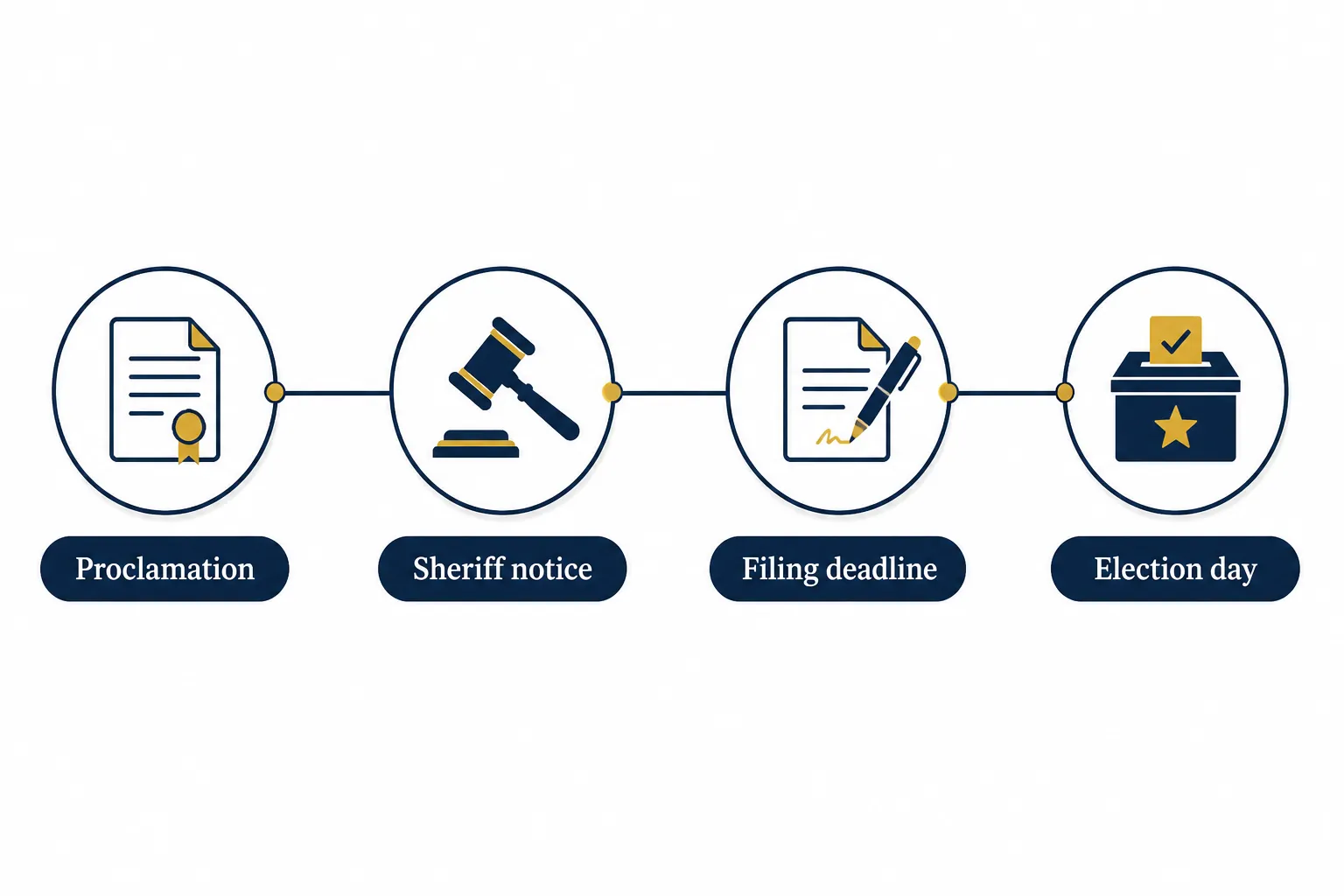
The center of the record is not the politics of the possible vacancy. It is the short chain of statutory acts that must be timed backward from election day. The current KRS pages should be checked directly in a browser before publication or filing use, because the LRC statute pages are JavaScript-rendered and the full live statutory text was not available in the captured source set.
| Authority | Actor or record point | Required action | Deadline status in the cited materials |
|---|---|---|---|
| KRS 118.720 | Governor / special-election proclamation process | A special election is called to fill the U.S. Senate vacancy; the winner fills the remainder of the unexpired term. | The statute supplies the special-election mechanism but, on the materials reviewed here, does not itself resolve every downstream deadline question [2]. |
| KRS 118.740 | Delivery of proclamations and writs to sheriffs | Copies of election proclamations or writs must be delivered to sheriffs. | LRC-linked and secondary materials report a 63-days-before-election delivery rule, but a conflicting 56-day figure appears in one 2026 explainer; verify the live text directly [3][6][7]. |
| KRS 118.770 | Candidates / nominating authorities | Petitions or certificates of nomination must be filed for the special election. | The cited statutory record and current explainers identify a 56-days-before-election filing cutoff [4][7][8]. |
| Kentucky Constitution Section 152 | Governor / constitutional vacancy rule | Section 152 addresses appointments to fill vacancies in offices to be filled by the vote of the whole state. | The interaction between this provision and HB 622’s special-election-only structure has not been tested in this U.S. Senate context [5][7]. |
The discrepancy is not cosmetic. If the special election is held on November 3, 2026, 63 days before election day falls on September 1, 2026. Fifty-six days before election day falls on September 8, 2026. A seven-day difference is enough to affect a proclamation-delivery task, a candidate filing plan, or a news report that tells readers when the state must act.
Newsweek also reports a 49-day sheriff-notice figure in the same live 2026 discussion [7]. That figure should not be blended into the 56-day filing deadline or the 63-day proclamation-delivery account. It should be treated as a separate reported number requiring direct confirmation against the current KRS text before anyone converts it into a calendar instruction.
The cleanest working rule for a lawyer or editor is therefore not “Kentucky has a 56-day deadline” or “Kentucky has a 63-day deadline.” The clean working rule is: HB 622 created a special-election-only process; KRS 118.720, 118.740, and 118.770 must be read together; the live text must be verified because current secondary accounts conflict on the sheriff/proclamation side of the chain [1][2][3][4][7][8].
Where the 2026 McConnell scenario sits on the calendar
The 2026 stress test exists because a possible vacancy involving Senator Mitch McConnell would collide with a general-election calendar that is already close. Current 2026 explainers frame August 3, 2026 as the date three months before the November 3, 2026 general election, and September 8, 2026 as the 56-days-before-election point [7][8].
| Date | Calendar position | Why it matters |
|---|---|---|
| August 1, 2026 | Last verification date for this record | The August 3 date is two days away, so the record should be treated as live rather than archival. |
| August 3, 2026 | Three months before the November 3 general election | This is the date current reporting ties to the Section 152 timing issue and Governor Beshear’s public comments [7]. |
| September 1, 2026 | 63 days before November 3 | This is the date that would matter if the 63-day proclamation-delivery reading controls [3][6]. |
| September 8, 2026 | 56 days before November 3 | This is the filing cutoff identified for nomination petitions and certificates, and it is also the conflicting proclamation figure in some reporting [4][7][8]. |
| November 3, 2026 | General election day | A special election could be synchronized with this date if the statutory and constitutional prerequisites are satisfied; the statute itself still has to be applied to the actual vacancy date and proclamation record [2]. |
The calendar should be read backward, not narrated as a generic election timeline. If November 3 is the target election day, the September cutoffs become hard practical constraints. If the relevant action is constitutionally or statutorily required earlier, the August 3 point becomes more than a talking point. It becomes the date around which litigants, election officials, and campaigns may argue about whether the new statute can operate as written.
The Section 152 problem is unresolved
Kentucky Constitution Section 152 says that vacancies in offices to be filled by the vote of the whole state are filled by gubernatorial appointment until a successor is elected, with timing rules tied to the next regular election [5]. HB 622, by contrast, removes the statutory appointment mechanism for a U.S. Senate vacancy and sends the vacancy to a special election [1][2].
That is the legal tension. It should not be reported as though a court has already decided it. Newsweek’s 2026 coverage cites University of Kentucky election-law professor Joshua Douglas for the expectation that litigation would follow if the vacancy scenario actually triggers the conflict [7]. That is a litigation-risk assessment in a live setting, not a holding.
A careful public answer should therefore separate three things: what HB 622 currently says, what Section 152 says, and what a court might do if asked to reconcile them. The first two are primary-source propositions. The third is untested.
Kentucky is unusual, but the national count is secondary here
For national context, the Congressional Research Service’s July 16, 2024 In Focus report lists five states that fill U.S. Senate vacancies only by special election: Kentucky, North Dakota, Oregon, Rhode Island, and Wisconsin. The same CRS report describes the other 45 states as allowing gubernatorial appointments, with variation in how temporary appointees are chosen and how long they serve [9].
Some current public-facing summaries describe the special-election-only group as four states rather than five [7][10]. That discrepancy is worth flagging, but it should not distract from the Kentucky task. CRS is sufficient here as a comparator; the Kentucky rule depends on HB 622 and the current KRS, not on how a national chart classifies Oregon on a given page.
Older Kentucky examples explain the change, not the current rule
Kentucky has not always operated under this special-election-only model. In 1974, Senator Marlow Cook resigned and Wendell Ford was appointed to the seat, a historical example cited in Kentucky coverage of the current vacancy question [11]. That precedent is useful only as history. It does not supply the operative 2026 rule after HB 622.
The same is true of the 2021 party-list appointment model. It helps explain why HB 622 drew attention, but it is not the current filing calendar. The current analysis begins with the 2024 act and the amended KRS sections [1][2][3][4].
Current status as of August 1, 2026
As of this record’s verification time, the cited 2026 materials discuss a possible vacancy scenario involving Senator McConnell; they do not report a vacancy-triggering event, a gubernatorial proclamation under KRS 118.720, or a filed lawsuit resolving the Section 152 issue [7][8][10][11].
That status can change quickly. The important point for present use is that Kentucky’s process is not routine administration in 2026. The special-election-only statute is new, the deadline chain contains report-level discrepancies that require primary verification, and the constitutional issue has not yet been tested.
Related verification records
- For another Regulation & Ethics obligations-tracker format, see AI Literacy in Schools Becomes a Legal Requirement.
- For a citation-checking workflow that applies when statutes have been amended or repealed, see What to Ask a San Jose Bicycle Accident Lawyer.
- For the broader risk of relying on AI-assisted legal summaries without primary-source checking, see Hank Green's ChatGPT Research Is a Legal Red Flag and GPT-5.6 Leads DeepSeek V4 on Legal Research, Neither Is Safe.
References
- 24RS HB 622 — Legislative Research Commission, Legislative Research Commission.
- KRS 118.720 — Proclamation for special election..., Legislative Research Commission.
- KRS 118.740 — Delivery of proclamations and writs to sheriffs, Legislative Research Commission.
- KRS 118.770 — Time for filing petitions..., Legislative Research Commission.
- Kentucky Constitution, Section 152 — Vacancies, Legislative Research Commission.
- Legislative Update 2024, Kentucky Bar Association.
- One Date Could Determine How Kentucky Replaces Mitch McConnell, Newsweek.
- What Kentucky law says about filling a US Senate vacancy, Louisville Courier Journal.
- U.S. Senate Vacancies: How Are They Filled? (CRS In Focus IF11907, updated July 16, 2024), Congressional Research Service, July 16, 2024.
- What happens if Mitch McConnell is unable to finish his US Senate term?, Al Jazeera.
- Senate vacancy procedure, Spectrum News 1.
Operationalizing workflow
No workflow has been explicitly linked to this obligation yet. See Workflows generally.
Illustrative cases
No illustrative case is currently tracked for this obligation. See Risk Digest for documented incidents generally.
← Back to RegulationReport a correction or tip
Spotted an outdated figure, a misstated fact, or a ruling this regulation entry should reflect? Public comments are disabled for this content given the professional cost of a misreported case outcome, penalty amount, or rule text — use the structured correction channel instead.
Report a correction or tip for this record →