
Hank Green's ChatGPT Research Is a Legal Red Flag
Hank Green's admission that he relied on ChatGPT for research triggered a backlash, a possible channel pause, and episodes pulled for fact-checking — the same unverified-AI pattern behind Rule 11 sanctions and ABA Formal Opinion 512 obligations in legal practice. 'Research only' is no risk defense: lawyers should subject AI-generated research notes to the same independent verification they already apply to filed citations.
- Jurisdiction
- United States
- Court
- No court proceeding
- AI tool named
- ChatGPT
- Ruling date
- Jul 29, 2026
- Source document
- View primary court order ↗
- Last verified
- Aug 1, 2026
Lex Machina Review is an independent risk-tracking and reference resource. Nothing on this site is legal advice, and using it does not create an attorney-client relationship. Every record is reviewed against primary sources but may not reflect the most current status of a matter — always verify directly against the cited court order, rule text, or a licensed attorney before relying on it.
Companion explanation — secondary to the source document above
The visible failure in the Hank Green ChatGPT AI script controversy was not an abstract warning about artificial intelligence. It was a production-room leak: prompt-feedback language apparently made it far enough into a script that viewers could see the research process poking through the finished product. Coverage of the episode describes on-screen or script-note fact-check cards involving claims about cat saliva and grooming, mantis shrimp vision, and artificial sweeteners; Green then faced backlash over relying on ChatGPT for research, said the channel may need to pause, and Complexly episodes were pulled for fact-checking. [1][2][3][4]
The timeline should be handled with some restraint. Kotaku described the relevant episode as posted July 29, while Dexerto described it as posted July 30. [2][3] Green’s original X post was later deleted, and several apology or explanation quotes now circulate through secondary coverage rather than the original post itself. [2][4] That does not erase the core event, but it matters for how far anyone should narrate motive, sequence, or admission.

As of August 1, 2026, I have not located a lawsuit, bar complaint, FTC action, or comparable legal proceeding against Green arising from this controversy. That is a negative search finding, not a docket-wide clearance certificate. It is also why the legal implications are best understood as a workflow warning rather than as a liability precedent. The useful question is not whether Green is sincere, or whether creators deserve a public pile-on. The useful question is whether “only for research” changes the duty to verify before a claim reaches an audience, a client, a court, or a regulator.
“Only for research” is where the risk usually starts
The phrase sounds modest. It suggests that the machine was not the author, not the decision-maker, not the final authority. In practice, research notes are often the first place a bad assertion becomes sticky. A draft claim gets framed around them. A follow-up question assumes them. A script or brief allocates space to them. Someone downstream then has to decide whether the output is a lead, a source, a fact, or a sentence already halfway to publication.
That is what makes the Green episode more relevant to legal practice than the usual “AI hallucination” morality play. The apparent failure mode was visible at the seam between research and script. Viewers were not merely told that ChatGPT can be wrong. They saw traces of a process in which AI-assisted factual prompts had entered the production path closely enough to require public cleanup. [1][4]
Lawyers do not need to be anti-AI to treat that seam as dangerous. A litigation team can use a model to brainstorm search terms, summarize a transcript, generate a first-pass research plan, or identify issues for human review. The risk changes when machine output begins to shape a representation before anyone has checked it against a reliable source. At that point, “research” is no longer private exploration. It is pre-publication influence.
Mata v. Avianca is the hard version of the same habit
The closest legal analogy is still Mata v. Avianca, the 2023 Southern District of New York sanctions decision arising from ChatGPT-generated legal citations. The court imposed a $5,000 Rule 11 sanction after fabricated cases made their way into a filed submission; the opinion also found subjective bad faith and described part of the submitted analysis as “gibberish.” [5]
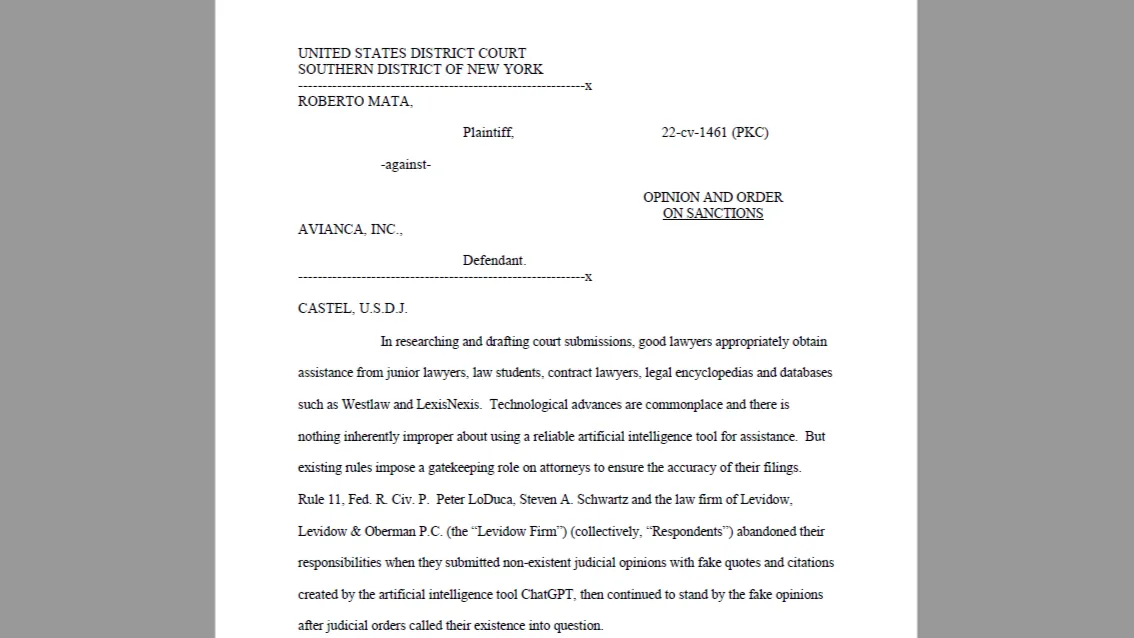
The easy, and wrong, lesson from Mata is that lawyers should not let ChatGPT write briefs. The more precise lesson is narrower and more durable: fabricated legal material survived long enough to be filed. Rule 11 did not care that the initial act could be characterized as research, drafting assistance, or technological experimentation. The certification problem arose when counsel presented legal authorities to the court without having done the ordinary work of confirming that those authorities existed and supported the propositions offered.
That distinction matters for law-firm AI policies. A prohibition on “AI-written briefs” may leave the actual risk untouched if lawyers are still allowed to paste AI-generated case lists, quotations, procedural histories, or statutory summaries into working drafts without source-level verification. A model does not need to draft the final brief to contaminate it. It only needs to supply the unverified premise around which a human later writes.
The same pattern shows up in the sanction incidents tracked in AI verification and sanctions coverage and in more practice-specific records such as AI hallucination sanctions in Social Security litigation. The recurring issue is not theatrical dependence on a chatbot. It is the duller institutional failure: no one stopped the output at the checkpoint where a citation, quote, or factual assertion still could have been repaired cheaply.
ABA Formal Opinion 512 does not give research notes a free pass
The American Bar Association’s Formal Opinion 512, issued July 29, 2024, was its first generative-AI ethics guidance for lawyers. The ABA framed the opinion through familiar professional duties, including competence, confidentiality, client communication, fees, candor to tribunals, and supervision under the Model Rules. [6] UNC Law Library’s analysis of the opinion likewise treats it as a paradigm for fitting generative AI into existing legal-ethics obligations rather than as a special AI-only code. [7]
That is why the “research only” defense does not travel well into legal practice. Competence is implicated if a lawyer does not understand enough about the tool to know that outputs require verification. Confidentiality is implicated if client information is placed into a system without adequate protection or authorization. Communication may be implicated when the use of a tool is material to the representation or client decision-making. Fees are implicated if a client is charged for inefficient or duplicative AI-assisted work. Candor is implicated if AI-shaped errors reach a tribunal. Supervision is implicated if lawyers or nonlawyer staff are allowed to use the tool without procedures that catch foreseeable errors.
| AI use label | Professional-duty question that still has to be answered |
|---|---|
| Research | Was each factual or legal proposition checked against an authoritative source before it affected advice, a filing, or a public assertion? |
| Summarization | Did someone compare the summary to the underlying document, transcript, record, or cited material? |
| Drafting | Did a responsible lawyer review the output for legal accuracy, factual support, tone, confidentiality, and tribunal obligations? |
| Brainstorming | Were generated theories treated as leads rather than as conclusions? |
| Citation assistance | Were existence, jurisdiction, quotation accuracy, procedural posture, and proposition support independently confirmed? |
A firm policy that stops at “do not file AI-generated text without review” is therefore too late in the process. The review has to attach before the generated research changes the document’s architecture. Once a lawyer has built an argument around a nonexistent case, a distorted holding, or an unsupported empirical claim, cite-checking becomes excavation. The person doing it is no longer just confirming accuracy; she is unwinding the draft’s load-bearing structure.
For teams building procedures, the better route is to separate ethics permissions from accuracy controls. A tool may be permissible to use and still unsafe to trust. The pre-filing pass described in AI verification workflow guidance and jurisdiction-specific records such as the Connecticut AI verification duty analysis should happen at the claim level, not merely at the document level.
The benchmark evidence supports caution, not product panic
The Stanford RegLab and HAI benchmark work is useful here because it gives the verification discussion some weight without pretending that every AI tool fails in the same way. In published 2024 studies, general-purpose large language models hallucinated on 58% to 82% of legal queries. Legal-specific tools performed better but still produced nontrivial hallucination rates: Lexis+ AI and Ask Practical Law AI were reported above 17%, while Westlaw AI-Assisted Research was reported above 34%. [8]
Those numbers should not be used as live August 2026 product scores. Vendors change systems, retrieval layers, interfaces, warnings, and evaluation methods. The narrower point is stronger: even legal-specific systems in the cited studies produced errors often enough that a lawyer cannot treat generated research as presumptively safe. General models performed worse in those studies, but the professional duty does not turn on whether a product is general or specialized. It turns on whether the lawyer verified the output before using it.
That is also the practical lesson from tool evaluations such as strict legal-research benchmark records and procurement-focused reviews such as the Dunia AI funding and verification-gap analysis. Better performance can reduce workload. It does not relocate responsibility from the lawyer to the system.
What verification has to mean before the claim moves
A useful AI research workflow does not need a ceremonial ban. It needs a hard boundary between generated leads and usable assertions. Before an AI-assisted research note affects a claim, citation, client communication, or filing, someone has to identify the underlying source and compare the proposed proposition to that source.
- For a case citation: confirm the case exists, the court and date are correct, the procedural posture is accurate, the quoted language appears in the opinion, and the cited passage supports the proposition.
- For a statute, rule, regulation, or standing order: confirm the current text, effective date, jurisdiction, and any local amendments or judge-specific requirements.
- For a factual claim: identify the primary or otherwise reliable source, check whether the number or statement measures what the draft says it measures, and preserve the source path.
- For a summary of client materials: compare the summary against the record, note omissions that matter, and avoid sending the generated version to anyone who might treat it as reviewed work product before that comparison is complete.
- For a public-facing script, alert, presentation, or client memo: assign a human reviewer to the claims that came from AI-generated notes, not just to grammar or tone.
The reviewer also has to know what she is reviewing. If AI-generated material is blended into a draft without being marked, the verification task becomes guesswork. A clean workflow tags AI-originated research notes at intake, records the source ultimately used to verify or reject them, and prevents unverified notes from being promoted into a final claim. That is not bureaucracy for its own sake. It is how a partner, supervising lawyer, fact-checker, or knowledge-management team avoids discovering the problem only after publication or filing.
This is where the Green controversy and the lawyer-sanctions cases part company. Green’s apparent consequence, based on the located coverage, is reputational and operational: backlash, a possible pause, and fact-checking cleanup. [1][2] A lawyer’s version can become Rule 11 exposure, an ethics problem under the duties mapped in Formal Opinion 512, a court standing-order violation, or an expensive client explanation. The underlying habit is the same: unverified machine output was allowed to influence what someone else was asked to believe.
The legal relevance stops there. The Hank Green episode does not create a new liability rule, and the available record does not support speculation about lawsuits or agency action. It does clarify the operational line lawyers should already be enforcing. Using AI for research is not the red flag by itself. Allowing unverified AI research to shape assertions is.
References
- Hank Green says his YouTube channel may need to pause after admitting to relying on AI for research — The Verge
- Famous Science YouTuber Admits He Has 'Unhealthy Relationship' With AI After Facing Backlash Over Recent Video — Kotaku
- Hank Green faces major backlash after admitting he used ChatGPT to research YouTube script — Dexerto
- Hank Green admits using ChatGPT after accidentally reading AI prompt feedback left in his script — Tribune
- Mata v. Avianca, Inc. — Wikipedia
- ABA issues first ethics guidance on a lawyer’s use of AI tools — American Bar Association, July 29, 2024
- ABA Formal Opinion 512: The Paradigm for Generative AI in Legal Practice — UNC Law Library, February 2025
- AI on Trial: Legal Models Hallucinate in 1 out of 6 (or More) Benchmarking Queries — Stanford HAI
Related records
Tool profile
How to Read Legal AI Benchmarks Ahead of the OpenAI IPOGoverning regulation
Browse the obligations tracker →Preventive workflow
Browse verification workflows →
Report a correction or tip
Spotted an outdated figure, a misstated fact, or a ruling this case record should reflect? Public comments are disabled for this content given the professional cost of a misreported case outcome, penalty amount, or rule text — use the structured correction channel instead.
Report a correction or tip for this record →