
Can the Military Ban Veterans' Social Media Speech?
- Authority
- U.S. Congress
- Rule type
- statute
- Jurisdiction scope
- US federal
- Source text
- Read primary rule text ↗
Personal-speech punishment under UCMJ Articles 88, 133, and 134 requires a concrete military nexus; separated veterans generally remain outside the chain of command and have the strongest First Amendment protection.
Last verified: 2026-08-02. Category: Regulation & Ethics. This is a legal-risk tracker, not legal advice; status, forum, device ownership, command relationship, and the exact charging theory can change the answer.
There is no single “military social media ban.” The phrase is doing too much work. A TikTok restriction on government devices is not the same legal act as closing a battalion Facebook page, and neither is the same thing as disciplining a soldier, retiree, or veteran for a personal post. The First Amendment question only becomes hard once the government moves from controlling its property or its own speech to punishing a person’s speech.
| Regime | Active-duty / Reserve or Guard in covered status | Retirees subject to 10 U.S.C. § 802 | Fully separated veterans / civilians | Bottom-line risk as of 2026-08-02 |
|---|---|---|---|---|
| Device or platform restrictions | The military can restrict use of government devices, networks, and covered platforms. TikTok v. Garland upheld the federal foreign-adversary divestiture framework 9-0, but that holding is about platform ownership and access, not punishment for a personal post. [1] | Usually a low personal-speech issue unless a retiree is using government systems, access, or credentials. | Ordinarily no military authority over a private device or private account merely because the speaker is a veteran. | Lowest First Amendment exposure when framed as government property, cybersecurity, or foreign-adversary access control. |
| Official-account consolidation | Army Directive 2026-17, as reported, limits official Army social media accounts to higher-level organizations and directs commanders to deactivate unauthorized accounts within 30 days. It expressly leaves soldiers’ personal accounts unaffected. [2] | No individual speech right in running an official Army page after retirement unless a separate appointment, authorization, or retaliation theory is involved. | No right to operate an official military account; possible forum issues arise only when the government opens comment spaces to the public. | Low individual-rights exposure when the rule governs official government speech; higher risk if officials use account rules to suppress private viewpoints in public-facing forums. |
| Personal-speech punishment | Punishment is possible under the UCMJ, but Articles 88, 133, and 134 require careful matching of speaker status, speech content, and military nexus. The reported post-Kirk enforcement wave makes this the exposed category. [3][4] | Contested. Retirees may remain subject to UCMJ jurisdiction under § 802, but applying military discipline to political or civic speech by a retiree presents the hardest status question. | Strongest First Amendment position. A fully separated veteran is normally outside the chain of command; official-page comment disputes look more like public-forum or viewpoint-discrimination cases than military discipline. | Highest First Amendment exposure, especially as the speaker moves away from active duty and the government cannot identify a concrete mission or discipline harm. |
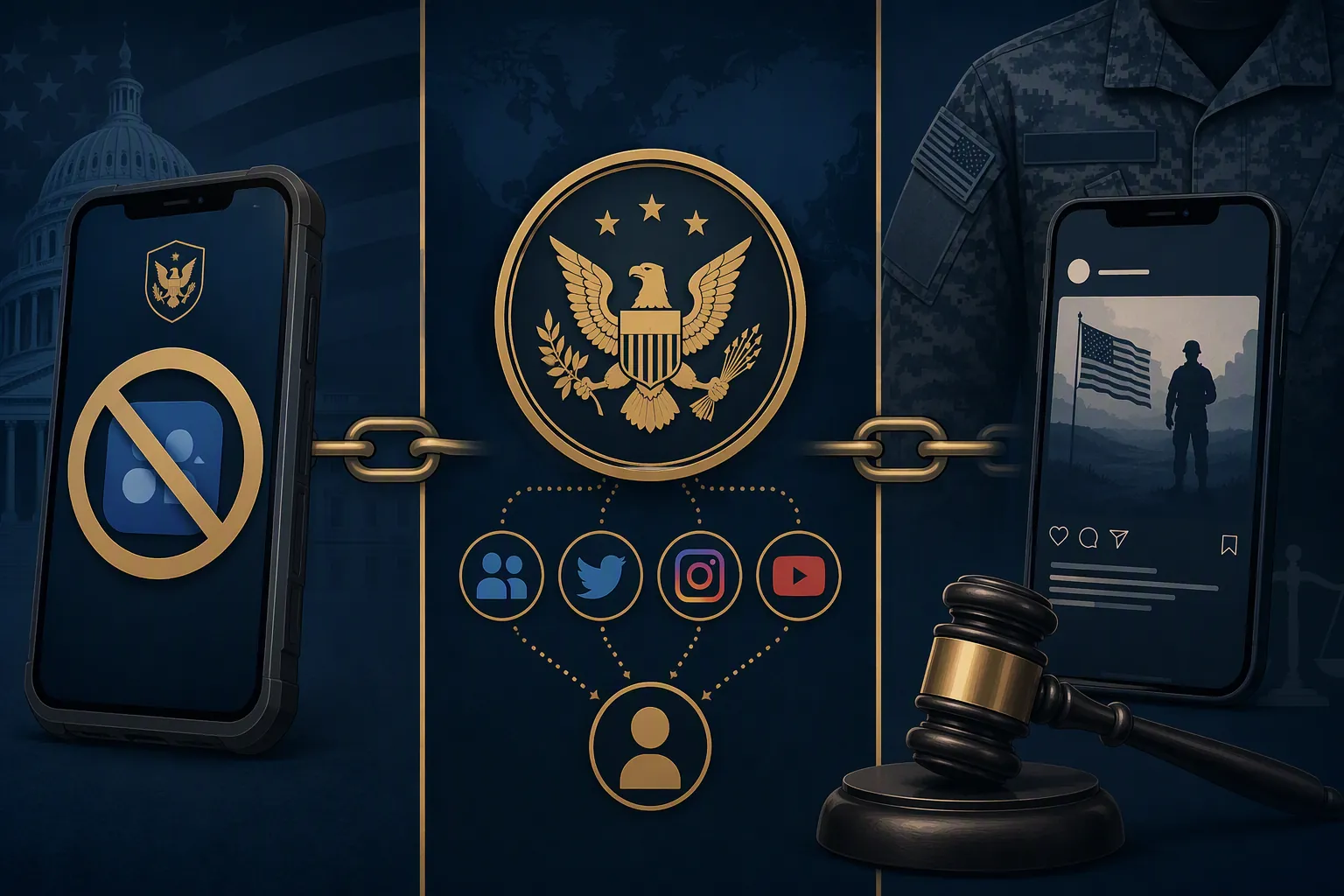
Start with the instrument, not the word “ban”
A useful analysis starts with four questions: who is speaking, where are they speaking, whose account or device is involved, and what legal instrument is being used. If the government is barring TikTok from official phones, the relevant authority is not the same as a court-martial specification. If the Army is deactivating redundant official accounts, the speaker is often the government itself. If a commander is investigating a personal post, the question becomes discipline, status, and nexus.
That distinction matters most for veterans. “Veteran” can mean a retiree still subject to UCMJ jurisdiction, a former Guardsman with no current military status, a reservist between duty periods, or a civilian who once served and is now commenting on an official page. Those are not interchangeable First Amendment categories.
Device and platform bans: real restrictions, but not personal-speech punishment
The cleanest constitutional win for the government is the foreign-adversary platform line. In TikTok v. Garland, the Supreme Court issued a 9-0 per curiam decision upholding the challenged federal divestiture framework. The holding belongs in the platform-access box: it does not decide when the military may punish a soldier, retiree, or veteran for the viewpoint expressed in a post. [1]
The timeline also needs care. Public summaries describe a de jure TikTok ban window running from January 19, 2025, to January 22, 2026, but that timeline is partly dependent on tertiary aggregation; it should not be treated as the source for the Supreme Court’s constitutional holding. [5] The defensible point is narrower: device and platform restrictions can be justified as foreign-adversary, cybersecurity, procurement, or government-property measures. They are not, by themselves, a rule that veterans may not speak online.
Official Army accounts: the 2026 cleanup is easy to misread
Army Directive 2026-17 is current and operationally significant, but it is not a personal-account ban on soldiers or veterans. Army Times reported that the directive, signed June 30, 2026, restricts official social media accounts to a list of higher-level organizations and gives commanders 30 days to deactivate unauthorized accounts. The same reporting says the directive expressly does not affect soldiers’ personal accounts. [2]
That carve-out is the fact that prevents the category error. If a brigade, battalion, or company page is no longer authorized as an official Army account, the Army is controlling its own speech architecture. It may be making a wise or clumsy communications decision, but the ordinary individual First Amendment claim is not triggered merely because an official page goes dark.
The sourcing is weaker than it should be for a directive this important. The Army’s own explanatory release was removed, so the public narrative rests on reporting by Army Times, Stars and Stripes, and local coverage rather than a stable Army press page. Stars and Stripes and KSWO also described the move as a further consolidation of the Army’s official digital footprint, following Army Directive 2025-25 from December 12, 2025. [6][7]
DoDI 5400.17 supplies part of the broader baseline for official social media use in public affairs, and it was amended in February 2025. [8] That matters because official-account governance is an institutional communications rule. The difficult First Amendment questions begin when a person’s own speech is investigated or punished.
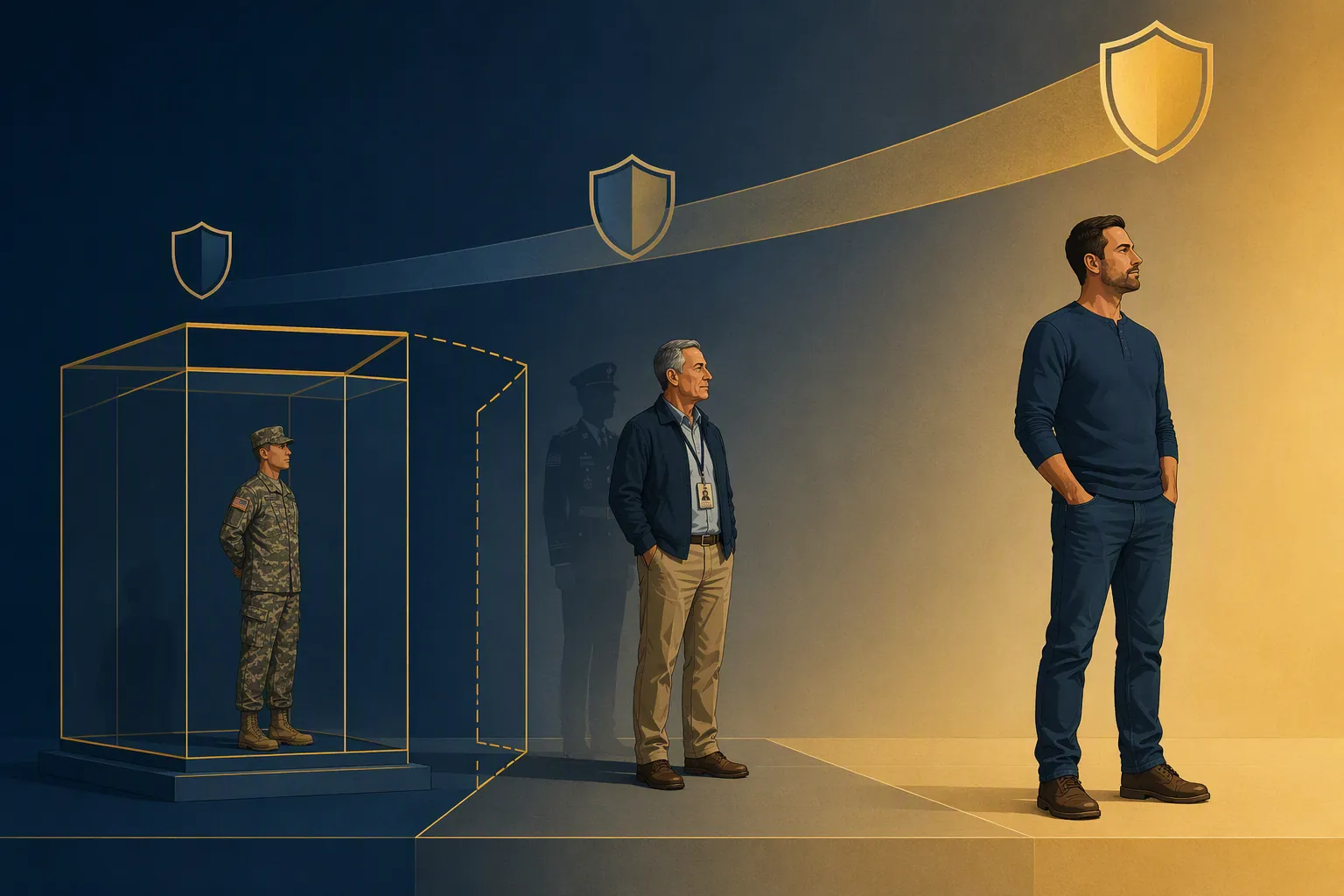
Personal posts: the government needs status and a military nexus
Military speech doctrine is not civilian workplace doctrine with uniforms pasted on top. Parker v. Levy remains the starting point for the armed forces as a “specialized society,” where discipline, obedience, and mission effectiveness can justify restrictions that would be intolerable in ordinary civilian life. [9] That premise is real. It is also not a blank check.
The limiting rule is most visible in United States v. Wilcox. The Court of Appeals for the Armed Forces rejected an Article 134 theory that treated extremist online speech as punishable without a sufficient connection to military order or discipline. The government needed more than proof that the speech was ugly or offensive; it needed the required military nexus. [4]
Current military-speech commentary treats United States v. Smith in the same line: Article 134 analysis requires a direct speech-mission nexus rather than generalized discomfort with online expression. The point is not that service members have civilian-strength speech rights while serving. They do not. The point is that the charge must still match the status, the speech, and the asserted harm. [10]
That is why Articles 88, 133, and 134 cannot be treated as interchangeable social-media cleanup tools. Article 88 has its own target and status limits. Article 133 requires conduct unbecoming an officer and a gentleman. Article 134 requires prejudice to good order and discipline or service-discrediting conduct, and Wilcox makes the nexus problem hard to avoid when the speech occurs online and away from duty. [3][4][10]
The post-Kirk enforcement wave is the exposed regime
The reported enforcement wave after the September 2025 Kirk assassination belongs in the personal-speech-punishment category, not the device-ban category. Lawfare, relying on reporting available in October 2025, described 128 service members and 158 nonuniformed personnel under investigation, with reported outcomes including 12 Army suspensions, 26 reprimands, and 3 nonjudicial punishments at that point. Those numbers are an as-reported snapshot, not a final count for August 2026. [3]
The government’s strongest case is usually the active-duty speaker whose post can be tied to unit cohesion, obedience to lawful orders, operational security, threat discipline, harassment, or a concrete public-facing mission problem. Even there, the better legal theory names the harm. “Online controversy” is not the same thing as prejudice to good order and discipline.
Nonuniformed personnel require another turn of the screw. A civilian employee may face workplace discipline, clearance consequences, or agency rules, but that is not automatically a UCMJ speech case. The sanctioning authority matters. So does whether the employee spoke on duty, using an official account, invoking an official position, or speaking as a private citizen.
Retirees are where the legal pressure concentrates. Lawfare’s account notes that roughly 2 million retirees may remain subject to UCMJ jurisdiction under 10 U.S.C. § 802. [3] Jurisdiction, however, is only the first question. A retiree’s political post, veteran advocacy, or comment about public events is far removed from the barracks floor. The government can point to statutory jurisdiction; the speaker will point to civilian life, diminished command relationship, and the need for a real mission nexus.
Kelly shows why retiree status cannot be waved away
Kelly v. Hegseth is useful precisely because its posture is not clean. The Free Speech Center reported that Judge Richard J. Leon issued a preliminary injunction on February 12, 2026, blocking the Pentagon from punishing Senator Mark Kelly for a call to resist unlawful orders. [11] Court-martial commentary separately reported that the government announced in February 2026 it would no longer pursue the case. [10] Then, on April 17, 2026, Protect Democracy reported that 72 retired generals, admirals, and service secretaries filed an amicus brief in the D.C. Circuit, which implies continuing appellate posture. [12]
The responsible way to state the case is pending or procedurally unresolved on the public record summarized here. It should not be used as final authority that retiree discipline is either categorically lawful or categorically unconstitutional. It does show the problem: once the speaker is a retiree and the speech is political or civic rather than operational, the government needs more than chain-of-command tidiness.
Separated veterans are not still in the command
A fully separated veteran is in the strongest First Amendment position. The military may still control access to installations, official events, government systems, or official pages under ordinary rules. But the veteran’s own post does not become military speech merely because the speaker once served.
Stanhope is the useful caution, not because it answers every veterans’ speech question, but because it keeps the forum and status issues separate. Military.com reported on July 31, 2026, that a veteran Guardsman reached a settlement in a First Amendment lawsuit over social media posts, with access restored and no monetary relief. [13] The site’s verified docket record, What the Timothy Stanhope National Guard Settlement Says, tracks the settlement without turning it into broader doctrine.
Rodriguez v. Bohner points in the same direction for official-page comment spaces. The Center for Individual Rights describes the case as a challenge involving the Kings Bay Facebook page; on March 27, 2026, the Eastern District of Virginia denied a motion to dismiss under the “formidable burden” standard for mootness. [14] That is not a court-martial posture. It is closer to the familiar question whether government officials opened a forum and then excluded a critic because of viewpoint.
This is where lumping all veterans together does real damage. A retired officer potentially subject to § 802, a former Guardsman suing over access to a state Guard page, and a civilian commenter on a Navy installation page are not standing in the same legal place. The government may have administrative tools in all three settings. It does not have the same disciplinary power in all three.
What counsel and reporters should verify before calling it a ban
- Identify the speaker’s status on the date of the post: active duty, Reserve or Guard in covered status, retiree subject to § 802, civilian employee, contractor, separated veteran, or ordinary civilian.
- Identify the account: official government account, command-managed page, personal account with rank or affiliation in the bio, anonymous account, or public comment on an official page.
- Identify the device and network: government device, government network, personal phone, or mixed-use account.
- Identify the sanction: device restriction, account deactivation, counseling, reprimand, suspension, nonjudicial punishment, court-martial charge, clearance action, employment discipline, or page ban.
- For UCMJ theories, identify the article and the nexus: Article 88, Article 133, Article 134, or another provision; then name the concrete order, discipline, mission, or service-discrediting harm.
The same discipline is useful in adjacent military-institution speech disputes, including academy and prior-restraint records such as Bakken v. West Point First Amendment Lawsuit Details. It is also useful outside the military context whenever political speech is converted too quickly into a legal-consequence headline; the enforcement-limits discussion in false claims in political debates tracks a similar category problem.
The defensible answer
Can the military ban veterans’ social media speech? Not as a single proposition. It can restrict government devices and covered platforms. It can consolidate or close official accounts. It can punish some member speech when the speaker is subject to military law and the speech is tied to discipline, mission, or service-discrediting harm. Those are different authorities.
The legally exposed regime is personal-speech punishment, especially after the post-Kirk investigations and especially as the speaker moves from active-duty status to retiree status to full separation. The farther the person stands from the command, the more work the government must do to explain why a post is a military offense rather than protected civic speech.
References
- TikTok Inc. v. Garland, Supreme Court of the United States, January 17, 2025.
- Army orders mass shutdown of official social media accounts, Army Times, July 9, 2026.
- The Military's Social Media Purge, Lawfare.
- United States v. Wilcox, United States Court of Appeals for the Armed Forces.
- Efforts to ban TikTok in the United States, Wikipedia.
- US Army orders tighter social media presence, Stars and Stripes.
- Army orders further consolidation of official social media accounts, KSWO, July 10, 2026.
- DoDI 5400.17: Official Use of Social Media for Public Affairs Purposes, Department of Defense.
- Rights of Military Personnel, First Amendment Encyclopedia.
- What the Military Can Actually Silence You For — And What It Cannot, Court-Martial Trial Practice Blog, Cave & Freeburg.
- Judge blocks Pentagon from punishing Sen. Mark Kelly..., MTSU Free Speech Center.
- 72 retired generals, admirals, & service secretaries file amicus brief..., Protect Democracy, April 17, 2026.
- Veteran Guardsman Reaches Settlement in First Amendment Lawsuit Over Social Media Posts, Military.com.
- Rodriguez v. Bohner, Center for Individual Rights.
Operationalizing workflow
No workflow has been explicitly linked to this obligation yet. See Workflows generally.
Illustrative cases
No illustrative case is currently tracked for this obligation. See Risk Digest for documented incidents generally.
← Back to RegulationReport a correction or tip
Spotted an outdated figure, a misstated fact, or a ruling this regulation entry should reflect? Public comments are disabled for this content given the professional cost of a misreported case outcome, penalty amount, or rule text — use the structured correction channel instead.
Report a correction or tip for this record →