
Tupac murder trial jury seated — AI exposure is the new test
- Authority
- Clark County District Court (Nevada)
- Rule type
- standing order
- Jurisdiction scope
- US state - Nevada
- Effective date
- Jun 30, 2026
- Source text
- Read primary rule text ↗
Counsel should use AI-specific voir dire, jury instructions, monitoring, and record preservation when full sequestration is denied.
The search phrase “Tupac murder trial jury seated 2025” needs an immediate correction: the jury was seated on Aug. 13, 2026, not in 2025. In State of Nevada v. Duane “Keffe D” Davis, the court seated 12 jurors and 4 alternates after several days of questioning more than 100 Clark County residents; the seated panel was reported as 10 women and 6 men, and Davis waived jury sentencing on the first day of selection.[1] That date matters because the trial-management problem is a 2026 problem, not a 2025 one.
The more consequential order came earlier. On June 30, 2026, Clark County District Judge Carli Kierny denied a defense request for full sequestration — the version that would have removed jurors’ phones and housed them in a hotel — while approving partial measures, including use of a back elevator and media screening.[2] That compromise is the hinge for counsel watching the trial from outside Las Vegas. The court did not make an artificial-intelligence ruling. No public report cited here identifies an AI tool, AI evidence, an AI sanction, or a juror’s AI misuse in this case. The AI issue is an exposure analysis prompted by the court’s management posture: if a high-profile jury is not fully sealed off, what must lawyers do when “outside information” now includes generative AI answers and algorithmically resurfaced case material?
The compromise order leaves a real exposure channel
Full sequestration is expensive, intrusive, and hard on jurors. It is also no longer the default answer courts reach for simply because a case has national attention. Judge Kierny’s order, as reported, kept the trial functioning in an ordinary courthouse rhythm while adding physical shielding around courthouse contact with media.[2] That is a recognizable modern compromise: protect the route into the courtroom, manage the press presence nearby, and trust jurors to obey instructions outside court.
The record already shows why this case required more than generic publicity screening. During jury selection, prospective jurors were questioned about exposure to the docuseries “Sean Combs: The Reckoning,” podcasts, and social media videos.[3] Opening statements began on Aug. 17, 2026, and by the first week of testimony the trial had already moved through gang-related language, old recordings, rap-feud framing, and prior statements that were likely to attract commentary outside the courtroom.[4] Those facts do not prove juror contamination. They show that the court and counsel were already treating outside media exposure as case-specific, not abstract.
That distinction matters on appeal. A lawyer cannot preserve much with a general lament that “everyone has heard about this case.” The useful record is narrower: which media source was asked about, which juror saw it, what the juror said, what instruction was requested, whether the court gave it, and whether counsel renewed the objection when partial shielding replaced sequestration.
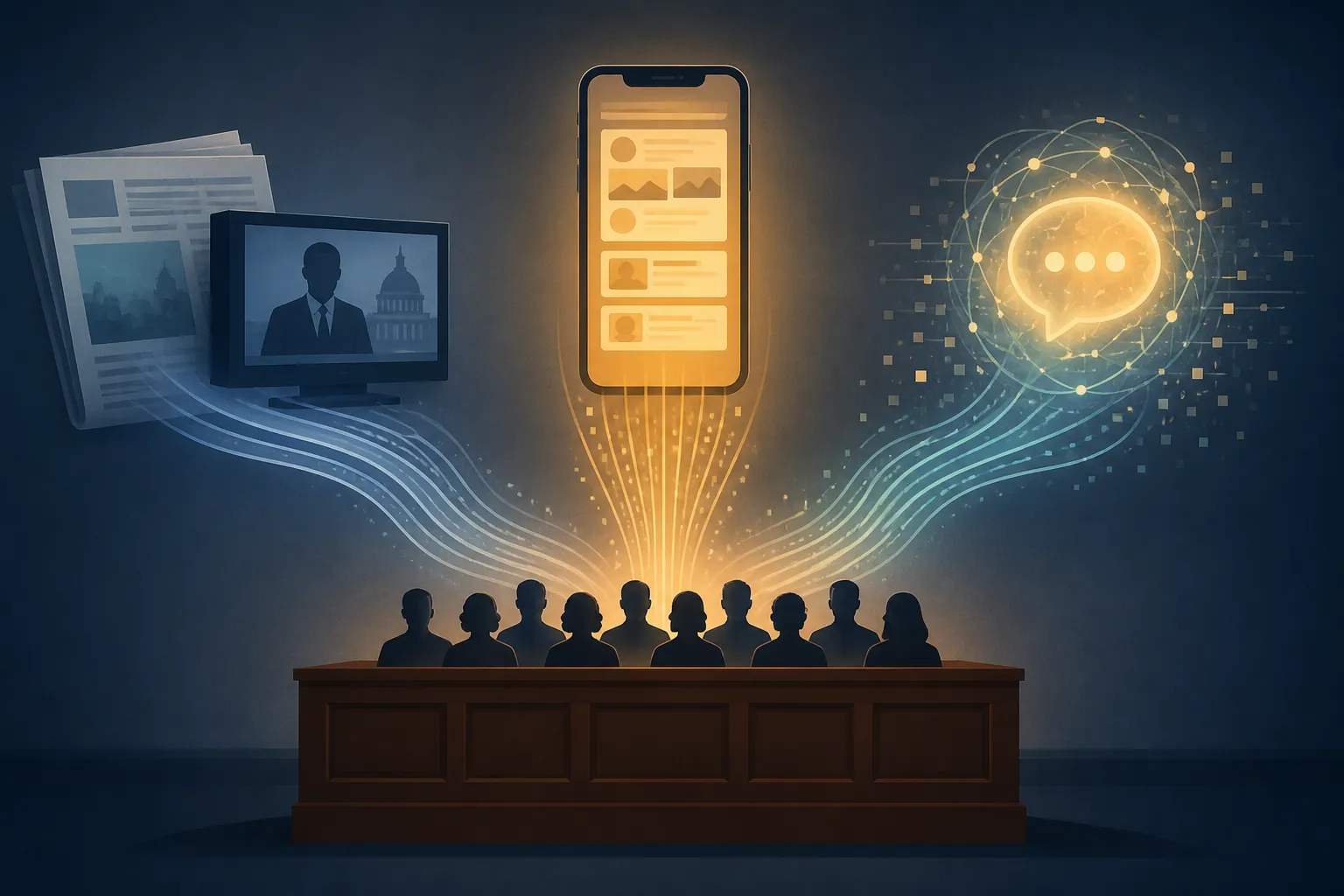
Three exposure risks that should not be collapsed
The old category, pretrial publicity, still matters. The American Psychological Association has summarized research showing that pretrial publicity can affect perceptions of witness testimony, defendant credibility, and verdict decisions.[5] That is the empirical reason courts ask jurors what they have seen and whether they can set it aside. In the Davis trial, questions about documentaries, podcasts, and social video fit within that familiar framework.
The second category is algorithmic resurfacing. A juror who watches one clip, listens to one podcast segment, or searches one name may then be served more material without setting out to conduct legal research. The court’s partial shielding can reduce courthouse contact with reporters, but it does not control a juror’s evening feed. That is not the same as deliberate misconduct, and it should not be treated as if every accidental exposure requires the same remedy. It does, however, require instructions that are precise enough for jurors to recognize the problem when it happens.
The third category is juror use of generative AI. This is different from reading an article or watching a clip. A juror can ask a chatbot to summarize the case, explain a legal term, compare witness accounts, evaluate credibility, or translate testimony into a timeline. The answer may sound confident and may include citation-like formatting. It may also be incomplete, synthetic, or influenced by materials no party has tested in court. That risk is not established as an incident in the Tupac trial; it is the next operational consequence of refusing full sequestration while allowing jurors to remain in ordinary digital life.
Courts are already dealing with synthetic evidence, even if this trial is not about AI
The National Center for State Courts has warned that AI-generated evidence threatens public trust in courts and has published bench materials and an evaluation guide for judges confronting synthetic content.[6] Its materials also discuss Mendones v. Cushman & Wakefield as a first-in-kind deepfake-sanctions context.[6] That does not convert every publicized criminal trial into an AI case. It does show that the judiciary’s evidence and authenticity problems are moving faster than traditional jury-management language.
The same pressure appears in adjacent litigation records. Courts and parties are already encountering AI-generated or AI-altered content in settings involving documentaries, bodycam evidence, authentication disputes, and appellate records. The point is that jury instructions and voir dire cannot keep assuming that “do not research the case online” covers every realistic exposure channel. For related examples, see the site’s records on the Idaho murders documentary AI forensics issue, the Nolan Wells pre-litigation deepfake risk, and the NBA YoungBoy bodycam evidence record.
One secondary source deserves cautious use. A June 2026 CMBG3 Law article reported that 50% of Americans used AI chatbots in 2026, up from 33% in 2024, and argued that confident chatbot answers pose a fair-trial risk distinct from ordinary internet research.[7] The usage statistic should be checked against the underlying survey before counsel relies on it in court or in a client briefing. The practical point is still sound enough for trial preparation: counsel should assume at least some jurors know how to ask a chatbot for an explanation of a case.
Voir dire has to name the tools
The Davis voir dire reportedly asked about specific content streams — a docuseries, podcasts, and social media videos.[3] That is the right instinct. In an AI-era trial, the next version of that questioning should not stop at “Have you researched this case on the internet?” A juror can answer no to that question and still have asked an AI system to explain the charges, summarize a witness, or identify “what really happened.”
Counsel in a comparable high-exposure case should propose questions that separate accidental exposure from active use and separate traditional search from generative tools. The language does not need to be theatrical. It needs to be reviewable.
- Have you watched, listened to, read, or been shown any documentary, podcast, livestream, short-form video, or social media commentary about this case?
- Have you searched for any person, event, charge, location, recording, or prior statement connected to this case?
- Have you used ChatGPT, Claude, Gemini, Perplexity, Copilot, Grok, or any other generative AI tool to ask about this case, the parties, the witnesses, the lawyers, the judge, or the evidence?
- Have you seen AI-generated images, videos, voice clips, summaries, timelines, or “explainer” posts about the case, even if you did not look for them?
- If online platforms show you more content about this case during the trial, can you stop watching, avoid clicking, and notify the court if you are exposed to something substantive?
The point is not to embarrass prospective jurors for ordinary technology use. The point is to find out whether a juror has already received case information from a source the parties cannot cross-examine and the court cannot authenticate. If the answer is yes, the follow-up should identify what the juror saw, how much of it the juror remembers, whether it discussed facts or law, and whether it expressed a view about guilt, credibility, motive, or punishment.
The instruction should prohibit generative AI, not just “research”
A standard no-research instruction still has value. It tells jurors not to look up news, definitions, maps, records, or commentary. But if the court has denied full sequestration, counsel should not leave the AI point implicit. A juror may not think of a chatbot as “research” if the tool presents itself as a conversational assistant rather than a search engine.
A stronger instruction would tell jurors, in substance, that they may not use any generative AI tool to obtain information, summaries, explanations, translations, timelines, legal definitions, credibility assessments, factual comparisons, or suggested conclusions about the case. It should name familiar tools while making clear that the rule applies to any similar service, including tools embedded in phones, browsers, search engines, messaging apps, or social platforms.
| Instruction problem | AI-era revision |
|---|---|
| “Do not research the case online.” | “Do not search for, ask about, summarize, explain, translate, analyze, or fact-check this case using any website, app, chatbot, AI assistant, search engine, social media platform, or similar tool.” |
| “Do not read media coverage.” | “If a feed, notification, recommendation, clip, podcast, documentary segment, or AI-generated summary about this case appears, stop viewing it and notify court staff as instructed.” |
| “Decide only on evidence in court.” | “Do not use outside tools to create timelines, compare testimony, evaluate credibility, define legal terms, or generate arguments for or against either side.” |
The instruction also needs a reporting mechanism. Jurors should know whom to tell if they accidentally see a clip, receive a push notification, or encounter a generated summary. Without that route, the first clean record of exposure may appear in a post-verdict motion, when everyone is reconstructing what happened after the fact.
Monitoring must match the court’s refusal to sequester
When a court denies full sequestration, counsel should not treat the issue as lost. The order defines the monitoring burden. If jurors are going home, using phones outside court, and returning the next day, the parties need a plan for recurring reminders and a way to raise exposure issues without turning every morning into a satellite hearing.
A proportionate plan can be simple. The court can repeat the AI-specific instruction at natural breaks. Court staff can remind jurors not to engage with case content during recesses and overnight. Counsel can ask the court to make a short daily record that the instruction was given. If a major documentary episode, viral clip, podcast interview, or AI-generated item becomes a visible public issue during trial, counsel can request a targeted inquiry rather than a broad fishing expedition.
That last distinction is important. Courts are right to resist speculative intrusions into jurors’ private lives. The cleaner request is tied to something concrete: an identified media item, an identified platform surge, an identified juror statement, or an identified ambiguity in the court’s existing instruction. Partial shielding reduces some contact points. It does not justify pretending the rest of the exposure environment disappeared.
The appellate record is built before the problem happens
The practical mistake is waiting for a juror note, a post-verdict interview, or a social media discovery before making the AI record. By then, the trial lawyer may be arguing from absence: no instruction naming AI, no rejected proposed language, no targeted voir dire question, no renewed objection after sequestration was denied, no request for a curative inquiry when a specific item surfaced.
Counsel who expects appellate scrutiny should put four things in the record early.
- A proposed voir dire set that names generative AI tools and distinguishes AI use from ordinary search, passive exposure, and traditional publicity.
- A proposed jury instruction that prohibits juror use of generative AI for summaries, legal explanations, evidence comparisons, credibility assessments, timelines, or deliberation aids.
- A monitoring request calibrated to the court’s sequestration ruling, including repeated reminders and a process for reporting accidental exposure.
- A renewed objection or supplemental request when the trial record changes — for example, when a case-specific documentary, podcast, viral clip, or AI-generated item becomes newly salient during trial.
Those steps do not guarantee reversal if something goes wrong. They do something more basic: they give the trial judge usable options in real time and give a reviewing court a record that shows what the lawyer asked for, why it mattered, and how the court responded.
Why the Tupac trial is a useful 2026 test
The Davis trial is ongoing as of Aug. 25, 2026, and no verdict should be anticipated here. The case is not, on the public record cited in this article, an AI-misuse case. Its usefulness lies elsewhere. It shows the likely default posture in a media-heavy criminal trial: detailed voir dire about known publicity, denial of full sequestration, partial physical shielding, repeated reliance on juror compliance, and a public information environment that does not stop at the courthouse door.
That posture is administratively understandable. It also shifts work to counsel. If courts are not going to house jurors, remove phones, and block outside contact in every high-profile case, lawyers have to draft for the world jurors actually occupy: feeds that recommend case content, documentaries that arrive during active proceedings, podcasts that repackage testimony, and AI systems that can produce fluent summaries of facts and law on demand. The Tupac murder trial is not an AI case, but it is a sharp 2026 test of whether high-profile jury management can adapt without waiting for the first chatbot-driven verdict challenge.
References
- Tupac murder trial jury seated in Las Vegas — KCRA
- Las Vegas judge denies motion to sequester jury, suppress evidence in Tupac murder case — FOX5 Vegas, June 30, 2026
- Jury selection begins in Tupac Shakur murder trial — Courthouse News
- Gangbangers, rap feuds and old tapes: What we learned in the first week of the Tupac murder trial — CNN, August 22, 2026
- Can we fairly select jury in high-profile cases? — American Psychological Association
- AI-generated evidence is a threat to public trust in the courts — National Center for State Courts, April 2025
- A New Threat to a Fair Trial: Artificial Intelligence and Juror Deliberations — CMBG3 Law, June 2026
Operationalizing workflow
No workflow has been explicitly linked to this obligation yet. See Workflows generally.
Illustrative cases
No illustrative case is currently tracked for this obligation. See Risk Digest for documented incidents generally.
← Back to RegulationReport a correction or tip
Spotted an outdated figure, a misstated fact, or a ruling this regulation entry should reflect? Public comments are disabled for this content given the professional cost of a misreported case outcome, penalty amount, or rule text — use the structured correction channel instead.
Report a correction or tip for this record →