
What does US law require for AI chip exports to China?
- Authority
- U.S. Department of Commerce, Bureau of Industry and Security (BIS)
- Rule type
- regulation
- Jurisdiction scope
- US federal
- Effective date
- Jan 15, 2026
- Source text
- Read primary rule text ↗
Covered advanced AI chips to China/Macau require export-license review; case-by-case path applies only to H200/MI325X-class chips below 21,000 TPP and 6,500 GB/s DRAM bandwidth and requires six certification conditions.
Last verified: August 4, 2026, 00:00 UTC. This Regulation & Ethics tracker is limited to U.S. export-control and related tariff obligations affecting advanced AI chips, related technology, cloud/IaaS access, and compute-procurement activity involving China and Macau. It is not legal advice. Legal-background review: editorial review by a J.D.-trained trade-compliance editor.
For anyone tracking China-bound AI hardware supply, export controls, and related legal exposure, the current answer is narrower than the headlines: U.S. law does not generally permit covered advanced AI chip exports or reexports to China/Macau without licensing analysis. Effective January 15, 2026, BIS moved a defined H200/MI325X-class band into case-by-case license review, but only for chips below 21,000 total processing performance and below 6,500 GB/s DRAM bandwidth, and only inside the rule’s stated conditions. [1][2]

Q3 2026 obligations map
| Obligation lane | Status as of August 4, 2026 | Compliance consequence |
|---|---|---|
| H200/MI325X-class advanced computing commodities to China/Macau | Case-by-case license review applies only within the January 15, 2026 performance band: TPP below 21,000 and DRAM bandwidth below 6,500 GB/s. [1][2] | Do not treat the licensing category as an authorization. Classification, destination, end user, and certification review still come first. |
| Six-condition certification pathway | The January 2026 pathway is conditioned on commercial availability, unit-sales reporting, foundry-capacity assurances, a 50% aggregate-TPP cap relative to U.S. end users, U.S.-based third-party lab testing before each shipment, and KYC/IaaS remote end-user identification obligations for designated countries. [3][4] | The practical burden sits with the party signing, testing, documenting, and maintaining the record. |
| Higher-performance advanced AI chips, excluded transactions, and certain reexports | Items outside the January 2026 band, third-country reexports to China/Macau, and transactions involving D:5-headquartered parties remain under more restrictive treatment, including presumption-of-denial treatment where specified. [3] | A China/Macau license path for one direct-export fact pattern should not be copied into third-country or affiliated-party flows. |
| Section 232 tariff | A 25% tariff applies from January 14, 2026 to covered chips not destined for the U.S. technology supply chain, with named exclusions for U.S. data centers above 100 MW of new load, U.S. R&D, startups, and U.S. public-sector use. [4] | Export licensing and tariff classification are separate checks. A license theory does not resolve duty exposure. |
| Reported March 2026 tiered framework | Reported but unconfirmed; based on accounts of a non-public draft framework and subject to Commerce-denial caveats. [10] | Do not build an approval memo on the draft unless and until BIS publishes binding text. |
The January 2026 rule is the operative bottleneck
The January rule matters because it changed the license-review posture for a defined slice of advanced computing commodities, not because it opened China/Macau as an ordinary sales channel. The rule applies to the H200/MI325X-class band described by BIS and the Federal Register notice: below 21,000 TPP and below 6,500 GB/s DRAM bandwidth. [1][2]
That performance line should be the first place the hardware team and export team reconcile their records. Marketing labels, customer shorthand, and “comparable to” language do not classify the item. A transaction file should show the ECCN analysis, the performance values used, and the source of the values. If the item sits outside the band, the January case-by-case policy is not the answer.
Even inside the band, case-by-case review is not a soft clearance standard. Law-firm analyses of the January rule describe six certification conditions that turn the pathway into a documentary funnel rather than a release valve. [3][4]
- The chip must be commercially available from U.S. commercial sources. [3][4]
- Unit sales must be reported. [3][4]
- The exporter must certify that the transaction will not divert foundry capacity away from U.S. orders. [3][4]
- The transaction must fit within a 50% aggregate-TPP cap measured relative to U.S. end users. [3][4]
- A U.S.-based third-party laboratory must test before each shipment. [3][4]
- KYC procedures must identify remote end users, including IaaS users, for designated countries. [3][4]
Those conditions do different kinds of work. Some are supply-side representations; some are testing controls; some push the exporter into customer and remote-user diligence. The 50% aggregate-TPP condition is especially easy to under-read because it is not a single-chip specification. It forces the company to compare aggregate processing performance associated with the transaction against U.S. end-user activity, which means the export file cannot be built only from the bill of materials.
The sixth condition is where hardware and cloud controls begin to meet. KYC and IaaS remote end-user identification are not solved by confirming the immediate buyer’s legal name. A cloud provider, reseller, managed-service provider, or enterprise compute buyer may need to know who can reach the controlled compute and from where. If the commercial team cannot describe the access model, the export team cannot safely describe the controlled transaction.
What the January rule did not move
The most dangerous internal memo after the January rule is the one that says “China is now case-by-case” without the rest of the sentence. Morgan Lewis’s analysis distinguishes the direct China/Macau pathway from categories that remain under presumption-of-denial treatment, including third-country reexports to China/Macau and transactions involving D:5-headquartered parties. [3]
That distinction matters in ordinary procurement structures. A distributor outside China, a cloud customer contracting through a non-China affiliate, or a parent headquartered in a D:5 country can change the review posture. The exporter’s question is not just “where is the chip physically going?” It is also whether the transaction is a reexport, whether a controlled party is directing or benefiting from it, and whether the remote-use design turns a hardware sale into an access-control problem.

A dated transaction checklist
A usable Q3 2026 record should read like a decision file, not like a market view. The same transaction may require several checks in sequence: item classification, destination, end user, transaction type, certification pathway, tariff exposure, and enforcement posture.
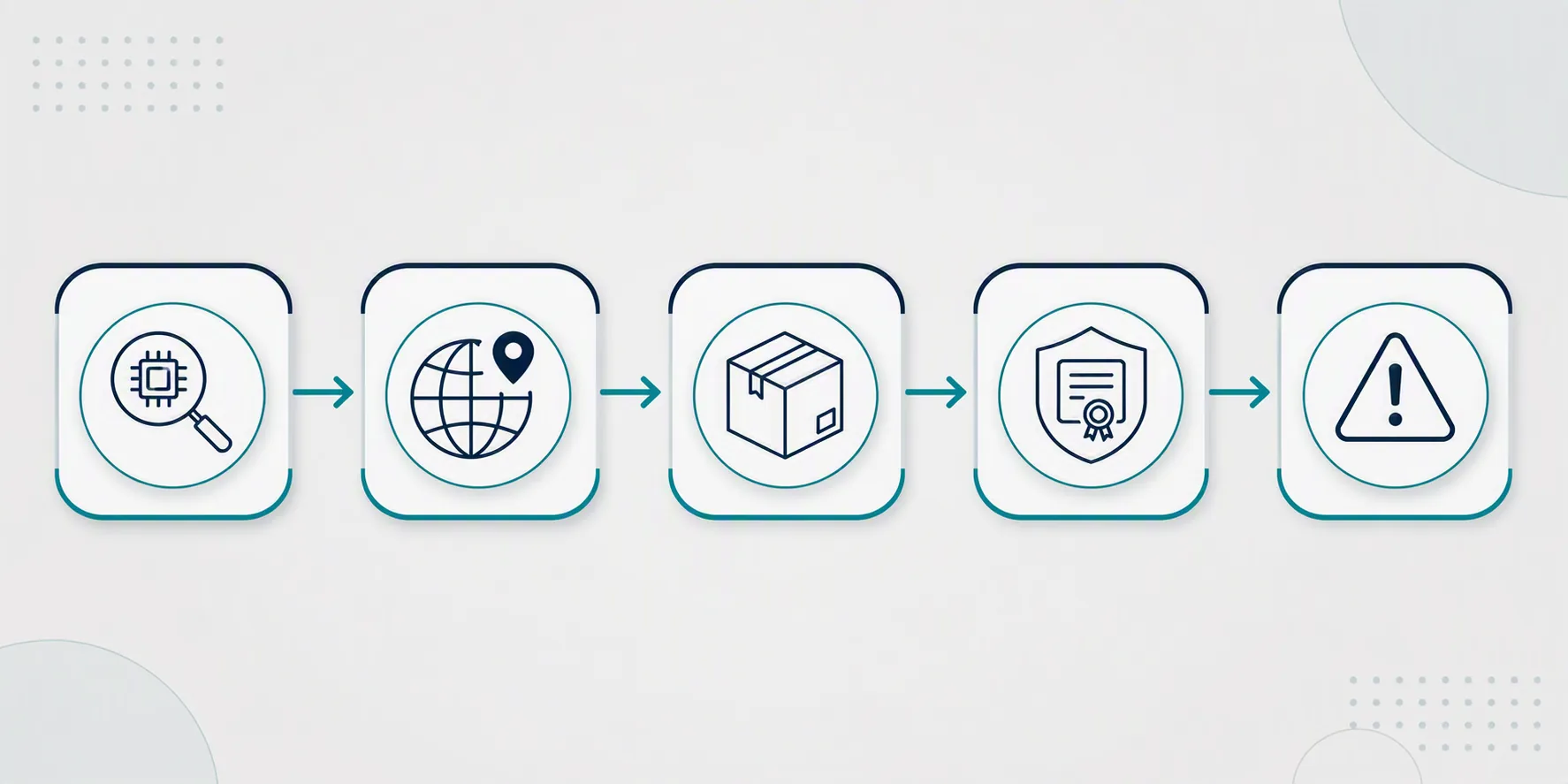
| Step | Question to answer | Record to keep |
|---|---|---|
| 1. Classify the item | Is the chip, board, system, software, or technology within an advanced computing ECCN or otherwise tied to controlled AI hardware? | ECCN analysis, performance values, DRAM bandwidth support, product configuration, and version date. |
| 2. Test the January 2026 band | If the item is an H200/MI325X-class chip, is it below 21,000 TPP and below 6,500 GB/s DRAM bandwidth? [1][2] | Engineering signoff and the source used for TPP and bandwidth. |
| 3. Identify the destination and beneficiary | Is the destination China/Macau, a third-country reexport to China/Macau, or a transaction involving a D:5-headquartered party? [3] | End-user, ultimate consignee, parent-company, and beneficial-use diligence. |
| 4. Identify the transaction type | Is this an export, reexport, in-country transfer, facilitation issue, technology release, cloud/IaaS access arrangement, or procurement instruction? | Contract flow, access architecture, user-location controls, and U.S.-person involvement analysis. |
| 5. Check whether certification can be made | Can the company support all six January 2026 conditions, including U.S. commercial availability, unit-sales reporting, no foundry-capacity diversion, the 50% aggregate-TPP cap, U.S.-based third-party lab testing before each shipment, and remote end-user KYC? [3][4] | Certification draft, testing record, KYC file, capacity representation, and internal approver. |
| 6. Separate tariff from export control | Is the covered chip subject to the January 14, 2026 Section 232 25% tariff, or does a named exclusion apply? [4] | Customs classification, destination/use support, and exclusion documentation. |
| 7. Recheck the date | Is the memo relying on a rescinded, superseded, reported, or pending rule? | Rule version, Federal Register citation if available, and last verification date. |
For exporters, the largest avoidable error is treating a sales approval as the compliance record. For cloud/IaaS providers, it is assuming the chip never crosses a border because the user only receives access. For compute buyers, it is accepting a procurement instruction without asking whether the supplier is being pushed into a controlled export, reexport, facilitation, or remote-access arrangement.
Internal teams should also cross-check adjacent records rather than rebuild the analysis in isolation. The site’s Nvidia regulatory-risk tracker covers export-control exposure around Nvidia-specific China products; the CXMT/HBM sanctions-risk record is the relevant companion for memory and high-bandwidth-memory dependencies; and the AI hardware substrate shortage record is useful where supply-chain diligence and legal-risk screening overlap.
Why the 2022–2025 layers still matter
The January 2026 rule sits on top of earlier controls; it does not erase them. The compressed history is enough to explain why stale memos are dangerous.
- October 7, 2022: BIS imposed A100-class advanced computing controls and a related U.S. Persons Rule, creating the first modern layer of AI-chip restrictions for China-focused transactions. [5]
- October 17, 2023: BIS expanded the advanced computing controls, closing workarounds and broadening the rule set. [5]
- December 2, 2024: BIS added another layer through Entity List additions, expanded Foreign Direct Product Rule coverage, and HBM controls. [5]
- January 13, 2025: BIS announced the AI Diffusion Framework, a worldwide control structure for advanced chips and AI model weights. [6]
- May 2025: the AI Diffusion Framework was rescinded, illustrating how quickly a planning assumption can become a dead citation. [6]
This is not background for its own sake. It is the reason a Q3 2026 export file should cite the rule actually being applied, not a slide deck that was accurate when the customer conversation began. The January 2026 case-by-case pathway exists inside this layered record and must be read against the remaining presumptions of denial, end-user restrictions, technology controls, and U.S.-person limits.
Section 232 runs in parallel
Export-control clearance and tariff exposure should not be collapsed into one green light. Mayer Brown’s analysis describes a January 14, 2026 Section 232 measure imposing a 25% tariff on covered chips not destined for the U.S. technology supply chain, with exclusions for U.S. data centers above 100 MW of new load, U.S. R&D, startups, and U.S. public-sector use. [4]
The >100 MW data-center exclusion is not an export license and should not be written that way. It belongs in the customs and tariff part of the file, supported by destination and use records. For related siting, power, and environmental obligations, compare the site’s AI data-center obligations tracker; for a parallel tariff-risk model outside semiconductors, see the drug-tariff legal-risk tracker.
Enforcement posture is not static
The enforcement signal is not limited to rule text. Analyses of the FY26 posture describe an approximately 23% BIS budget increase and a $10 million earmark for ECCN 3A090 enforcement. [7][4]
The February 2026 Applied Materials matter is useful here only as backdrop. BIS announced a $252.5 million civil penalty for illegal exports of semiconductor manufacturing equipment, and trade practitioners treated it as a major semiconductor reexport enforcement event involving China-related flows. [8][9]
That does not make Applied Materials an AI-chip export precedent for every 3A090 file. It does make a weaker point that matters more in daily practice: if a company misses the gap between the version of the rule used by sales and the version in force at shipment, the enforcement environment is no longer a quiet assumption.
Reported, pending, and practical boundaries
The reported March 2026 tiered framework belongs in a separate lane. Global Trade & Sanctions Law described reported draft rules keyed to compute volume, including 1,000 and 200,000 GB300-class thresholds, while also flagging that the framework was based on a non-public draft and that Commerce had denied aspects of the reporting. [10]
That is not binding law as of this tracker’s verification date. A compliance note can monitor it, assign an owner, and identify transactions that would be affected if BIS publishes a final rule. It should not replace the January 2026 Federal Register text or the current license-review standard.
There is also a practical boundary outside U.S. legal authorization: Reuters-reported PRC Customs holds on H200 clearances and reported Chinese government pressure on buyers. Those reports should not be used to rewrite U.S. export-control obligations, and this tracker does not treat them as BIS authority. They are a transaction-risk flag: a U.S. license pathway may still fail to produce actual shipment, clearance, customer acceptance, or payment.
Pending legislative items, including the House-passed Remote Access Security Act and the AI Overwatch Act noted in the available record, should be handled the same way unless and until they become operative obligations: monitor, date-stamp, and keep out of the binding-law section of the export memo.
Q3 2026 compliance posture
As of August 4, 2026, the safest written posture is precise and date-bound: covered advanced AI chips and related technology bound for China/Macau require export-control analysis; the January 15, 2026 rule creates a case-by-case pathway only for the defined H200/MI325X-class performance band; that pathway depends on six demanding certification conditions; third-country reexports and D:5-headquartered-party transactions can remain outside the apparent opening; Section 232 tariff exposure is a separate check; and reported draft policy is not binding law.
The durable legal risk is the obligation gap: between export and cloud-access workflows, between a direct shipment and a reexport, between a product label and an ECCN record, and between a confirmed rule and a reported draft. That is where the China chip competition reaches the AI hardware supply file: not as theater, but as the memo someone has to sign before the transaction moves.
References
- Department of Commerce Revises License Review Policy for Semiconductors Exported to China, Bureau of Industry and Security.
- Revision to License Review Policy for Advanced Computing Commodities, Federal Register, January 15, 2026.
- BIS Revises Export Review Policy for Advanced AI Chips Destined for China and Macau, Morgan Lewis, January 2026.
- Administration Policies on Advanced AI Chips Codified, Mayer Brown, January 2026.
- GAO-25-107386, U.S. Government Accountability Office.
- BIS Announces Worldwide Export Controls on Advanced Chips and AI Models, Simpson Thacher, January 15, 2025.
- Managing Export Control Risks in the AI Chip Ecosystem, Morrison Foerster, February 9, 2026.
- Applied Materials to Pay $252 Million Penalty to BIS for Illegally Exporting Semiconductor Manufacturing Equipment, Bureau of Industry and Security, February 2026.
- Export Enforcement Update: Huge Penalty Imposed for Semiconductor Reexports to China, Bass Berry & Sims.
- Reported Draft Rules Signal New Semiconductor Export Controls Framework, Global Trade & Sanctions Law.
Operationalizing workflow
No workflow has been explicitly linked to this obligation yet. See Workflows generally.
Illustrative cases
No illustrative case is currently tracked for this obligation. See Risk Digest for documented incidents generally.
← Back to RegulationReport a correction or tip
Spotted an outdated figure, a misstated fact, or a ruling this regulation entry should reflect? Public comments are disabled for this content given the professional cost of a misreported case outcome, penalty amount, or rule text — use the structured correction channel instead.
Report a correction or tip for this record →