
Why cities are removing Flock cameras over legal concerns
- Authority
- U.S. federal courts and state legislatures
- Rule type
- Case law and statute
- Jurisdiction scope
- US federal and US state
- Source text
- Read primary rule text ↗
Cities must document ALPR retention, sharing defaults, access audits, verification rules, and vendor warranties before renewal, termination, or replacement.
Last verified: August 25, 2026. This article is legal and regulatory risk analysis, not legal advice.
The 2026 “de-Flocking” count is already slippery enough to make a city attorney reach for the procurement file. The Guardian, relying on the campaign-maintained DeFlock tracker, reported that 56 municipalities had removed or voted to remove Flock Safety license-plate-reader cameras; AP put the count at more than 50 jurisdictions. Those numbers sit against a much larger operating network: MRSC described Flock as having more than 120,000 cameras, used by more than 5,000 agencies across more than 6,000 communities. The removals are real enough to require legal analysis. The tracker count, by itself, is not the legal conclusion. [1][2][3]
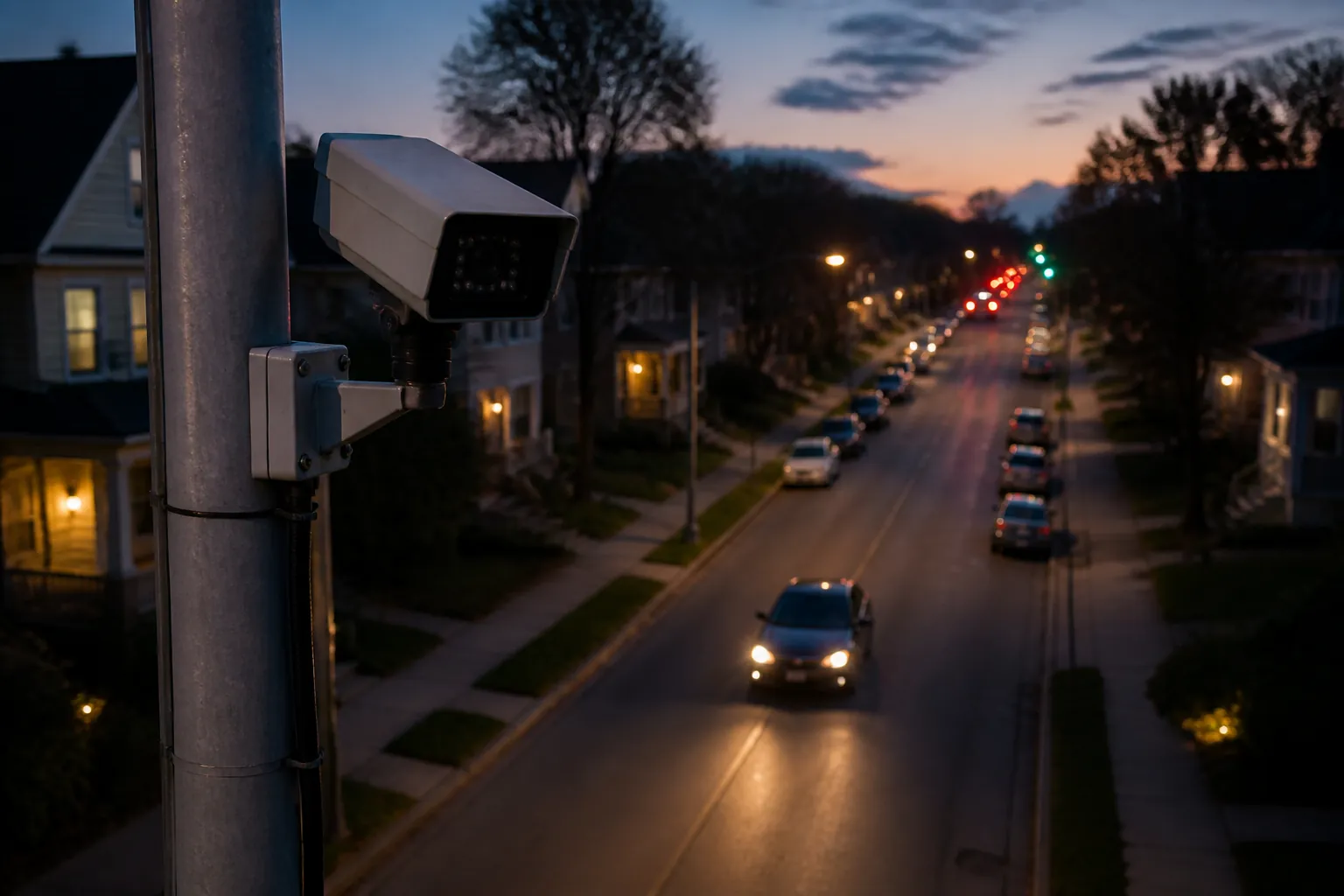
The useful question is not whether cities are removing Flock cameras because of “privacy.” Some are, but that word is carrying too much weight. In the current record, the removals cluster around four different legal fault lines: unsettled Fourth Amendment litigation over fixed-camera dragnet collection; federal or ICE-adjacent access that can breach local promises or state law; officer misuse that turns a database search into discipline, criminal exposure, or evidentiary trouble; and inaccurate vendor-facing representations that make a council’s approval record hard to defend later.
Those are not interchangeable problems. A city trying to solve a Fourth Amendment risk negotiates differently from a city trying to stop out-of-state searches, document officer discipline, or repair a flawed council presentation. Treating every termination as the same privacy backlash is how a municipality removes one vendor and recreates the same exposure in the next surveillance contract.
The constitutional fight is unresolved, not imaginary
The first legal concern is the most familiar: whether a city can operate a fixed network of automated license plate readers without a warrant. The Norfolk litigation matters because it is not a press-release dispute. In January 2026, a federal district judge held that Norfolk’s use of Flock cameras did not violate the Fourth Amendment, a ruling reported as a win for the city and for the proposition that plate reads from public roads are not, standing alone, unconstitutional searches. [4]
That result should not be overstated. The Institute for Justice announced an appeal, and the ACLU’s case page continues to frame Schmidt v. Norfolk as a constitutional challenge to prolonged, citywide ALPR tracking. For readers tracking the docket posture rather than the slogans, the site’s Flock Safety license-plate-camera cases record and police-misuse and Fourth Amendment docket are the better places to keep the litigation timeline separate from the procurement debate. [5][6]
The complication is Chatrie. On June 29, 2026, the Supreme Court decided Chatrie v. United States, a geofence-warrant case, and the decision disturbed a Fourth Circuit precedent that Norfolk’s defenders had relied on. That does not automatically decide the ALPR question. A geofence request to Google and a municipality’s fixed license-plate-reader network are not the same technology, dataset, or legal posture. But it does mean Norfolk’s appeal is proceeding in a less settled landscape than the district-court victory alone suggests. [7]
Municipal counsel do not need to predict the final appellate answer to see the procurement problem. A contract that leaves retention, search scope, and historical access vague gives plaintiffs the easiest version of the city to sue: not a targeted stolen-car tool, but a persistent location database whose limits appear only in vendor materials or police practice. The question for a city is not simply “Are ALPRs constitutional?” It is whether the city can show, from the contract and policy record, what it collected, how long it kept it, who could search it, and why those limits were legally meaningful.
Vendor and advocacy figures should be handled with the same discipline. Flock has asserted legal and operational defenses, including claims reported in the Norfolk coverage about favorable ALPR precedent. Advocacy groups have cited contrary privacy metrics, including figures about how few scanned vehicles are associated with crime. Those statements may be relevant in briefing a council, but they are not substitutes for the city’s own retention schedule, search rules, and audit trail. [4][6]
Federal access is the problem that turns operations into compliance
The second fault line is more operationally frightening for city hall because it can make a local public-safety contract collide with sanctuary rules, state statutes, or the city’s own public promises. The issue is not only whether a camera scan is constitutional. It is whether the city can prove that its sharing defaults, agency permissions, and outside searches complied with the law that the council thought it was buying under.
Mountain View is the clean example. In 2026, the city announced it would terminate its Flock Safety agreement after concerns about federal access to ALPR data, including concerns connected to immigration enforcement. Whatever one thinks about ALPRs generally, that kind of termination is not a broad philosophical rejection of cameras. It is a contract-control failure: the municipality no longer had adequate confidence that access to locally collected data matched local legal and policy constraints. [8]
The University of Washington Center for Human Rights gave that anxiety a structure in its “Leaving the Door Wide Open” report, describing routes by which immigration authorities could obtain ALPR data through direct access, indirect sharing, or other pathways. The labels matter less than the municipal consequence. If a city promised that its system would not be used for immigration enforcement, counsel has to know whether that promise is enforced by configuration, contract, audit, and termination rights—or only by assurances. [9]
Illinois shows the same issue in statutory form. Secretary of State Alexi Giannoulias said out-of-state police had used Illinois license-plate-camera data illegally, according to Capitol News Illinois reporting. That is a different legal problem from the Norfolk Fourth Amendment case. A city could believe its ALPR deployment is constitutional and still violate state limits on who may search the data, for what purpose, and across which jurisdictional lines. [10]

This is where procurement minutes often age badly. A council may be told that the police department controls its data, that outside access is restricted, or that the tool is used only for serious crime. Months later, the city may have to answer narrower questions: Which agencies were approved? Were federal accounts disabled or merely discouraged? Did mutual-aid sharing override a local ordinance? Could an out-of-state officer query local reads? Who reviewed the logs, and how often?
Those are not activist hypotheticals. They are the questions that decide whether the city can defend the difference between a police tool and an uncontrolled data-sharing system. A council that wants to renew a Flock contract should make the police department and vendor identify the actual access architecture, not the intended use case.
Misuse turns the database into evidence against the department
Officer misuse is a narrower driver than constitutional doctrine, but it lands directly on liability, discipline, and evidentiary reliability. The ACLU, discussing Washington Post reporting, pointed to roughly 50 cases of alleged unauthorized use of Flock or other ALPR systems. The same broader record includes reported discipline in Savannah and a Milwaukee prosecution tied to alleged misuse. Those incidents do not prove that most officers misuse ALPR systems. They do prove that a city cannot treat access logs as paperwork to be produced only after a scandal. [11]
The municipal exposure comes in several forms. An improper query can support employee discipline. It can create civil claims from the person searched. It can contaminate a criminal investigation if the ALPR hit becomes part of the path to a stop, search, arrest, or charging decision. It can also undermine a council’s prior assurances that the system is limited to stolen vehicles, violent crime, or active investigations.
Audit design is therefore not a decorative privacy feature. It is part of the evidentiary chain. Who initiated the query? What purpose code was selected? Was a case number required? Did a supervisor review searches outside approved categories? Could the city export logs in a public-records dispute or litigation hold? If the answer is “the vendor can probably provide that,” the city has already made counsel’s job harder.
Misreads and alert verification belong in the same risk family, even though they are not the same as intentional misuse. Washington’s SB 6002 analysis, as summarized by MRSC, focuses on restrictions for ALPR use, including rules that affect retention and sharing. The site’s theft-alert verification record separately tracks the stop-rule and plate-misread problem. For a municipal attorney, the point is practical: if an officer relies on an alert, the city needs a written rule for verification before enforcement action, not just a dashboard notification. [3]
Oshkosh shows why council representations matter
The fourth fault line is vendor truthfulness and procurement integrity. Oshkosh matters because it is not necessary to prove that every vendor statement everywhere is false. The legal problem is smaller and more damaging: if a council approves a surveillance system based on inaccurate or incomplete representations, the city’s own record becomes weak when residents, journalists, litigants, or state officials later ask what was approved.
In July 2026, the ACLU reported that Oshkosh revoked approval for Flock cameras one day after a controversy over whether the system produced a heat map, after prior denial of that capability. The legal significance is not the phrase “heat map” in isolation. It is the gap between what elected officials were told and what the product could apparently do. [11]
That gap matters in contract defense. A city that later faces a public-records fight, civil-rights claim, referendum campaign, or state investigation will have to explain the basis for approval. If the record says the system lacks a function that later appears in vendor materials, counsel is left arguing intent, misunderstanding, version history, or sales imprecision. None of those is a comfortable foundation for a surveillance procurement.
The cure is not to demand perfect product metaphysics at every council meeting. It is to put representations where they belong: in the contract, in exhibits, in data-use policies, and in termination clauses. If a feature affects retention, searchability, sharing, analytics, or public transparency, it should not live only in a slide deck.
Flock’s guardrails are a response, not a municipal defense
Flock has not been silent. On August 13, 2026, the company published a guardrails announcement addressing license-plate-reader privacy concerns and police transparency. That document belongs in the file. It does not end the city’s analysis. [12]
A vendor guardrail changes the risk only to the extent it changes enforceable terms or verifiable system behavior. Does it shorten retention by default or merely describe options? Does it disable certain sharing pathways or require the customer to configure them correctly? Does it give the city audit logs it can independently review? Does it create a termination right if product claims made to council prove inaccurate? Does it bind subcontractors, partner agencies, and future product modules?
Those questions sound tedious until the first disclosure request arrives. Then they are the difference between a controlled legal file and a scramble through emails, vendor help pages, and police-administration recollections.
State law is becoming the compliance floor
The constitutional fight gets attention because it can produce a clean headline. State statutes are where many cities will feel the daily constraint. Washington’s SB 6002, Oregon’s SB 1516, and California’s SB 1013 debate all point toward a more regulated ALPR environment, with attention to retention, sharing, access, and permissible use. The details differ by state, which is exactly why a national vendor default should not be treated as a local legal answer. [3][13][14]
For a jurisdiction-by-jurisdiction view, the site’s state retention and sharing statute map is the right companion record. The procurement lesson is simple enough: the minimum lawful configuration in one state may be an unlawful or politically indefensible configuration in another.
| Fault line | What the city must identify before renewal, termination, or replacement |
|---|---|
| Fourth Amendment dragnet risk | Retention period, historical-search scope, authorized purposes, warrant or process rules, and whether the city can distinguish targeted alerts from location-history searches. |
| Federal or out-of-state access | Default sharing settings, approved-agency list, federal-account controls, mutual-aid pathways, sanctuary-law limits, and proof that outside searches can be blocked and audited. |
| Officer misuse and evidentiary exposure | Purpose-code requirements, case-number requirements, supervisory review, alert-verification policy, discipline triggers, litigation-hold procedures, and log export rights. |
| Vendor representation and procurement integrity | Contractual warranties for product capabilities, incorporated council representations, change-notice duties, audit cooperation, indemnity limits, and termination rights for material misstatements. |
The diligence question is which problem the city is solving
A city terminating Flock for federal-access concerns does not necessarily prove that another city must terminate for Fourth Amendment reasons. A city pausing after Oshkosh-style representation problems does not necessarily prove that every ALPR hit is unreliable. The point of separating the fault lines is not to soften the legal risk. It is to make the risk administrable.
Before renewing, terminating, or replacing a system, counsel should be able to answer four questions from the written record:
- What retention and search terms keep the system from looking like a general location-history database?
- What sharing defaults and permissions prevent federal, out-of-state, or otherwise unauthorized access?
- What audit logs, verification rules, and discipline procedures will survive litigation or a public-records request?
- What contract terms make vendor representations enforceable if the council was told something inaccurate or incomplete?
If those answers are missing, removing the cameras may be prudent. If the answers are documented, enforceable, and matched to local law, removal may be unnecessary. The same discipline will matter when the next networked surveillance vendor arrives with a different interface and the same compliance problem, a pattern already visible in the broader AI-surveillance regulatory gray zone. A city that cannot name which fault line it is solving is likely to buy the next one on faith, too.
References
- Their cities dropped Flock surveillance cameras. They're still being watched, The Guardian, August 20, 2026
- Flock license plate cameras surveillance DeFlock, AP News
- Restrictions on Flock Cameras, MRSC, April 2026
- Judge holds Norfolk's license plate reader use constitutional, Courthouse News Service
- Hampton Roads Residents Will Appeal Court Decision Upholding Norfolk’s License Plate Reader Surveillance, Institute for Justice
- Schmidt v. Norfolk, ACLU
- Chatrie v. United States, SCOTUSblog
- City of Mountain View Announces Termination of Flock Safety Agreement, City of Mountain View
- Leaving the Door Wide Open, University of Washington Center for Human Rights, October 21, 2025
- Illinois license plate cameras used illegally by out-of-state police, Giannoulias says, Capitol News Illinois
- Flock Safety Credibility Lost as It Repeatedly Lies to City Councils, Police Departments, and Public Across the Country, ACLU
- Flock Guardrails Address LPR Privacy Concerns and Police Transparency, Flock Safety, August 13, 2026
- New Oregon law regulates use of license plate readers, OPB, April 23, 2026
- California Flock license plates bill, CalMatters, August 2026
Operationalizing workflow
No workflow has been explicitly linked to this obligation yet. See Workflows generally.
Illustrative cases
No illustrative case is currently tracked for this obligation. See Risk Digest for documented incidents generally.
← Back to RegulationReport a correction or tip
Spotted an outdated figure, a misstated fact, or a ruling this regulation entry should reflect? Public comments are disabled for this content given the professional cost of a misreported case outcome, penalty amount, or rule text — use the structured correction channel instead.
Report a correction or tip for this record →