
What's confirmed in Aaron Farinacci's Old Trails Fire case
A confirmed-vs-reported case record for Aaron Farinacci, the Old Trails Fire arson suspect arrested Aug. 3, 2026, in Spokane County. It separates what primary sources verify — a first-degree arson booking under RCW 9A.48.020, $1M bond, witness and evidence accounts — from reporting-only claims on acreage, damage totals, and his Arizona prior record.
- Jurisdiction
- US-WA
- Court
- Spokane County Superior Court
- AI tool named
- No AI tool named
- Ruling date
- Aug 3, 2026
- Source document
- View primary court order ↗
- Last verified
- Aug 4, 2026
Lex Machina Review is an independent risk-tracking and reference resource. Nothing on this site is legal advice, and using it does not create an attorney-client relationship. Every record is reviewed against primary sources but may not reflect the most current status of a matter — always verify directly against the cited court order, rule text, or a licensed attorney before relying on it.
Companion explanation — secondary to the source document above
Aaron Farinacci, 37, is in the Spokane County record as an Old Trails Fire arson suspect, not as a convicted defendant in that fire. The confirmed public baseline is narrower: Spokane County said investigators arrested him on Aug. 3, 2026, around 5 p.m., on an arrest warrant; served a search warrant at his W. Elliott Drive residence; and booked him into the Spokane County Jail for first-degree arson under RCW 9A.48.020, with bond listed at $1 million. The same county release said the Old Trails Fire was first reported on Aug. 1 near North Old Trails Road and West Euclid Road, and that Washington DNR investigators had ruled out a natural cause. [1]
As of this Aug. 4, 2026 verification point, no public charging document or probable-cause affidavit has been confirmed in the available sources reviewed for this record. That matters. The arrest, booking statute, warrant activity, and bond are one category of fact. The reported witness accounts, item seizures, fire-size estimates, damage totals, and prior-record descriptions are another. In the Aaron Farinacci Old Trails Fire suspect case, those categories are already being blurred.

The booking record is the floor, not the whole case
| Item | Current record status | Source posture |
|---|---|---|
| Identity | Aaron Farinacci, 37 | Confirmed in Spokane County release and repeated in published reports. [1] |
| Arrest | Arrested Aug. 3, 2026, around 5 p.m., without incident, on an arrest warrant | Confirmed by Spokane County. [1] |
| Residence search | Search warrant served at Farinacci’s W. Elliott Drive residence | Confirmed by Spokane County. [1] |
| Booking basis | Booked for first-degree arson under RCW 9A.48.020 | Confirmed by Spokane County; the statute is Washington’s first-degree arson provision. [1][2] |
| Bond | $1 million | Confirmed by Spokane County. [1] |
| Formal charge | Not confirmed in the sources reviewed as of Aug. 4, 2026 | NBC reported it was unclear whether Farinacci had been formally charged or represented by counsel; CNN reported attorney status was still being determined. [3][4] |
| Probable-cause affidavit | Not confirmed as publicly available in the sources reviewed | Reported evidence claims should be treated as reporting until the affidavit is available. |
Washington’s first-degree arson statute is not a casual label. RCW 9A.48.020 covers knowingly and maliciously causing a fire or explosion under specified circumstances, including where a person is manifestly endangered, a dwelling is involved, or other listed property-risk conditions are present; the statute classifies first-degree arson as a class A felony. [2] That explains why the booking entry is significant. It does not answer whether prosecutors have filed that charge, what elements they will allege, or what defenses may be raised.
The same distinction is used in this site’s Santa Rosa arson-arrests record: booking language is not made to do the work of a filed information, complaint, indictment, or adjudication. That is not a favor to the suspect. It is a minimum condition for reading a live criminal record accurately.
What investigators reportedly say they have
The public investigative account has more detail than the county’s booking summary, but much of it comes through news reporting rather than a posted affidavit. CNN, citing Spokane County Sheriff John Nowels, reported that witnesses allegedly saw Farinacci kneeling in grass at the ignition point; that officers found waterproof matches and a butane lighter on him; and that investigators later used body-worn camera footage from a same-day detention encounter in the investigation. [4]
Those details are material if they appear in a probable-cause affidavit. A witness account placing a person at an ignition point, fire-starting items allegedly found on that person, and body-worn camera footage from the contact are not equivalent kinds of evidence, and they will not carry the same weight merely because they sit in the same paragraph of a news story. The camera footage, in particular, is a record class with its own custody, completeness, angle, timing, audio, and disclosure problems; this site has treated that separately in its NBA YoungBoy bodycam evidence record.
Spokane County’s release also credits citizen tips and responding officers as part of the investigative path to Farinacci’s arrest. [1] That is the available primary-source path. A separate ALPR, or automated license plate reader, claim has circulated socially, but the crawled primary sources reviewed for this record do not confirm it. It should not be treated as part of the case record unless a law-enforcement filing, agency statement, or other verifiable source actually puts it there.
The wildfire numbers are not lining up cleanly
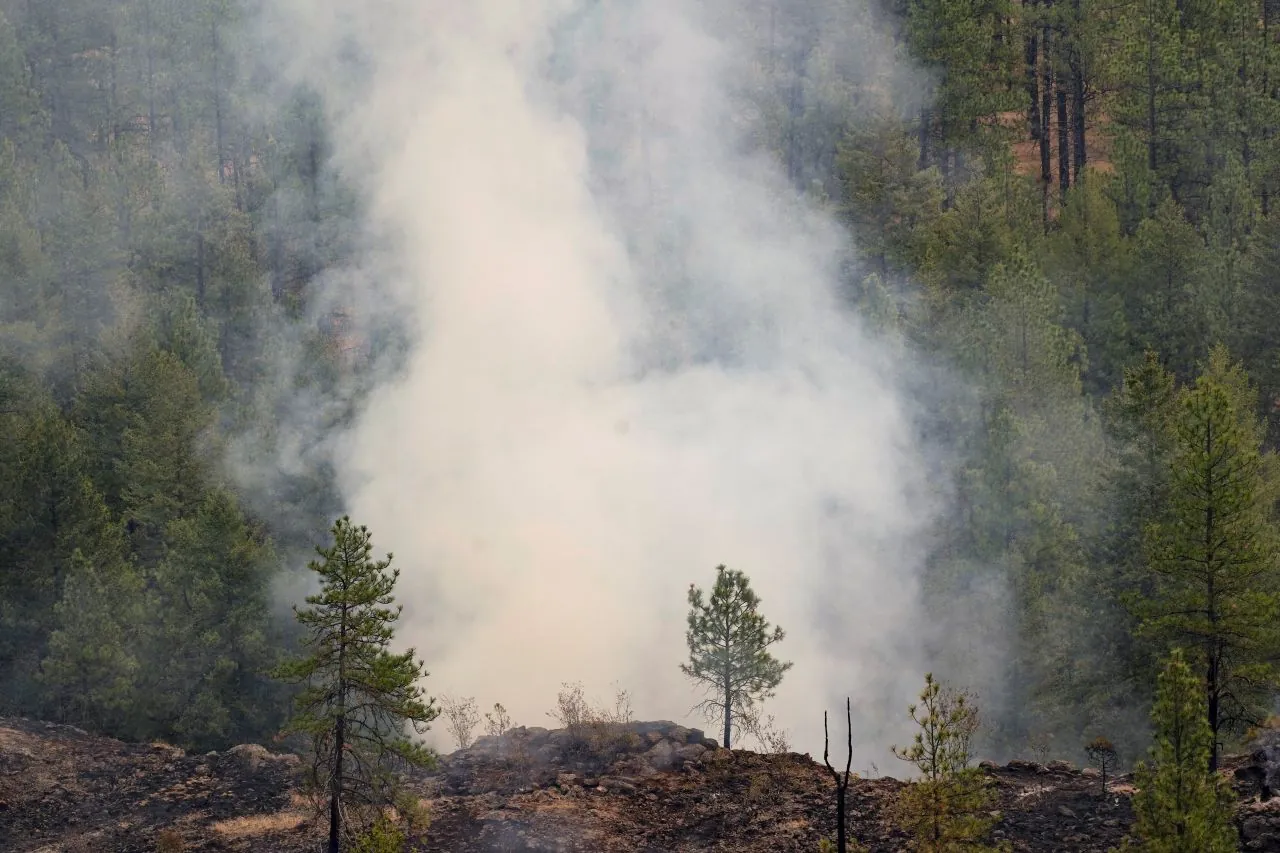
The Old Trails Fire was dangerous long before the public record became tidy, and the people under evacuation orders do not need a perfect table to know what they are losing. Still, the public numbers matter because they shape charging narratives, civil exposure, insurance triage, political pressure, and the background noise around a jury-eligible case.
| Metric | Reported versions in circulation | How to read it now |
|---|---|---|
| Fire start / report time | Spokane County said the Old Trails Fire was first reported around noon on Aug. 1; NBC reported the fire began around 10 a.m. [1][3] | Do not merge these into one time. One is the county’s reported-time formulation; the other is news reporting. |
| Acreage | NBC and CNN reported more than 8,000 acres; KXLY reported more than 10,000 acres as of Monday evening. [3][4][5] | Treat as a moving wildfire metric and identify the outlet and timestamp posture. |
| Homes / structures | The Spokesman-Review reported around 700 homes; Fox, carrying AP-style reporting, used at least 700 structures; CNN reported 700-plus structures. [6][7][4] | Homes and structures are not interchangeable terms. Do not silently substitute one for the other. |
| Evacuees | NBC reported about 67,000 people under evacuation orders; CNN reported nearly 65,000. [3][4] | Both are reported figures. They may reflect different update points or definitions, but the current record does not justify harmonizing them. |
| Damage totals | Published reports described major losses and expected totals to rise. [3][4][6] | Use as provisional reported damage, not a final damage count. |
This is the same discipline used in this site’s Clooney wildfire evacuation record and Clooney vineyard fire-claims record: a wildfire estimate can be operationally important and still be too unstable to recite as settled fact. In a criminal matter, that caution is not cosmetic. “Around 700 homes” and “at least 700 structures” may sound close in a headline. They are different claims.
The Arizona prior record needs narrower wording than some reports give it
Farinacci’s Arizona history is relevant because several reports introduced it quickly after the Spokane County arrest. It is also where loose wording can do real damage.
Phoenix New Times reported in 2010 that Farinacci was accused in Mesa, Arizona, of shooting his father twice after an argument over dishes, then shooting himself in the chest. [8] Later reporting cited in the Old Trails coverage described the case as one in which an original first-degree murder charge was followed by a 2012 guilty plea to manslaughter and aggravated assault. [3]
That is not the same thing as a conviction for “premeditated murder.” AZFamily’s report used wording that described Farinacci as a convicted felon in Arizona for manslaughter and premeditated murder, while also reporting that he had killed his father in Mesa. [9] The narrower supported formulation is that the available reporting describes an original first-degree murder allegation and a later guilty plea to manslaughter and aggravated assault. Unless a docket or judgment of conviction says otherwise, the conviction language should track the plea reporting, not the most severe early allegation.
What is still unconfirmed
Several items should remain outside the confirmed record unless later filings supply them.
- Formal charging status: NBC reported it was unclear whether Farinacci had been formally charged, and the available sources reviewed here do not supply a public charging document as of Aug. 4, 2026. [3]
- Defense counsel: NBC reported representation was unclear, and CNN reported attorney status was still being determined. [3][4]
- Probable-cause affidavit: the reported witness, match, lighter, and body-camera details should be rechecked against the affidavit when it becomes available.
- ALPR involvement: no crawled primary source reviewed for this record confirms an automated license plate reader role.
- Connection to other fires: officials said there was no evidence connecting Farinacci to the still-open Autumn Lane and Fairview fire investigations. [3][4]
- Final loss figures: acreage, evacuation counts, and damage totals were still being reported as moving or expected to rise. [3][4][6]
There is a practical reason to keep that list short and hard-edged. In a fast wildfire case, the next document can change the working record without changing every human fact on the ground. A filed information may mirror the booking statute or depart from it. A probable-cause affidavit may firm up the reported ignition-point account, narrow it, or add facts that have not reached public reporting. A defense appearance may correct assumptions about counsel, mental state, identity, or the use of prior history.
As of the Aug. 4 verification point, the most reliable reading of the Farinacci matter is therefore a live case record: confirmed arrest, warrant, booking, statutory basis, and bond; reported evidence claims that need affidavit-level checking; public wildfire metrics that diverge by outlet and update point; and a prior Arizona record that should be described by the plea history rather than by the most aggravated shorthand in circulation.
References
- Investigators Arrest Old Trails Fire Arson Suspect • Spokane County, WA — Spokane County
- RCW 9A.48.020 — Washington State Legislature
- Man accused of arson in the biggest of 3 major fires in Spokane, Washington — NBC News
- CNN live updates — CNN
- Convicted felon arrested for arson in connection with massive Spokane wildfire — KXLY
- Investigators arrest 37-year-old man in connection to devastating Spokane County wildfire — The Spokesman-Review
- Spokane Old Trails Fire arson arrest — Fox News
- Mesa Father Tells Son to Do Dishes; He Didn't Want to, so He Shot His Father — Phoenix New Times, Oct. 12, 2010
- Man who killed father in Mesa suspected of starting Washington wildfire — AZFamily
Related records
Tool profile
How Meta's AI Spending Reshapes Law Firm ProfitabilityGoverning regulation
Browse the obligations tracker →Preventive workflow
Browse verification workflows →
Report a correction or tip
Spotted an outdated figure, a misstated fact, or a ruling this case record should reflect? Public comments are disabled for this content given the professional cost of a misreported case outcome, penalty amount, or rule text — use the structured correction channel instead.
Report a correction or tip for this record →