
AI Evidence Enters Greece's Murder Investigation
A risk record on the Finikounda campsite double-murder investigation (Messinia, Greece), the first widely reported Greek murder proceeding in which AI app search history and chatbot conversations entered the pre-trial case file as core evidence. It flags the reported-not-confirmed evidence, the ongoing investigation, and the lack of any AI-specific admissibility or privilege rule, giving counsel a basis to assess Greek proceedings before advising or filing.
- Jurisdiction
- Greece
- Court
- Messinia investigating magistrate (pre-trial)
- AI tool named
- Unnamed AI search/chatbot app
- Ruling date
- Jan 14, 2026
- Source document
- View primary court order ↗
- Last verified
- Aug 3, 2026
Lex Machina Review is an independent risk-tracking and reference resource. Nothing on this site is legal advice, and using it does not create an attorney-client relationship. Every record is reviewed against primary sources but may not reflect the most current status of a matter — always verify directly against the cited court order, rule text, or a licensed attorney before relying on it.
Companion explanation — secondary to the source document above
Risk record, last verified Aug. 3, 2026: Greece; Messinia/Finikounda; double-murder investigation; pre-trial stage; AI tool unnamed; AI-search and chatbot material reported in the case file, not confirmed by a public Greek court order. No public admissibility ruling has been identified. No AI-specific Greek privilege rule has been identified in the available materials. No public English-language pre-trial file is available to verify the reported contents directly.
That limited status is the point of the record. The Finikounda proceeding is the first widely reported Greek murder investigation in which AI app search history and AI chatbot conversations have been described as core pre-trial evidence. The reported use is not decorative: investigators are said to be treating the material as bearing on concealment intent and premeditation. The unresolved question is not whether digital material can matter in a Greek murder case file. Phones and search histories plainly can. The narrower question is how far a Greek court will let AI interactions travel once the defense can test acquisition, attribution, context, reliability, and legal relevance.

What is reported to be in the AI evidence
The first reported AI category is phone-based AI app search history attributed to the arrested nephew. To Vima reported on Jan. 12, 2026 that investigators found searches concerning how to remove DNA traces, how to clean bloodstains from clothing and objects, and which mistakes most often lead to arrest after serious crimes.[1] Those topics are plainly the kind of material police would want to compare against the physical evidence, the suspects’ movements, and any alleged post-offense conduct. They do not, by themselves, prove who planned or committed the killings.
The second category is more sensitive because it is described not as ordinary search terms but as exchanges with an AI chatbot. On Jan. 14, 2026, To Vima reported that August 2025 conversations now in the case file included questions about whether a “perfect crime” exists, the chances of arrest if a shotgun is used and shell casings are collected, and whether revolvers leave ballistic signatures.[2] The same report described answers involving gunshot residue and firearm trace issues, but those answers are second-hand in public reporting. They are not a substitute for the case file, a forensic report, or expert testimony.
For counsel, the distinction matters. A search-history exhibit can raise one set of questions: extraction method, device ownership, account access, timestamp integrity, synchronization, and whether a query was typed, suggested, cached, or retrieved. A chatbot-conversation exhibit adds further questions: whether the platform stored the exchange, whether the displayed text is complete, whether prompts and responses were preserved together, whether the account was shared, whether the model or app can be identified, and whether any response is being smuggled into the file as if it were reliable technical evidence.
The public reports do not identify the AI tool. It should not be called ChatGPT unless a source document or court filing says so. The reports also do not establish that the AI responses were accurate, relied on, or acted upon. At this stage, the safer characterization is narrower: investigators reportedly consider the nephew’s AI searches and chatbot conversations probative of preparation, concealment, or state of mind.
The case chronology, kept to what matters procedurally
The underlying case concerns the killings of the Finikounda campsite owner and another man on Oct. 5, 2025. By mid-October, two 22-year-old suspects had been arrested and remanded, and they were given until Sunday, Oct. 19, to testify, according to eKathimerini’s report on the early proceedings.[3] That sequence places the case quickly inside the ordinary machinery of a serious felony investigation rather than in a media-only allegations cycle.
The nephew entered the public record later. To Vima reported in December 2025 that the slain owner’s nephew had been arrested as the alleged instigator, along with a coffee-shop owner, and that a third warrant had been issued.[4] The National Herald also reported the arrest of an accomplice suspect in connection with the double campsite murder.[5] These are allegations, and the presumption of innocence remains operative.
There is a small but important identification caution. The nephew’s age has been reported inconsistently: To Vima’s December report described him as 37, while To Vima’s January AI-search report and News247’s inheritance report described him as 33.[1][4][6] Until a primary procedural document is available, the age should not be treated as settled.
The will and estate reporting supply motive context, not proof. News247 reported that the uncle’s will was notarized on Oct. 2, 2025, three days before the killings, and that most of an estate reported at about EUR 30 million would pass to the nephew.[6] That is why the inheritance issue appears in the file-facing risk record. It should not be allowed to do more work than the evidence can support.
Where the AI issue sits in Greek criminal procedure
The reported posture is pre-trial. In a Greek felony case, the main investigation is conducted before an investigating magistrate; after the investigation, the prosecutor makes a recommendation; and the Judicial Council decides whether the accused should be referred to trial. Greek Law Digest’s procedural summary describes that path and also states that every lawfully acquired means of proof is, in principle, admissible, with evidence subject to free evaluation by the court under Greek Code of Criminal Procedure Articles 177–178.[7]
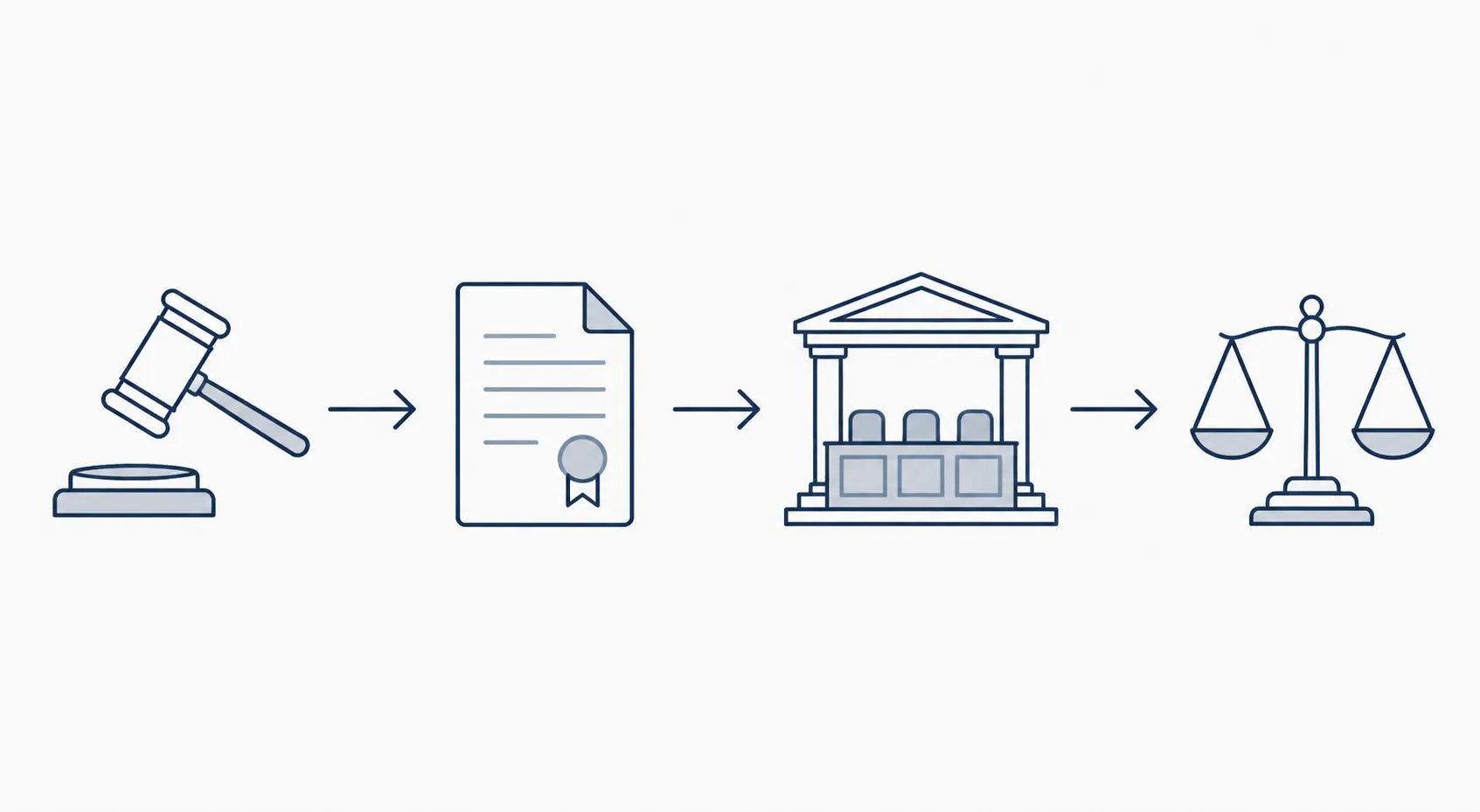
That is a conventional evidence frame, not an AI doctrine. The available materials do not show a Greek court announcing a special admissibility test for chatbot logs, AI app search histories, or model-generated answers. They also do not identify an AI-specific privilege rule. Unless and until a Greek court says otherwise, the apparent litigation path is ordinary and fact-heavy: Was the device or account lawfully accessed? Is the extraction complete and attributable? Is the conversation relevant to the charged conduct? Is the probative value being overstated because the material came through an AI interface?
The court’s free evaluation does not mean evidence floats into the case file without challenge. It means the fight is likely to be less about whether “AI evidence” exists as a category and more about acquisition, authenticity, completeness, attribution, and weight. A defense challenge can therefore be procedural and technical without needing to persuade a court that AI material is categorically inadmissible.
The dated procedural source should also be handled carefully. Greek Law Digest’s summary is useful for orientation, but it is from 2018 and should be checked against the current Code of Criminal Procedure before any filing or client advice relies on article wording or procedural sequence.[7] This record flags risk; it is not a substitute for Greek counsel’s current-code analysis.
What counsel should verify before treating the reports as evidence
The highest-risk mistake is to treat press descriptions as if they were filed exhibits. The public record, as reviewed here, does not include the Greek pre-trial file, a forensic extraction report, a prosecutor’s recommendation, a Judicial Council decision, or an admissibility ruling. The reported AI material may be central to the investigation; that does not tell counsel whether it is complete, uncontested, or trial-ready.
- Confirm the source of acquisition: seized phone, account return, cloud backup, app export, screenshot, or witness production.
- Separate user prompts from model responses, app suggestions, browser results, and cached or synchronized content.
- Test attribution: device control, account credentials, shared access, timing, language, and whether any suspect denies authorship.
- Check completeness: deleted material, surrounding conversations, prompt chains, attachments, edits, and export limitations.
- Avoid relying on the AI tool’s answer as forensic truth unless an expert or admissible technical source independently supports it.
- Preserve the distinction between premeditation evidence, concealment evidence, motive evidence, and proof of participation in the killings.
A similar discipline applies to parallel Greek live records. The internal Athens suitcase record on AI search and pre-trial reporting is useful mainly as a reminder to keep confirmed filings separate from reported investigative claims. The Fukuoka workflow on evidence authentication after a deepfake allegation is the adjacent authentication problem, not a shortcut to resolving this Greek case.
Why the cross-jurisdiction trend is relevant, but not controlling
Other jurisdictions are already forcing lawyers to treat AI conversations as discoverable or evidentiary material. In February 2026, U.S. commentary reported a federal criminal proceeding in which Claude chatbot searches were ruled discoverable despite privilege and work-product objections.[8][9] That does not answer Greek admissibility, but it undercuts any assumption that AI searches sit outside ordinary litigation collection.
Criminal cases are also beginning to show AI-chat evidence in more familiar proof settings. TechPolicy.Press discussed a Virginia murder conviction involving Snapchat’s My AI, where conversations with the chatbot became part of the evidentiary record.[10] CNN also reported on an affidavit in the Abugharbieh matter describing ChatGPT-related material in a criminal investigation.[11] These examples are context only. They do not prove what a Greek Judicial Council or trial court will do with the Finikounda material.
The practical lesson is narrower and more durable: AI interactions are no longer safely classed as novelty evidence. They can be searched for, extracted, described by police, and argued over like other digital traces. The harder questions then become ordinary litigation questions with unfamiliar facts attached.
Current risk marker
As of Aug. 3, 2026, the Finikounda record supports a cautious marker for Greek murder proceedings: AI app search history and chatbot conversations have reportedly entered a Greek double-murder pre-trial file as core evidence of alleged planning or concealment. The record does not support a claim that a Greek court has admitted the material, created an AI-evidence doctrine, resolved privilege, identified the tool, validated the chatbot’s technical answers, or determined the nephew’s alleged role.
Counsel with Greek criminal exposure should therefore treat AI interactions as live evidence risk, while treating every public claim about this file as provisional until matched against primary Greek procedural materials.
References
- AI Searches Expose Nephew in Greek Campsite Double Murder, To Vima, Jan. 12, 2026
- Chats With AI App Put Nephew Under Scrutiny in Double Murder, To Vima, Jan. 14, 2026
- Suspects in double campsite murder given until Sunday to testify, eKathimerini
- Nephew of Slain Owner Arrested in Finikounda Campsite Double-Murder, To Vima
- Greek Police Arrest Accomplice Suspect in Double Campsite Murder, The National Herald
- Murder in Finikounta: The will speaks, News247
- Procedure Before Criminal Courts, Greek Law Digest
- AI Searches Ruled Discoverable in Federal Criminal Proceeding, Scopelitis
- AI Searches Are Now Discoverable in Criminal Proceedings, Jacobs & Dow
- When Conversations With AI Become Evidence, TechPolicy.Press
- ChatGPT AI privacy crime, CNN, May 2, 2026
Related records
Tool profile
How Meta's AI Spending Reshapes Law Firm ProfitabilityGoverning regulation
Browse the obligations tracker →Preventive workflow
Browse verification workflows →
Report a correction or tip
Spotted an outdated figure, a misstated fact, or a ruling this case record should reflect? Public comments are disabled for this content given the professional cost of a misreported case outcome, penalty amount, or rule text — use the structured correction channel instead.
Report a correction or tip for this record →