
AI Litigation by the Numbers: Case Volume, Venue Concentration, and Defendant Exposure in 2025–2026
A data-driven baseline for litigation risk officers and in-house counsel: AI-related federal cases surged from 7 in 2022 to 94 in 2025, concentrated in the N.D. Cal. and S.D.N.Y., with OpenAI named in over 40% of all tracked filings. This article provides the quantitative foundation for sizing AI litigation risk, budgeting for defense costs, and evaluating insurance exposure.
Lex Machina Review is an independent risk-tracking and reference resource. Nothing on this site is legal advice, and using it does not create an attorney-client relationship. Every record is reviewed against primary sources but may not reflect the most current status of a matter — always verify directly against the cited court order, rule text, or a licensed attorney before relying on it.
Companion explanation — secondary to the source document above
The Scale Shift: From 7 Cases in 2022 to 94 in 2025
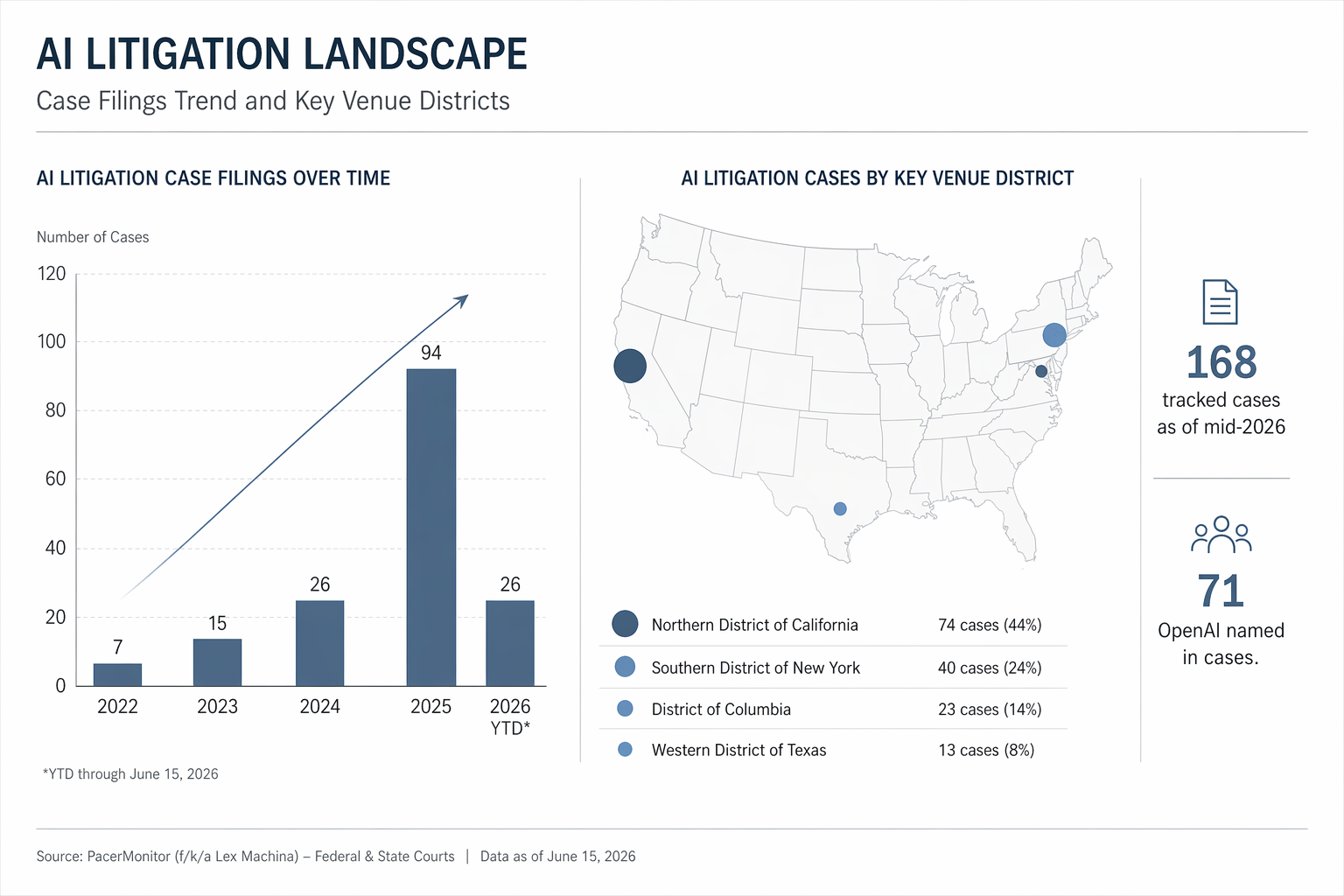
The quantitative story of AI litigation is one of sudden, dramatic acceleration. A targeted manual review of federal district court cases conducted by DOAR tracked just 7 AI-related filings in 2022. That number rose to 19 in 2023 and 22 in 2024 — a steady but unremarkable climb. Then, in 2025, the figure jumped to 94 cases, a single-year total that exceeds the sum of all prior years combined and accounts for more than half of the 168 cases in the dataset.
This is not a speculative projection or a vendor-funded forecast. It is a count of actual federal court filings where AI technology is central to the dispute. For litigation risk officers and in-house counsel, the implication is straightforward: the volume of AI-related cases has crossed an inflection point, and the infrastructure for managing that volume — insurance coverage, defense budgets, venue-specific counsel — needs to be evaluated against a fundamentally different baseline than what existed two years ago.
Where Cases Land: Venue Concentration and What It Signals
AI litigation is not distributed evenly across the federal judiciary. It is heavily concentrated in a small number of districts, a pattern that has practical consequences for forum-shopping risk, local counsel strategy, and the development of judicial expertise.
The Northern District of California leads by a wide margin, hosting 53 of the 168 tracked cases. The Southern District of New York follows with 23 cases. Together, these two districts account for 45% of all filings. The remaining cases are spread across a long tail of districts, with only eight others — D.D.C. (9), W.D. Tex. (9), C.D. Cal. (7), E.D. Tex. (6), N.D. Tex. (5), D. Del. (4), D. Colo. (4), and E.D. Va. (4) — hosting more than a handful of cases.
| District | Case Count | Share of 168-Case Dataset |
|---|---|---|
| N.D. Cal. | 53 | 31.5% |
| S.D.N.Y. | 23 | 13.7% |
| D.D.C. | 9 | 5.4% |
| W.D. Tex. | 9 | 5.4% |
| C.D. Cal. | 7 | 4.2% |
| E.D. Tex. | 6 | 3.6% |
| N.D. Tex. | 5 | 3.0% |
| D. Del. | 4 | 2.4% |
| D. Colo. | 4 | 2.4% |
| E.D. Va. | 4 | 2.4% |
The concentration in N.D. Cal. is unsurprising given its proximity to Silicon Valley and the number of AI companies headquartered there. But the S.D.N.Y. figure is notable: it suggests that plaintiffs' firms and class-action specialists in New York are actively filing AI cases, and that the Southern District's well-developed case law on securities, privacy, and consumer protection is being leveraged for novel AI theories. For companies with operations in either district, the probability of being sued there is disproportionately high.
Defendant Concentration: OpenAI in 71 of 168 Tracked Cases
Just as venue is concentrated, so too is defendant exposure. OpenAI appears in 71 of the 168 tracked cases, accounting for more than 42% of all filings in the DOAR dataset. No other defendant comes close to this level of exposure. Meta, Anthropic, Microsoft, and Google each appear in smaller but still significant numbers, but the landscape is dominated by a single company.
This concentration has direct implications for risk assessment:
- Companies that integrate OpenAI's models into their products or workflows face a higher probability of being drawn into litigation as co-defendants or through indemnification claims.
- Insurance carriers underwriting D&O and E&O policies for AI-related exposures are likely to scrutinize OpenAI-dependent deployments more closely.
- The sheer volume of cases against a single defendant may create pressure for early settlements or global resolutions that could set precedents affecting the entire ecosystem.
The defendant concentration also means that the risk of AI litigation is not evenly distributed across the AI ecosystem. Companies using models from providers with smaller litigation footprints — or running open-source models on their own infrastructure — may face a different risk profile than those relying on OpenAI's API or ChatGPT Enterprise.
Case-Type Breakdown: Copyright Dominates, New Categories Emerge
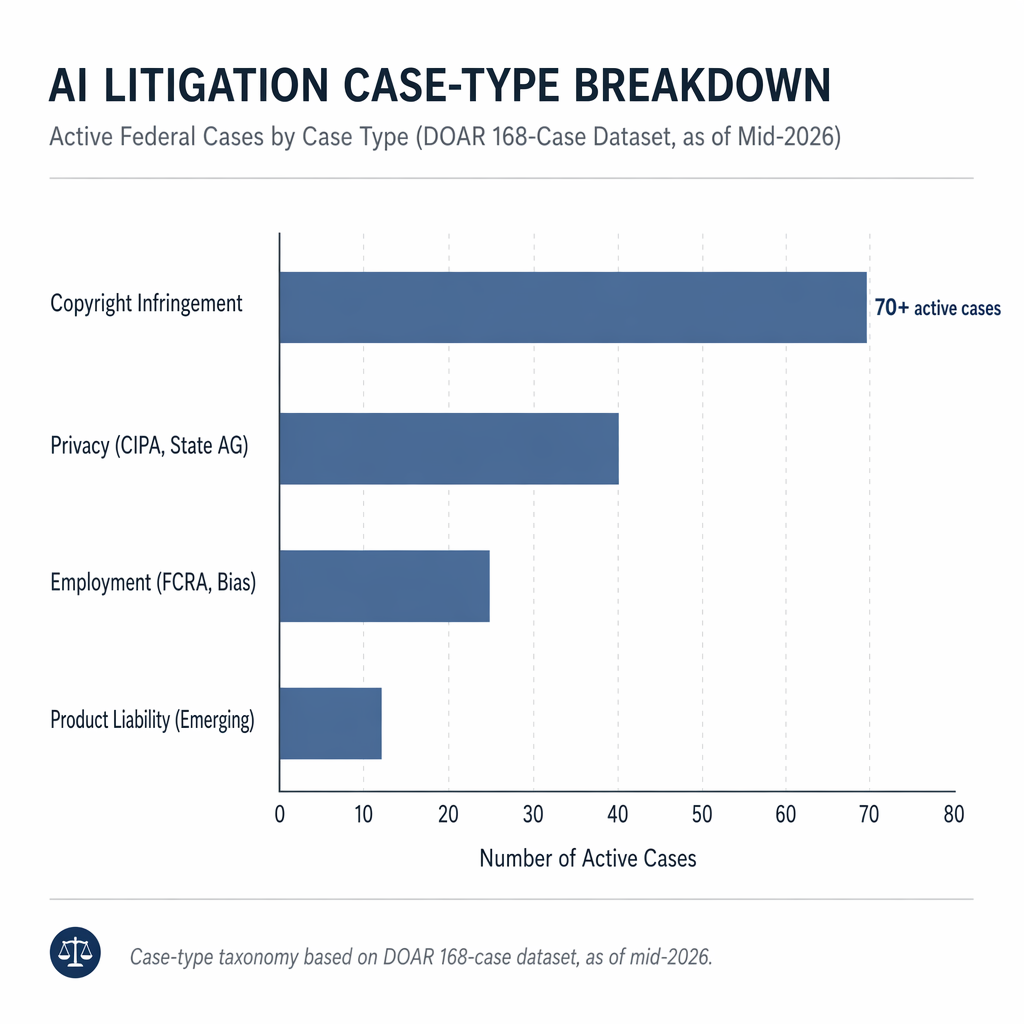
The case-type taxonomy reveals a landscape that is still dominated by copyright infringement but is rapidly diversifying into new liability theories.
| Case Category | Estimated Volume | Key Developments (2025–2026) |
|---|---|---|
| Copyright Infringement | 70+ active cases | Grew from ~30 cases at end of 2024 to 70+ by end of 2025. Bartz v. Anthropic settled for $1.5 billion. In Re OpenAI MDL consolidated in S.D.N.Y. with discovery ongoing. |
| Privacy (CIPA, State AG) | Growing rapidly | Taylor v. ConverseNow Technologies allowed CIPA wiretapping claim against AI chatbot to survive motion to dismiss. Bipartisan state AG warning on AI chatbots and child safety (Aug. 2025). FTC launched AI companion chatbot inquiry (Sept. 2025). |
| Employment (FCRA, Bias) | Emerging | Kistler v. Eightfold AI (filed Jan. 2026) alleges AI hiring platform operated as unregistered consumer reporting agency under FCRA. Expands AI litigation beyond algorithmic bias into privacy implications of hiring tools. |
| Product Liability | Early stage | Garcia v. Character Technologies (M.D. Fla., Oct. 2024) — court treated chatbot app as 'product' under strict-liability pleading. Raine v. OpenAI (Cal. Sup. Ct., Aug. 2025) — parents allege ChatGPT fostered emotional dependency. Nippon Life v. OpenAI (N.D. Ill., Mar. 2026) — insurer seeks recovery from AI-assisted meritless filings. |
The copyright category remains the largest, but its growth rate may be slowing as courts begin to issue substantive rulings on fair use. The privacy and employment categories are where the most novel legal theories are being tested, and where the risk surface is expanding most rapidly for companies that deploy AI in customer-facing or hiring contexts.
Parallel to private litigation, regulatory enforcement is also intensifying. The FTC brought at least a dozen 'AI-washing' cases in 2025, distributed over $15 million in connection with Avast's deceptive privacy claims involving AI, and launched an inquiry into AI chatbots acting as companions. State attorneys general in Texas investigated Meta and Character.AI over therapeutic claims. For readers interested in the regulatory side of the risk landscape, our separate analysis covers the enforcement shift from guidance to penalties in detail.
What the 2026 Filing Pace Suggests
As of the DOAR crawl date in Q1/Q2 2026, 26 new AI-related cases had already been filed. This is partial-year data and should not be annualized without noting the methodology, but the pace is worth examining.
If the filing rate observed in the first half of 2026 continues, the year could approach or exceed 2025's total of 94 cases. Even if the rate moderates, the 26-case YTD figure already exceeds the full-year totals for 2022 (7), 2023 (19), and 2024 (22). The trend line is unambiguous: AI litigation is not a temporary spike but a structural shift in the litigation landscape.
One contributing factor to the rising case count may be increased pro se filings assisted by AI tools. Our separate analysis of the AI-fueled pro se surge examines how free AI lawyer apps are reshaping federal litigation in 2026. However, the aggregate case volume data suggests that the growth is driven primarily by sophisticated plaintiffs' firms and class-action specialists, not by individual pro se litigants.
Practical Implications for Risk Assessment and Insurance
The data presented in this article provides a quantitative foundation for several actionable risk-management steps.
- Venue-specific exposure: Companies with operations, customers, or data centers in the N.D. Cal. and S.D.N.Y. face disproportionate litigation risk. Local counsel relationships in these districts should be reviewed, and litigation hold protocols should account for the higher probability of being sued there.
- Defendant concentration risk: Organizations using OpenAI-powered tools — whether through direct API integration, ChatGPT Enterprise, or third-party products built on OpenAI models — should assess their indemnification provisions and insurance coverage. The 42%+ defendant concentration means that even companies that are not AI developers can be drawn into litigation through their technology stack.
- Expanding risk surface: The emergence of product-liability and FCRA theories expands the risk surface beyond copyright. Companies deploying AI in customer-facing roles (chatbots, hiring platforms, content generation) should evaluate their exposure under these newer theories, not just under traditional IP frameworks.
- Insurance coverage review: The pace of filings suggests that litigation budgets and D&O/E&O coverage should be reviewed against the new baseline. Policies written before 2024 may not have anticipated the volume or diversity of AI-related claims now being filed.
For readers who need details on the distinct liability area of AI hallucination sanctions in legal filings, our separate risk-digest article covers the sanctions trajectory and verification discipline every lawyer should adopt. That article focuses on a different dimension of AI litigation risk — the professional responsibility consequences of relying on AI-generated citations — and complements the aggregate-volume perspective presented here.
Related records
Tool profile
Browse tool evaluations →Governing regulation
Browse the obligations tracker →Preventive workflow
Browse verification workflows →
Report a correction or tip
Spotted an outdated figure, a misstated fact, or a ruling this case record should reflect? Public comments are disabled for this content given the professional cost of a misreported case outcome, penalty amount, or rule text — use the structured correction channel instead.
Report a correction or tip for this record →