
Who is legally eligible to claim an Amazon tariff refund?
The legal claim to an Amazon tariff refund belongs to the importer of record on the CBP entry, not the seller who paid the fee or the marketplace that collected it. Seller eligibility depends on holding importer-of-record status and acting within the CAPE declaration window or the 180-day protest deadline; sellers without that status are left to contractual pass-through rather than a direct claim against CBP.
- Jurisdiction
- US federal
- Court
- U.S. Supreme Court
- AI tool named
- No AI tool involved
- Ruling date
- Feb 20, 2026
- Source document
- View primary court order ↗
- Last verified
- Aug 1, 2026
Lex Machina Review is an independent risk-tracking and reference resource. Nothing on this site is legal advice, and using it does not create an attorney-client relationship. Every record is reviewed against primary sources but may not reflect the most current status of a matter — always verify directly against the cited court order, rule text, or a licensed attorney before relying on it.
Companion explanation — secondary to the source document above
The short legal answer is uncomfortable but clear: an Amazon tariff refund claim belongs first to the importer of record on the customs entry, not to the seller who believes it bore the cost and not necessarily to the marketplace that collected a tariff-related charge. CBP’s refund regulation pays refunds to the importer of record; protest standing is limited by statute; Part 174 supplies the protest machinery; CBP’s IEEPA refund process limits CAPE filings to the importer of record or the licensed broker that filed the entries; and Amazon’s own July 30, 2026 earnings-call disclosure was that it is “not the importer of record for the large majority of items sold in our store.” [1][2][3][4][5]
That is the legal center of the eligibility analysis. The first question is not who wrote a check, who increased prices, who saw a duty line in Seller Central, or who feels the refund ought to be passed through. The first question is: whose name and importer number are on the CBP entry?
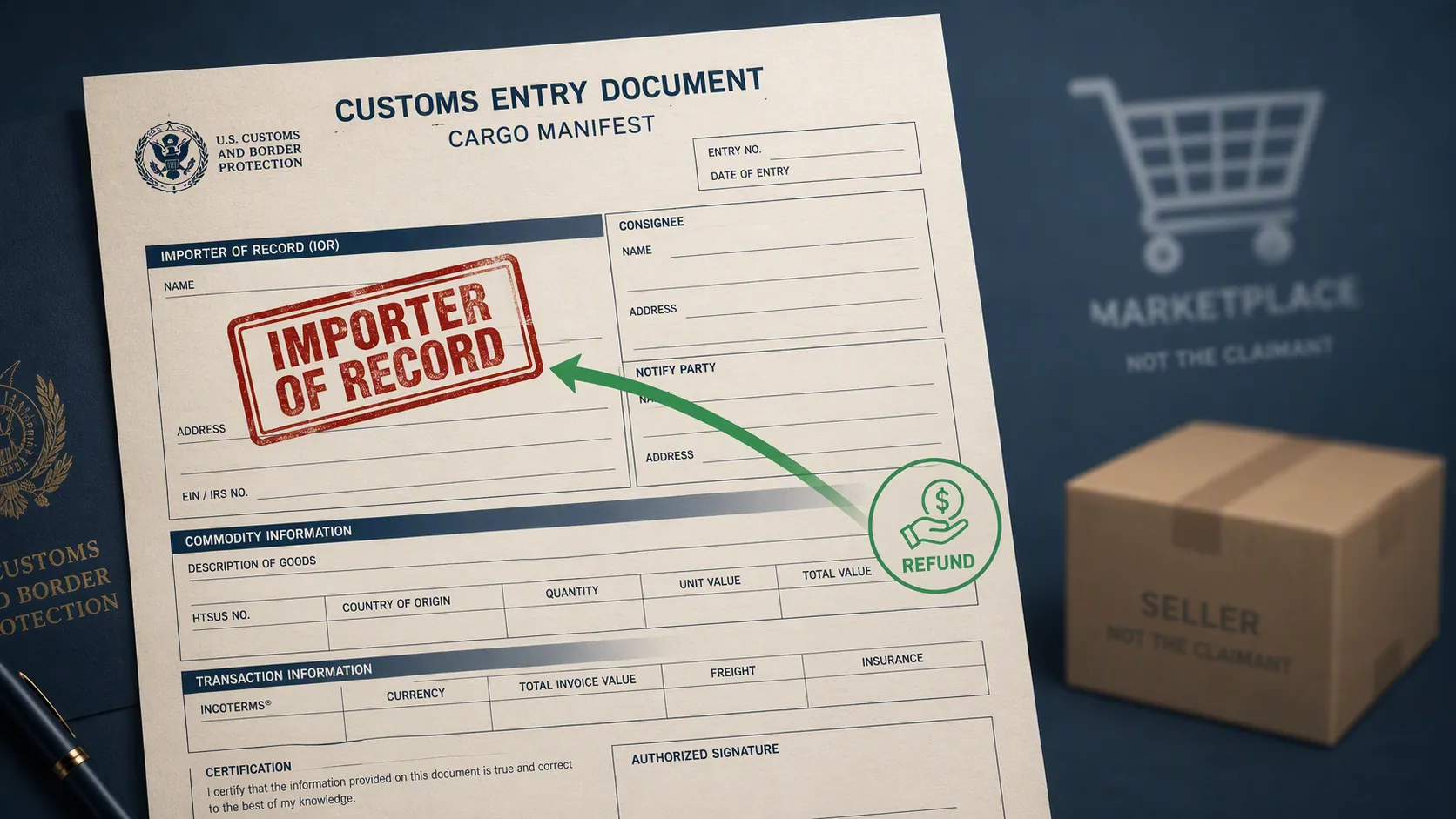
Start with the entry, not the Amazon charge line
The public shorthand around Amazon’s reported recovery makes the problem look like a marketplace accounting dispute: Amazon collected tariff-related money, Amazon received refunds, so sellers ask whether Amazon must return the money. That may become the commercial dispute. It is not how CBP identifies the refund claimant.
CBP works from the entry record. For a seller, the useful document is usually the CBP Form 7501 entry summary or broker entry package showing the importer of record, entry number, tariff classification lines, Chapter 99 tariff line, and liquidation date. If the invalidated IEEPA duty was not on that seller’s entry, the seller cannot build a direct CBP claim by pointing to a marketplace fee label alone.
The Supreme Court’s February 20, 2026 decision in Learning Resources, Inc. v. Trump is the reason this question exists: the Court invalidated the IEEPA tariff basis, leaving refund mechanics to the customs process rather than writing a seller-facing marketplace rule. [6] That distinction matters. A judicial ruling that a duty was unlawfully collected does not answer which private party in a supply chain receives the administrative refund from CBP.
The legal claimant and the economic payer are often different people
A third-party seller may have absorbed the duty in every practical business sense. It may have reimbursed a freight forwarder, paid an import deposit, accepted an FBA charge, raised prices, reduced margin, or watched a tariff line appear in a seller-facing report. None of those facts should be dismissed as imaginary costs. They simply do not replace the entry-paper question.
| Status or role | Why it matters for a CBP refund claim |
|---|---|
| Importer of record | The central claimant. CBP refund rules direct refunds to the importer of record, and CAPE eligibility is built around the IOR or the broker that filed the entry. |
| Consignee named on the entry papers | Included in the protest-standing statute, but the consignee’s authority still depends on the entry record and the decision being protested. |
| Surety | May protest within the statutory standing list when its surety interest is implicated. |
| Person paying a charge or exaction | Potentially relevant under 19 U.S.C. 1514(c)(2), but paying Amazon or another commercial party is not the same thing as proving that CBP exacted the charge from that person on the entry. |
| Person seeking entry | A statutory protest category tied to the customs entry process, not a general label for anyone commercially affected by tariffs. |
| Drawback claimant | Has standing for drawback matters; that is a different refund mechanism from the IEEPA entry-duty refund process. |
| Marketplace, consolidator, freight forwarder, or broker | Eligibility turns on the role actually held on the entry. A broker may file a CAPE declaration for entries it filed, but the refund is still tied to the IOR/4811 mechanics. |
| Seller who paid a tariff-related marketplace charge | Economic burden alone does not create a direct CBP refund right. The seller needs an entry-based status or must pursue pass-through through contract and commercial records. |
This is where many Amazon seller files split. If a seller imported its own goods, used its own importer number, and can match the IEEPA Chapter 99 duty line to a still-actionable entry, the seller may have a CBP path. If a consolidator, logistics provider, Amazon entity, or another party was the importer of record, the seller’s direct CBP theory becomes much harder. The seller may still have a commercial pass-through argument, but that is no longer the same claim.
Amazon’s Q2 2026 disclosure is useful for exactly that reason. CNBC reported that Amazon said it recovered about $600 million in tariff refunds during the quarter, while also reporting Amazon’s statement that it is not the importer of record for the large majority of items sold in its store; CNBC also reported that third-party sellers account for more than 60% of goods sold on the marketplace. [5] The Hill likewise reported the approximately $600 million refund figure in connection with Amazon’s earnings-call disclosures. [7]
That does not prove Amazon was or was not the importer of record for any particular seller’s inventory. It does something narrower and more useful: it warns sellers not to assume that Amazon’s corporate refund number maps onto their own entries. Amazon may have been the importer of record for some merchandise and not for other merchandise. Third-party FBA and Seller Fulfilled Prime inventory requires entry-by-entry verification.
The document set that decides the first fork
For counsel or compliance staff, the practical review starts with a small number of documents, not with a refund calculator. The file should identify:
- the CBP entry number;
- the importer of record name and importer number;
- the licensed customs broker that filed the entry;
- the liquidation date or current unliquidated status;
- the tariff classification lines and the specific IEEPA Chapter 99 line;
- the amount of IEEPA duty paid, separate from base MFN duty and any Section 301, Section 232, or Section 201 duties;
- any 4811 notify-party designation, ACH refund setup, and broker authorization records.
Seller Central labels can help reconstruct the commercial chain, but they do not replace those records. Seller-reported references to FBA “International Freight Duties and Taxes Charge” lines may explain why sellers believe they funded the duty. Those labels are not, by themselves, CBP entry papers.
Hagens Berman has publicly framed seller claims around Amazon’s position that it is not the importer of record for FBA and Seller Fulfilled Prime third-party orders. [8] That is relevant pressure in the seller-Amazon dispute, but it should not be overstated. Amazon’s IOR status for any particular stream of goods is an entry-file fact, not something that can be assumed from a class-action theory or an earnings-call sentence.
Once the IOR is known, the deadline controls the route
After importer-of-record status, the next hard fact is liquidation posture. That date determines whether the file belongs in CBP’s CAPE declaration process, a protest, post-denial litigation, or a commercial pass-through dispute.
| Entry posture | Likely procedural route | Deadline or constraint |
|---|---|---|
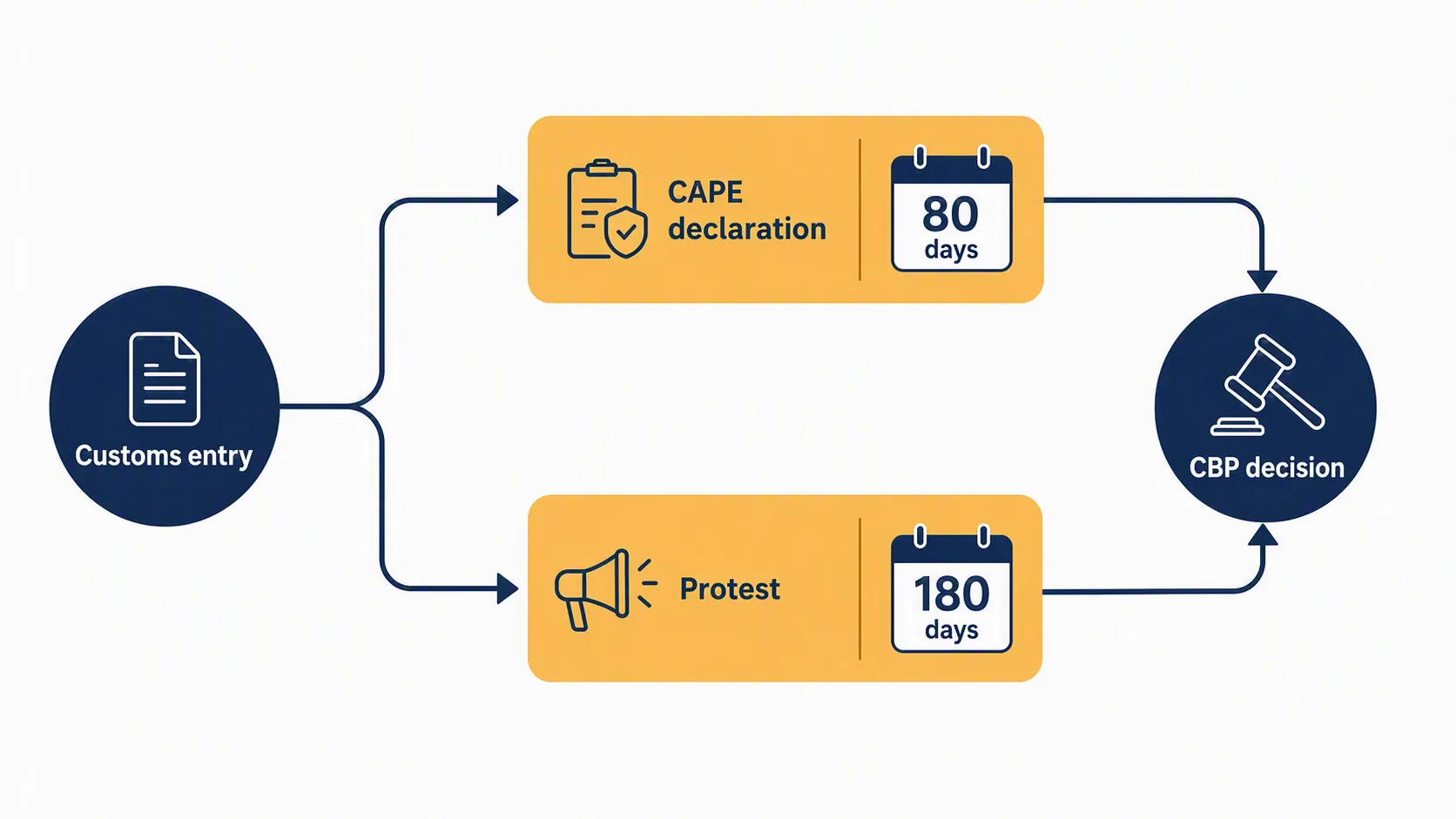
| Unliquidated entry with an IEEPA duty line | CAPE declaration, if the filer meets CBP’s eligibility rules | CBP opened the CAPE portal on April 20, 2026; only the IOR or licensed broker that filed the entries may submit. |
| Entry within CBP’s CAPE liquidation window | CAPE may be available within CBP’s stated 80-day category | Do not treat this as a substitute for preserving a protest deadline where liquidation has occurred. |
| Liquidated entry still within 180 days after liquidation | Administrative protest on CBP Form 19 or through the ACE protest module | The protest deadline is 180 days after liquidation. |
| Protest denied | Court of International Trade action | The action must be commenced within 180 days after protest denial. |
| Seller is not the IOR and has no other entry-based standing | Commercial pass-through, broker, consolidator, or Amazon dispute | CBP is not the forum for refunding a private marketplace surcharge. |
CAPE is a customs filing route, not a seller reimbursement program
CBP’s CAPE process is the administrative shortcut for eligible IEEPA duty refunds on unliquidated entries and entries that fall within CBP’s specified 80-day liquidation category. CBP’s IEEPA refund page states that Phase 1 declarations may be filed by the importer of record or the licensed customs broker that filed the entries; CSV submissions are capped at 9,999 entries; ACH enrollment is required; refunds generally process within 60 to 90 days; and refunds are paid to the importer of record or the designated 4811 notify party. [4]
CAPE also does not wash the whole entry clean. It removes the IEEPA duty component. Other duties remain collectible unless another legal basis applies. That means the seller or IOR has to isolate the IEEPA Chapter 99 line from base duty and from Section 301, Section 232, or Section 201 duties. A marketplace charge that bundled “duties and taxes” into one seller-facing amount may be commercially meaningful but legally too crude for the refund file.
For a deeper CAPE compliance treatment, including recordkeeping and audit exposure, see Meeting IEEPA Tariff Refund Eligibility and Compliance Standards. The important point here is narrower: CAPE eligibility follows the entry filer and IOR structure, not the party that ultimately felt the duty in its margins.
After liquidation, protest is the administrative gate
For liquidated entries, the protest deadline is unforgiving. Under 19 U.S.C. 1514(c)(3), a protest must be filed within 180 days after liquidation or another protestable decision; 19 CFR 174.12 carries that deadline into the protest regulations. [2][3] CBP’s protest guidance states that a protest is the method for challenging a CBP decision after liquidation and that, once liquidation has occurred, protest is the only administrative remedy. [9]
That deadline is especially important for Amazon-adjacent sellers because marketplace billing records often arrive in a different rhythm from customs records. A seller may spend weeks trying to reconcile charge lines, shipment IDs, FBA reports, forwarder invoices, and broker statements. CBP’s clock is not waiting for that reconciliation. It runs from liquidation.
The protest must also identify the decision being challenged and the relief requested with enough specificity to let CBP act on the entry. A seller that has only a spreadsheet of Amazon charges is not in the same position as an importer with entry numbers, liquidation dates, classification lines, and duty amounts.
Section 301 refunds are related only procedurally
Some seller files mix IEEPA duties with Section 301 duties or exclusion claims. The mechanics may look familiar, but the legal basis is different. CBP’s Section 301 exclusion guidance in CSMS 42566154 used the same basic timing divide: post-summary corrections for unliquidated entries and protests within 180 days after liquidation. [10] That parallel is useful for workflow, not for expanding the IEEPA refund amount.
In other words, a successful IEEPA refund declaration does not automatically refund Section 301, Section 232, Section 201, or ordinary customs duties. Those lines need their own authority. If a seller’s Amazon-facing charge combined multiple duty categories, the legal review has to unbundle them before anyone can say what amount is potentially recoverable.
What if the seller is not the importer of record?
If the seller is not the IOR, the analysis usually leaves CBP and moves into contracts and commercial records. The seller’s questions become different:
- Did Amazon, a logistics provider, a consolidator, or another intermediary serve as importer of record?
- Was any tariff-related amount charged to the seller as a reimbursement, estimate, deposit, freight duty component, or separate service charge?
- Did the governing agreement require pass-through of duty refunds, allow retention, net charges across shipments, or leave the issue unstated?
- Can the seller tie the commercial charge to a specific CBP entry and IEEPA duty line?
- Is the party that received the CBP refund willing or required to provide entry-level accounting?
Those are real disputes, but they are not direct refund claims against CBP. A seller may be able to argue that an intermediary should pass through a refund because the seller funded the underlying duty. That argument depends on contract language, course of dealing, invoice structure, agency relationships, and proof. It does not become stronger merely because the word “tariff” appeared in a seller-facing charge label.
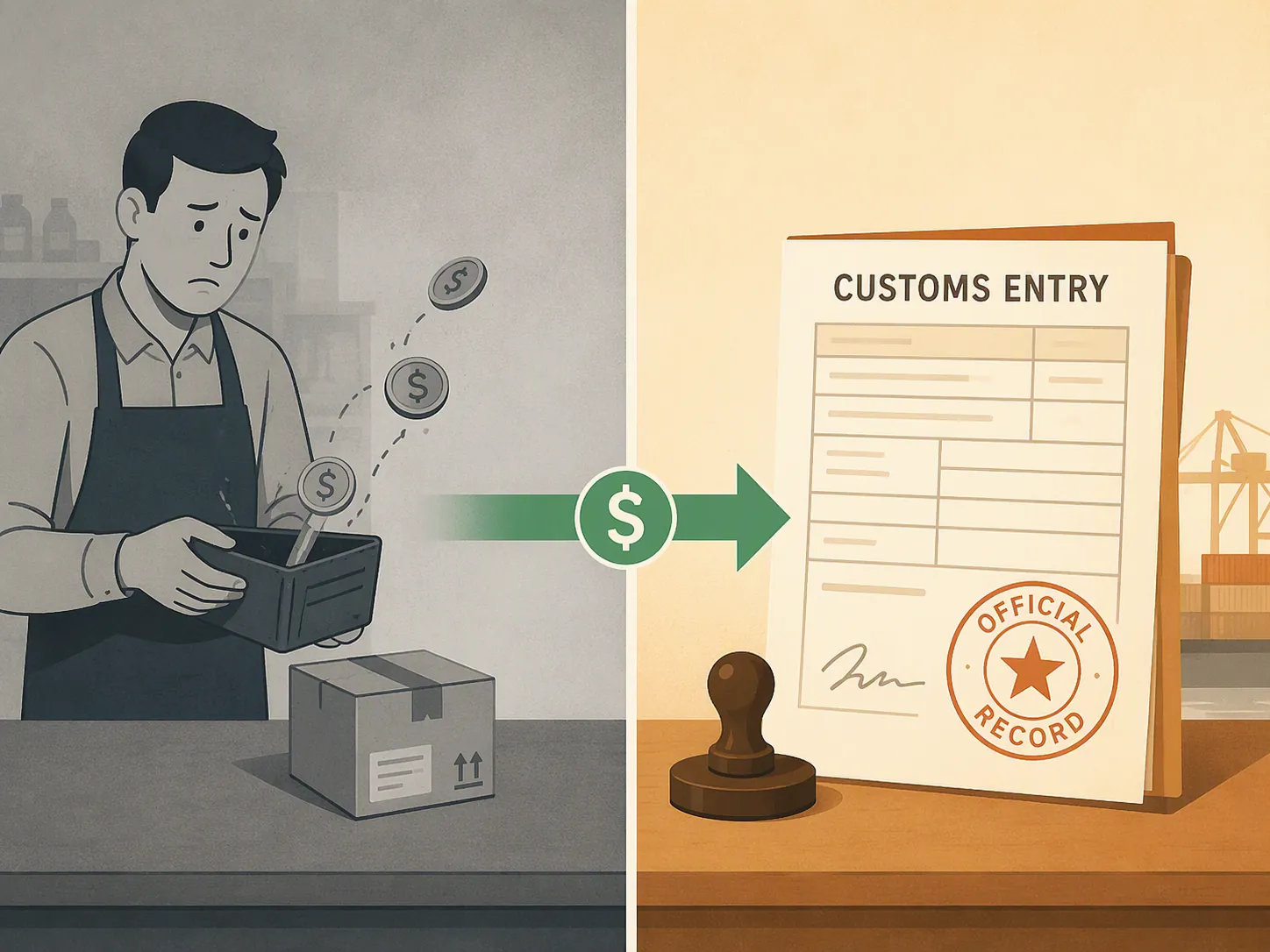
This is also where the consumer class-action layer can distract from the seller’s customs deadline. Consumer suits over tariff pass-through theories may raise different reliance, disclosure, arbitration, and damages issues. They do not determine whether a third-party seller has protest standing on a particular CBP entry. For that separate litigation track, see Trump Tariffs Legal Impact on Consumers Reaches the Courts.
The unresolved litigation affects scope, not the entry-paper discipline
There is still litigation uncertainty around how broad the refund remedy will be. The Department of Justice appealed the across-the-board refund order to the Federal Circuit on May 29, 2026, and the government’s position has been that refunds should not automatically extend beyond importers that sued. [11] That uncertainty matters for risk assessment and for how aggressively parties preserve claims. It does not make a non-IOR seller the refund claimant on someone else’s entry.
The post-protest forum also has its own clock. Under 19 CFR 174.31, a civil action contesting denial of a protest must be commenced within 180 days after the date of mailing of the notice of denial. [3] The AGS Co. Auto. Sols. v. CBP reliquidation ruling, discussed by Skadden in February 2026, is a reminder that liquidation and reliquidation posture can decide whether money is administratively recoverable at all. [12]
For a broader procedural map of the Supreme Court ruling, pending appeal, and refund tracks, see The Supreme Court tariff refund ruling: a procedural roadmap. For the business-plaintiff litigation background, see Small Businesses Challenged Trump Tariffs in Court.
A practical decision rule for Amazon sellers
A seller reviewing Amazon tariff refund eligibility should not start with Amazon’s $600 million figure. Start with the seller’s own entry file.
- If the seller is the importer of record, identify every entry with an IEEPA Chapter 99 duty line and determine liquidation status.
- If the entry is unliquidated or within CBP’s CAPE-eligible liquidation category, evaluate a CAPE declaration through the IOR or the broker that filed the entry.
- If the entry has liquidated, calendar the 180-day protest deadline from liquidation and preserve the protest route if still available.
- If a protest is denied, calendar the 180-day period for a Court of International Trade action.
- If the seller is not the IOR and has no other statutory standing, stop treating CBP as the refund counterparty and review the contract, broker file, consolidator relationship, or Amazon pass-through records.
Amazon’s recovery does not create seller entitlement by itself. A third-party seller can pursue CBP only if the seller has the relevant legal status on the entry and is still inside the proper window. Otherwise, the question is no longer “Who can claim the tariff refund from CBP?” It is “Who, if anyone, agreed to pass through money received on an entry where someone else was the legal claimant?”
That is an eligibility analysis, not legal advice on any seller’s specific entry file.
References
- 19 CFR § 24.36 - Refunds of excessive duties, taxes, etc. — eCFR.
- 19 U.S. Code § 1514 - Protest against decisions of Customs Service — Legal Information Institute, Cornell Law School.
- 19 CFR Part 174 - Protests — eCFR.
- IEEPA Duty Refunds — U.S. Customs and Border Protection.
- Amazon says it received about $600 million in tariff refunds in second quarter — CNBC, July 30, 2026.
- Learning Resources, Inc. v. Trump, No. 24-1287 — Supreme Court of the United States, February 20, 2026.
- Amazon recovers $600M from tariff refunds — The Hill, July 30, 2026.
- Amazon Tariff Refund Investigation — Hagens Berman.
- Protests — U.S. Customs and Border Protection.
- CSMS #42566154 - Section 301 Exclusions Extensions and Retroactive Application — U.S. Customs and Border Protection.
- Supreme Court Issues Tariff Refund Ruling; DOJ Appeals to Federal Circuit — SCOTUSblog, June 2026.
- Trade Court Addresses Reliquidation and Refunds in AGS Co. Auto. Sols. v. CBP — Skadden, February 2026.
Related records
Tool profile
How Meta's AI Spending Reshapes Law Firm ProfitabilityGoverning regulation
Browse the obligations tracker →Preventive workflow
Browse verification workflows →
Report a correction or tip
Spotted an outdated figure, a misstated fact, or a ruling this case record should reflect? Public comments are disabled for this content given the professional cost of a misreported case outcome, penalty amount, or rule text — use the structured correction channel instead.
Report a correction or tip for this record →