
Ceuta Migrant Surge Tests Asylum Rulings in US and Spain
The US and Spanish supreme courts split on where asylum 'arrival' begins, and the July 2026 Ceuta surge is the first mass test of Spain's ruling. This comparison clarifies what each holding obliges at the border and why Spain's line could be moved by regulation.
- Jurisdiction
- United States; Spain
- Court
- U.S. Supreme Court; Spain's Supreme Court
- Judge
- Alito
- AI tool named
- No AI tool named
- Ruling date
- Jun 29, 2026
- Source document
- View primary court order ↗
- Last verified
- Aug 1, 2026
Lex Machina Review is an independent risk-tracking and reference resource. Nothing on this site is legal advice, and using it does not create an attorney-client relationship. Every record is reviewed against primary sources but may not reflect the most current status of a matter — always verify directly against the cited court order, rule text, or a licensed attorney before relying on it.
Companion explanation — secondary to the source document above
The asylum-law implications of the Ceuta migrant surge did not begin with the July 30–31 crowds at the Spanish enclave. They began with a legal switch. On June 25, 2026, the U.S. Supreme Court decided Mullin v. Al Otro Lado and held, 6–3, that an alien “arrives in the United States” for purposes of the INA only after crossing the border; a person still outside the line has no statutory entitlement to apply for asylum and no corresponding right to inspection by an immigration officer. SCOTUSblog records the case as No. 25-5, decided by an opinion of Justice Alito. [1]
Four days later, Spain’s Supreme Court answered a closely related question in the opposite direction. Judgment 814/2026, issued by Section 5 of the Administrative Litigation Chamber on June 29, held that migrants trying to reach Ceuta or Melilla by swimming are not within Spain’s special “hot return” route unless they are attempting to overcome physical border-containment elements. Drones, thermal cameras, and sensors may detect a person, but they do not themselves become the border barrier. [2]
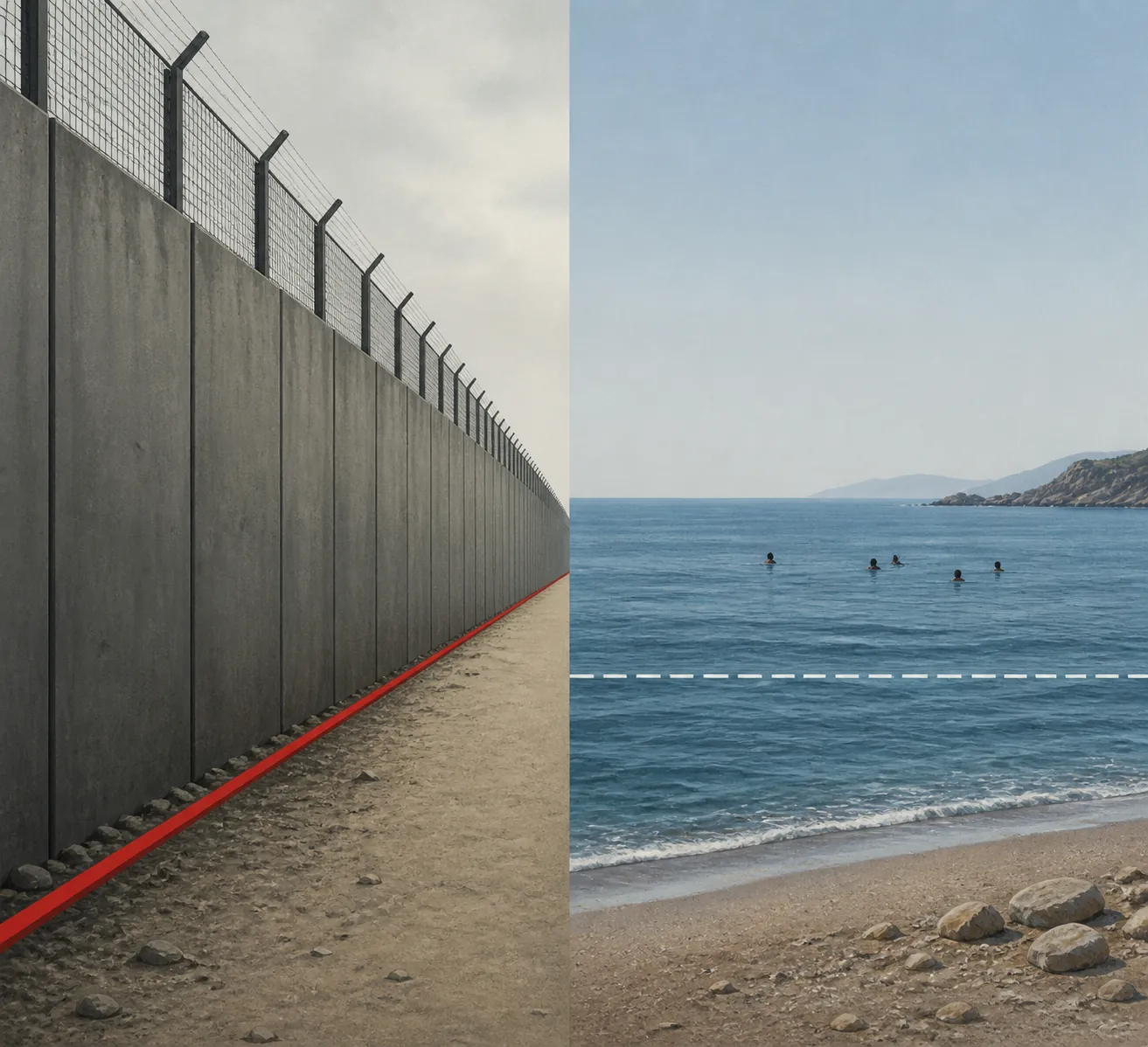
That sequence matters more than the spectacle of the surge. The same practical question—what must an officer do when a person is at the border but not yet safely inside the territory?—received two jurisdiction-specific answers within five days. In the United States, the statutory threshold is physical crossing. In Spain, for swimmers intercepted at sea outside physical containment elements, the threshold arrives before landfall.
Mullin draws the U.S. line at physical crossing
Mullin turns on two INA provisions that border lawyers know well but that public coverage often treats as if they answer every perimeter problem automatically: 8 U.S.C. § 1158(a)(1), which governs who may apply for asylum, and 8 U.S.C. § 1225(a), which governs inspection of applicants for admission. The Court’s holding, as recorded in the available public case materials, reads those provisions to require crossing the border before the statutory machinery begins. [1]
The consequence is not just verbal. If a person is standing at the U.S. perimeter but has not crossed, the INA, under Mullin, does not yet give that person a statutory right to lodge an asylum application. Nor does it require an immigration officer to conduct the inspection that would follow from arrival. [1]
For an officer, that is a hard instruction. The surveillance contact, the person at the gate, or the applicant held just outside the line is not treated as having triggered the statutory inspection queue. For counsel, it is equally hard: an asylum-access argument premised only on the person’s presence at the U.S. border perimeter now runs into a Supreme Court holding that places the INA threshold after crossing, not at approach.
That does not make Mullin a universal answer to every constitutional, treaty, or operational question that can arise at the border. The holding addressed the statutory “arrives in the United States” problem. Its force for U.S. asylum access lies in the way it separates desire to apply from statutory arrival: the person may be seeking protection, and the officer may know that, but the INA duty identified in Mullin has not begun until the crossing occurs.
Readers tracking the related June 25 U.S. immigration line can compare the site’s separate record on the Mullin deportation-review ruling. The point here is narrower: for asylum access at the perimeter, Mullin makes physical crossing the statutory switch.
Spain’s Judgment 814/2026 puts swimmers on the other side of the procedural line
Spain’s case arose from a maritime interception, not a land-gate application. The underlying incident involved Algerian migrants intercepted on November 14, 2024, while trying to enter Ceuta by swimming. Spain’s Supreme Court confirmed that the statutory fast track for “rejection at the border” does not apply to that setting when the person is not trying to overcome physical border-containment elements. [2]
The distinction is unusually concrete. The Tenth Additional Provision of Organic Law 4/2000 permits a special rejection regime at Ceuta and Melilla for people detected while attempting to cross the border elements that physically contain entry. The Court treated those elements as barriers, not as the state’s general capacity to see, monitor, or intercept. Surveillance technology—drones, thermal cameras, sensors—may tell officers where a swimmer is, but it does not convert open water into a containment fence. [2][3]
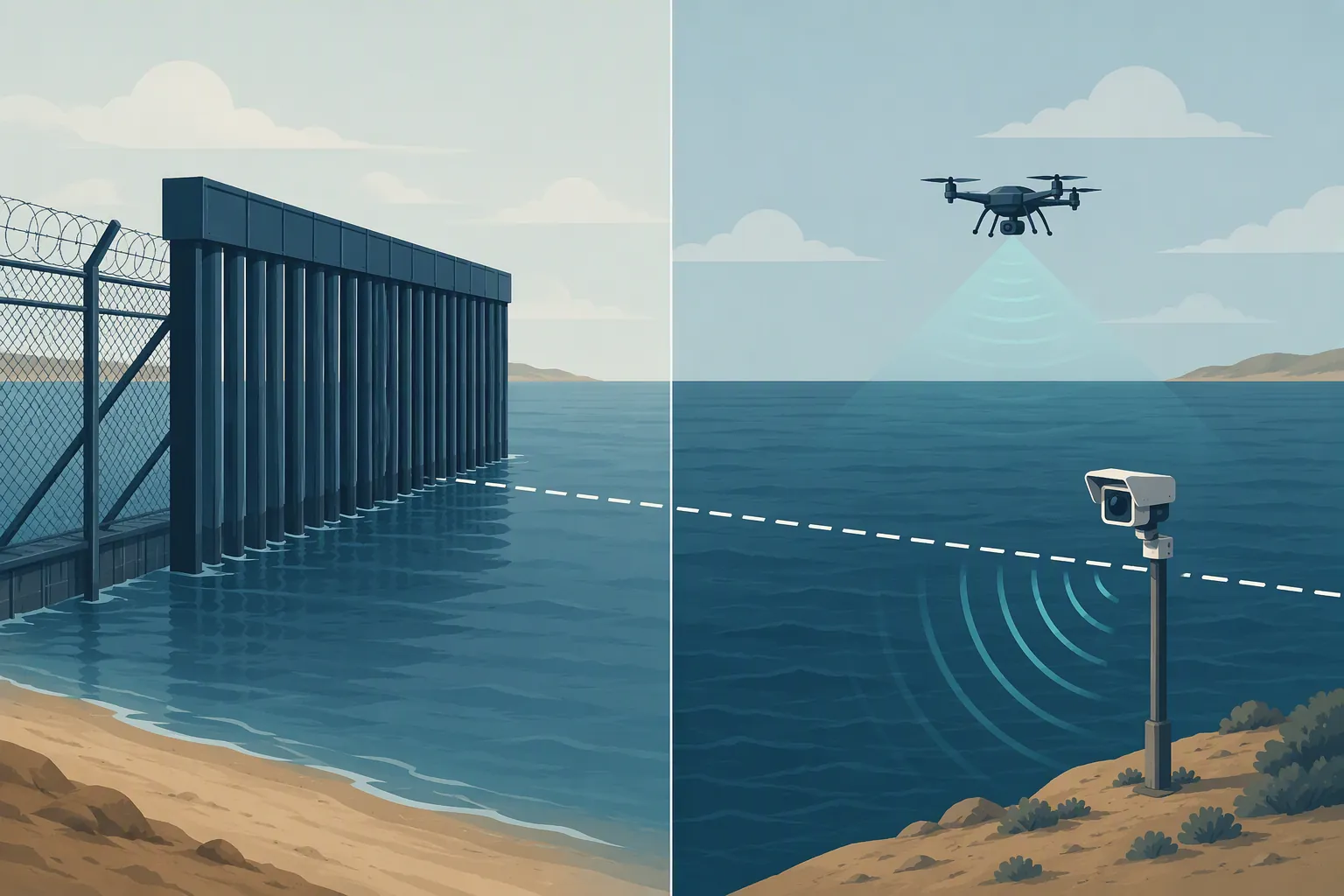
Once the fast track is unavailable, the ordinary return route matters. The Court’s analysis requires use of the Article 58.3 procedure, with an individualized decision, legal assistance, interpretation, and safeguards for access to asylum. [2][3]
That is the doctrinal hinge of the Ceuta problem. The Spanish judgment does not say every maritime contact is an asylum admission. It says the state cannot use the Ceuta-and-Melilla hot-return shortcut for swimmers intercepted outside the physical containment system. The officer’s act of interception still may lead to return, but it must pass through the ordinary procedure rather than a perimeter rejection.
The judgment’s most important qualification is its obiter on physical sea barriers. The Court’s reasoning leaves open the possibility that if Spain installs border-containment elements at sea, encounters with swimmers at those elements could fall back within the special rejection regime. The line is therefore not simply “land” versus “sea.” It is physical containment versus surveillance. [3]
The two holdings do not disagree about migrants; they disagree about the legal object that starts duty
| Question | United States: Mullin | Spain: Judgment 814/2026 |
|---|---|---|
| Where does the relevant threshold begin? | After physical crossing of the U.S. border for the INA asylum and inspection provisions at issue. [1] | Before landfall for swimmers intercepted at sea when no physical border-containment element is being overcome. [2][3] |
| What does surveillance do? | The available holding does not make perimeter awareness enough to trigger statutory arrival. | Surveillance detects the person but is not itself a containment element. [2][3] |
| What procedure follows? | No statutory entitlement to apply or corresponding inspection duty before crossing under the INA reading in Mullin. [1] | Ordinary Article 58.3 return procedure, including individualized decision, legal assistance, interpretation, and asylum-access safeguards. [2][3] |
| Can the line move? | The holding fixes the INA threshold at crossing. | Potentially, if physical sea-containment elements are installed and treated as border elements under the Court’s obiter. [3] |
The table is not a harmonization exercise. It shows why advice that begins with “the border” is too coarse. In one jurisdiction, the relevant legal fact is crossing. In the other, the relevant legal fact may be the nature of the object the person is trying to overcome—or, in open water, the absence of that object.
Ceuta became the first mass test of Spain’s new line
The July 30–31 Ceuta surge did not create the legal issue. It exposed the Spanish answer at scale. Euronews reported Spain’s legal dilemma after record arrivals into Ceuta, while France 24 described an EU effort to contain the crisis after thousands crossed into the enclave. [4][5]
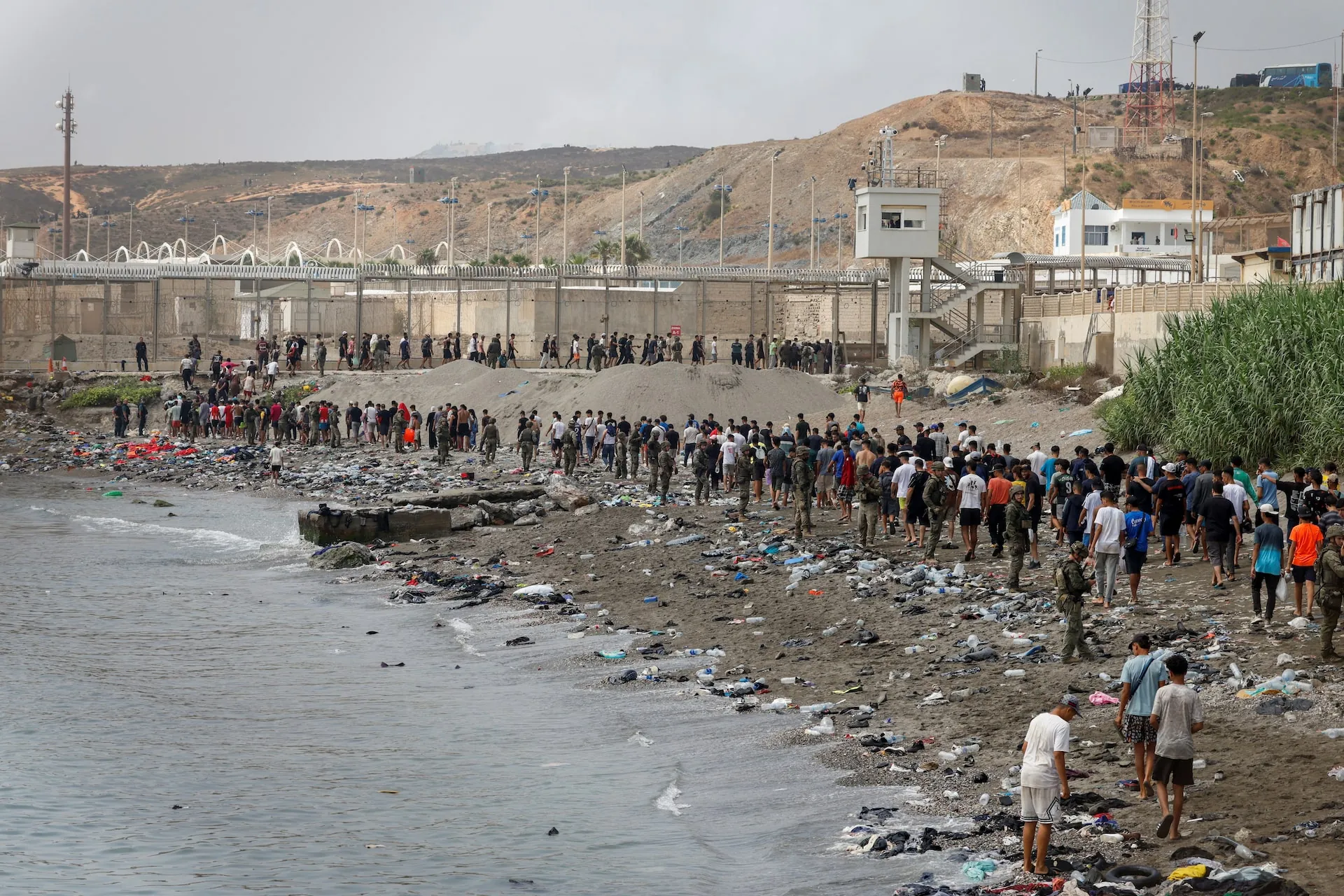
The reported numbers do not line up perfectly and should not be made neater than the record permits. The Interior Ministry figure was about 49,000 crossings in a day, while Ceuta’s president, Juan Vivas, put the number at 60,000. Reports also described roughly 48,000 to 48,300 returns as “voluntary,” but those characterizations were not independently verified in the materials available here. [4][5]
Spain deployed troops, and political calls included demands to suspend Schengen movement rules. The Interior Ministry also attributed the surge to smuggling networks in statements reported by Euronews. [4][5]
The operational sentence that matters most for asylum procedure came from the reported Civil Guard position: “Right now we cannot return them … we must grant them their rights.” That is not a court holding, and it should not be inflated into one. It is an account of how the judgment changed what officers understood they could do in the water and at the shoreline. [4]
Published casualty accounts for the surge were not uniform in the materials reviewed, so no single death-toll number is treated here as verified. The legal point does not depend on choosing among those figures. It depends on the procedural fact that large numbers of swimmers and attempted entrants met a rule that turns on whether they were overcoming a physical border element or merely being detected by surveillance.
For a fuller Spain-side chronology of Judgment 814/2026 and the surge, see the site’s Ceuta Supreme Court ruling record. For the maritime-return mechanics and the Melilla angle, the separate analysis of Melilla sea hot returns carries the deeper Spanish administrative-law treatment.
Why hot returns already came with European baggage
Ceuta and Melilla are not new laboratories for border procedure. Spain’s push-back practices at the enclaves have long been tracked in asylum-access reporting, and the European human-rights litigation over N.D. and N.T. v. Spain made the legality of immediate returns at the fences a central issue in the European debate. [6][7]
That background should not be allowed to obscure what Judgment 814/2026 adds. N.D. and N.T. concerned land-fence crossings and the circumstances in which Spain could use immediate returns at the Melilla perimeter. Judgment 814/2026 turns to swimmers and asks whether open sea monitored by technology is legally equivalent to a physical border structure. The Court’s answer was no. [2][3]
The pending Spanish bill would test the court’s own escape hatch
The forward-looking risk is not that Spain’s judgment has already been undone. It has not. The risk is that legislation or regulation could try to move the physical line. Euronews reported that the Popular Party was advancing a bill to extend the fast-track framework to sea entries, a process described as potentially taking months. [4]
As of August 1, 2026, that must be treated as pending and conditional, not enacted. The practical importance is the obiter in Judgment 814/2026. If Spain installs physical containment elements at sea, the same swimmer who is now outside the hot-return route could later be characterized as attempting to overcome a border element. That would not change the human facts in the water. It could change the procedure the state claims is available.
For lawyers advising carriers, NGOs, public bodies, or companies exposed to border operations, the bill is therefore not just a political proposal. It is a legal-threshold proposal. It asks whether the state can make surveillance-plus-water into containment-plus-border by installing an object that satisfies the Court’s own terminology.
The practical advice changes with the line, not the vocabulary
The comparison leaves no single border-asylum answer. A person approaching the U.S. perimeter after Mullin is outside the INA arrival threshold until crossing. A swimmer intercepted off Ceuta or Melilla after Judgment 814/2026 may already be inside the ordinary-return-and-safeguards zone if no physical containment element is being overcome. Both rules can be described as border rules. They start state duty at different places.
That is the point counsel should preserve when briefing asylum exposure at a border. The first question is not only which statute applies. It is what the jurisdiction treats as the beginning of arrival: a crossed line, a fence, a sea barrier, a surveillance contact, or an ordinary procedure triggered before landfall. In Spain, that answer may move if the physical architecture moves. In the United States, Mullin fixes the statutory INA line at crossing.
References
- Noem v. Al Otro Lado, SCOTUSblog.
- El Tribunal Supremo confirma que la ley no permite las ‘devoluciones en caliente’ de los migrantes que pretenden entrar a nado en Ceuta y Melilla, Consejo General del Poder Judicial.
- The Spanish Supreme Court on Rejection at the Borders of Ceuta and Melilla: What About Human Rights at Sea?, EJIL: Talk!.
- Spain’s legal dilemma behind Ceuta’s record migrant arrivals, Euronews, July 31, 2026.
- EU races to contain new migrant crisis as thousands cross into Spanish territory of Ceuta, France 24, July 31, 2026.
- Access to the territory and push backs, AIDA.
- N.D. and N.T. v. Spain, ECCHR.
Related records
Tool profile
How Meta's AI Spending Reshapes Law Firm ProfitabilityGoverning regulation
Browse the obligations tracker →Preventive workflow
Browse verification workflows →
Report a correction or tip
Spotted an outdated figure, a misstated fact, or a ruling this case record should reflect? Public comments are disabled for this content given the professional cost of a misreported case outcome, penalty amount, or rule text — use the structured correction channel instead.
Report a correction or tip for this record →