
Courtney Clenney Privilege Ruling Maps AI Review Duties
Court-adjudicated privilege violation in Courtney Clenney's murder case — family-defense communications read by prosecutors, evidence suppressed, recusal sought — is documented here as a template for privilege-screen and taint-team obligations in AI-assisted e-discovery. No AI tool is implicated (editorial analogy only), and plea terms remain undisclosed ahead of the Aug. 10 hearing.
- Jurisdiction
- US-FL
- Court
- Miami-Dade County Circuit Court
- Judge
- Laura Shearon Cruz
- AI tool named
- No AI tool implicated
- Ruling date
- Jun 26, 2024
- Source document
- View primary court order ↗
- Last verified
- Aug 3, 2026
Lex Machina Review is an independent risk-tracking and reference resource. Nothing on this site is legal advice, and using it does not create an attorney-client relationship. Every record is reviewed against primary sources but may not reflect the most current status of a matter — always verify directly against the cited court order, rule text, or a licensed attorney before relying on it.
Companion explanation — secondary to the source document above
The ruling that matters for review risk
The useful way to read the Courtney Clenney record is not through the reported plea first. It is through Judge Laura Shearon Cruz’s June 26, 2024 privilege ruling: the communication at issue “is protected by attorney-client privilege and/or work product privilege. This privilege was violated, albeit perhaps unknowingly, when the communication was read by prosecutors in this case.” The court ordered exclusion of the evidence tied to that violation. [1]
That sentence is the operational event. Privileged material was not merely collected, indexed, or placed somewhere in a digital evidence set. Prosecutors read it. Once that happens, the problem changes from a document-classification error into a taint question: who saw the material, whether the exposure affected later decisions, and whether the same prosecuting office can continue handling the matter.
This is therefore a privilege-taint and evidence-handling record. It is not an AI case. No AI tool is implicated in the reported Clenney record. The AI relevance is narrower: this is the same failure mode that privilege screens, taint teams, ingestion controls, reviewer access logs, and escalation procedures are supposed to prevent when counsel use AI-assisted review or large language model workflows on legal materials.
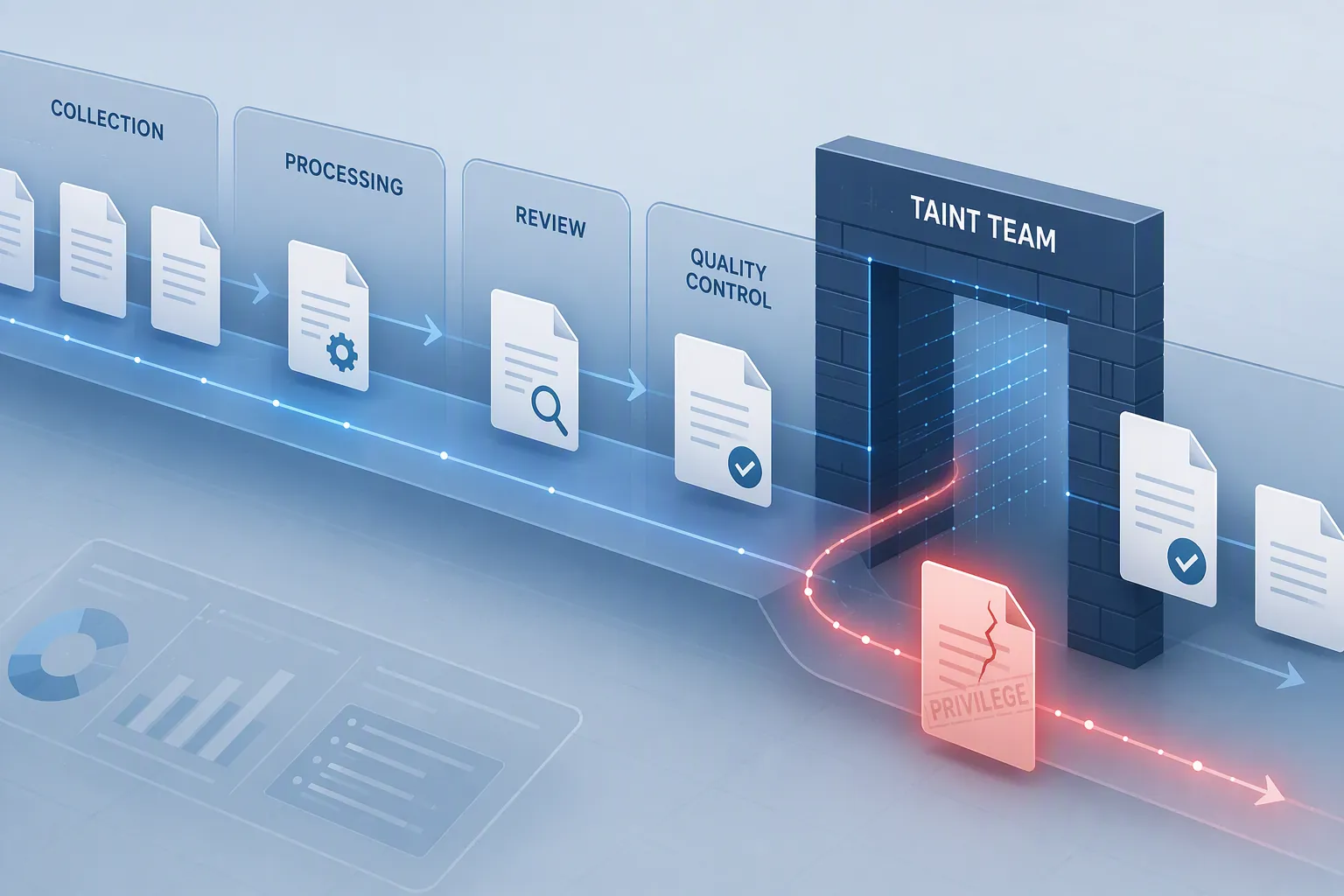
How the taint entered the digital evidence stream
The reported origin was an iCloud extraction. Investigators found communications in Clenney’s father’s iCloud account concerning family efforts, with defense attorneys, to guess passwords to access Obumseli’s laptop after his death. Those communications became part of the prosecution-side review path before the court later treated them as privileged or work product material. [1][2]
That route matters more than the device label. A cloud account can contain personal messages, family logistics, attorney communications, retained-counsel strategy, password notes, duplicated media, and forwarded material in the same broad extraction. If the receiving side treats that population as ordinary evidence before privilege triage is complete, a single protected message can move from collection to review before anyone with authority stops the workflow.
The Clenney ruling does not require speculation about an exotic technical failure. The court-adjudicated fact is simpler and more familiar: protected communications entered the opposing side’s evidence stream and were read. For a review supervisor, that is enough to trigger the questions usually reserved for the incident log, not the trial recap.
Suppression was only the first remedy question
Judge Cruz’s remedy excluded the evidence at issue after finding the privilege violation. The defense then asked for the Miami-Dade State Attorney’s Office to be recused and for Gov. Ron DeSantis to assign a new prosecuting office. [1]
That is the expected escalation path once privileged material has actually been seen. Suppression addresses use of the evidence itself. Disqualification asks whether exposure has contaminated the lawyers or office that saw it. The first remedy can be written against a document or category of evidence. The second requires reconstruction of people, timing, access, internal communications, strategy decisions, and derivative use.
The available reporting supports the narrower point: the defense sought removal of the prosecuting office after a judicial finding that prosecutors read protected material. It does not support a broader claim, without more, that every prosecutor in the office was personally tainted or that the violation was intentional. The quoted ruling itself leaves room for an unknowing violation, which is important for ethics analysis but not especially comforting for evidence-handling design. An unknowing exposure can still force suppression, motion practice, and disqualification litigation.
What the reviewer after the fact has to rebuild
After a privilege breach, the hard work is rarely proving that a document existed. The hard work is proving what happened after it entered the system. A competent record has to show when the material was collected, how it was labeled, whether any privilege screen ran before review, who opened it, whether it was copied into notes or summaries, whether it affected interviews or charging strategy, and who had authority to stop the review once the problem surfaced.
That is why “they did not mean to read it” is not a complete control answer. Intent may matter to sanctions or discipline. It does not erase exposure. A review system that can only explain intent, but cannot reconstruct access and downstream use, leaves the later judge with too little to separate harmless mistake from operational contamination.
The Miami-Dade misconduct context adds pressure, not a second storyline
The defense did not raise the Clenney privilege issue in a vacuum. It invoked broader concerns about Miami-Dade prosecution conduct, including Judge Andrea Ricker Wolfson’s March 2024 removal of Miami-Dade prosecutors Michael Von Zamft and Stephen Mitchell from the Corey Smith death-penalty case for misconduct. The same reported context included the Miami chapter of the Florida Association of Criminal Defense Lawyers pressing for an outside-run ethics unit with State Attorney Katherine Fernandez Rundle’s office. [3]
That context should stay in its lane. It helps explain why the Clenney defense framed recusal as an institutional remedy rather than a document-by-document dispute. It does not convert this article into a survey of Miami-Dade misconduct litigation, and it does not prove anything beyond the cited matters. The Clenney record is most useful here because it contains a privilege finding and a remedy chain in a digital-evidence setting.
The plea is timeline context, not the center of this record
For readers looking for the plea-deal update, the current posture is short: a plea deal was reported on July 31, 2026; an acceptance hearing was set for Aug. 10, 2026, at 9:00 a.m. EDT before Judge Andrea Ricker Wolfson; and the plea terms were not disclosed in the cited reporting. [4][5][6]
The companion case-status record, Clenney Self-Defense and Abuse Evidence Case Awaits a Plea, carries that plea posture. An earlier Courtney Clenney murder case status record covers the broader case background. This record stays with the privilege ruling because that is the part with reusable obligations value for lawyers supervising evidence review.
Two verification limits are worth keeping visible. First, reported plea terms should not be filled in from social-media speculation; the cited sources leave them undisclosed. Second, the judge’s surname appears inconsistently in some secondary references, while the majority reporting used here identifies Judge Andrea Ricker Wolfson. That spelling should be checked against the court record before any last-verified docket stamp is added.
What the ruling maps onto in AI-assisted review
The AI connection is an analogy, not a fact claim about the Clenney prosecution. But it is a strong analogy because AI-assisted review expands the number of places where privileged material can be seen, summarized, embedded, cached, exported, or used to shape later work before a human decision-maker realizes the population was contaminated.
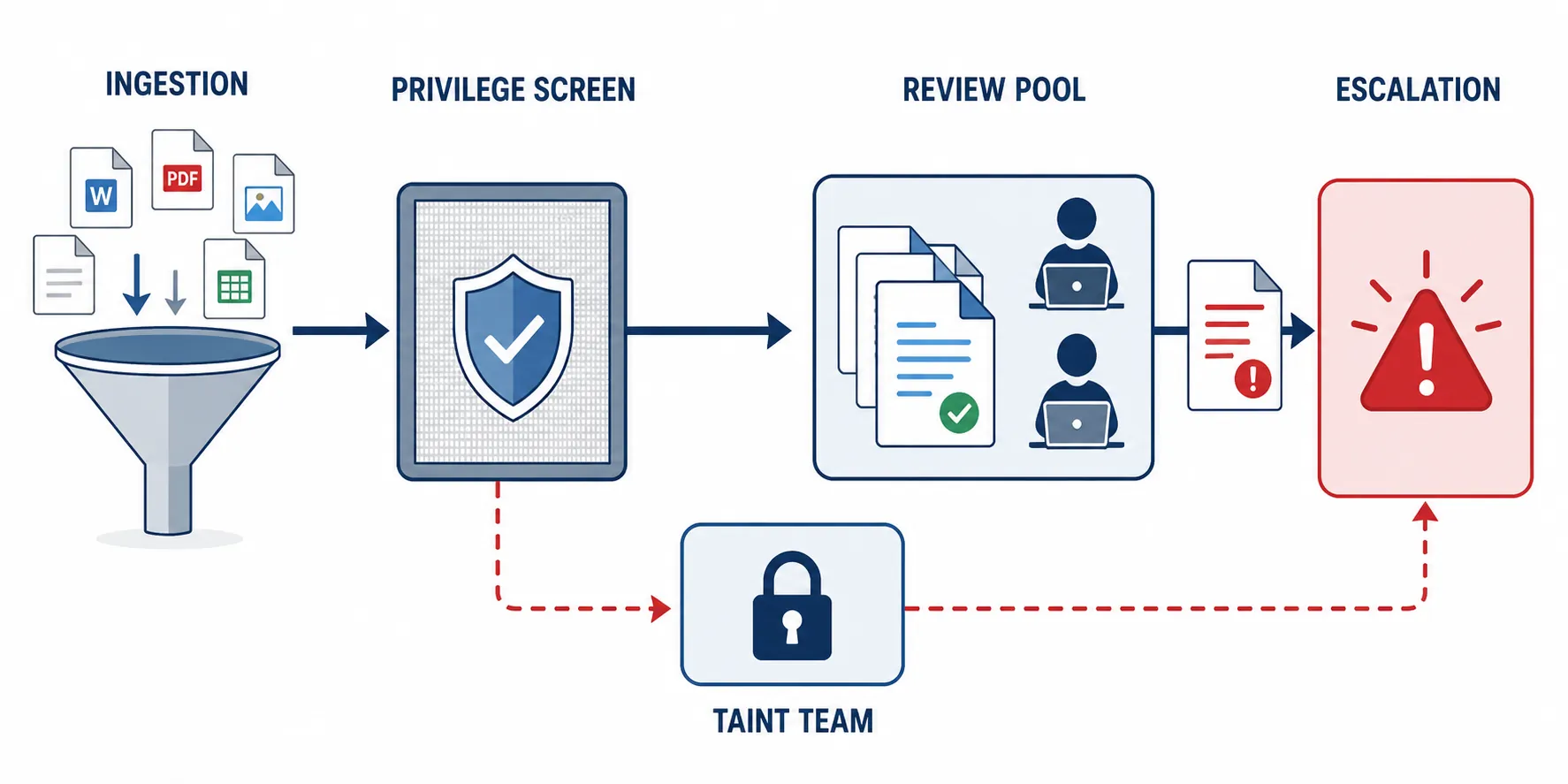
In a conventional review, exposure may mean a prosecutor or litigation associate opened a document. In an AI-assisted review environment, exposure can also mean the material entered a training set, a vector index, a document-summary layer, a prompt transcript, a quality-control export, or a work-product memo generated from a mixed corpus. The legal problem remains privilege. The operational surface is larger.
| Control point | What it must prevent | What the Clenney ruling makes concrete |
|---|---|---|
| Ingestion gate | Privileged family, attorney, and defense-team communications entering the ordinary review pool without triage | The source account mattered because the cloud extraction mixed potentially reviewable evidence with protected defense communications |
| Privilege screen | Reviewers seeing protected material before classification is resolved | The court’s finding turned on protected material being read by prosecutors |
| Taint team or filter team | Case team access before a separated reviewer has isolated privilege issues | Once the case team is exposed, later proceedings shift to who saw what and whether recusal is required |
| Access logs | Unverifiable claims about exposure | Suppression and recusal motions require a reconstruction of readers, dates, and downstream use |
| LLM and analytics controls | Privileged content being summarized, embedded, cached, or reused outside the original document | Deleting or suppressing a source document may not answer whether the information shaped later review outputs |
| Escalation procedure | A reviewer continuing ordinary review after recognizing a privilege issue | The duty is to stop, isolate, document, and route the material before exposure spreads |
The lesson for AI review procurement is not that every legal AI product is unsafe. It is that privilege architecture has to be evaluated before scale is applied. A tool that can process millions of documents quickly can also accelerate the movement of privileged material into places where it becomes harder to prove non-use.
A defensible AI-assisted workflow should therefore answer several questions before a sensitive corpus is loaded: whether attorney and family-defense communications are segregated at ingestion; whether the model or review platform stores prompts, embeddings, summaries, or reviewer notes; whether privileged items can be purged from every downstream layer; whether access logs show human and system-level interaction; and whether reviewers know when to stop and escalate rather than continue coding around the problem.
The same risk appears in other professional-responsibility settings. The AI defense-attorney withdrawal workflow treats lawyer obligations as a sequence of verification, disclosure, correction, and withdrawal decisions. The AI memory and privileged-data ingestion discussion addresses the separate problem of privileged material persisting inside tool memory or retrieval systems. The common thread is not technology enthusiasm or technology panic. It is whether counsel can prove that protected material was isolated before it influenced the merits work.
What should not be added to the record
Some details should remain out unless primary support is obtained. Snippet-level reporting about taint-team protocols for the parents’ iCloud extractions is not enough to describe the actual protocol. The Miami Herald misconduct-context article was available here through an AOL repost carrying the byline, not through direct access to the original. Primary Miami-Dade docket access was not directly reachable for this write-up, so reported hearing and plea-status facts should be rechecked against the court record before a final docket-verification stamp is applied.
That restraint is the point. A privilege-taint record loses value if it starts filling gaps with plausible courtroom detail. The useful comparison model is a suppression-ruling tracker such as the genetic-genealogy cold-case legal implications record: identify the evidence-handling decision, state the remedy, separate proved holdings from reported context, and leave unsupported operational details out. The same verification discipline appears in the confirmed not AI-related docket-verification model.
The Clenney record is valuable because a court adjudicated the privilege breach: protected family-defense communications from a cloud extraction were read by prosecutors, the evidence was suppressed, and the defense sought removal of the prosecuting office. That is a usable template for digital evidence handling and for AI-assisted e-discovery controls. It is not an AI case, and it is not a plea-terms update.
References
- Judge rules Miami-Dade prosecutors violated OnlyFans model's attorney-client privilege, NBC 6 South Florida
- Judge tosses out contents of laptop as evidence in case of ex-OnlyFans model accused in boyfriend's murder, WSVN
- Judge denies misconduct charge, refuses to remove state prosecutor from 2020 murder case, AOL
- Miami OnlyFans model expected to take plea deal in 2022 murder, NBC 6 South Florida
- OnlyFans Model Courtney Clenney Reaches Plea Deal in Boyfriend's Killing, People
- OnlyFans model Courtney Clenney taking plea deal in Miami murder case, Local10
Related records
Tool profile
How Meta's AI Spending Reshapes Law Firm ProfitabilityGoverning regulation
Browse the obligations tracker →Preventive workflow
Browse verification workflows →
Report a correction or tip
Spotted an outdated figure, a misstated fact, or a ruling this case record should reflect? Public comments are disabled for this content given the professional cost of a misreported case outcome, penalty amount, or rule text — use the structured correction channel instead.
Report a correction or tip for this record →