
Did AI cause the Coldcard hack? No charges filed yet
As of Aug 2, 2026, the Coldcard entropy-bug sweep has no court findings, charges, or filed complaint, and Coinkite's AI-involvement claim is disputed and unverified. The record separates confirmed sweep and root-cause facts from reported-only investigation claims so counsel can brief the incident accurately.
- Jurisdiction
- No jurisdiction identified
- Court
- No court identified
- AI tool named
- Unspecified AI tool
- Source document
- View primary court order ↗
- Last verified
- Aug 2, 2026
Lex Machina Review is an independent risk-tracking and reference resource. Nothing on this site is legal advice, and using it does not create an attorney-client relationship. Every record is reviewed against primary sources but may not reflect the most current status of a matter — always verify directly against the cited court order, rule text, or a licensed attorney before relying on it.
Companion explanation — secondary to the source document above
Risk Digest status: reported incident, no court record
Last verified: Aug. 2, 2026, UTC. For the Coldcard hack, the status line is narrower than the online story: the confirmed layer is a Coldcard firmware entropy failure and a bitcoin sweep; the AI-involvement claim is disputed and unverified; and the legal-investigation layer is reported only. As of this verification date, there are no court findings, no charges, and no filed complaint identified for this incident.
This record is a legal-risk briefing, not legal advice. It discusses possible claim theories and attorney commentary only as commentary. It does not conclude that a user has a viable claim, that Coinkite is liable, that a specific actor committed theft, or that AI legally caused the loss.
| Field | Status as of Aug. 2, 2026 |
|---|---|
| Matter type | Reported crypto-wallet sweep / technical vulnerability |
| Case status | Reported; no court record identified |
| Confirmed technical layer | Coldcard firmware entropy issue affecting seed generation |
| Confirmed sweep baseline | About 594 BTC from roughly 500 single-signature wallets in about 25 minutes, based on sourced reporting |
| AI involvement | Company assertion; disputed and unverified |
| Investigation status | Reported user, company, provider, and law-enforcement activity; no docketed case identified |
| Jurisdiction | n/a |
| Court | n/a |
| Judge | n/a |
| Penalty | n/a |
| Ruling date | n/a |
| Court source document | n/a |
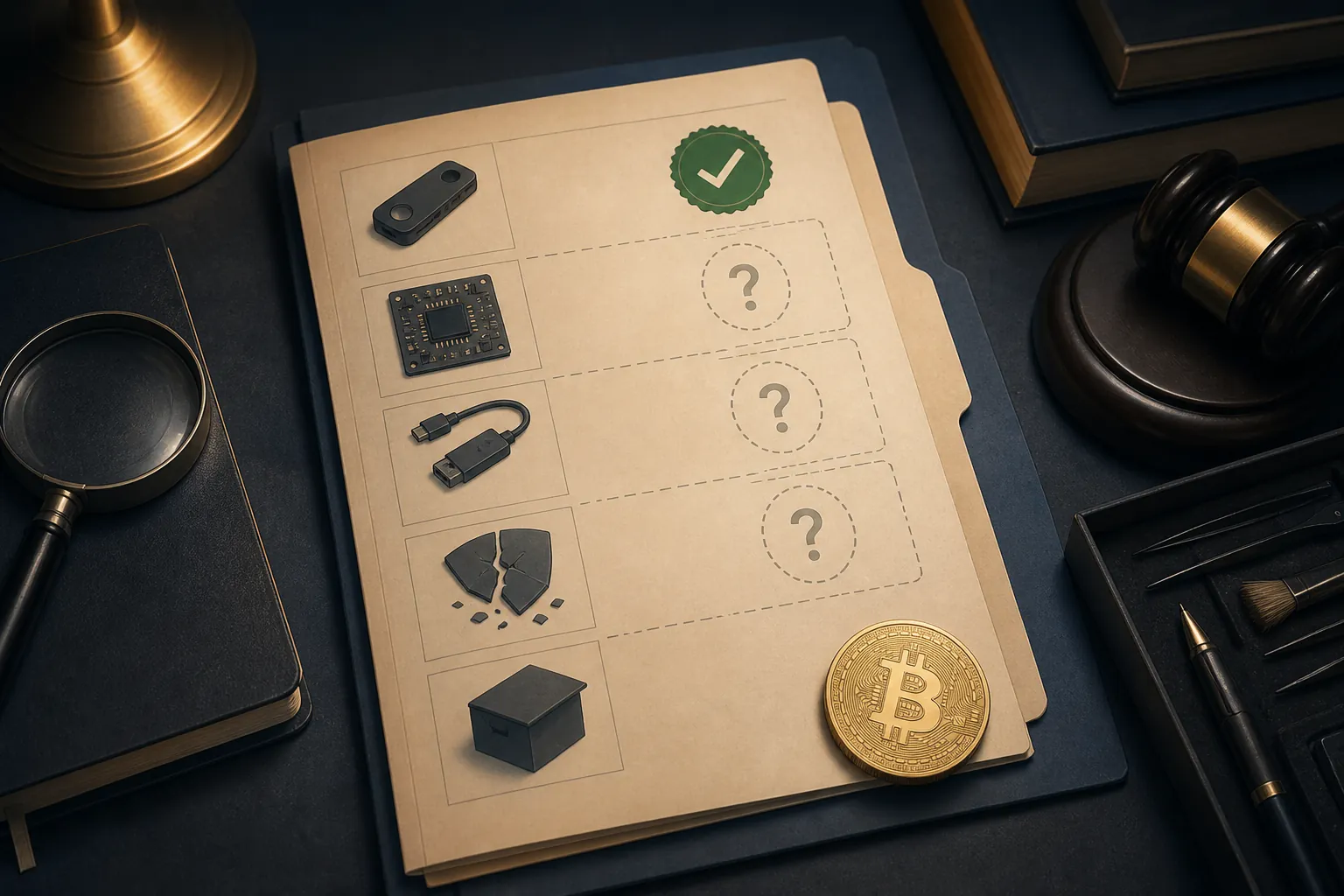
That table matters because the public vocabulary around this incident is already compressing different statuses into one sentence. “Reported,” “suspected,” “identified,” “filed,” and “charged” are not interchangeable. The reliable brief should preserve the distance between them.
What is confirmed about the sweep
The sourced baseline is concrete. Reporting tied the sweep to about 594 BTC, roughly $38 million at the time, taken from roughly 500 single-signature wallets in about 25 minutes on July 31, 2026, between 2:14 and 2:39 UTC. The funds were then consolidated, and one address reportedly held 562 BTC that had not moved as of the reporting window.[1][2]
Those numbers are useful because they describe an observable blockchain event, not a theory of liability. They do not by themselves answer who ran the sweep, whether a particular victim relied on a particular representation, whether a warranty applies, or whether any insurer will treat the loss as covered. They are the starting point, not the pleading.
Later, larger theft totals and wallet counts circulated on social media. They should not be treated as the baseline for a legal-risk memo unless they are tied back to a source with a reviewable method. The record here uses the narrower sourced sweep facts because they are the facts that can be stated without turning rumor into arithmetic.
The strongest record is the entropy bug, not the AI story
The root-cause record is much firmer than the attribution record. Coinkite’s own technical materials describe a seed-generation failure in which affected Coldcard firmware bound to MicroPython’s Yasmarang software PRNG fallback rather than the STM32 hardware random-number generator. Coinkite described the practical result as much lower effective entropy than intended: about 40 bits for Mk2/Mk3 devices and about 72 bits for Mk4/Q/Mk5 devices, compared with an intended 128 bits.[3][4]

Block’s independent technical analysis reached the same essential root-cause category, describing a predictable RNG fallback and a 32-bit reseed issue in Coldcard firmware.[5] For counsel, the important point is not the exact firmware mechanics. It is that the key-generation process, as described by both the vendor and an independent technical reviewer, produced a far smaller search space than users would reasonably associate with a properly generated 128-bit seed.
That distinction does real work. A bitcoin theft story can become theatrically complex very quickly: wallet hygiene, open-source review, AI tooling, blockchain analytics, insurance notices, and possible police reports all appear at once. The entropy record is different. It is a technical explanation for why a sweep against single-signature wallets was possible, and it is supported by named technical materials rather than by inference from the attacker’s behavior.
AI involvement remains an assertion, not a finding
Coinkite has publicly suggested that AI may have helped someone find the bug, with reporting quoting the company’s position that it “has to assume” someone used AI to review its open-source firmware.[6] That is a notable statement. It is not proof.
There are two immediate reasons to keep the AI label in the reported-only column. First, security researchers disputed the framing that the vulnerability class was necessarily novel, with reporting noting that the bug class is documented in embedded-systems literature.[1] Second, reporting also states that Coinkite’s own AI audit weeks earlier missed the bug.[6] Those facts do not disprove AI involvement. They do prevent the AI allegation from doing evidentiary work it has not earned.
This is the same verification problem that appears whenever an “AI-generated” or “AI-assisted” label arrives before the underlying artifacts. The safer method is to ask what has been independently corroborated: the prompt logs, model output, repository history, code-review trail, exploit-development artifacts, communications, or admissions. Without that layer, “AI involved” is a label attached to a hypothesis. The site applied the same caution in its Nancy Guthrie ransom-notes AI record: an AI attribution may be important, but importance is not corroboration.
The investigation layer is reported, not docketed
The investigation record is active-looking but not court-recorded. Bitcoin Magazine, citing Block engineer Clay Garrett, reported that Block’s investigation identified use of a paid account at a named but undisclosed blockchain-services provider and that authorities were notified.[7] Separately, reporting said Coinkite CEO NVK publicly committed to supporting police reports, insurance claims, and user investigations.[8]
Those are meaningful operational details. A paid-account lead can matter. A provider relationship can matter. Police reports and insurance submissions can matter. But none of those items is a complaint, indictment, information, court order, warrant return, judgment, or agency finding in the public record presented here.
The same status discipline appears in the site’s Linda Blair kennel investigation record, where pre-filing investigation activity is separated from docketed legal action. The subject matter is different, but the memo problem is the same: do not make a court case appear by using litigation verbs too early.

Possible civil theories are commentary at this stage
Some civil-claim vocabulary is already available in public commentary. Stoltmann Law Offices discussed warranty, negligence, and product-defect theories in connection with the Coldcard incident.[9] That is attorney-advertising analysis, not a court holding and not a neutral statement of governing law for every user.
A careful internal memo can mention that such theories have been floated, but it should not convert them into conclusions. The useful next questions are factual and jurisdiction-specific: which device model, which firmware version, what user disclosures, what purchase terms, what custody setup, what loss documentation, what mitigation steps, and what applicable limitation or arbitration language. Those questions cannot be answered from the sweep headline.
ETF confidence is context, not the legal center
CoinDesk framed the incident partly as a confidence shock for self-custody and a possible reason some investors might prefer exchange-traded products.[2] That market reaction is plausible context, especially for counsel advising boards or investment committees that compare direct custody with regulated vehicles. It should not displace the incident record.
For broader crypto-market and enforcement context, readers may want the site’s records on Fidelity bitcoin ETF outflows and SEC duties, Coinbase SEC crypto enforcement, and the CLARITY Act crypto regulation explainer. Those materials help with the custody and regulatory setting. They do not change the status of this incident from reported to filed.
What counsel can safely say as of Aug. 2
A defensible brief can say that a Coldcard firmware entropy issue has been identified by Coinkite and independently analyzed by Block; that sourced reporting describes a rapid sweep of about 594 BTC from roughly 500 single-signature wallets; that Coinkite asserted possible AI-assisted discovery of the bug; that researchers disputed the novelty framing and the AI assertion remains unverified; and that investigation activity has been reported but no court filing, charge, or ruling has been identified as of Aug. 2, 2026.
The brief should not say that AI caused the Coldcard hack, that police have charged a suspect, that a lawsuit has been filed, or that any court has found Coinkite liable. Those statements may become true only if later documents support them. They are not supported by this record now.
The incident is serious without being over-labeled: a real entropy failure, a real bitcoin sweep, a disputed AI attribution, and reported investigation activity. Until a court finding, charge, or filed complaint exists, the safest legal sentence keeps those labels intact.
References
- A build error in Coldcard's firmware drained $38 million in bitcoin in 25 minutes, crypto.news
- Coldcard's $38 million (so far) exploit shakes faith in self-custody, may push investors to ETFs, CoinDesk
- Technical Deep Dive into the Entropy Issue, Coinkite
- Coldcard Security Advisory, Coinkite
- Predictable RNG Fallback and 32-Bit Reseed in COLDCARD Firmware, Block
- AI might have helped hackers steal $38M in bitcoin, Cybernews
- Coldcard Bitcoin Thief Likely Used Top Blockchain Services Provider: Report, Bitcoin Magazine
- Coinkite Releases Fixed Firmware After Coldcard Bug; AI Likely Involved In The Breach, Bitcoin Magazine
- Coldcard Wallet Hack, Stoltmann Law Offices
Related records
Tool profile
How Meta's AI Spending Reshapes Law Firm ProfitabilityGoverning regulation
Browse the obligations tracker →Preventive workflow
Browse verification workflows →
Report a correction or tip
Spotted an outdated figure, a misstated fact, or a ruling this case record should reflect? Public comments are disabled for this content given the professional cost of a misreported case outcome, penalty amount, or rule text — use the structured correction channel instead.
Report a correction or tip for this record →