
Costco Email Lawsuit Eligibility: Washington CEMA Risk After Brown
The Washington Supreme Court's Brown v. Old Navy decision and the HB 2274 amendment reshaped email marketing liability; this article examines the landscape using the Costco $14M settlement as the anchor case and explains what residual risk retailers still face despite the statutory damages reduction.
- Jurisdiction
- Washington (US)
- Court
- King County Superior Court
- Judge
- Janet Helson
- AI tool named
- None
- Ruling date
- Jul 29, 2026
- Source document
- View primary court order ↗
- Last verified
- Jul 29, 2026
Lex Machina Review is an independent risk-tracking and reference resource. Nothing on this site is legal advice, and using it does not create an attorney-client relationship. Every record is reviewed against primary sources but may not reflect the most current status of a matter — always verify directly against the cited court order, rule text, or a licensed attorney before relying on it.
Companion explanation — secondary to the source document above
The useful way to read the Costco email lawsuit eligibility question in Washington in 2026 is not to start with a payout estimate. Start with the filing date. Aaland v. Costco Wholesale Corp., No. 25-2-16392-0 SEA, is a King County Superior Court case before Judge Janet Helson, and the reported settlement is $14 million. More important for the risk picture, the case was filed before June 11, 2026, so it remained exposed to Washington’s older Commercial Electronic Mail Act damages model: $500 per qualifying email and no knowledge requirement for the sender.[1]
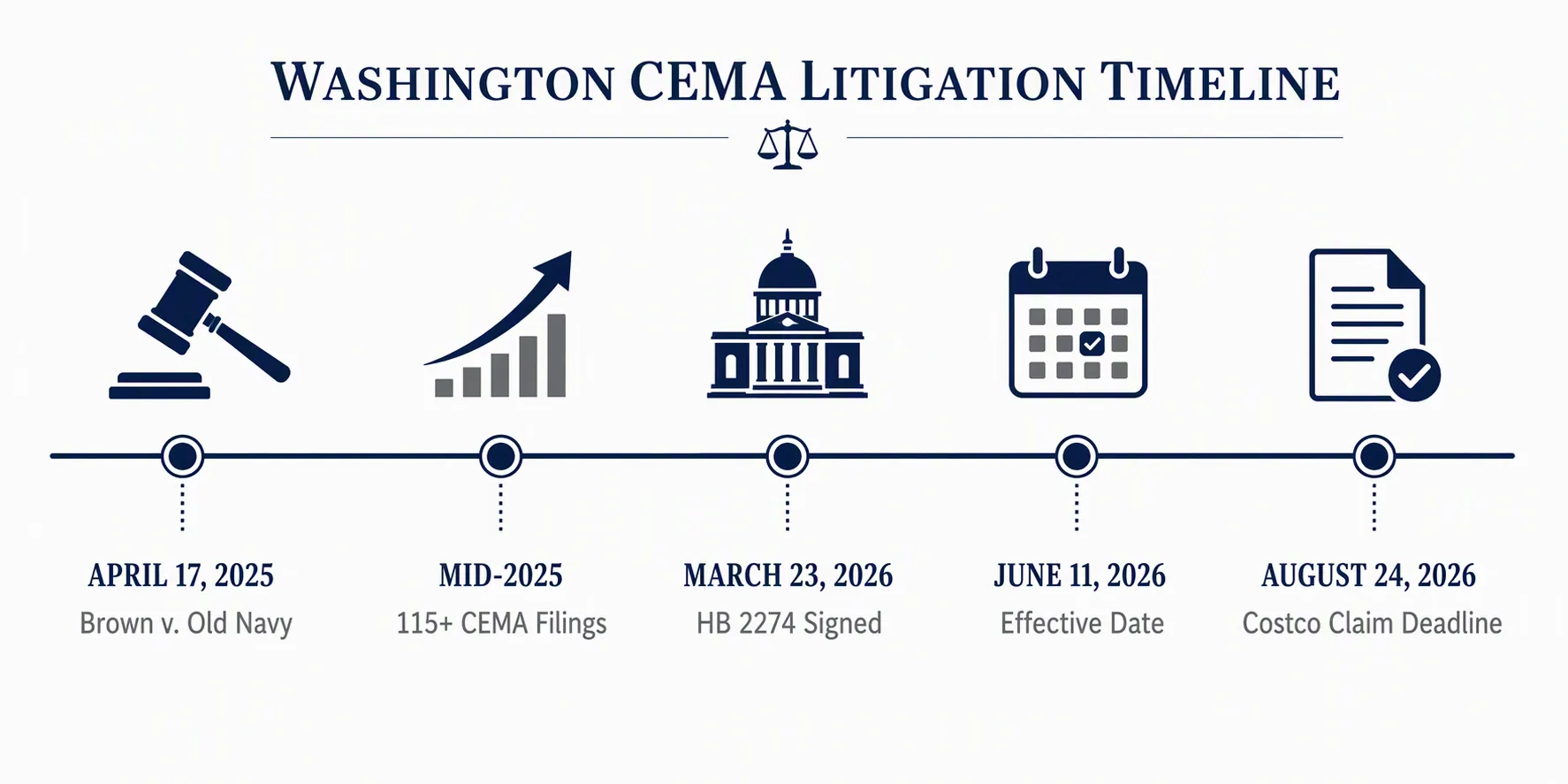
That timing is why Costco is a benchmark rather than an isolated retail nuisance. The settlement sits between two legal dates that changed the economics of promotional email litigation in Washington: the Washington Supreme Court’s April 17, 2025 decision in Brown v. Old Navy, and HB 2274’s June 11, 2026 prospective effective date.[2][3]
Costco Is the Anchor Case, Not the Whole Story
The reported Costco settlement resolves claims that promotional emails sent to Washington residents used subject lines that allegedly misrepresented the duration or urgency of offers. The case was originally filed on June 2, 2025, soon after Brown, and before the legislature’s later cutoff for the amended regime. Newsweek’s account, relying on the settlement agreement, also notes a named-plaintiff substitution: Joseph Zydel filed the original complaint, and Michael Aaland later became the named plaintiff because Zydel had an active Chapter 13 bankruptcy.[4]
That substitution is not the heart of the case, but it is a useful reminder to keep the docket separate from the headline. Brown was an Old Navy case. Costco was not before the Washington Supreme Court in Brown. The common thread is the legal theory: promotional email subject lines, especially phrases such as “last day” or other duration claims, became more dangerous after the court read Washington’s email statute broadly enough to reach misleading subject-line content.[2]
For Washington consumers, eligibility remains a practical issue. The Costco claim deadline is August 24, 2026, and final per-claimant amounts cannot be known until the number of valid claims is set and the court resolves fees, costs, and related awards.[1] For readers who need claim mechanics rather than the litigation landscape, the deeper settlement-record pages are better starting points: How Costco's $14M Settlement Changes Washington Email Marketing Liability, Costco's $14M Email Settlement Sets a CEMA Risk Benchmark, and Costco Email Lawsuit Payout in Washington: File by August 24.
One caveat belongs near the front: the official settlement website requires authentication, so settlement mechanics that are not independently available from docket materials should be treated as checked against secondary sources that reproduce court-approved notice language, not as directly crawled from the settlement site.
What Brown Changed About Ordinary Promotional Email
Before Brown, many retail marketing teams would have treated “Today is the last day,” “Last chance,” or similar subject-line language as ordinary promotional urgency. Brown made that habit expensive in Washington when the urgency claim did not match the actual offer period. The Washington Supreme Court held that CEMA’s prohibition on false or misleading information in a commercial email subject line was not limited to technical routing information or sender identity; it could reach promotional duration claims in the subject line itself.[2]
The difference matters because subject lines are standardized, repeated, and searchable. A claim about one email can become a claim about a campaign. A claim about one campaign can become a class inventory question: how many Washington recipients, how many sends, how many subject lines, and which versions of the offer page or promotion calendar existed when the email went out.

That is the hinge Brown created. It did not prove that every “last chance” email is unlawful. It did make the mismatch between a subject-line claim and the actual promotion terms a statutory-damages problem under Washington law. For retailers with large Washington recipient lists, the old $500 number was not merely a remedy. It was a multiplier.
The Filing Surge Was a Statutory Design Signal
The post-Brown docket activity is often described as a wave, which is accurate enough but slightly theatrical. The cleaner point is that plaintiffs’ lawyers found a statute with fixed damages, repeatable marketing records, and a new state supreme court interpretation. According to advisories discussing the Washington Senate bill report, only eight CEMA lawsuits against retailers had been filed before June 2025.[3][5]
After Brown, the numbers changed quickly. Seyfarth Shaw reported approximately 115 CEMA cases filed after the Washington Supreme Court ruling, while Ballard Spahr reported 105 within the first year.[3][5] Those counts come from advisory sources and differ by measurement window, so the exact number should not be over-polished. The direction is the point: a little-used retail email theory became a mass filing environment.
| Period | Reported Litigation Signal | Why It Matters |
|---|---|---|
| Before June 2025 | Eight CEMA lawsuits against retailers reported in the Washington Senate bill-report discussion | Low baseline before Brown made promotional subject-line claims more actionable |
| After April 17, 2025 | Roughly 105 to 115-plus CEMA cases reported by advisory sources | Repeat retail email practices became class-action inventory |
| Before June 11, 2026 | Filing rush before HB 2274’s prospective effective date | Cases filed before the cutoff preserved the older $500 strict-liability exposure |
This is where “eligibility” becomes a defendant-side word as well as a consumer one. Which complaints were filed before June 11, 2026? Which campaigns reached Washington recipients? Which subject lines made a duration or scarcity claim? Which sends occurred under templates that marketing teams copied across brands, seasons, or abandoned-cart flows? The same segmentation work used to optimize an email program can become the map for damages.
HB 2274 Narrowed the Statute Prospectively
Washington did not leave the old economics untouched. HB 2274 was signed on March 23, 2026, and became effective for actions filed on or after June 11, 2026.[3] The amendment made three changes that matter for retailers and class counsel.
- Statutory damages fell from $500 per violation to $100 per violation.[3]
- The statute moved away from the old strict-liability model by requiring that the sender knew or should have known the subject line was false or misleading.[3]
- The changes apply prospectively to actions filed on or after June 11, 2026, not retroactively to earlier-filed cases.[3]
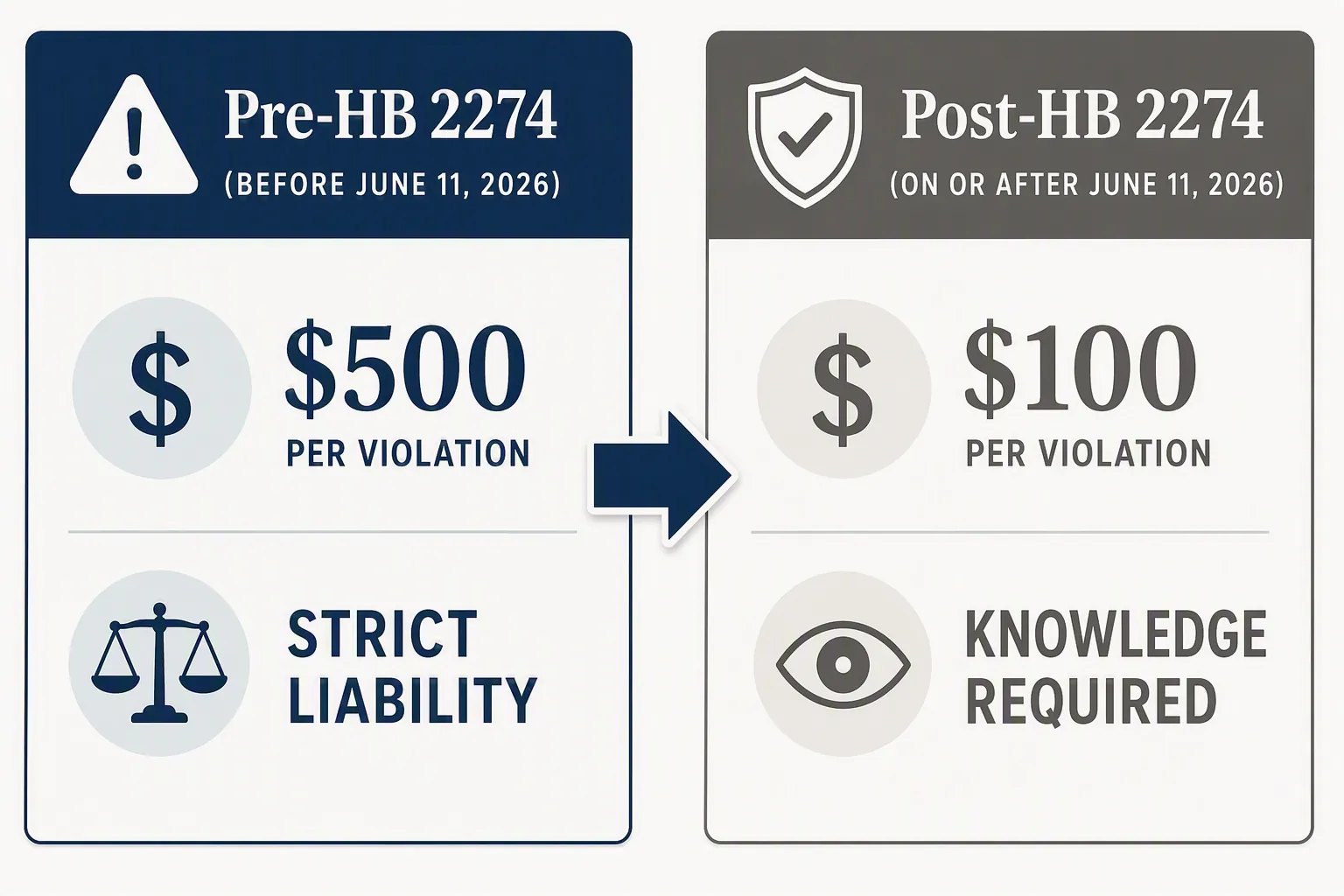
The third change is the one that explains the filing behavior. A statute can reduce future damages and still leave earlier defendants in the older, harsher lane. That is why Costco’s pre-cutoff filing date matters more than the existence of HB 2274 itself. The amendment did not rescue cases already filed under the old regime.
The knowledge requirement also changes what companies will fight about. Under the amended version, litigation should spend more time on what the sender knew or should have known about the accuracy of a subject-line claim. That pulls in approval workflows, promotion calendars, vendor instructions, template reuse, and exception handling. It does not turn a misleading subject line into a harmless one; it changes the proof burden and the settlement math.
Why Costco Still Faced Old-Regime Exposure
Costco’s reported $14 million settlement makes sense only if the timing is kept in view. The case was filed after Brown and before HB 2274’s June 11, 2026 effective date, so the litigation posture reflected the older $500-per-email strict-liability framework.[1][3] The Washington Supreme Court did not decide Costco’s facts. The legislature did not retroactively move Costco into the amended damages model. Those two boundaries are easy to blur and expensive to misunderstand.
For consumers, that old-regime posture is one reason the settlement is large enough to draw public attention. For retailers, it is a reminder that legacy email programs cannot be assessed only against the law as it stands today. The relevant question is often which version of the law governed when the complaint was filed.
There is also a claims-administration reality that should not be dressed up as certainty. A $14 million gross settlement is not a per-person promise. Reported net-fund estimates depend on assumptions about attorneys’ fees, costs, service awards, administrative expenses, and the final number of valid claims. Until the August 24, 2026 claim deadline passes and the court resolves those issues, any exact per-claimant figure is provisional.[1]
The Amended $100 Model Can Still Scale
The move from $500 to $100 per violation is significant. It cuts the statutory unit exposure by 80 percent. But class-action risk rarely lives in the unit number alone. It lives in the multiplication.
A simple hypothetical shows the residual exposure without pretending to be a real case: if 1,000 Washington recipients each received 10 qualifying emails, the amended $100-per-violation model would still produce $1,000,000 in aggregate statutory damages before litigation costs, fee exposure, settlement leverage, or injunctive terms are considered. The amendment lowered the ceiling for each message. It did not make repeated campaigns irrelevant.
That matters for legal-tech and compliance teams because the risk controls are operational. Someone must know which campaigns used scarcity or duration language. Someone must compare the subject line with the actual promotion mechanics. Someone must preserve the approval trail. And if an outside agency, email vendor, or merchandising team changes the offer after the subject line is approved, someone must own the correction before the send goes out.
The Unresolved Challenges Should Stay in the Unresolved Box
There are constitutional and federal-preemption arguments around Washington’s amended CEMA framework, including dormant Commerce Clause and CAN-SPAM preemption challenges. As of July 29, 2026, the materials here do not identify an appellate ruling resolving those issues. That uncertainty is real, but it is not a license to assume the statute disappears.
For now, the more reliable working assumption is narrower: post-June 11 cases face a reduced damages amount and a knowledge element; pre-June 11 cases do not get those changes merely because the legislature later softened the statute. Costco belongs in the latter category.
The Risk Picture After Brown and HB 2274
The Costco settlement is useful because it keeps all the moving parts visible at once: a Brown-triggered subject-line theory, a pre-cutoff filing date, an old $500 strict-liability damages model, and a consumer claims process still awaiting final numbers. It also shows why articles that treat eligibility only as “who can claim cash” miss half the story. Eligibility now also means which cases, dates, emails, and proof records qualify for which CEMA regime.
HB 2274 changed the unit economics and added a knowledge requirement for future filings. It did not erase the pre-June 11 inventory, and it did not make Washington promotional email risk trivial. After Brown and HB 2274, the liability is smaller per message, more knowledge-dependent, and still materially aggregate.
References
- $14M Costco Settlement Resolves Class Action Lawsuit Over Promo Emails, ClassAction.org
- Brown v. Old Navy, Washington Supreme Court, April 17, 2025
- Amendment to Washington's Commercial Electronic Mail Act (CEMA), Seyfarth Shaw, April 15, 2026
- Costco Customers Could Claim Cash From $14 Million Settlement—Who Qualifies, Newsweek
- Ballard Spahr advisory on Washington CEMA litigation, Ballard Spahr
Related records
Tool profile
Browse tool evaluations →Governing regulation
Browse the obligations tracker →Preventive workflow
Browse verification workflows →
Report a correction or tip
Spotted an outdated figure, a misstated fact, or a ruling this case record should reflect? Public comments are disabled for this content given the professional cost of a misreported case outcome, penalty amount, or rule text — use the structured correction channel instead.
Report a correction or tip for this record →