
What the Dennehy Murder Case Teaches About Legal Impact
In the Patrick Dennehy murder case, nearly every headline claim diverged from the record: the 'decapitation' reports, the self-defense confession, the coach's fabricated drug-dealer story, and the psychosis accounts each required a primary source to correct. That claim-to-source mapping — autopsy, FBI, court, and NCAA records — is the verification discipline legal teams should apply to AI-generated research and content before reliance.
- Jurisdiction
- US-Texas
- Court
- Texas state district court
- Judge
- Ralph Strother
- AI tool named
- AI-generated legal research
- Ruling date
- Jun 15, 2005
- Source document
- View primary court order ↗
- Last verified
- Jul 31, 2026
Lex Machina Review is an independent risk-tracking and reference resource. Nothing on this site is legal advice, and using it does not create an attorney-client relationship. Every record is reviewed against primary sources but may not reflect the most current status of a matter — always verify directly against the cited court order, rule text, or a licensed attorney before relying on it.
Companion explanation — secondary to the source document above
The Patrick Dennehy murder case is remembered through phrases that travel well and verify badly: “decapitation,” “self-defense,” “drug dealer,” “psychosis.” Each one sounds like a settled fact until the source underneath is named. That is where the case has legal impact for present-day legal work: not as a fresh moral lesson about a long-known crime, but as a record of how confident claims had to be corrected by different classes of primary or near-primary material.
A legal team reviewing an AI-generated summary of the case would not fix the problem by asking for a smoother narrative or another secondary article. The checking pass would have to ask a narrower question: which source type had authority to prove, correct, or downgrade each claim?
The claim map matters more than the remembered story
| Claim as it tends to travel | Source class needed | Correction or limitation |
|---|---|---|
| Dennehy was “decapitated.” | Autopsy and investigative explanation. | The record supported death by gunshot wounds to the head; investigators attributed the later head/body separation to animal scavenging rather than the manner of death [1][2]. |
| Dotson’s confession made the killing self-defense. | FBI-confession materials checked against autopsy wound placement. | Dotson gave a self-defense account, but the autopsy showed two gunshot wounds, one above the right ear and one behind it toward the back of the head [3][4]. |
| Dennehy was a drug dealer. | NCAA institutional findings on the Baylor basketball cover-up. | The NCAA record found that coach Dave Bliss tried to have players portray Dennehy that way, supplied tape recorders for rehearsed interviews, and participated in broader falsification; the drug-dealer framing was part of the cover story, not a settled fact [5][6]. |
| Psychosis explains the case in a simple way. | Competency and hospital-evaluation record as reported in court coverage. | FBI-confession documents recorded religious and paranoid statements, but a North Texas State Hospital psychologist described Dotson’s symptom accounts as “markedly inconsistent” and “suspect” [7][3]. |
| The criminal case can be summarized from headlines alone. | Court rulings, plea and sentencing reports, and later parole records. | The record includes incompetency in October 2004, restoration in February 2005, an open guilty plea in June 2005, a 35-year sentence, and later parole approval and release in 2024 after roughly 19 years [3][2][4][8]. |
| Baylor’s civil exposure can be stated from institutional messaging. | Court dismissal reporting separated from university statement. | Most of the father’s wrongful-death claims were reported dismissed in February 2004 on no-duty-to-prevent-off-premises-crime grounds; Baylor later said all claims had been dismissed, but the university statement is not the same thing as the order itself [9][10]. |
That map is the work. It prevents a reviewer from treating all corrections as if they come from the same drawer. A forensic claim needs the autopsy. A confession claim needs the confession account tested against physical findings. A fabricated institutional narrative needs the infractions report. A procedural claim needs the court record or the closest reliable court reporting. A civil-liability claim needs the dismissal order or reporting tied to the order, not a university’s preferred phrasing.
The autopsy did the work that headline memory could not
The “decapitation” phrasing is the easiest error to remember and the most dangerous to let stand unexamined. It supplies a visual fact that feels dispositive, but it does not answer the forensic question that matters in a criminal record: how did Dennehy die? The published correction points to gunshot wounds to the head as the cause of death, with investigators attributing the separation of the head from the body to scavenging animals after death [1][2].
That distinction is not cosmetic. A draft that says Dennehy was decapitated may sound merely graphic, but it changes the implied conduct. It can also mislead the next reviewer about which evidence matters. Once the claim is rewritten around the autopsy finding, the checking task becomes narrower and cleaner: cite the gunshot wounds for the cause of death; if the later condition of the remains is mentioned at all, attribute it to the investigative explanation and keep it separate from cause of death.
The self-defense account required the same discipline, but with a different pressure point. Carlton Dotson’s FBI confession included a self-defense version of events [3]. Standing alone, that is a claim about what Dotson said. It is not proof that the physical record supported him. Sentencing coverage reported that the autopsy showed two shots to Dennehy’s head: one above the right ear and one behind it toward the back of the head [4].
For legal review, that is the difference between preserving a statement and adopting it. The accurate sentence is not “Dotson killed Dennehy in self-defense.” It is closer to: Dotson gave a self-defense account, but prosecutors and the autopsy evidence did not treat that account as controlling. That wording keeps the confession in the file without letting the confession overwrite the forensic record.
The NCAA report corrected a different kind of false record
The drug-dealer story was not a forensic error. It was an institutional cover story, and that means the correct source class changes. The NCAA’s June 23, 2005 public infractions record described misconduct by former Baylor basketball coaches, including efforts by Dave Bliss to have players portray Dennehy as a drug dealer and to prepare for interviews using tape recorders [5]. Baylor’s own public-relations account of the infractions matter likewise described penalties for former coaches and the NCAA findings against the program [6].
This is the sort of claim an AI system can flatten badly. “Coach said Dennehy was a drug dealer” and “Dennehy was a drug dealer” are not neighboring facts; one is evidence of a cover-up narrative, the other is an accusation against the victim. The NCAA record also found falsified financial records and a fabricated statement involving another player’s mother [5]. Those findings do not turn every related rumor into a fact. They show which conduct the institution charged and penalized through the NCAA process.
It is just as important not to overcorrect. The materials support the point that Bliss’s exposure in this record ran through NCAA infractions, not criminal charges. They do not justify converting the infractions report into a criminal judgment. A reviewer should keep those tracks separate: NCAA violations, university response, criminal prosecution of Dotson, and civil litigation against Baylor are not interchangeable merely because they arise from the same scandal.
Competency belongs in the record, but it does not simplify the record
Dotson’s mental-health presentation is another place where summary language can become too confident. FBI-confession materials reported statements that “a higher power told him to talk to the FBI” and that people were trying to kill him because he was Jesus [7]. Those statements matter because they were part of the competency setting. They do not, by themselves, settle competency, criminal responsibility, or motive.
The competency timeline is more precise. Judge George Allen found Dotson incompetent on October 28, 2004, and committed him to a state hospital; he was restored in February 2005 on the condition that he continue taking anti-psychotic medication [3]. The same reporting described North Texas State Hospital psychologist Thomas Gray as calling parts of Dotson’s symptom accounts “markedly inconsistent” and “suspect” [3].
A clean legal summary should therefore resist both shortcuts: it should not erase the competency proceedings, and it should not use “psychosis” as a one-word explanation for the murder. The record supports a narrower formulation: competency was litigated, Dotson was initially found incompetent, he was later restored under medication conditions, and at least some symptom reporting was treated skeptically by the hospital evaluator.
Use the criminal timeline as an anchor, not as a substitute for verification
The criminal timeline gives the case its procedural frame. Dotson entered an open guilty plea on June 8, 2005, with no sentencing deal; District Attorney John Segrest said he was surprised by the plea [2]. Judge Ralph Strother sentenced Dotson to 35 years in prison on June 15, 2005 [4]. Later reporting on his custody status recorded parole denials from 2020 through 2023, approval on March 25, 2024, and release on November 19, 2024, after roughly 19 years, under Super Intensive Supervision [8].
Those dates are useful because they bound the record a reviewer is summarizing. They also show why small date claims should not be treated as harmless filler. Public summaries conflict on the indictment date: some sources place it in August 2003, while Baptist News Global reported September 3, 2003 [1][8][9]. Without the indictment or a court docket entry in hand, the safer drafting choice is “indicted in 2003,” with the discrepancy flagged for anyone who needs the exact date.
The same restraint applies to parole-eligibility phrasing. Eligibility descriptions varied in earlier reporting, but the later outcome is clearer: denial in the 2020–2023 period, approval in March 2024, and release in November 2024 [8]. A legal-workflow note should privilege the verified outcome over a paraphrased prediction about eligibility unless the governing parole record is being reviewed directly.
The civil track shows why institutional statements are not court orders
The wrongful-death litigation against Baylor is not the center of this verification record, but it is a useful parallel. Baptist News Global reported that most of the father’s claims were dismissed on February 6, 2004, with the court rejecting a duty to prevent an off-campus crime [9]. Baylor later issued a statement saying all claims in the Dennehy lawsuit had been dismissed [10].
A legal summary can cite both, but it should not make them do the same work. The dismissal reporting supplies the legal basis as reported from the court action. Baylor’s statement supplies the institution’s public position after the dismissal. If the exact scope or procedural posture matters, the order is the target source; a university statement is not a substitute for it.
What this teaches an AI-assisted legal review team
The Dennehy record predates the legal-AI era, but the workflow problem is current. AI-generated legal content often arrives with the same surface defect that older headline memory has: it speaks as if the claim has already survived source review. The review task is to break the prose back into claims before anyone relies on it.
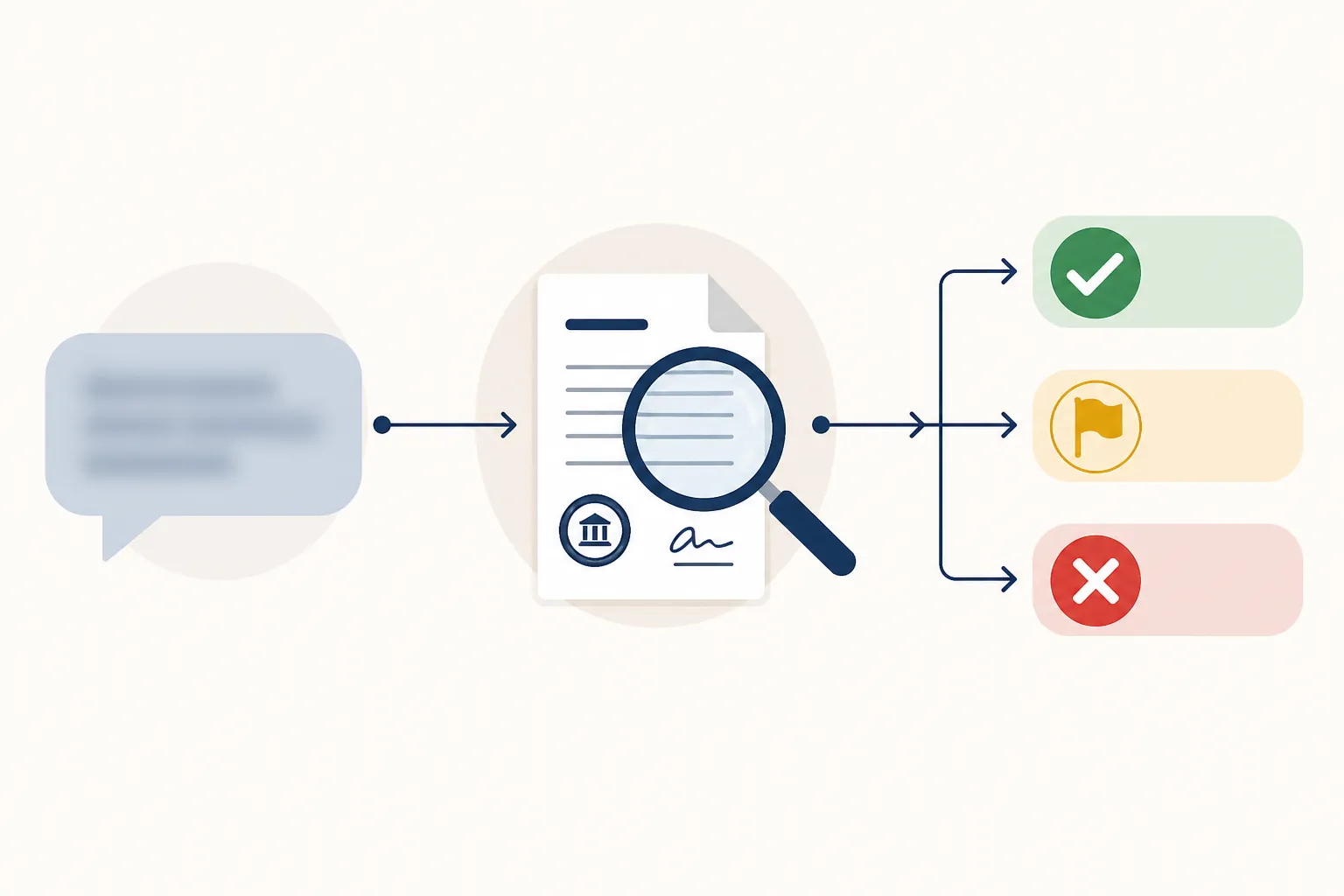
A practical pass looks like this:
- Extract every material claim, including adjectives that imply a legal or forensic conclusion.
- Assign a source class to each claim: autopsy or lab record, agency file, court order, plea or sentencing transcript, institutional findings report, or verified custody record.
- Separate statements made by a party from facts found by a court, agency, medical examiner, or institution.
- Downgrade claims that rest only on secondary phrasing: “reported,” “alleged,” “the confession stated,” “the NCAA found,” or “the university said” may be the accurate wording.
- Remove claims that cannot be paired with a source type capable of proving them.
This is the same habit behind other verification records, whether the task is separating confirmed facts from media inference in a legal name-change record, checking a court order against press wording, or preserving confirmed/reported labels in a procedural criminal record. The point is not to make every draft longer. It is to make every material sentence traceable.
A hypothetical review note for this case would not say, “verify Dennehy murder facts.” It would say: “Cause of death — autopsy source. Self-defense — confession claim checked against autopsy. Drug-dealer allegation — NCAA cover-up finding. Competency — court and hospital-evaluation reporting. Sentence and release — sentencing and parole records. Civil dismissal — court order or court-tied reporting, with university statement separately labeled.”
That level of pairing is what prevents a vivid secondary phrase from becoming a durable false fact. Before reliance, every material claim needs to be matched to the source type capable of proving or correcting it. If it cannot be matched, it should be downgraded, flagged, or removed.
References
- Murder of Patrick Dennehy, Wikipedia.
- Teammate pleads guilty to murder of hoop player, Sun Journal, June 9, 2005.
- 35-Year Sentence In Baylor Slay, CBS News.
- Dotson receives 35-year sentence, The Oklahoman, June 16, 2005.
- Baylor University Former Basketball Coaches Penalized for Multiple Violations of NCAA Rules, NCAA, June 23, 2005.
- Baylor University Former Basketball Coaches Penalized For Multiple Violations Of NCAA Rules, Baylor Media and Public Relations, June 23, 2005.
- Baylor Suspect Competent to Trial, Fox News.
- Ex-Baylor University basketball player who killed teammate out on parole, back in Waco, KWTX, June 6, 2025.
- Judge dismisses most counts against Baylor in wrongful death suit, Baptist News Global.
- Baylor University Statement On Dismissal Of Dennehy Lawsuit, Baylor Media and Public Relations, February 25, 2004.
Related records
Tool profile
How Meta's AI Spending Reshapes Law Firm ProfitabilityGoverning regulation
Browse the obligations tracker →Preventive workflow
Browse verification workflows →
Report a correction or tip
Spotted an outdated figure, a misstated fact, or a ruling this case record should reflect? Public comments are disabled for this content given the professional cost of a misreported case outcome, penalty amount, or rule text — use the structured correction channel instead.
Report a correction or tip for this record →