
What’s Confirmed in the Lindsay Clancy Trial
As of July 31, 2026, with the trial in its witness phase and no verdict, this is the verified procedural record of the Lindsay Clancy case — jurisdiction, judge, counsel, charges, key rulings, and witness phase — each fact timestamped and flagged confirmed or reported.
- Jurisdiction
- Massachusetts
- Court
- Plymouth County Superior Court
- Judge
- William Sullivan
- AI tool named
- None
- Ruling date
- Jul 24, 2026
- Source document
- View primary court order ↗
- Last verified
- Jul 31, 2026
Lex Machina Review is an independent risk-tracking and reference resource. Nothing on this site is legal advice, and using it does not create an attorney-client relationship. Every record is reviewed against primary sources but may not reflect the most current status of a matter — always verify directly against the cited court order, rule text, or a licensed attorney before relying on it.
Companion explanation — secondary to the source document above
As of July 31, 2026, the Lindsay Clancy case is still a live criminal trial, not a completed outcome. The last sourced trial activity in this record is witness testimony after jury selection and opening statements; no verdict is available in the materials used for this article. That matters for legal and newsroom use: the defense theory has not been accepted by a jury, and the prosecution theory has not been proved by a verdict.
The stable layer is procedural: Plymouth County Superior Court, Judge William Sullivan, three first-degree murder charges, jury selection from July 20–23, 2026, a July 24 access ruling, July 27 opening statements, and Patrick Clancy’s testimony window from July 27–29. Those are the facts this record can carry safely today, with source-status labels attached.

Current record spine
| Record field | What can be stated now | Status label | Last verified |
|---|---|---|---|
| Court and venue | Plymouth County Superior Court is the reported trial court for the criminal case. | Reported in accessible press coverage; primary docket should remain the control record. | July 31, 2026 |
| Judge | Judge William Sullivan is reported as presiding over the trial and the July 24 access ruling. | Reported by AP and Boston.com. [1][2] | July 31, 2026 |
| Counsel identified in reporting | The prosecution is identified in reporting with District Attorney Jennifer Sprague; the defense with attorney Kevin Reddington. | Reported by AP. [1] | July 31, 2026 |
| Charges | Lindsay Clancy faces three counts of first-degree murder in the January 24, 2023 strangulation deaths of her children Cora, 5, Dawson, 3, and Callan, 8 months. | Reported charging status; not a verdict. [1] | July 31, 2026 |
| Trial stage | Jury selection occurred July 20–23, 2026; opening statements began July 27; witness testimony followed. | Reported trial activity; no verdict in this record. [1][3] | July 31, 2026 |
| Access ruling | On July 24, 2026, Judge Sullivan reportedly limited public access to Patrick Clancy’s 911 call and the children’s autopsy photographs. | Reported ruling; should be checked against the court docket when the primary order is available. [2] | July 31, 2026 |
| AI/tool field | No AI system or software tool is implicated in the cited record. | Record-classification note; not an AI incident. | July 31, 2026 |
The table deliberately treats press reporting as press reporting. In a live trial, reputable reporting is often the only accessible record before a docket entry or transcript becomes available. That does not make it useless; it does mean it should not be silently upgraded into a court finding.
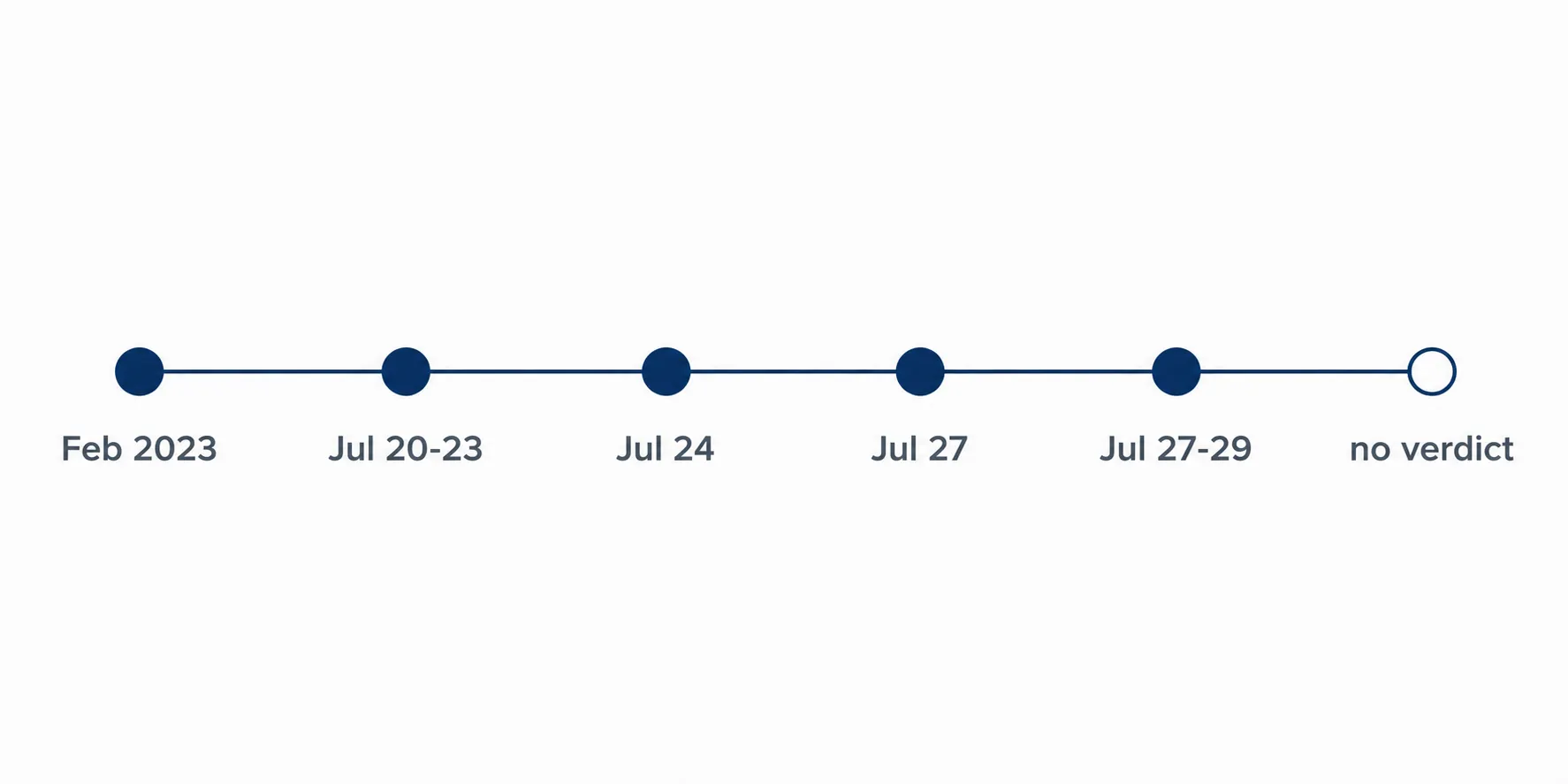
Dated procedural timeline
| Date or window | Event | Source status |
|---|---|---|
| January 24, 2023 | Cora, Dawson, and Callan Clancy died after being strangled, according to the charging narrative reported in the trial coverage. | Reported background to the charges. [1] |
| February 7, 2023 | Clancy was arraigned from a hospital, according to AP’s case chronology. | Reported procedural event. [1] |
| July 20–23, 2026 | Jury selection took place, with 18 jurors seated, including six alternates. | Reported trial procedure. [1] |
| July 24, 2026 | Judge Sullivan reportedly restricted public access to the 911 call and the children’s autopsy photographs. | Reported access ruling; primary docket confirmation remains preferable. [2] |
| July 27, 2026 | Opening statements began. | Reported trial event. [3] |
| July 27–29, 2026 | Patrick Clancy testified, and reporting described playback of the 911 call during that testimony window. | Reported testimony window. [3] |
| July 31, 2026 | No verdict is available in this record. | Current status of this article’s source set. |
The July 20–23 jury-selection window is more than a calendar detail. It fixes the start of the trial phase and prevents a common error in running summaries: treating pretrial claims, motions, or expert positions as if they had already been weighed by a trial jury. AP reported that jury selection began on July 20 and that the panel ultimately included 18 jurors, six of them alternates. [1]
The July 24 access ruling also needs a narrow description. Boston.com reported that Judge Sullivan limited public access to Patrick Clancy’s 911 call and to autopsy photographs of the children. That is an access ruling about what the public may receive, not a ruling that the material does not exist, and not a ruling resolving the factual meaning of the call or photographs. [2]
The witness phase began after opening statements on July 27. BBC reporting placed Patrick Clancy’s testimony across July 27–29 and described his account of the day of the children’s deaths, including the courtroom playback of the 911 call. Those are reported trial events. They are not a verdict on intent, mental state, criminal responsibility, or any clinical diagnosis. [3]
What the jury is being asked to decide
The case is being tried around sharply opposed accounts of mental state. The prosecution’s position, as reported, points to evidence of premeditation, including online searches about distances. The defense’s position, as reported, argues lack of criminal responsibility through claims involving postpartum psychosis, voice-command hallucinations, and overmedication. A third disputed area is the prosecution’s challenge to the suicide-attempt evidence, including the reported emphasis on “minor scratches.” These are trial positions and reported evidence, not adjudicated findings. [3][4]
| Issue | Safe status label | What can be said | What cannot be said yet |
|---|---|---|---|
| Premeditation | Prosecution theory and reported evidence | The prosecution is reported to be using planning-type evidence, including digital-search material, to argue premeditation. | That premeditation has been proved. |
| Postpartum psychosis and lack of criminal responsibility | Defense theory and contested clinical/legal claim | The defense is reported to argue that Clancy lacked criminal responsibility because of postpartum psychosis-related symptoms, including voice-command hallucinations and medication issues. | That a court or jury has found postpartum psychosis caused the killings. |
| Suicide-attempt evidence | Contested inference | The prosecution is reported to challenge the defense’s account of the suicide attempt, including through the “minor scratches” point. | That the court has found the attempt genuine, staged, or legally dispositive. |
| 911 call and autopsy photographs | Access ruling plus trial evidence | The public-access ruling was reported on July 24; the 911 call was also reported as played during Patrick Clancy’s testimony. | That restricted public access equals exclusion from the jury or a ruling on the merits. |
For readers who need the doctrine rather than the procedural spine, the deeper Massachusetts standard is better handled separately: see the site’s explainer on whether postpartum psychosis can meet the McHoul standard and the companion piece on the Massachusetts insanity-defense standards in the Clancy trial. This record only marks where those questions sit in the live trial.
Warning-signs material belongs in a narrower lane
The phrase “warning signs” is dangerous in this case if it is used to backfill certainty from tragedy. Clinical context can explain why the defense is making a postpartum-psychosis argument and why public-health writers are covering the case, but it cannot convert a litigated claim about Clancy herself into a medical conclusion. PBS NewsHour’s trial-period explainer addressed postpartum psychosis as clinical context, while the courtroom record remains focused on whether the legal standard for criminal responsibility is met. [5]
That distinction is not semantic housekeeping. A headline that says “postpartum psychosis defense” is describing a defense theory. A sentence that says “postpartum psychosis caused the killings” is asserting a finding the current record does not contain. The same restraint applies in the other direction: reported planning evidence and cross-examination points are prosecution evidence, not a conviction.
For broader clinical and forensic context, use the site’s separate pieces on the DSM-5 gap around postpartum psychosis, sudden-onset postpartum psychosis and insanity claims, and the postpartum-psychosis precedent map. Those articles can carry the clinical and doctrinal weight; this one should not pretend to diagnose a defendant from reported testimony.
The stakes are alternatives, not outcomes
The legal stakes are severe on both possible paths. If Clancy succeeds on a lack-of-criminal-responsibility defense, reporting describes the consequence as commitment to a state psychiatric hospital. If she is convicted on the three first-degree murder counts, reporting describes the consequence as life without parole. Those are the alternatives before the court, not results already reached. [4][6]
That is also why the case should not be summarized as “postpartum psychosis vs. murder” without a status label. The trial is deciding criminal responsibility and charged homicide counts under Massachusetts law. Public understanding suffers when a defense theory is written as a diagnosis accepted by the court, or when a prosecution theory is written as a finding before the jury has returned anything.
Source limits to keep attached to the record
- No verdict is available in this article’s source set as of July 31, 2026. Any sentence implying a 2026 outcome should be corrected unless a later docket entry or verdict report supports it.
- The July 24 access ruling is carried here from Boston.com reporting. It should be replaced or supplemented with a primary court order if the docket record becomes available.
- Reported testimony remains reported testimony until transcripts or exhibits can be checked. That includes descriptions of Patrick Clancy’s testimony, the 911-call playback, online-search evidence, medication evidence, and clinical-symptom claims.
- The defense’s postpartum-psychosis and overmedication claims are contested. The prosecution’s premeditation and suicide-attempt challenges are contested. Neither side’s theory should be treated as a judicial finding.
- No AI tool is implicated by the cited record. The only reason to use a Risk Digest-style format here is record discipline: jurisdiction, court, judge, parties, procedural posture, source status, and update date.
The adjacent site records remain useful for narrower questions: Judge Sullivan’s evidentiary rulings are tracked in the five-rulings record; the first day of advocacy is covered in the opening-statements recap; and the prosecution’s digital-footprint theory is separated into the premeditation analysis. This record should be updated only when the procedural record changes: new testimony, new docket material, rulings, jury instructions, deliberations, verdict, or sentencing.
For now, the record stops in the witness phase. There is no verdict, no judicial finding that postpartum psychosis has been established, and no accepted prosecution theory of premeditation.
References
- Jury selection starts in Lindsay Clancy's trial over her children's deaths, AP News
- Lindsay Clancy trial: Judge limits access to husband's 911 call and autopsy photos, Boston.com
- 'Blood everywhere' — Lindsay Clancy's ex-husband recounts day of children's deaths, BBC News
- Postpartum psychosis or murder? Trial of mother who killed her kids spotlights mental health, The Guardian
- As Lindsay Clancy goes to trial, here's what to know about postpartum psychosis, PBS NewsHour
- Insanity defense in Massachusetts: Cases to know before Lindsay Clancy trial opening statements, MassLive
Related records
Tool profile
Browse tool evaluations →Governing regulation
Browse the obligations tracker →Preventive workflow
Browse verification workflows →
Report a correction or tip
Spotted an outdated figure, a misstated fact, or a ruling this case record should reflect? Public comments are disabled for this content given the professional cost of a misreported case outcome, penalty amount, or rule text — use the structured correction channel instead.
Report a correction or tip for this record →