
Diddy Solitary Confinement Exposes Prison Reform Gap
The Federal Bureau of Prisons has not adopted a categorical durational limit on disciplinary segregation despite the 2018 First Step Act and multiple oversight reports. Sean Combs' July 2026 placement at FCI Fort Dix highlights the systemic gap between stated reform objectives and field practice.
- Jurisdiction
- US-Federal
- Court
- FCI Fort Dix
- AI tool named
- Not applicable
- Ruling date
- Jul 27, 2026
- Source document
- View primary court order ↗
- Last verified
- Jul 30, 2026
Lex Machina Review is an independent risk-tracking and reference resource. Nothing on this site is legal advice, and using it does not create an attorney-client relationship. Every record is reviewed against primary sources but may not reflect the most current status of a matter — always verify directly against the cited court order, rule text, or a licensed attorney before relying on it.
Companion explanation — secondary to the source document above
Last verified: July 30, 2026. The public record on Sean “Diddy” Combs’ reported Special Housing Unit placement at FCI Fort Dix is still incomplete. NBC News and ABC News reported that Combs was placed in solitary confinement after a prison fight at the New Jersey federal facility, with the reported window running from July 24 to July 27, 2026.[1][2] TMZ separately described Fort Dix SHU conditions based on an inmate handbook it obtained, while CBS News reported the Bureau of Prisons’ position that it does not comment on “conditions of confinement, disciplinary matters, or other information regarding individual inmates.”[3][4] That leaves the Fort Dix handbook as a proxy for likely institutional rules, not proof of the exact conditions imposed on Combs.
That evidentiary line matters. The question is not whether one famous inmate has already proved an unconstitutional punishment, or whether a reported fight deserved administrative separation. The narrower and more useful question is why the federal system can still impose disciplinary segregation without a categorical duration cap, even after Congress, oversight bodies, state legislatures, and international standards have all pushed the same basic constraint into view.
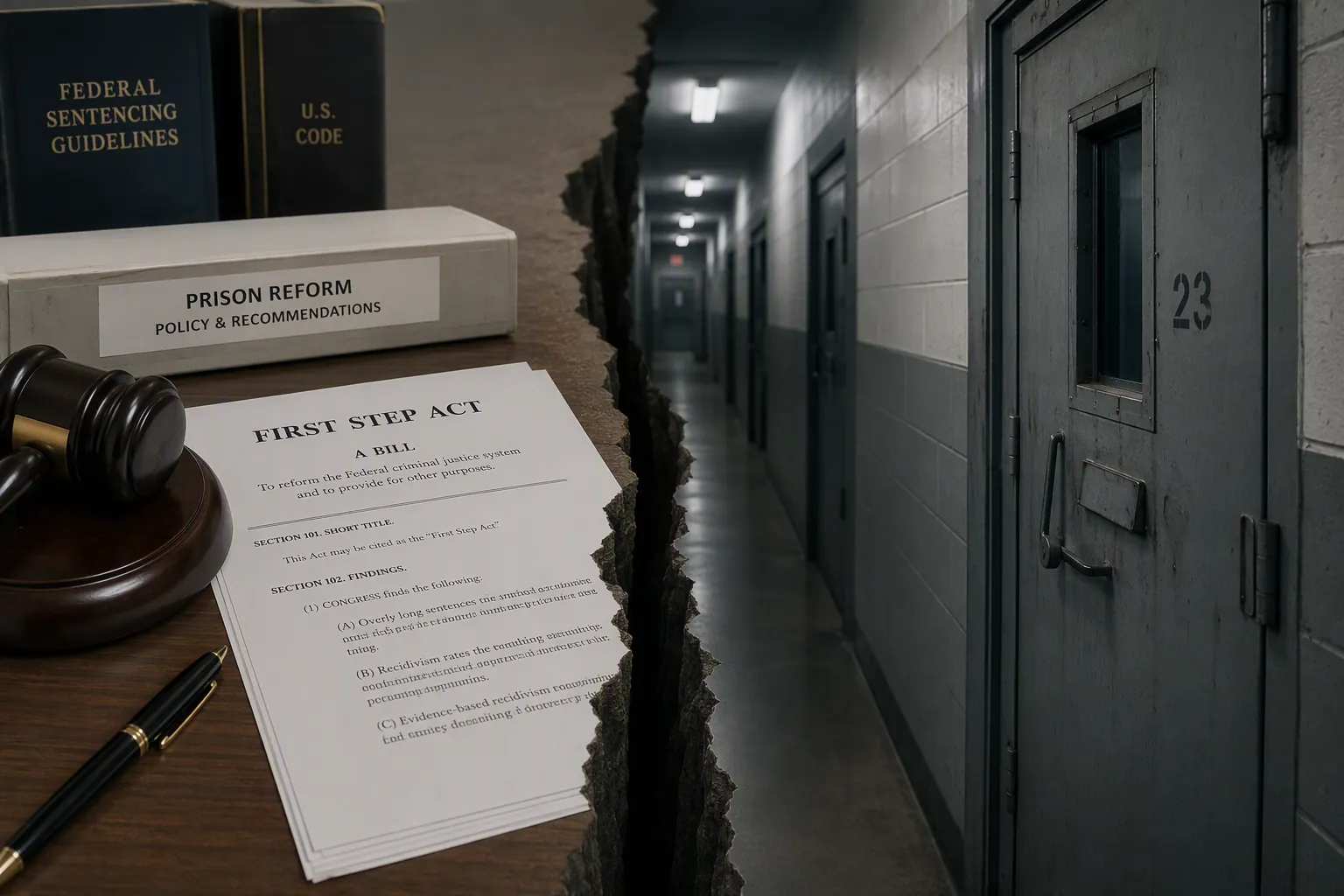
What the Combs Record Shows, and What It Does Not
The reported incident is straightforward only at the surface level. Combs was reportedly involved in a fight at FCI Fort Dix and then placed in the SHU. ABC characterized the conduct as a fight; the research record available for this article identifies Code 201, fighting, as the reported disciplinary framing, but the Bureau of Prisons has not confirmed the prohibited-act code, the hearing status, the sanction imposed, or the exact duration of segregation.[2][4]
That non-confirmation is not a minor press-office footnote. In a prison-conditions dispute, the most important facts are often the ones an outside reader cannot see: when the SHU clock started, when it stopped, whether the placement was administrative or disciplinary at each point, what process occurred, whether privileges were removed, and whether program participation or release-credit progress was interrupted. A public agency can withhold individual disciplinary information for legitimate privacy and security reasons. But when the same opacity surrounds a routine restrictive-housing practice, the accountability problem does not disappear; it moves from the celebrity file to the system file.
TMZ’s Fort Dix handbook reporting is therefore useful only in a limited way. It can describe the facility’s stated SHU regime: restricted movement, reduced privileges, and institutional control over communication and property.[3] It cannot establish how long Combs remained under those conditions, whether he received all required process, or whether any specific restriction exceeded Bureau policy. Those questions belong in a case-specific disciplinary record, not in a handbook.
For the due-process framework, the better starting point is the existing Risk Digest analysis of Sean Combs’ solitary-confinement due process rights. For the individual sanction range, including the reported Code 201 exposure, see the separate breakdown of Combs’ Fort Dix fight sanction risk. This article is concerned with the rule that is missing even when ordinary disciplinary process exists.
The Missing Federal Constraint Is Duration
Federal restrictive housing is not legally unregulated. The Bureau of Prisons has disciplinary procedures, prohibited-act codes, review mechanisms, and institutional policies. A person accused of fighting does not move through a blank legal space. But the part that would matter most for systemic reform—the outer limit on how long disciplinary segregation may last—is not supplied by a categorical federal cap.
That absence is increasingly conspicuous because other actors have already identified duration as the line that separates temporary separation from a harsher, compounding sanction. The Senate Judiciary Committee’s announcement of the End Solitary Confinement Act cited a February 2023 Department of Justice report finding that the Bureau of Prisons had not meaningfully reduced restrictive housing numbers, and it also cited Government Accountability Office findings that BOP had not addressed longstanding concerns about overuse of solitary confinement.[5] Those are oversight findings about implementation, not a court judgment that any one SHU placement is unlawful. Their value is different: they show that the federal problem has been noticed at the institutional level and still has not been closed at the rule level.
The distinction is not academic. A policy objective can say the agency will reduce restrictive housing. A dashboard can count placements. A program statement can describe reviews. None of those devices performs the same work as a durational limit that a facility must obey when it imposes disciplinary segregation. Without that limit, reform remains vulnerable to exactly the kind of case now visible at Fort Dix: a placement that can be described as ordinary prison management while the decisive facts remain unavailable outside the institution.
Why SHU Time Can Alter Release Timing
The First Step Act made the federal gap sharper, not softer. The 2018 law created a risk-and-needs assessment structure and an earned-time-credit system for eligible people who participate in qualifying programs and productive activities. But the implementing rule provides that an eligible inmate may not earn First Step Act time credits during placement in disciplinary segregation, codified at 28 CFR § 523.42(c)(2).[6]
That rule changes the character of SHU time. Disciplinary segregation is not only separation from the general population. It can also stop the accrual of credits that otherwise move a person toward prerelease custody or supervised release. The sanction therefore has two clocks: the visible confinement clock and the less visible release-credit clock. When the Bureau does not disclose the duration or status of the placement, an outside observer cannot tell where one punishment ends and the next consequence begins.
Consider the difference between two otherwise similar disciplinary outcomes. In one, an incarcerated person receives a short SHU placement and quickly returns to eligible programming. In the other, the person remains in disciplinary segregation long enough to miss a meaningful block of credit-earning opportunity. The second outcome may look, on a sanction form, like a housing decision. In practical release planning, it can operate like a delay. The First Step Act’s credit structure is supposed to reward participation and risk reduction; disciplinary segregation interrupts the very mechanism Congress elevated.
That is why Combs’ case should not be reduced to the usual argument over whether a high-profile inmate is receiving special leniency or special harshness. The same credit-accrual rule applies without regard to notoriety. The legal-risk issue is whether a federal facility can impose a placement that affects release incentives while the system lacks a categorical duration rule and the Bureau declines to confirm case-level details.
The separate Risk Digest article on Steve McBee Sr.’s early release from federal prison explains the practical importance of First Step Act credits in a different posture. The same system that can accelerate release through earned credits can also slow credit progress when disciplinary segregation removes the person from accrual eligibility.
The Federal Position Is Now Out of Step With Multiple Reform Benchmarks
The Bureau of Prisons does not need to be compared with an idealized prison system to see the divergence. State reforms and international standards already provide practical reference points. New York’s HALT Act, enacted in 2021, limits solitary confinement to 15 consecutive days and bans it for vulnerable populations; New Jersey’s 2019 Isolated Confinement Restriction Act limits isolated confinement to 20 consecutive days; and Colorado reduced solitary use by more than 70% between 2016 and 2020, according to Solitary Watch’s compilation of reform data.[7]
| Benchmark | Relevant Limit or Finding | Why It Matters Here |
|---|---|---|
| New York HALT Act | 15 consecutive days; ban for vulnerable populations | Shows a state-level categorical duration rule. |
| New Jersey 2019 law | 20 consecutive days | Shows another enacted statutory cap, not merely an agency objective. |
| Colorado reform record | More than 70% reduction in solitary use between 2016 and 2020 | Shows that large reductions have been attempted operationally. |
| Mandela Rules | 15 consecutive days as the recommended maximum | Shows the international benchmark the federal system has not adopted as binding. |
The Mandela Rules are not binding U.S. federal law. They should not be treated as if a Fort Dix SHU placement automatically violates domestic law because it crosses an international recommendation. Their importance is more precise: the United Nations Standard Minimum Rules identify 15 consecutive days as the maximum recommended period for solitary confinement, and the federal Bureau of Prisons has not converted that benchmark into a binding categorical limit for disciplinary segregation.[7]
The state comparisons also should not be oversold. A statute on paper does not prove perfect compliance in New York or New Jersey. Colorado’s reduction does not mean long-term restrictive housing cannot reappear under another label or emergency rationale. But these examples do establish that duration caps and steep reductions are administratively imaginable. The federal system’s continued refusal to adopt a categorical limit is therefore harder to defend as a matter of operational impossibility.
The Oversight Record Points to Implementation, Not Awareness, as the Failure
The Department of Justice and GAO materials cited by Senate sponsors do not describe an agency unaware of solitary-confinement concerns. They describe an agency that has not made the restrictive-housing reduction objective travel reliably into field practice.[5] That is the compliance problem. Awareness can sit in testimony, reform memoranda, and strategic plans for years. A duration cap either binds the placement decision or it does not.
The Federal Anti-Solitary Task Force blueprint and the End Solitary Confinement Act show that federal remedies have been drafted. The Senate Judiciary Committee release describes reform proposals including reporting requirements, independent oversight, and limits on solitary confinement, but the bill has not become law.[5] That leaves the Bureau operating under a weaker accountability structure than the reform conversation implies.
Reporting is not a substitute for a cap, but it is the condition that lets anyone test whether a cap or reduction policy is real. If the public cannot see how many people are in restrictive housing, for how long, under what status, with what review, and with what effect on earned credits, then the system can claim reform while preserving facility-level discretion where the consequences occur.
The Risk Indicators Are Concrete
The strongest argument for duration limits does not require treating every SHU placement as identical. A short separation after a violent incident and months of isolation used as disciplinary control present different legal and operational questions. The problem is that, without a categorical limit and transparent reporting, the federal system does not force that distinction early enough.
Solitary Watch’s FAQ cites Texas data finding a 60.84% rearrest rate within three years for people released from solitary, compared with 48.8% for people released from general population, and a North Carolina study finding a 17% higher premature mortality risk after one solitary placement and a 38% higher risk after multiple placements.[7] Those figures should be handled carefully because the FAQ is an advocacy-source compilation and the underlying studies should be checked directly before litigation-grade reliance. Still, the direction of the risk is not abstract: restrictive housing can affect release outcomes, health outcomes, and reentry stability.
The cost signal is similarly practical. Solitary Watch reports an approximate annual cost of $75,000 per person in solitary confinement versus about $25,000 in general population.[7] Cost data do not answer the legal question by themselves. They do make it harder to treat long restrictive-housing stays as a low-friction default. If the more expensive option also carries documented health, mortality, and reentry risks, then duration control becomes a governance issue as much as a humanitarian one.
What the Combs SHU Episode Actually Tests
A high-profile placement does not prove the ordinary case. It does something narrower: it tests whether the Bureau can explain an ordinary practice when the public is suddenly looking. Here, the answer so far is limited. Reporters can identify a reported fight and a reported SHU stay. They can quote the Bureau’s refusal to discuss individual conditions or discipline. They can obtain and compare a facility handbook. They cannot confirm the placement status, exact duration, disciplinary code, credit consequences, or conditions applied to the person at the center of the story.[1][2][3][4]
That gap does not establish an Eighth Amendment violation. The constitutional question depends on facts that are not public: duration, conditions, medical vulnerability, official knowledge, deprivation severity, and available remedies. The separate Risk Digest analysis of whether Combs’ solitary confinement violates the Eighth Amendment addresses that enforcement path. The policy-reform question is already ripe without it.
The Bureau can comply with minimum disciplinary procedure and still operate a restrictive-housing system that fails the reform commitments surrounding it. That is the uncomfortable legal-risk posture: not an obvious one-case violation, but a standing divergence between federal field practice and the limits now visible in state law, oversight findings, proposed federal legislation, and international standards.
The Fort Dix episode matters because it exposes where the rule stopped traveling. Congress built earned-time credits into the First Step Act. Oversight bodies flagged restrictive-housing overuse. States enacted duration caps. The Mandela Rules supplied a 15-day benchmark. Reform advocates drafted federal reporting and oversight proposals. Yet the Bureau of Prisons still has not adopted the categorical durational limit that would constrain disciplinary segregation at the facility level.
Without that limit, and without transparent reporting on duration and credit consequences, the federal system can keep describing restrictive-housing reform while leaving the decisive constraint unenforced. Combs’ reported SHU placement does not prove illegality on the current public record. It shows why the accountability gap is no longer hidden inside low-visibility prison administration.
References
- Sean ‘Diddy’ Combs in solitary confinement after fight at New Jersey federal prison, NBC News.
- Sean ‘Diddy’ Combs involved in prison fight, placed in solitary confinement, ABC News.
- Sean ‘Diddy’ Combs’ Life Inside Solitary Confinement, TMZ, July 27, 2026.
- Sean ‘Diddy’ Combs prison chapel drug rehab phone call, CBS News.
- Durbin, Coons Introduce Bill to Limit Use of Solitary Confinement, Senate Judiciary Committee.
- Statistics Collected Under The First Step Act 2025, Forbes, March 15, 2026.
- FAQ, Solitary Watch.
Related records
Tool profile
Browse tool evaluations →Governing regulation
Browse the obligations tracker →Preventive workflow
Browse verification workflows →
Report a correction or tip
Spotted an outdated figure, a misstated fact, or a ruling this case record should reflect? Public comments are disabled for this content given the professional cost of a misreported case outcome, penalty amount, or rule text — use the structured correction channel instead.
Report a correction or tip for this record →