
Fauci, Maher, and What the Fifth Amendment Actually Covers
Analyzes the legal risk in Fauci's Fifth Amendment invocation before Congress, including why the preemptive pardon does not bar the privilege and how Bill Maher's 'actual lies' comment reads as protected opinion. Counsel advising subpoenaed witnesses get the black-letter test and the practical posture to run before any appearance.
- Jurisdiction
- us-federal
- Court
- U.S. Senate
- AI tool named
- None
- Ruling date
- Jul 29, 2026
- Source document
- View primary court order ↗
- Last verified
- Aug 2, 2026
Lex Machina Review is an independent risk-tracking and reference resource. Nothing on this site is legal advice, and using it does not create an attorney-client relationship. Every record is reviewed against primary sources but may not reflect the most current status of a matter — always verify directly against the cited court order, rule text, or a licensed attorney before relying on it.
Companion explanation — secondary to the source document above
Risk Digest legal-risk analysis. Not legal advice. Legal-background review: Maya R. Kline, J.D. Last verified: Aug. 2, 2026, 18:00 UTC. Status note: the Senate hearing record is only three days old, the reported DOJ pardon warrant has not been independently reviewed here, and Sen. Rand Paul’s contempt posture is reported as potentially moving during the week of Aug. 3, 2026. Treat the witness-risk analysis as live, not settled.
The counsel-facing question is narrower than the television fight around it: if a pardoned public figure appears before Congress and invokes the Fifth Amendment, what legal risk is he still avoiding? For a subpoenaed witness, the answer begins with the room, not the punditry.
The hearing posture created the risk
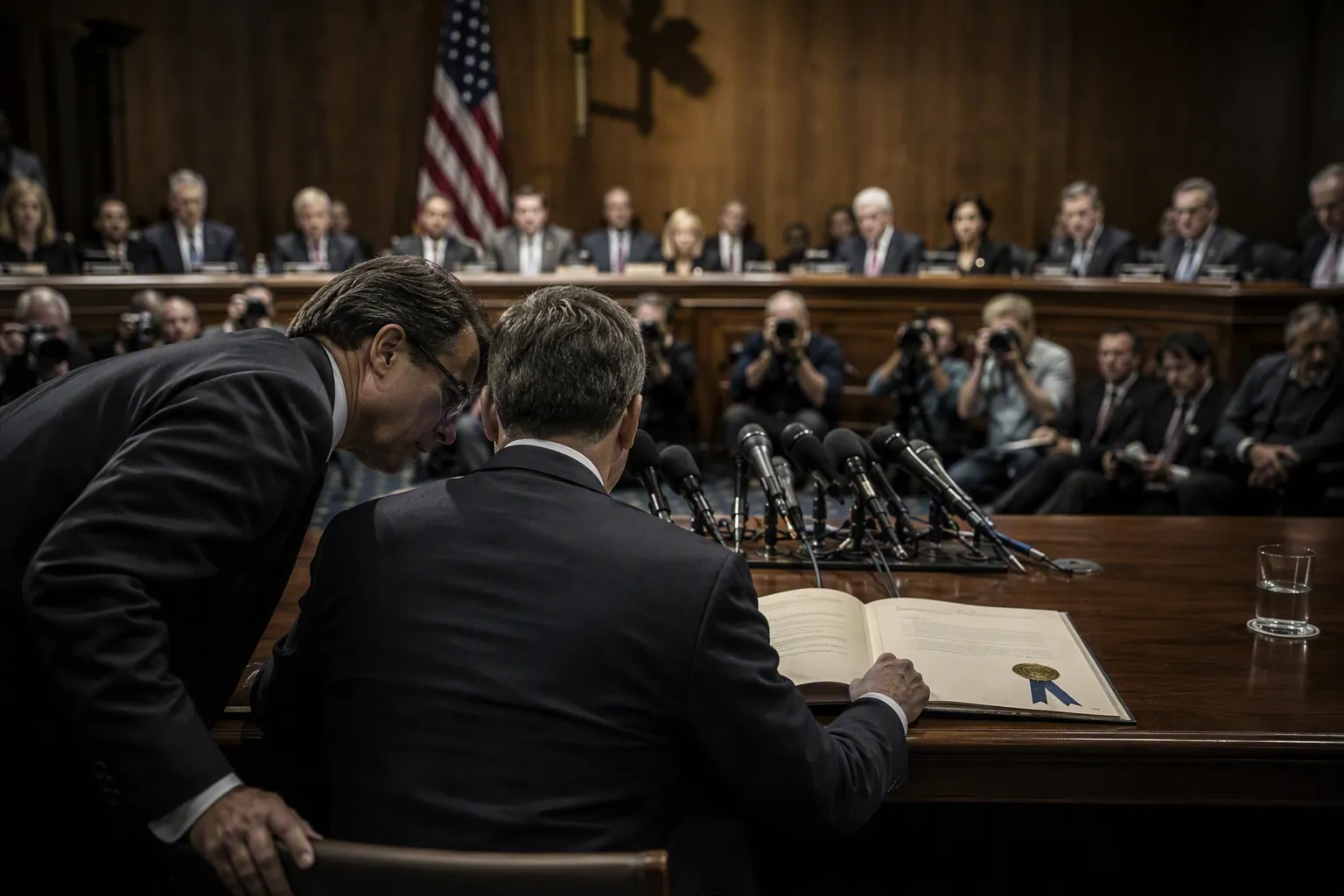
On July 29, 2026, Anthony Fauci appeared before a Senate committee and invoked the Fifth Amendment 111 times, according to NBC’s account of the hearing. NBC also reported that Paul had Fauci’s lawyer removed from the witness table and that the exchange included Paul calling Fauci “unhinged.” Those details matter less as theater than as record architecture: sworn testimony, hostile questioning, counsel pushed farther away, and a chairman who had publicly pressed for prosecution all increase the chance that a complete answer becomes a later exhibit. [1]
CNN, PolitiFact, BBC, The Hill, Al Jazeera, and BMJ all treated the hearing as part of a broader confrontation over Fauci’s pandemic-era conduct, the Biden pardon, and possible contempt proceedings. That does not prove criminal exposure existed on any particular question. It does show why a defense lawyer would not analyze the hearing as a polite oversight session where a witness could safely narrate his way through broad factual disputes. [2][3][4][5][6][7]
The immediate point is simple enough to be missed: appearing and invoking is not the same act as refusing to appear. A witness who sits for questioning gives the committee jurisdictional and reputational leverage, but also preserves a constitutional objection question by question. A witness who does not appear forces a different contempt analysis before anyone reaches the Fifth Amendment merits.
For site readers tracking the same live record, the prior Risk Digest entries on the Fauci pardon and Fifth Amendment issue, the hearing subpoena risk template, and the pending contempt-vote analysis should be read together rather than as separate political episodes.
The black-letter test is familiar; applying it after a pardon is not mechanical
The Fifth Amendment privilege protects against compelled, testimonial, self-incriminating communications. In Hoffman v. United States, the Supreme Court framed the privilege broadly enough to cover answers that would furnish a “link in the chain” of evidence needed for prosecution, not only answers that directly confess a completed offense. [8]
That framing is why open-ended congressional questions can be dangerous even when the witness believes he has an innocent explanation. A question about who reviewed a grant, who forwarded an email, or who approved a public statement may not sound incriminating in isolation. In a later referral, the government’s theory may be that the answer was incomplete, misleading, or false when compared with documents obtained elsewhere.
The operational problem is not whether Fauci had already been pardoned for a defined period. It is whether any truthful answer at the July 29 hearing could expose him to a prosecution that the pardon did not reach, or whether any untruthful answer could create a new offense. That is a different question from the one asked in most pundit summaries.
The reported pardon window leaves at least three gaps
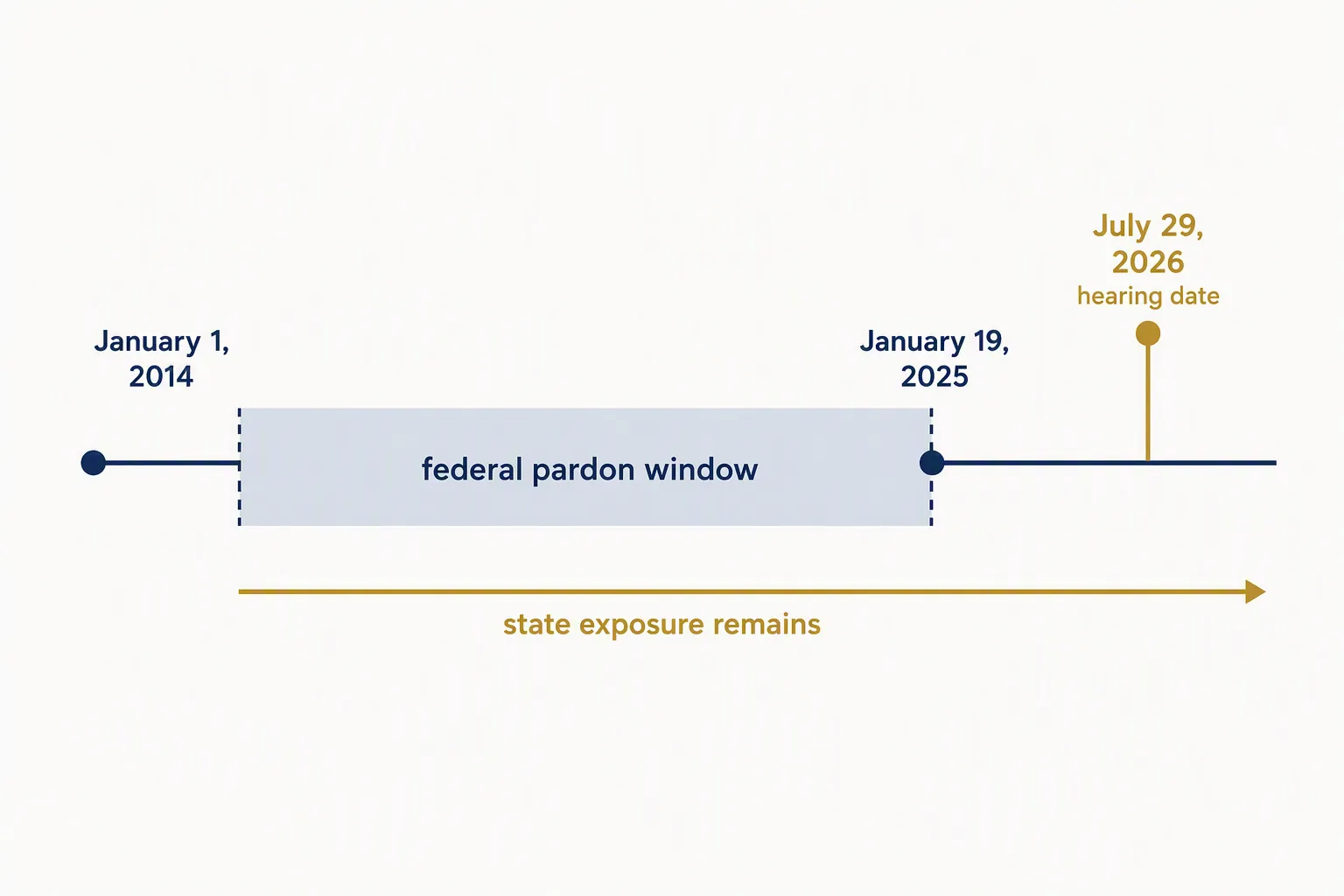
NBC, PolitiFact, and Al Jazeera reported the Biden pardon as full and unconditional for federal offenses during the period from Jan. 1, 2014, through Jan. 19, 2025, citing the Justice Department warrant. Because the underlying DOJ PDF was not independently accessed for this article, the precise terms should be treated here as secondarily confirmed rather than independently reproduced. [1][3][6]
Even taking those reported terms as accurate, the pardon does not obviously eliminate the privilege. The first gap is temporal. A pardon ending Jan. 19, 2025, does not cover a new false-statement or perjury theory arising from sworn testimony on July 29, 2026. A witness can be immunized or pardoned for old conduct and still face risk from the way he answers questions about that conduct later.
The second gap is sovereign. A presidential pardon reaches federal offenses; it does not bind a state attorney general. PolitiFact and Al Jazeera both noted state-level exposure in connection with a Florida attorney general investigation. The current public record does not establish that such an investigation would result in charges, or that any particular state-law theory would survive. It does establish why federal pardon language is not the end of counsel’s analysis. [3][6]
The third gap is doctrinal. Some critics point to Brown v. Walker for the proposition that immunity can remove the danger of self-incrimination and therefore remove the privilege. Brown is an important anchor, but it involved statutory immunity, not a preemptive presidential pardon for a fixed past window followed by later compelled testimony before Congress. [9]
Burdick v. United States also keeps the pardon analysis from becoming automatic. Burdick held that a pardon may be rejected, and it treated acceptance as carrying legal significance. That does not answer every modern privilege-after-pardon question, but it is enough to make overconfident claims suspect when they treat the mere existence of a pardon as though it mechanically dissolves the Fifth Amendment. [10]
The better working formulation is narrower: Fauci’s invocation was legally grounded because the hearing presented plausible routes to post-pardon and non-federal exposure. That is not the same as saying every court would sustain every invocation to every question if the committee litigated each one.
Negative inference is real, but not the same thing as guilt
Taking the Fifth carries cost. PolitiFact quoted Michael Gerhardt describing negative inference as the “biggest immediate downside” for Fauci. In plain terms, critics can say he looked evasive, allies can say he was disciplined, and cable segments can replay the invocation count as a moral fact. None of that decides whether the privilege was available. [3]
Baxter v. Palmigiano permits adverse inferences from silence in civil or administrative settings, but a congressional committee’s political inference is not a binding adjudication of criminal liability. The distinction is not cosmetic. A civil factfinder may be allowed to weigh silence under Baxter; a hostile senator may use it rhetorically; neither move converts invocation into a confession. [11]
That is where witness counseling often becomes uncomfortable. The legally safer answer may be reputationally damaging in the short term. Counsel still has to protect the record the witness will live with after the hearing clip stops circulating.
Contempt turns on posture
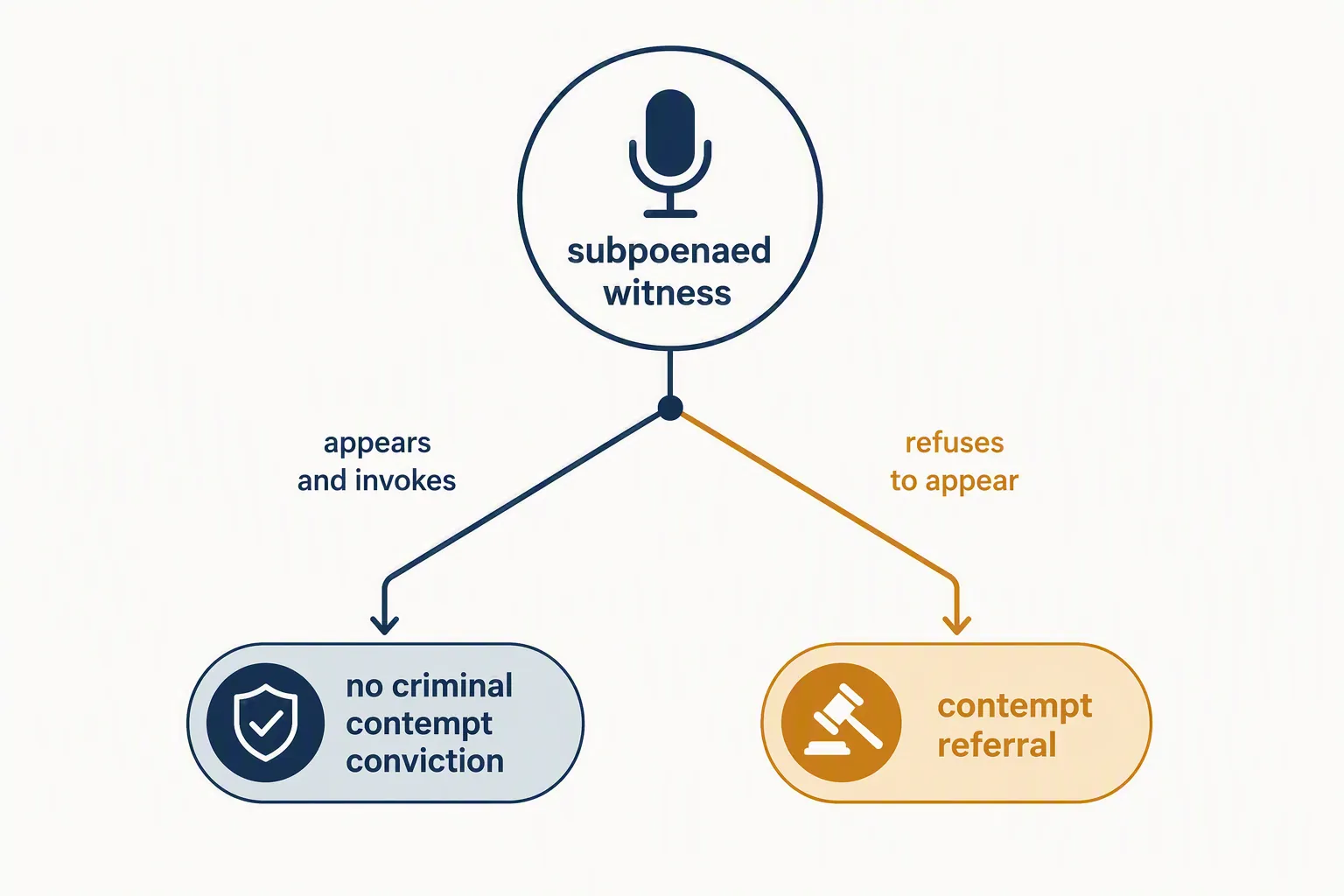
Congress can subpoena a witness, compel an appearance, press questions, threaten contempt, and make the witness pay a reputational price. The committee’s legal due should not be understated. But contempt risk differs sharply depending on whether the witness appears and invokes privilege or refuses to appear altogether.
BBC quoted legal analyst Michael Stern saying Fauci was on “solid legal ground” and reported the important contempt-history point: no witness who appeared before Congress and invoked the Fifth Amendment has been successfully held in criminal contempt. The Lois Lerner episode is the closest modern cautionary example in the materials; in 2014, the House held Lerner in contempt after she appeared and invoked, but the matter did not produce a successful criminal contempt conviction. [4]
That history does not make contempt impossible. It makes the committee’s path harder than in refusal-to-appear cases. The Navarro and Bannon comparisons belong here only as contrasts: those cases turned on witnesses who did not comply with appearances in the same way. For readers tracking that distinction, the site’s Navarro records on executive-privilege contempt risk, the conviction surviving review, and the Navarro contempt timeline are useful precisely because they show how different the refusal posture is.
The reported expectation of a Paul contempt vote during the week of Aug. 3, 2026, is therefore important but not dispositive. A contempt vote can raise the cost of the invocation and create a referral record. It does not by itself answer whether a criminal contempt prosecution would succeed against a witness who appeared, was sworn, and asserted the Fifth question by question. [5]
| Witness posture | Main legal consequence | Why counsel treats it differently |
|---|---|---|
| Appears, is sworn, and invokes the Fifth question by question | Committee may threaten contempt and create political cost; criminal contempt success is historically unsupported in the reported contempt history | Privilege is preserved on a question-specific record |
| Refuses to appear | Committee has a cleaner noncompliance theory for contempt referral | The dispute may be framed before any privilege assertion is tested question by question |
| Appears and answers broadly | Answers may become the basis for later false-statement or perjury theories | The witness gains narrative control but creates new sworn-testimony exposure |
Maher’s comments change the atmosphere more than the privilege analysis
Bill Maher enters this story as reputational fuel, not as the doctrinal center. The reported Real Time comments came through a Breitbart transcript, with Fox News corroborating the gist; no official HBO transcript was available in the sources reviewed here. That matters because the exact wording should not be treated as a court-ready transcript. [12][13]
As reported, Maher referred to Fauci being “caught in actual lies” and added language along the lines of “I think that’s what did happen.” In context, those phrases read more like political commentary and opinion about a public figure than like a clean, provably false factual assertion. That is a harsh reputational statement, but harshness is not the legal test.
For a public figure, New York Times v. Sullivan supplies the governing frame: liability requires actual malice, meaning knowledge of falsity or reckless disregard for truth. The available reporting does not establish that standard. It shows a commentator giving a sharply stated view in a political-media setting after a congressional hearing already framed around alleged falsehoods. [14]
The April 2026 dismissal of Loomer v. Maher reinforces the same practical point. NBC reported that Judge Moody’s 18-page ruling treated the challenged Maher segment through a “reasonable viewer” lens, a setting in which audiences understand political talk-show comments as commentary rather than literal pleading-style factual allegations. [15]
None of that makes Maher’s wording careful. It means the legal system usually gives wide breathing room to opinionated commentary about public figures. For the subpoenaed-witness lawyer, Maher matters because his comments amplify reputational inference and prosecution pressure. They do not decide whether the Fifth Amendment was available at the committee table.
What counsel should separate before the witness walks in
Before any congressional appearance in this posture, counsel should divide the file into categories that do real legal work. First, identify federal conduct inside the reported pardon window. Second, identify conduct outside that window, including post-pardon testimony risk. Third, map any state-law exposure that a federal pardon cannot reach. Fourth, isolate questions likely to invite answers that can later be characterized as false, incomplete, or inconsistent with documents. Fifth, decide whether the client is appearing and invoking, refusing to appear, or answering selectively, because contempt risk changes with that choice.
The witness-preparation file should also record who is authorized to answer procedural questions, how privilege assertions will be phrased, what counsel will do if moved away from the witness table, and which questions require immediate consultation. A committee hearing is not a deposition with a neutral discovery referee. The transcript will be read later by people who were not in the room and who may have incentives to characterize hesitation as concealment or precision as evasion.
For internal risk teams, this is where a verification workflow belongs. Confirm counsel’s criminal-defense role, privilege authority, subpoena scope, possible parallel proceedings, and the status of any pardon or immunity instrument before the appearance date. The site’s criminal-defense-lawyer verification workflow is the more useful tool than a media clip when the client is about to sit at the table.
The Fauci hearing does not establish that a pardon makes the Fifth vanish. It also does not establish that invocation is consequence-free. It shows why the analysis has to be sorted before the oath: federal pre-pardon conduct, new sworn-testimony exposure, state exposure, reputational inference, and contempt posture are different risks, and treating them as one risk is how witnesses get trapped.
References
- NBC News report on Fauci’s July 29, 2026 Senate hearing — NBC News.
- CNN report on Fauci’s Fifth Amendment invocation before Congress — CNN.
- PolitiFact analysis of why Fauci invoked the Fifth Amendment — PolitiFact.
- BBC report on Fauci, the Fifth Amendment, and congressional contempt history — BBC.
- The Hill report on Rand Paul’s expected Fauci contempt vote — The Hill.
- Al Jazeera report on Fauci’s pardon and Fifth Amendment invocation — Al Jazeera.
- BMJ coverage of Fauci’s Senate testimony and pandemic-era allegations — BMJ.
- Hoffman v. United States, 341 U.S. 479 — Justia.
- Brown v. Walker, 161 U.S. 591 — Justia.
- Burdick v. United States, 236 U.S. 79 — Justia.
- Baxter v. Palmigiano, 425 U.S. 308 — Justia.
- Breitbart transcript of Bill Maher’s Aug. 1, 2026 Real Time comments on Fauci — Breitbart.
- Fox News coverage corroborating Maher’s comments on Fauci — Fox News.
- New York Times Co. v. Sullivan, 376 U.S. 254 — Justia.
- NBC News report on the April 2026 dismissal of Loomer v. Maher — NBC News, April 2026.
Related records
Tool profile
Browse tool evaluations →Governing regulation
Browse the obligations tracker →Preventive workflow
Browse verification workflows →
Report a correction or tip
Spotted an outdated figure, a misstated fact, or a ruling this case record should reflect? Public comments are disabled for this content given the professional cost of a misreported case outcome, penalty amount, or rule text — use the structured correction channel instead.
Report a correction or tip for this record →