
AI Deepfake Defense Fails in Fukuoka Bribery Probe
As of August 3, 2026, the Fukuoka Prefectural Assembly pay-to-play probe remains under investigation with no charges filed, but a sequence of ¥5 million cash testimonies and an audio recording initially dismissed as AI-generated—later supported by a voiceprint analysis reported at over 99.99% probability—has tested the viability of AI audio defenses. This record separates confirmed from reported facts, traces the defense's collapse timeline, and outlines the criminal-law exposure under Japanese Penal Code Articles 197–198.
- Jurisdiction
- Japan – Fukuoka Prefecture
- Court
- Fukuoka Prefectural Assembly (investigative body; no court proceeding located)
- AI tool named
- Unspecified AI audio/deepfake tool
- Ruling date
- Aug 3, 2026
- Source document
- View primary court order ↗
- Last verified
- Aug 3, 2026
Lex Machina Review is an independent risk-tracking and reference resource. Nothing on this site is legal advice, and using it does not create an attorney-client relationship. Every record is reviewed against primary sources but may not reflect the most current status of a matter — always verify directly against the cited court order, rule text, or a licensed attorney before relying on it.
Companion explanation — secondary to the source document above
Record posture as of August 3, 2026
| Field | Current record |
|---|---|
| Jurisdiction | Fukuoka Prefectural Assembly, Japan |
| Matter type | Reported / investigative political money-exchange matter; no indictment or court-tested charge theory located as of August 3, 2026 |
| Primary court record | No primary court order, indictment, evidentiary ruling, or authenticated forensic filing available in the reviewed materials |
| Source base | Japanese newspaper and broadcaster reporting, plus assembly-investigation reporting; press-conference and press-interview statements are not sworn courtroom testimony |
| Institutional next step | External-lawyer interviews of all 87 assembly members were expected in August, but the reported process was not a third-party committee with formal fact-finding authority [1] |
The useful starting point is not whether the Fukuoka matter is politically ugly. It is how the record should be classified before anyone cites it. The phrase “fukuoka assembly 5 million yen bribery testimony 2026” points toward a criminal-law frame, but the available record is still made of reported statements, interviews, press coverage, and an unpublished media-commissioned audio analysis. That is a different thing from trial testimony, a court-accepted expert report, or a filed prosecution theory.
The AI angle is also inverted. This is not, on the present record, a case where fake AI audio was introduced to manufacture evidence. It is a case where an incriminating recording was reportedly met with an AI explanation before authentication had run its course. FNN reported that a Japan Acoustic Lab voiceprint analysis it commissioned found the voice to be the vice speaker’s with a probability of over 99.99%, and that AI generation and partial splicing were “clearly denied” in that analysis [2]. That sentence needs all of its qualifiers: reported, commissioned by media, unpublished, and not tested in any proceeding.
How the AI audio defense rose and then weakened
The sequence matters more than the catchphrase. On July 7, 2026, an audio recording was released in connection with the Fukuoka Prefectural Assembly money-exchange allegations. The recording reportedly placed then-vice speaker Masayuki Nakao in a conversation that became damaging because it was tied to accounts of cash moving around speaker-selection politics. When asked about the recording, Nakao’s reported posture included the line that AI could make anything possible — “AIでなんとでもなる” — a broad attack on the recording’s authenticity rather than a narrow objection to a transcript, context, or translation [2].
FNN then reported on July 13–14 that its commissioned analysis by Japan Acoustic Lab assessed the voice as Nakao’s with over 99.99% probability and denied AI generation or partial splicing [2]. The result is important, but not because “99.99%” has become a court finding. It has not. The lab report itself is not in the public record reviewed here, the methodology is not available for adversarial testing, and no judge has ruled on admissibility or weight. For a risk record, the number can carry reporting significance without being treated as evidentiary finality.
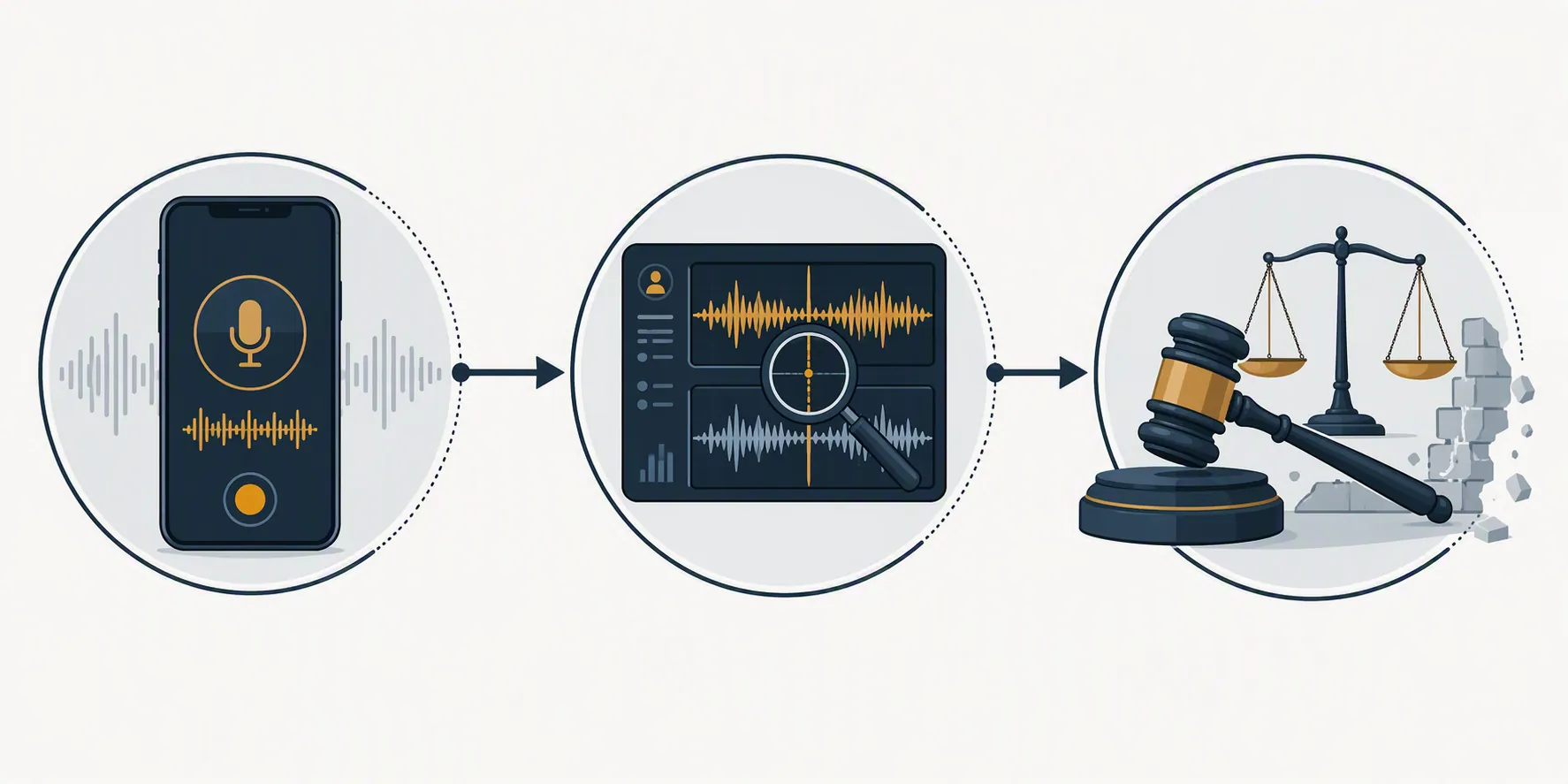
The defense weakened further because the reported dispute shifted. After the analysis was published, Nakao was reported to have conceded that the words on the recording were his, while continuing to deny that he had received money and disputing what terms such as “luggage” or “large sum” meant in context. Asahi later reported that Nakao resigned as an assembly member on July 24 [3]. That does not prove a criminal offense. It does make the AI-authenticity objection look, on the reported sequence, like a short-lived effort to blunt evidentiary pressure rather than a sustained forensic position.
For legal and compliance readers, that is the part worth preserving. The pattern is not “deepfake evidence fooled the system.” It is “deepfake language was used against potentially real evidence, then narrowed after a reported voiceprint analysis.” That distinction changes how the matter should be filed, searched, and compared with other AI-evidence disputes.
The ¥5 million accounts: what is reported, and what remains disputed
The cash accounts matter here because they explain why the recording became so consequential. The reviewed materials describe three separate ¥5 million accounts connected to assembly leadership politics. They do not establish, by themselves, that bribery occurred. They are reported statements by former or current political actors, with denials and disputes still attached.
| Reported account | Reported cash movement | Current caution |
|---|---|---|
| Hideyuki Eto account | Mainichi reported that former Fukuoka prefectural assembly member Hideyuki Eto said he paid ¥5 million to caucus executive Masayuki Nakao in January–February 2020, with total payments reportedly exceeding ¥8 million [4]. | This is a reported press account, not sworn courtroom testimony or a judicial finding. |
| Former Minshu-caucus vice speaker account | Mainichi also reported a separate account from a former vice speaker in the Minshu caucus who said he paid ¥5 million to his caucus chair [4]. | The account is part of the reported money-exchange record; the reviewed materials do not show a tested charge theory. |
| Former vice speaker account involving Speaker Isao Kurauchi | Mainichi reported that another former vice speaker said he handed ¥5 million to Speaker Isao Kurauchi at a ryotei; Asahi reported Kurauchi denied the account [5][6]. | This remains a reported allegation and denial, not an adjudicated fact. |
Those accounts are easy to flatten into a single “¥5 million bribery testimony” headline. That would be careless. The record is more granular: different speakers, different alleged recipients, different contexts, and at least one direct denial from Kurauchi as reported by Asahi [6]. Nakao’s position also cannot be reduced to “admitted bribery” merely because he reportedly conceded that recorded words were his. The reported concession concerned the words on the audio; his denial of receiving money and his dispute over meaning remain part of the record [2][3].
That separation is not pedantry. If the audio is cited later, the relevant evidentiary question is not simply whether cash was alleged. It is whether a specific speaker made specific recorded statements, whether those statements have been authenticated, what they mean in context, and whether they connect legally to any official act or request. The current public materials do not answer all of that.
Why “bribery” is an exposure frame, not a filed conclusion
Japanese Penal Code Articles 197–198 are the obvious legal frame for readers trying to classify potential public-official bribery exposure. In the summary provided by Chambers, Article 197 addresses a public official who accepts, solicits, or promises to accept a bribe, with punishment of up to five years, or up to seven years where the official acts in response to a request. Article 198 addresses the giver side, with exposure of up to three years or a fine of up to ¥2.5 million [7].
That legal frame should not be mistaken for a charging decision. No indictment was located in the reviewed record as of August 3, 2026. No prosecution filing has tested whether the reported payments, if proved, would be charged under Articles 197–198, some other theory, or not charged at all. The speaker-selection context also requires care because the public reporting uses broader money-exchange and shakedown language, not a court-tested bribery label.
One more boundary is worth making explicit: statute-of-limitations figures circulating in secondary summaries were not confirmed in the reviewed primary materials. They should not be repeated as record facts without checking the Penal Code and Code of Criminal Procedure directly.
The assembly process is still investigative
The institutional process has moved, but not into a court record. Fukuoka Now reported that the assembly ordered an independent probe, with external-lawyer interviews of all 87 assembly members expected in August [1]. The available description does not make that process equivalent to a third-party committee with formal fact-finding authority, and it does not turn reported interviews into sworn testimony.
That is the posture professionals should carry forward: reported investigative matter; no charges located; no court-authenticated audio ruling; a media-commissioned forensic result reported at over 99.99%; and a later reported retreat from the broad AI explanation, while money and meaning remain disputed.
How to classify the AI-evidence point
The narrow classification is stronger than the broad one. This is not a proven AI-forensics precedent. It is not a judicial acceptance of Japan Acoustic Lab’s analysis. It is not a finding that a politician committed bribery. It is, instead, a useful reported example of an AI label being used as an authenticity attack against damaging audio, and of that attack losing force after a reported independent voiceprint analysis and a reported concession that the words were the speaker’s.
For adjacent classification problems, this record sits closer to an AI-generated label is not a finding problem than to a classic synthetic-media fraud. It also belongs near records separating real events from AI fakes, records on what provenance signals can and cannot prove, and verified-negative classifications such as the Shukur Aikebaer AI evidence check. The common discipline is the same: do not let an AI accusation stand in for authentication, and do not let an authentication report stand in for a judgment.
On the present record, Nakao’s AI-deepfake defense looks weak. The reason is not that a court has said so. The reason is that the public sequence now contains a reported over-99.99% voiceprint result, a reported denial of AI generation and splicing, and a reported later concession that the recorded words were his. Until the underlying forensic report is published, filed, authenticated, or tested, the matter remains reported and investigative.
References
- Assembly Orders Independent Probe, Fukuoka Now
- “99.99%本人”鑑定に渦中の副議長「AIでなんとでもなる」, FNN
- 福岡県議会の中尾副議長が議員辞職, Asahi Shimbun, 2026-07-24
- 「500万円払った」元福岡県議ら新たに2人証言, Mainichi Shimbun, 2026-07-10
- 福岡元副議長「議長に500万円渡した」, Mainichi Shimbun, 2026-07-15
- 福岡県議会の「ドン」蔵内氏、「料亭で500万円手渡した」証言否定, Asahi Shimbun
- Anti-Corruption 2026 — Japan, Chambers and Partners
Related records
Tool profile
How Meta's AI Spending Reshapes Law Firm ProfitabilityGoverning regulation
Browse the obligations tracker →Preventive workflow
Browse verification workflows →
Report a correction or tip
Spotted an outdated figure, a misstated fact, or a ruling this case record should reflect? Public comments are disabled for this content given the professional cost of a misreported case outcome, penalty amount, or rule text — use the structured correction channel instead.
Report a correction or tip for this record →