
The State Department AI map watermark shows origin, not review
This article examines the sole public evidence that the State Department's mislabeled Africa map was AI-generated: a watermark detected by Reuters. It explains what such provenance signals can and cannot prove and describes the verification workflow that would have prevented the error.
- Jurisdiction
- US Federal
- Court
- U.S. Department of State
- AI tool named
- OpenAI
- Ruling date
- Jul 30, 2026
- Source document
- View primary court order ↗
- Last verified
- Aug 3, 2026
Lex Machina Review is an independent risk-tracking and reference resource. Nothing on this site is legal advice, and using it does not create an attorney-client relationship. Every record is reviewed against primary sources but may not reflect the most current status of a matter — always verify directly against the cited court order, rule text, or a licensed attorney before relying on it.
Companion explanation — secondary to the source document above
The public evidence starts with a watermark
The accountability question in the State Department map incident turns on a narrow piece of evidence. Reuters reported that the image in the AIDS 2026 presentation carried “an artificial intelligence watermark that signals it was made with OpenAI tools,” and that OpenAI said it was investigating the matter. [1]
That is the strongest public basis for treating the map as AI-generated. It is not the same thing as an agency admission. The State Department did not confirm AI generation in the reported statement; it described the slide as an error and attributed it to a team member who had “hurriedly altered” a deck. [1] The status flag matters because another account of the same episode said OpenAI did not respond to a request for comment, creating a small but real record discrepancy around the company’s public posture. [2]
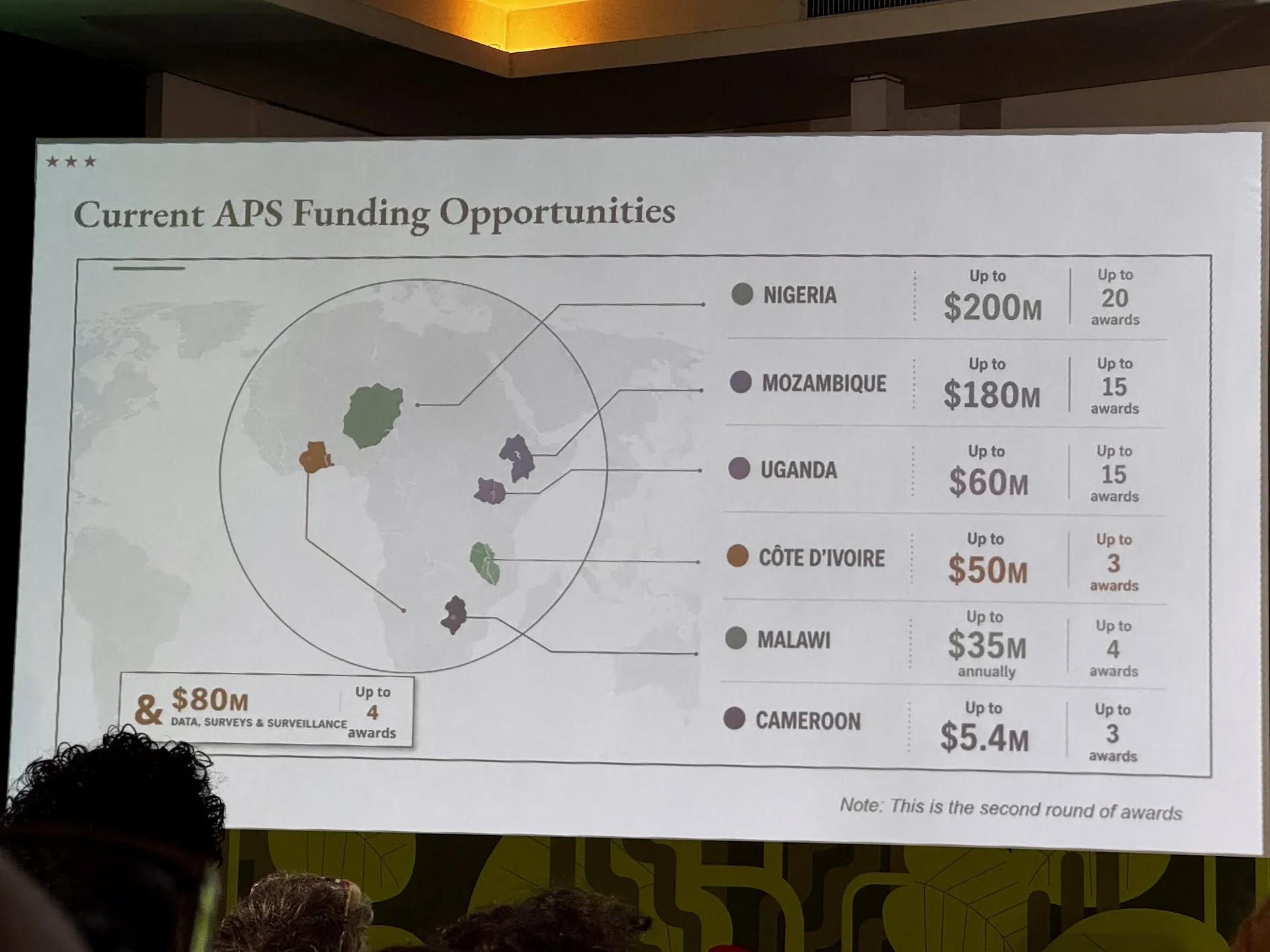
The map itself explains why the watermark matters. The slide, shown at AIDS 2026 in Rio de Janeiro during a presentation by PEPFAR health envoy Jeff Graham, mislabeled every country it labeled: Nigeria appeared landlocked in the Sahara, Mozambique was placed toward the Horn of Africa, Ivory Coast was transposed, Uganda and Malawi were misshapen, and Cameroon was referenced even though it did not appear on the map. [1] Emily Bass published screenshots of the slide on July 26, 2026, giving the public a durable artifact rather than just a secondhand description of an embarrassing graphic. [3]
The AI Incident Database later recorded the event as Incident 1616, listing synthetic image generation and OpenAI image generation tools among implicated systems and identifying harmed entities that included epistemic integrity and AIDS 2026 attendees. [4] That incident record is useful because it preserves the episode in a structured form. It should not be mistaken for a finding that fills in every missing fact about authorship, review, or intent.
What the watermark can prove, and where it stops
A watermark or provenance signal can be powerful evidence, but it is evidence of a limited kind. Functionally, it is a marker associated with a file or image that indicates something about how the artifact was created or processed. It may appear through embedded metadata, an attached credential, or a signal detectable in the media itself. In this case, the sourced public description goes no further than Reuters’ statement that the image carried an AI watermark signaling it was made with OpenAI tools. [1]
That description supports a tool-origin claim. It does not support a complete authorship story. It does not identify the person who generated the image, the wording of any prompt, the person who inserted the image into the deck, whether the image was later edited, who reviewed the presentation, or whether anyone intended the map to be used as a serious geographic representation.
| Question | What the public watermark evidence supports | What remains unproven |
|---|---|---|
| Was there a signal of AI generation? | Reuters reported an AI watermark signaling the image was made with OpenAI tools. | The underlying detection method and specific watermarking standard were not publicly detailed in the cited report. |
| Who generated the image? | The watermark points to a tool origin, not a person. | The public record does not identify the prompt author or operator. |
| Who reviewed the slide? | The watermark says nothing about review. | The public record does not identify the reviewer who missed the errors. |
| Was the map accurate? | The watermark does not measure factual accuracy. | The map’s content required a separate geospatial and contextual review. |
| Did the State Department admit AI use? | No public statement in the cited agency response confirmed AI generation. | The reported agency response accepted responsibility for an error while describing a hurried deck alteration. |
This is the distinction that gets lost when provenance is treated as a finished answer. A file artifact can carry a useful creation signal without telling us how the institution used it. The watermark belongs at the start of the inquiry, not the end.
For litigators, compliance reviewers, and legal-technology buyers, that distinction is not academic. In discovery or authentication work, a provenance marker may help form a challenge or narrow a search. It may justify asking for the original file, edit history, prompts, approval logs, or communications around the document. It cannot by itself establish reliance, negligence, institutional knowledge, or the absence of human review.
The State Department response answers a different question
The State Department’s reported response operated on the accountability layer, not the provenance layer. The agency said it took “full responsibility” for the “unfortunate error” and attributed the problem to a team member who hurriedly altered the presentation. [1] That response matters because it accepts responsibility for the public communication without admitting the technical path by which the image was made.
Those are compatible positions. An agency can be accountable for relying on a bad visual even if it does not confirm that the visual came from a generative AI system. Conversely, a watermark can indicate likely tool origin without proving the internal sequence of human decisions. The responsible analysis keeps both tracks visible.
The liability-track questions are better handled separately. For readers following that angle, the companion records on the State Department AI map error’s legal fallout and the State Department AI blunder apology and liability address the FTCA and governance-exposure frame. The point here is narrower: the record contains evidence of reported AI origin and evidence of institutional responsibility for a bad slide, but those two forms of evidence do not collapse into one another.
The missed check was not only technical
A provenance check might have identified the image as risky before it reached the screen. It would not have been enough. The public failure was that a map used in an official presentation at a global health conference survived without a basic substantive review.
The required review was not exotic. Someone had to look at the map as a map. If the slide was meant to orient an audience to countries, programs, or regional context, the reviewer needed to verify country placement, borders, labels, and omissions. The defects were not subtle cartographic disputes. The labeled countries were wrong in ways that defeated the communicative purpose of the graphic.
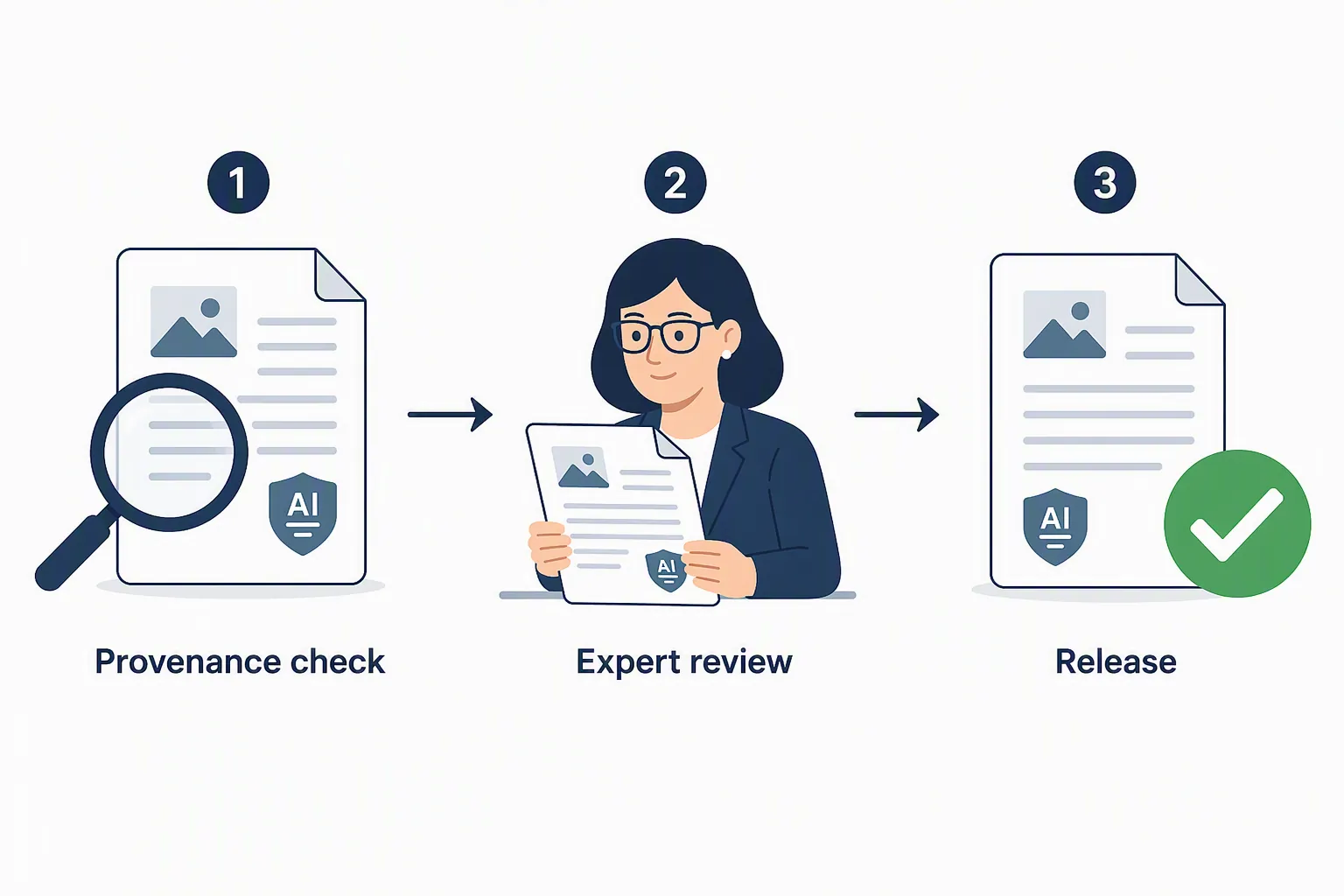
A workable review flow for public-facing AI-suspected content has two distinct gates. The first gate asks where the artifact came from. The second asks whether the artifact is true enough, accurate enough, and contextually appropriate enough to rely on.
- Preserve the artifact before editing it further. Keep the file, not only a screenshot, because later review may need metadata, version history, export settings, or surrounding document context.
- Run a provenance check. Look for metadata, watermarks, provenance records, generator traces, file-history clues, and internal asset-management records. Treat the result as an origin clue, not as a factual review.
- Ask whether the content is being relied on. A decorative placeholder, a factual map, a regulatory chart, and an evidentiary exhibit do not carry the same verification burden.
- Assign subject-matter review to someone who can catch the relevant error. For a map, that means geospatial and contextual review. For a legal filing, it means citation and record review. For a medical or policy presentation, it means domain review.
- Record the approval. The review log should show what was checked, by whom, and against what source or standard. Without that record, the organization is left arguing after the fact from institutional confidence rather than documented diligence.
The same separation appears in legal filing disputes involving hallucinated citations: detection of AI involvement is not the whole duty; the nondelegable step is checking the content before using it. The site’s discussion of AI-hallucinated immigration brief sanctions follows that review-duty track. In visual content, the same discipline shows up in provenance and disclosure questions around AI product image legal risks. The common problem is not that a tool touched the work. It is that the user or institution treated tool output as ready for reliance before the right human check occurred.
Federal AI governance did not supply the missing map review
The broader federal AI framework gives this episode context, but it should not be made to do more than it does. OMB M-25-21, issued on April 3, 2025 under Executive Order 14179, addresses accelerating federal AI use through innovation, governance, and public trust. [5] Executive Order 14409, issued on June 2, 2026, is part of the same federal AI policy environment. [6] The State Department also maintains AI governance materials describing its approach to artificial intelligence. [7]
Those materials do not, on the record supplied here, create a specific public-communications rule requiring a provenance label or geospatial accuracy signoff for a conference slide. That is why this incident is a poor vehicle for pretending that a single overlooked OMB clause explains the failure. The better lesson is operational. Where public communications can be mistaken for institutional fact, teams need a release process that pairs AI-origin awareness with subject-matter verification.
That is especially important in government settings because the audience is not merely evaluating design quality. A slide from an official delegation carries institutional weight. At a health-policy conference, attendees are entitled to assume that a government map has at least passed the most basic geographic sanity check before it appears in support of a policy presentation.
A practical evidence rule for AI-suspected documents
When a disputed image, slide, filing, exhibit, or report is suspected of being AI-generated, the first question should be evidentiary: what exactly shows AI involvement? A watermark, metadata field, vendor log, prompt history, admission, or forensic finding may each support different claims. They should not be blended into a generic assertion that “AI made this” unless the record supports that phrasing.
The second question is institutional: who relied on the artifact, for what purpose, after what review? That is where accountability usually sits. A provenance signal can help find the path. It cannot substitute for proof of the decisions made along that path.
In this incident, the watermark matters because it gives the public a concrete reason to suspect OpenAI-tool origin rather than mere bad design. It remains a reported provenance signal, not an agency admission and not a complete history of the slide. The accountable failure was not simply that an AI-generated image may have entered an official deck. It was that no human verification process caught errors that a basic subject-matter review should have caught before release.
References
- US government map of Africa mislabels every country at global conference, Reuters, July 30, 2026
- US government map mislabels African countries, The Guardian, July 30, 2026
- The US State Department redraws the, Emily Bass, July 26, 2026
- Incident 1616, AI Incident Database
- OMB M-25-21: Accelerating Federal Use of AI through Innovation, Governance, and Public Trust, Digital Government Hub, April 3, 2025
- New AI Executive Order, Skadden, June 2026
- Artificial Intelligence, U.S. Department of State
Related records
Tool profile
Neither Codex nor Claude Code Is Safe for Legal AI AgentsGoverning regulation
Browse the obligations tracker →Preventive workflow
Browse verification workflows →
Report a correction or tip
Spotted an outdated figure, a misstated fact, or a ruling this case record should reflect? Public comments are disabled for this content given the professional cost of a misreported case outcome, penalty amount, or rule text — use the structured correction channel instead.
Report a correction or tip for this record →