
Which laws apply to the Fukuoka cash-for-post scandal?
The Fukuoka money scandal's legal implications split into two tracks: Japan's light-touch AI-content rules and the political-money statutes behind the cash-for-post allegations. As of August 2026 the money claims remain alleged, not adjudicated, and counsel must verify each track independently.
- Jurisdiction
- Japan
- Court
- Fukuoka Prefectural Assembly
- AI tool named
- Unspecified AI audio tool
- Ruling date
- Jul 24, 2026
- Source document
- View primary court order ↗
- Last verified
- Aug 4, 2026
Lex Machina Review is an independent risk-tracking and reference resource. Nothing on this site is legal advice, and using it does not create an attorney-client relationship. Every record is reviewed against primary sources but may not reflect the most current status of a matter — always verify directly against the cited court order, rule text, or a licensed attorney before relying on it.
Companion explanation — secondary to the source document above
Current as of August 4, 2026, the Fukuoka assembly vice chair resignation money scandal has to be briefed in two legal tracks, not one. Masayuki Nakao resigned as vice chair of the Fukuoka Prefectural Assembly on July 24, 2026, after allegations involving money, influence, and internal assembly posts; as of this date, the money allegations remain allegations, not adjudicated findings, and no criminal charges have been filed in the materials reviewed for this article.[1]
That status matters. The Fukuoka facts may interest readers because an “AI made the tape” defense collapsed in public view, but the legal implications of the money scandal do not become an AI-law enforcement matter merely because audio authenticity became part of the story. Japan’s AI-content rules sit on one track. Political-money, public-service, and possible bribery analysis sit on another. The audio dispute is an evidence-authentication issue outside both.
This is not legal advice. It is a status-and-scope map for counsel, risk teams, and editors who need to know which law might apply before turning an alleged violation into a written conclusion.
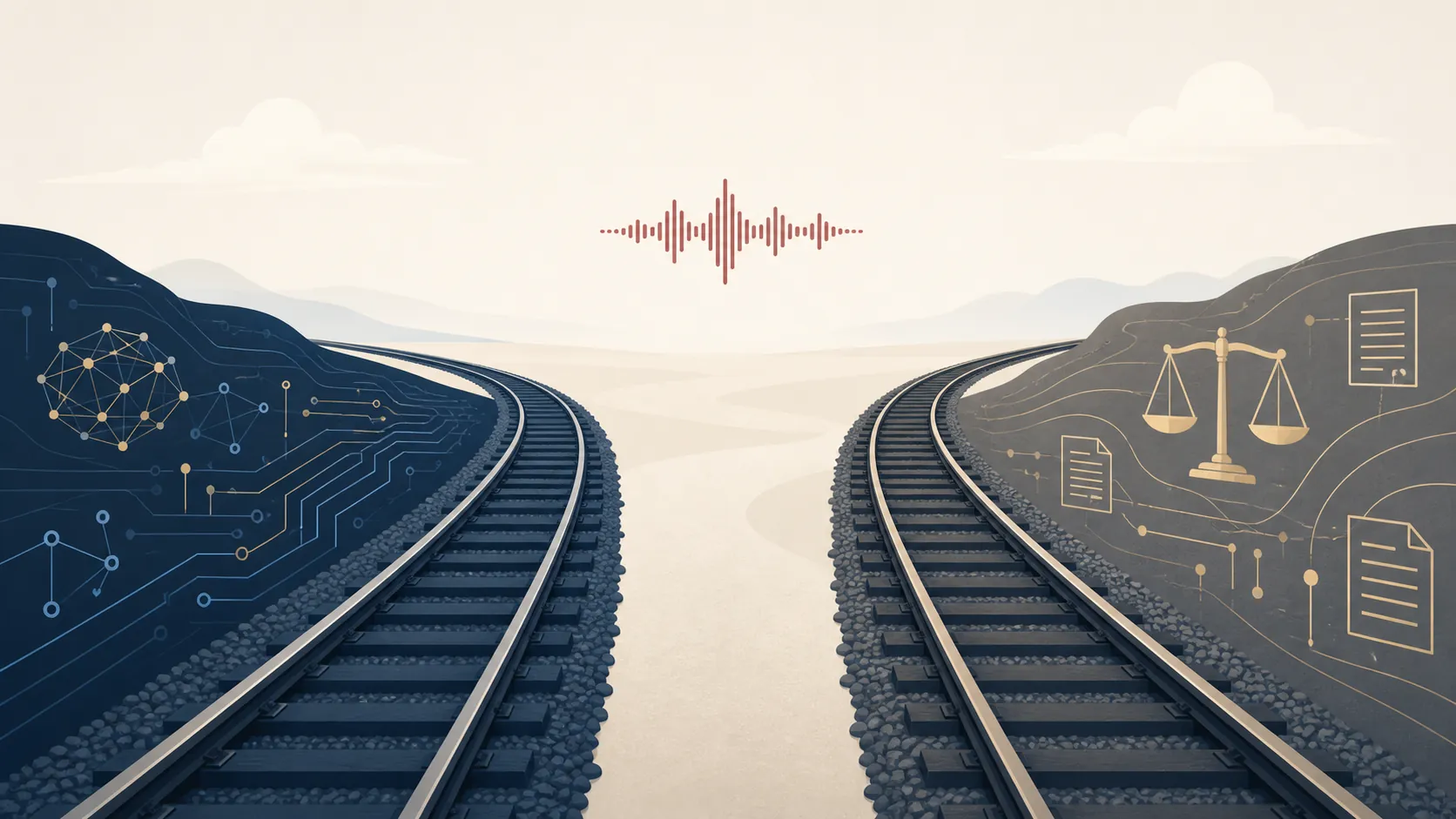
The working map: AI content, political money, and audio evidence are separate questions
| Question counsel is being asked | Proper legal drawer | What can safely be said now |
|---|---|---|
| Does Japan’s AI law govern the Fukuoka money allegations? | AI-content regulation | Japan has AI-content and election-social-media rules, but they do not turn alleged cash-for-post conduct into an AI-law case. |
| Did the alleged use of deducted membership fees for fundraising party tickets violate political-money or public-service rules? | Political-money and public-service statutes | Mainichi quoted experts flagging possible Political Funds Control Act and Local Public Service Act issues; that is expert characterization, not an adjudication. |
| Does the failed “AI made the tape” claim change the statutory analysis? | Evidence authentication | It may affect whether a recording is treated as credible evidence, but it does not decide which political-money statute applies. |
| Could bribery law enter the analysis? | Outer criminal boundary | Only cautiously. The alleged conduct concerns intra-party leadership selection, not a simple official-duty bribery fact pattern. |
The distinction is not academic. A company, law firm, or newsroom that compresses these tracks into “Japan AI scandal” loses the operative date of the election-content rules, overstates the reach of Japan’s AI Act, and risks converting a possible statutory issue into a stated violation before an authority or court has done so.
Why the legal question is live, but not decided
The resignation did not close the legal question. Fukuoka Prefecture announced Nakao’s resignation as vice chair on July 24, 2026.[1] Separate reporting described an oversight process under which lawyers selected by the Fukuoka Bar Association, following Japan Federation of Bar Associations third-party committee guidelines, would examine whether officials demanded money in connection with assembly posts.[2]
For legal-risk purposes, that creates a live review environment, not a settled liability finding. The right sentence is still conditional: the allegations may implicate political-money and public-service rules if the facts reported by Japanese media are substantiated and if the statutory elements are met. The wrong sentence is shorter and more dangerous: the vice chair violated the law.
The third-party process also affects timing. Interviews, document review, and factual reconstruction can change which legal theories remain plausible. Counsel briefing leadership before that work is complete should preserve three statuses separately: resignation is confirmed; expert concern is reported; legal violation is not adjudicated.
Track one: Japan’s AI Act is relevant context, not the enforcement engine
Japan’s first AI legislation is easy to overread in a scandal that contains the word AI. The statute passed on May 28, 2025, as a framework law focused on promoting AI research, development, and use. White & Case’s summary emphasizes the point that matters here: the law is designed as a promotion-oriented framework and does not impose monetary penalties.[3]
That makes it unlike a sanctions-heavy enforcement regime. It can shape government planning, guidelines, institutional coordination, and expectations around AI use, but it is not the obvious statutory vehicle for punishing alleged cash-for-post conduct in a prefectural assembly. White & Case also notes that Japan approved a Basic AI Plan on December 23, 2025, and AI Utilization Guidelines on December 19, 2025, reinforcing the framework-and-guidance character of the regime.[3]
The election-focused social-media content law is more specific, but still must be kept in its lane. Nikkei Asia reported in July 2026 that Japan enacted a law requiring social-media platforms to flag AI-generated content in elections.[4] The operative platform duties are mapped in our existing record on Japan’s AI election-content rules, including the March 1, 2027 effective date for the duties that matter to platforms.
That date is a useful guardrail. A 2026 prefectural money allegation involving internal political influence cannot be analyzed as though March 2027 platform obligations already governed the conduct. Nor should platform labeling duties be used as a substitute for political-finance analysis. If an election deepfake, campaign account, or platform moderation failure becomes part of a separate fact pattern, the election-content law may matter directly. On the current Fukuoka money question, it is contextual.
There is a neighboring Japan AI-regulation track around voice rights and synthetic audio, but it should not be imported casually either. The better practice is to cross-reference the adjacent AI records — including our notes on Japan AI voice-rights obligations — without letting those materials answer a political-money question they were not built to answer.
Track two: the money allegations point first to political-funds and public-service law
The more important statutory track for the Fukuoka cash-for-post allegations is not AI law. It is the reported use of money connected to prefectural officials and political fundraising.
Mainichi reported that membership fees deducted from salaries for a prefectural department-chief association were used to buy fundraising party tickets for assembly leaders. The article quoted experts who said the arrangement could implicate the Political Funds Control Act and the Local Public Service Act.[5]
The wording has to stay that careful. Mainichi’s article is not a judgment. The experts’ comments are not a prosecutor’s charging instrument. They are a legal characterization of reported facts: if salary-deducted association fees were used for political fundraising tickets, and if the relevant consent, purpose, accounting, solicitation, or public-service constraints are met, then political-funds and local-public-service rules may be engaged.
For counsel, the document requests flow from that characterization. Who authorized the salary deductions? What did members understand the association fees would be used for? Were fundraising party tickets purchased in the association’s name, by individuals, or through intermediaries? How were the purchases recorded? Were any officials pressured, and by whom? Those questions are mundane compared with an AI-defense headline, but they are the questions that decide whether political-money law is doing any work.
The Local Public Service Act issue is similarly fact-dependent. A public-service statute does not become applicable merely because prefectural employees are somewhere in the background. The statutory concern, as framed by the reported expert commentary, is tied to the relationship between officials’ salary-deducted fees, political fundraising purchases, and the conduct expected of local public servants.[5]
Where bribery law belongs in the analysis
Bribery belongs at the edge of this article, not at its center. Latham & Watkins’ Japan chapter in Global Legal Insights states that domestic public-official bribery can carry imprisonment of up to three years or a fine of up to ¥2.5 million, but those figures should be re-verified against the original statutory text or PDF before relying on them in a formal legal memo.[6]
The caution is not just about numbers. The Fukuoka allegations concern influence around intra-party or assembly leadership selection, not a straightforward exchange for an official administrative act. A bribery frame may be relevant as an outer criminal boundary, especially if further facts show a clearer official-duty nexus, but it should not be allowed to swallow the political-funds and public-service analysis that the available materials actually support.
The committee process is a fact-finding mechanism, not a verdict
Asahi reported that a third-party committee would ask Fukuoka officials whether they demanded money for posts, with lawyers selected by the Fukuoka Bar Association involved in the review.[2] A later Asahi report described further details around golf, cash bags, and the alleged pay-to-play mechanism in Fukuoka.[7]
Those reports help explain why legal teams should not treat the matter as a closed ethics story. The committee’s work may clarify whether alleged demands were isolated, repeated, institutionalized, misunderstood, or unsupported. It may also separate what was done by assembly members, what was done by prefectural officials, and what was done through associations or informal intermediaries.
That separation affects legal exposure. The Political Funds Control Act question may turn on donations, ticket purchases, accounting, and reporting. The Local Public Service Act question may turn on public servants’ conduct and whether they were placed under improper pressure. A bribery question would require a different element-by-element analysis. A defamation threat, if made in response to reporting or allegations, would be yet another track; in the materials reviewed here, it remains threatened rather than filed.
The “AI made the tape” episode should stay in the evidence drawer
The AI-audio turn is tempting because it supplies the cleanest narrative: a recording appears, the speaker questions its authenticity, forensic work follows, and the AI defense weakens. TNC reported the reversal in which audio data first described as lacking credibility was later met with an acknowledgment that the conversation occurred.[8]
That is important, but only for the right reason. It goes to evidence authentication: whether a recording can be treated as a credible account of a conversation, whether tampering or synthesis claims survive technical review, and how investigators or journalists should handle challenged audio. Our existing Fukuoka records cover the AI-defense thread in more detail, including the Fukuoka bribery AI-evidence case, the failed Fukuoka AI deepfake defense, and the related forensic audio authentication protocol.
For this article, the point is narrower. A failed AI-authenticity defense does not itself prove a Political Funds Control Act violation. It does not activate Japan’s AI Act penalties, because the framework law has no monetary penalties. It does not make the March 2027 election-content platform duties retroactive. It makes one category of evidence harder to dismiss, and that is enough.
How to brief the Fukuoka legal implications without overstating them
A usable internal brief should begin with status, then statute, then uncertainty. The order prevents the two common errors: treating the resignation as proof of illegality, and treating the AI-audio dispute as the governing legal regime.
- Status: Nakao resigned as Fukuoka Prefectural Assembly vice chair on July 24, 2026; no criminal charges have been filed in the materials reviewed as of August 4, 2026.
- AI-content track: Japan’s 2025 AI Act is a promotion-oriented framework law with no monetary penalties; the election/social-media AI-content law concerns platform duties that become operative March 1, 2027.
- Political-money track: Mainichi-quoted experts characterized the alleged use of salary-deducted membership fees to buy fundraising party tickets as possibly implicating the Political Funds Control Act and the Local Public Service Act.
- Evidence track: the challenged audio and failed AI-defense claim may affect evidentiary confidence, but they do not decide the political-money statutory elements.
- Criminal boundary: Penal Code bribery exposure should be considered only after verifying the official-duty nexus and the current statutory penalties from primary sources.
The safest current formulation is therefore restrained: the Fukuoka cash-for-post allegations raise possible political-funds and local-public-service issues, as characterized by quoted experts, while Japan’s AI-content rules remain relevant to the surrounding media and platform environment rather than to the alleged money conduct itself. The audio-authentication dispute may matter to proof, not to which statute applies.
Before advising, filing, or publishing, verify the primary law text, operative dates, committee mandate, allegation status, and any reported penalty figures independently. The separation exercise is the legal implication: one scandal can generate more than one risk track, but none of those tracks should be made to do another’s work.
References
- 福岡県議会副議長の辞職について — Fukuoka Prefectural Government. link
- Fukuoka officials to be asked if they demanded money for post — The Asahi Shimbun AJW. link
- Japan's first AI legislation becomes law – Focus is on promoting research and development; no monetary penalties — White & Case. link
- Japan enacts social media law requiring flagging of AI content in elections — Nikkei Asia. link
- 福岡県幹部の親睦会費で議長らのパー券購入 地公法に抵触の恐れ — Mainichi Shimbun. link
- Bribery & Corruption – Global Legal Insights (8th edition), Japan chapter — Latham & Watkins. link
- Details on golf, cash bags arise in 'pay-to-play' ploy in Fukuoka — The Asahi Shimbun AJW. link
- 【続報】音声データ「信ぴょう性乏しい」一転「会話したんでしょう」と認める… — TNC. link
Related records
Tool profile
How Meta's AI Spending Reshapes Law Firm ProfitabilityGoverning regulation
Browse the obligations tracker →Preventive workflow
Browse verification workflows →
Report a correction or tip
Spotted an outdated figure, a misstated fact, or a ruling this case record should reflect? Public comments are disabled for this content given the professional cost of a misreported case outcome, penalty amount, or rule text — use the structured correction channel instead.
Report a correction or tip for this record →