
Four legal gates remain for Gwangju's semiconductor cluster
A statute-level legal map of the Honam semiconductor cluster after the July 6, 2026 Gwangju military airport site selection, identifying which legal gates remain un-cleared as of early August 2026 and where the government's fast-track and parallel-processing claims meet the limits of the statutory text. Counsel and diligence teams can use it to verify the designation path — including the stalled relocation track and its unresolved hosting-application conflict — before relying on the announced timeline.
- Jurisdiction
- South Korea
- Court
- Seoul Administrative Court
- AI tool named
- No AI tool implicated
- Ruling date
- Jan 15, 2026
- Source document
- View primary court order ↗
- Last verified
- Aug 4, 2026
Lex Machina Review is an independent risk-tracking and reference resource. Nothing on this site is legal advice, and using it does not create an attorney-client relationship. Every record is reviewed against primary sources but may not reflect the most current status of a matter — always verify directly against the cited court order, rule text, or a licensed attorney before relying on it.
Companion explanation — secondary to the source document above
Legal-background review: Mina Han. This analysis is informational and is not legal advice. Last verified: 2026-08-04, UTC. Statutory article references should be checked against the controlling Korean text before use in a transaction document, board paper, financing condition, or public filing.
For counsel, the useful starting point is a verb. On July 6, 2026, the Gwangju military airport site was selected for the Honam semiconductor cluster. It was not thereby designated as a semiconductor specialized complex, approved as a national industrial complex, acquired, supplied with power and water, or legally relocated away from its military-airport function. The statutory core still runs through ministerial designation, committee deliberation, and the fast-track provisions of the Semiconductor Special Act and its June 25 enforcement-decree materials.[1] The July 6 announcement was a policy decision and an administrative acceleration signal, not a buildable-site legal conclusion.[2][3]
That distinction matters because the government’s own language is about parallel processing “within the law.” The president’s instruction to speed up administrative steps does not remove the steps; it changes the pressure on agencies to run them without waiting for the last department to finish first.[4] For diligence purposes, the record should therefore be split into four separate legal tracks.
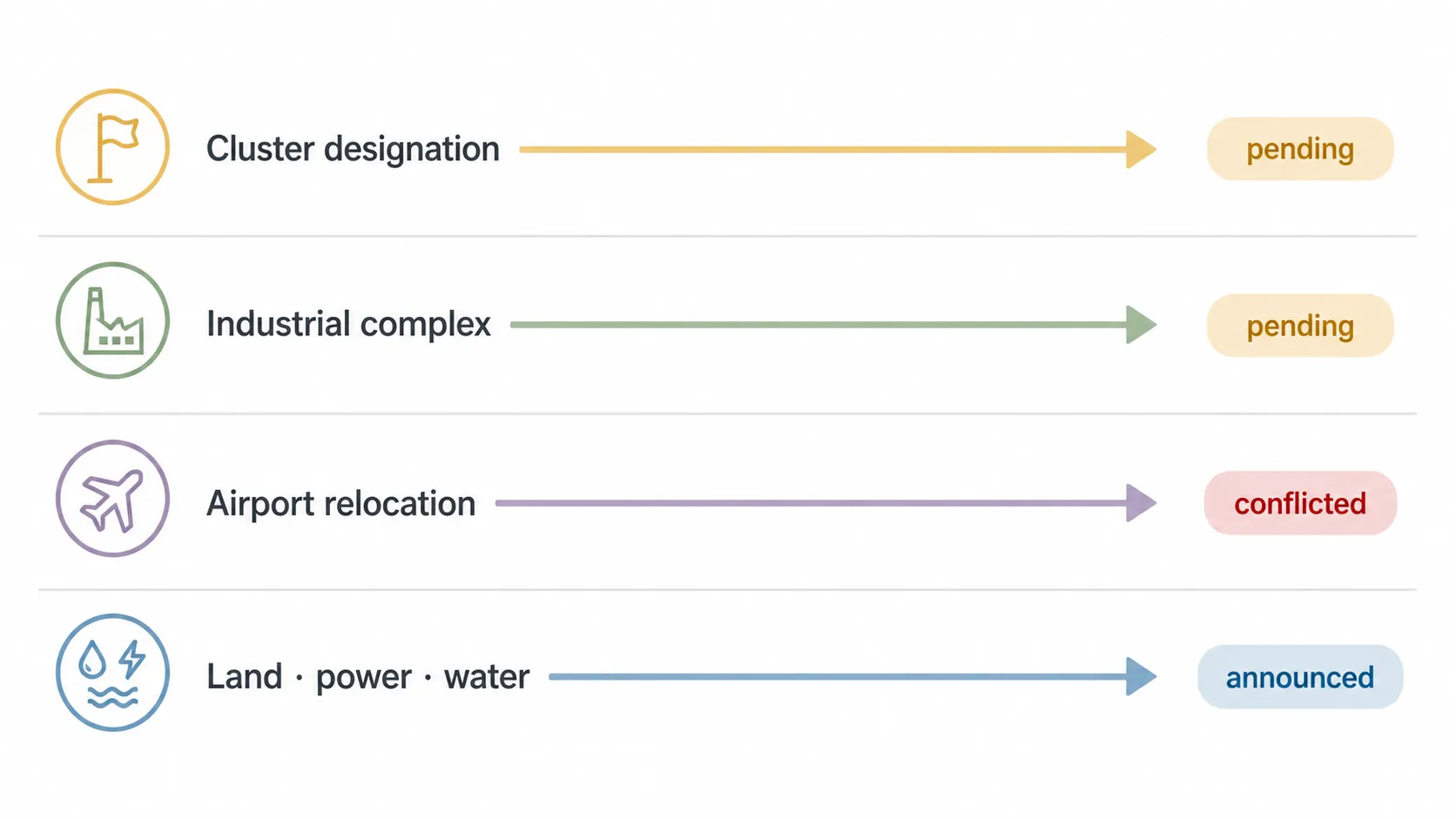
Status map: four gates, four different legal clocks
| Track | What has happened | Controlling next gate | Status as of 2026-08-04 |
|---|---|---|---|
| Semiconductor cluster designation | The Gwangju military airport site has been selected as the Honam cluster site in policy announcements. | MOTIE designation after deliberation by the committee under the Semiconductor Special Act; non-capital-region preference is relevant, but not self-executing.[1] | Pending — selected, not legally designated. |
| National industrial complex approval | MOLIT and LH have begun acceleration work, including compressed bidding timing and an October 2026 design-start target.[5] | National industrial complex designation and approval mechanics, including required plans, review, and project-operator steps. | Pending — accelerated, not complete. |
| Military airport relocation | Muan remains at the candidate-site stage; the relocation sequence has not cleared the hosting-application gate.[6] | Military Airport Transfer Act process: preliminary candidate site, candidate-site designation, support plan, resident vote, hosting application, final designation. | Conflicted — the county head has not submitted the hosting application, and the cited MOLEG interpretation says the resident vote does not bind that official.[6] |
| Land, power, and water | A 364.19 km² land transaction permit zone was designated for July 14, 2026 through July 13, 2028; power and water figures have been announced at industrial scale.[7][6] | Negotiated purchase, possible compulsory acquisition, grid and water permitting, and related infrastructure approvals. | Announced / early-stage — scale identified, rights and permits not cleared. |
A deal team should not collapse those tracks into one closing condition. A clean condition precedent would not say “Gwangju site selected.” It would identify which authority has issued which designation, approval, acquisition decision, utility commitment, or relocation act, and whether appeal periods, consultation layers, or local-government applications remain open. This is the same discipline used in other layer-by-layer legal status records, such as export-control status-flag analysis: the legal layer is only cleared when the legal act for that layer has occurred.
The semiconductor designation path is real, but it is not automatic
The Semiconductor Special Act track is the easiest place to overread speed language. The materials identify a ministerial designation structure: MOTIE designation after deliberation by the relevant committee under Article 9, with Article 11(6) giving preference to non-capital-region specialized complexes.[1] That is meaningful for Honam. It gives the Gwangju site a statutory lane that fits the government’s regional-industrial policy. It does not make the July 6 selection itself the designation.
The June 25, 2026 enforcement-decree pre-announcement is also narrower than some shorthand accounts suggest. The draft materials dropped an “exclude the capital region” clause while codifying non-capital-region preference.[1] Those are not the same legal proposition. Excluding the capital region would operate as a hard negative rule. Preference for non-capital regions is a weighting instruction. It can matter strongly in committee review and ministerial judgment, but it still leaves a review to be performed and a decision to be issued.
Practitioner framing on Korea’s national high-tech strategic-industry complexes points in the same direction: specialized-complex status can carry material advantages, but it is a designation architecture, not a press-release label.[8] In diligence, that means the question is not whether the site has been politically favored. It has. The question is whether the statutory decision-maker has taken the statutory act that makes the site part of the relevant legal regime.
What the fast-track provisions actually shorten
Two provisions carry most of the government’s plausible “speed within the law” theory. Article 27(5) is described as a 60-day deemed-complete permitting rule. Article 43 provides active-administration disciplinary immunity.[1] Both can change agency behavior. The first limits how long a permitting authority can sit on a qualifying item before the statute treats the step as complete. The second reduces personal downside for officials who move quickly inside the permitted administrative zone.
Neither provision should be translated into waiver authority. A deemed-complete rule presupposes that the relevant application, consultation, or review channel exists and that the clock has properly started. Active-administration immunity protects officials from certain disciplinary consequences; it does not transfer a county head’s application power to a ministry, deem land acquired, or convert an airport relocation candidate site into a final relocation designation. The statute can compress delay. It does not erase jurisdiction.
The relocation track is the fragile gate
The military-airport relocation track is not a side issue. It is the legal hinge under the announced site. If the site is still carrying the legal and operational consequences of the Gwangju military airport, the semiconductor cluster cannot be treated as if the land were already available for industrial buildout.
The reported statutory sequence under the Military Airport Transfer Act is staged: preliminary candidate site, candidate-site designation, support plan, resident vote, hosting application, and final designation.[6] Muan is still described as being at the candidate-site stage, and the county has boycotted the selection committee process.[6] The important legal fact is not local displeasure in the abstract. It is that the sequence appears to require a hosting application before the Ministry of National Defense can finalize the designation.
The cited MOLEG interpretation makes the problem sharper: a resident vote does not bind the county head, and MND cannot designate the relocation site without the hosting application.[6] That is the point at which political sequencing and legal sequencing separate. A favorable resident vote, if one occurs, may be politically powerful. On the interpretation cited in the current record, it does not itself substitute for the county head’s application.
This is not a prediction that Muan will ultimately defeat the relocation, or that the county head will never file. It is a status flag. As of 2026-08-04, the application gate remains uncleared. A timetable that assumes relocation has effectively been solved is relying on a future legal act by a local official who has not yet taken it.
That gate is also different in kind from an agency deadline. A ministry can be ordered to work in parallel. A bidding period can be compressed. A design contractor can be prepared. But if the relocation statute gives legal significance to a hosting application, a central-government acceleration order cannot simply write that application into the file. The relocation track is therefore the most likely place for the announced timeline to break legally, even if every other ministry is trying to move.
MOLIT and LH acceleration is an execution signal, not final industrial-complex approval
The industrial-complex track should not be dismissed as theater. MOLIT and LH activity is a real execution signal. Newsis reported that the bidding window was cut from about 107 days to about 58 days, with a design start targeted for October 2026.[5] Those are the kinds of administrative moves that matter if the government is trying to prevent a selected site from spending a year in pre-paperwork.
They still sit on the approval side of the ledger, not the completion side. Preliminary project-operator activity, design procurement, and two-track amendment discussions do not by themselves amount to national industrial complex approval.[5] For a lender, strategic investor, or tenant negotiating reservation rights, the question should be framed as: what industrial-complex designation or approval instrument has been issued, under what authority, with which conditions, and with what unresolved challenge routes?
The October 2026 design-start target is useful precisely because it is dated. It gives counsel a near-term verification point. If the design work begins before relocation, semiconductor designation, and land matters are fully complete, that may show parallel processing. It should not be mislabeled as proof that those legal predicates have already cleared.
Land, power, and water are not footnotes to designation
The land record already shows a control move. Aju Press reported a 364.19 km² land transaction permit zone running from July 14, 2026 through July 13, 2028.[7] That is not land acquisition. It is a transaction-control layer designed to manage speculative or destabilizing transfers while the state tries to assemble an industrial site.
The acquisition path can include negotiated purchase and, where statutory requirements are met, compulsory acquisition. But compulsory acquisition is not a magic wand either. It requires the project to sit inside the correct public-project and industrial-complex legal framework, with compensation and procedural protections. For the junior diligence lawyer reconciling Korean statutes and English summaries, the correct notation is not “land secured.” It is “land-control measure announced; acquisition route to be verified parcel by parcel and authority by authority.”
The utility numbers show why this cannot be left until the end. New Daily reported power needs of about 6.3 GW for fabs and about 18.4 GW for AI data centers, plus about 650,000 tons per day of water from eight Seomjin and Yeongsan dams.[6] Those figures are scale indicators, not proof of deliverability. Grid connection, generation or procurement arrangements, water intake, dam allocation, environmental review, and local infrastructure works each have their own documentary trail.
This is where semiconductor-cluster analysis begins to resemble data-center permitting analysis. Large power and water numbers create jurisdiction-split obligations that cannot be solved by a single industrial-policy announcement. A comparable tracking problem appears in AI data center buildout as a legal docket: the infrastructure promise is only as reliable as the permits, contracts, and public-law approvals behind it.
Two contingencies should stay outside the main designation box
First, SOFA consultation is a separate timeline contingency. The record identifies a U.S.-ROK consultation layer tied to the collocated operating base, including a 7th Air Force statement about important military interests and consultations beginning July 10, 2026.[3] That does not become part of MOTIE’s semiconductor designation law merely because it affects the same site. It is an international and defense-operational track that can slow or condition relocation planning even if domestic economic ministries are aligned.
Second, litigation risk should be framed prospectively. The January 15, 2026 Seoul Administrative Court ruling in the Yongin national industrial complex dispute is relevant as a reminder that climate-assessment and approval-record challenges can be brought against major industrial-complex decisions. But it is not a Gwangju holding, and no equivalent suit against the Gwangju selection was identified in the reviewed public record as of 2026-08-04. The right diligence takeaway is challenge posture, not assumed injunction.
The investment number is less useful than the cleared-gate list
The public record contains inconsistent headline figures: site area is variously described around 8.2, 8.26, or 8.3 million m², and investment is reported in different accounts as roughly $518 billion, $522 billion, $530 billion, or 800 trillion won.[2][3][9] Those inconsistencies may be explainable by exchange rates, scope differences, rounding, or source timing. They still matter in diligence because they show why the legal status map should not be built from a single English-language headline.
Investor-side analysis has treated the project as part of a large Korean semiconductor bet, with obvious implications for foreign suppliers, tenants, equipment makers, and infrastructure participants.[9] That commercial framing is fair. It is also exactly why the legal record needs sharper labels. A supplier deciding whether to expand Korean capacity does not need another statement that the Honam cluster is ambitious. It needs to know whether the site is legally designated, whether the industrial complex is approved, whether the airport relocation application gate is clear, and whether power and water rights can support the load case.
As of 2026-08-04, the safe formulation is narrow: the Gwangju military airport site has been politically selected and administratively accelerated. It should not be treated as legally buildable until the semiconductor designation, national industrial complex approval, military airport relocation, and land, power, and water tracks each have their own source-backed status update.
References
- DaeRyuAju analysis of the Semiconductor Special Act and its enforcement decree, Law Times
- S. Korea selects Gwangju military airport site for Honam chip cluster, Yonhap News Agency, July 6, 2026
- Gwangju military airport site selected for Honam chip cluster, Korea JoongAng Daily
- President’s within-the-law parallel-processing directives for Honam semiconductor cluster, The Korea Herald
- MOLIT and LH acceleration track for the Honam semiconductor industrial complex, Newsis
- Relocation sequence stall and power-water requirements for the Honam semiconductor cluster, New Daily, July 28, 2026
- Gwangju land transaction permit zone for Honam semiconductor cluster, Aju Press, July 10, 2026
- Specialized Complex for National High-Tech Strategic Industry designation insight, Kim & Chang
- Seoul Bets Big: What South Korea’s $518 Billion Semiconductor Gamble Means for Global Tech Companies, Foley & Lardner, July 2026
Related records
Tool profile
How Meta's AI Spending Reshapes Law Firm ProfitabilityGoverning regulation
Browse the obligations tracker →Preventive workflow
Browse verification workflows →
Report a correction or tip
Spotted an outdated figure, a misstated fact, or a ruling this case record should reflect? Public comments are disabled for this content given the professional cost of a misreported case outcome, penalty amount, or rule text — use the structured correction channel instead.
Report a correction or tip for this record →