
What Mustang Mach-E recalls mean for legal exposure
A primary-source-linked status check of the Mustang Mach-E recall wave, verified as of August 2026: which NHTSA campaigns are open, which consumer and dealer class actions are pending, and where lemon-law claims fit — with sourcing limits flagged.
- Jurisdiction
- US federal
- Court
- U.S. District Court, C.D. Cal. and E.D. Mich.
- AI tool named
- Non-AI risk digest entry
- Ruling date
- Mar 16, 2026
- Source document
- View primary court order ↗
- Last verified
- Aug 2, 2026
Lex Machina Review is an independent risk-tracking and reference resource. Nothing on this site is legal advice, and using it does not create an attorney-client relationship. Every record is reviewed against primary sources but may not reflect the most current status of a matter — always verify directly against the cited court order, rule text, or a licensed attorney before relying on it.
Companion explanation — secondary to the source document above
Status note: this is an exceptional non-AI Risk Digest entry, last verified in August 2026. It is not legal advice. The record was reviewed by a legal-background editor and is limited to the recall, docket, regulatory, and attorney-authored materials identified below. Where a docket status or unit count could not be verified from the reviewed primary materials, the gap is stated rather than filled.
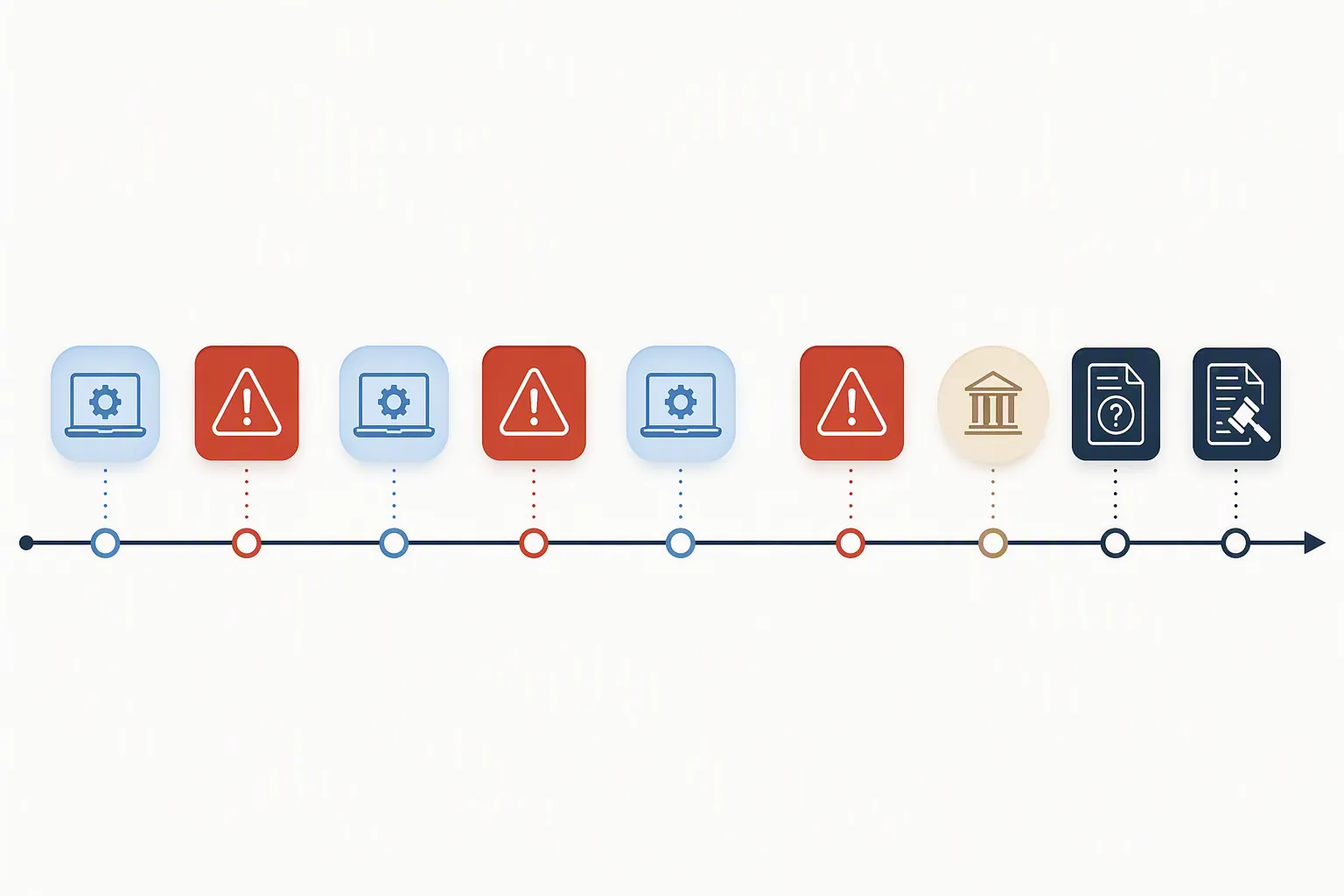
For Mach-E legal exposure, the useful answer is not “there was a Mach-E recall.” The record is a stacking pattern: software remedies, hardware follow-ons, expanded or corrective campaigns, an open ODI recall query, consumer class-action pleadings, and a dealer-side warranty reimbursement suit. The legal exposure turns on how those layers interact, not on any one campaign label.
Campaign-and-docket status map
| Record | Verified scope or allegation | Remedy posture | Legal relevance |
|---|---|---|---|
| NHTSA 22V-412 / Ford 22S41 | 48,924 U.S. 2021–2022 Mustang Mach-E vehicles; HVBJB main-contactor overheating after DC fast charging and repeated wide-open-pedal events; temporary stop-sale ordered in June 2022. [1] | Software remedy. | The first major HVBJB record; later allegations and regulatory attention focus on whether the software remedy adequately addressed the risk. |
| Ford 23S56 / NHTSA 25V441 issue | HVBJB replacement and vehicles described as previously repaired incorrectly under 22V-412. Public unit counts conflict: about 30,013 in forum materials, about 34,762 in a Cars.com summary, and a 239-vehicle figure in the reviewed 25V441 Part 573 snippet. [2][3][4] | Hardware/corrective-repair layer following the software remedy. | The conflict is not cosmetic. Any pleading, notice analysis, or exposure memo should pin the affected count to the exact campaign document being used. |
| NHTSA 25V-404 / Ford 25S65 | 197,432 U.S. 2021–2025 Mustang Mach-E vehicles; e-latch lockout or entrapment risk when the 12V battery discharges below about 8.4V; stop-sale; four warranty claims, three customer-service reports, and three child-entrapment allegations, including one window-breaking rescue allegation. [5] | Software remedy now available. [5] | This is the main door/e-latch layer and overlaps with the live Salas consumer litigation posture discussed below. |
| NHTSA 25V-863 / Ford 25C69 | 272,645 vehicles total: 88,064 2024–2026 Mach-Es, 104,113 F-150 Lightnings, and 80,468 Mavericks; integrated park module rollaway risk and FMVSS 114 noncompliance; 22 Mach-E warranty claims as of Nov. 4, 2025. [6] | OTA remedy. | A compliance-based rollaway record, not an HVBJB or e-latch record; it should not be merged into a single defect story. |
| NHTSA 26V417 / Ford 26S50 | 42,784 2021–2023 rear-wheel-drive Mach-Es; rear-differential pinion shaft fracture; 62 warranty claims, 14 CQIS reports, four GCC reports, and two European white alerts as of June 11, 2026; no accidents or injuries reported in the reviewed recall record. [7] | Remedy not expected until Q4 2026. [7] | The open-remedy window is a fact to preserve for owner repair-history and out-of-service-day analysis, without assuming lemon-law eligibility. |
| NHTSA 26V487 | Manufacturer report dated July 28, 2026, involving 2023–2025 Mach-Es and rear side quarter window glass trim. [8] | Campaign stream still active as of the current verification window. | Useful mainly as a status marker: the Mach-E recall record was still moving in late July 2026. |
| NHTSA ODI RQ23-004 | Recall query opened in August 2023 into 64,727 Mach-Es after 12 post-fix complaints, including one reported second catastrophic HVBJB failure two days after the software update with power limited to about 30%. [9] | Open regulatory query in the reviewed materials. | Not a civil finding, but it matters because it tests the adequacy of the prior recall remedy. |
| Kegele et al. v. Ford | Reported filed July 1, 2022. [10] | Termination or dismissal status was not verified from CourtListener/PACER in the reviewed materials. | Do not print a terminated status without opening the docket. |
| Salas et al. v. Ford, 2:25-cv-01701 | Filed Feb. 27, 2025, in the Central District of California. [11] | Reported March 16, 2026 reconsideration ruling left the UCL claim standing over e-latch doors. [12] | The current consumer-litigation anchor in the reviewed docket materials. |
| Dealer warranty reimbursement suit, E.D. Mich. | Hagens Berman says the case was filed Dec. 12, 2025, and alleges New York Dealer Act warranty-reimbursement underpayments since Dec. 1, 2022; the firm gives one dealer example involving 28 EV batteries, about $22,600 claimed per battery, about $600 reimbursed per battery, and an alleged shortfall of about $615,000. [13] | Allegations only, based on the firm’s own account in the reviewed materials. | Dealer-side exposure should be separated from owner defect claims unless the docket is independently checked. |
This site has used a similar recall-cascade method in the Ford Bronco recall cascade record, but the comparison should stop at method. This is a different vehicle, different campaign set, different docket set, and a live ODI recall-query posture. The Bronco materials may help orient the reader to layered recall analysis; they do not supply the Mach-E facts.
The HVBJB records are where the adequacy question starts
The June 2022 HVBJB campaign is not just an early entry on a timeline. It is the source of the software-remedy problem that later filings and regulatory materials keep returning to. NHTSA 22V-412 covered 48,924 U.S. 2021–2022 Mach-Es and described high-voltage battery junction box main contactors that could overheat after DC fast charging and repeated wide-open-pedal events; Ford also ordered a temporary stop-sale. [1]
A software remedy can be legally meaningful. It can also become legally awkward if later documents suggest that the same population, or an adjacent one, needs hardware replacement or corrective repair. That is why 23S56 and 25V441 should not be treated as a footnote to 22V-412. The reviewed materials describe a later HVBJB replacement layer and a 25V441 issue involving vehicles previously repaired incorrectly under 22V-412, but the affected-unit figures conflict across sources: about 30,013 in forum materials, about 34,762 in a Cars.com account, and 239 in the reviewed Part 573 snippet. [2][3][4]
That conflict is exactly the kind of compression that causes legal memos to go bad. The correct move is not to average the numbers or choose the largest. The correct move is to identify which document the number came from, what campaign it describes, and whether it counts all vehicles, a corrective subset, or some other population.
RQ23-004 then adds the regulatory layer. ODI opened the recall query in August 2023 into 64,727 Mach-Es after 12 post-fix complaints. The inquiry notice included a specific post-remedy allegation: one owner reported a second catastrophic HVBJB failure two days after receiving the software update, with power limited to about 30%. [9] That is not a liability finding. It is, however, a primary-source reason to stop describing 22V-412 as a closed historical event.
The e-latch campaign carries a different kind of injury allegation
NHTSA 25V-404 is not an HVBJB sequel. It concerns e-latch lockout or entrapment when the 12V battery discharges below about 8.4V. The NHTSA communication reviewed here lists 197,432 U.S. 2021–2025 Mach-Es, a stop-sale, four warranty claims, three customer-service reports, and three child-entrapment allegations, including one allegation that a window had to be broken for rescue. [5]
One window-breaking allegation is a serious pleaded or reported fact, not a rate. The record reviewed here does not support saying child entrapment was common, nor does it support treating every 12V discharge as an injury event. What it does support is that Ford and NHTSA treated the e-latch condition as a safety recall, that a remedy is now available, and that the allegations are concrete enough to matter in litigation framing. [5]
That matters for Salas because the case is not just an abstract EV-reliability complaint. The docket materials identify Salas et al. v. Ford, 2:25-cv-01701, as filed in the Central District of California on Feb. 27, 2025, and the reported ruling says the court would not reconsider allowing a UCL claim to proceed over the e-latch-door theory. [11][12] The survival of one claim is not a merits ruling for the class. It is still a live pleading posture that counsel should not ignore.
Rollaway and driveline campaigns should stay in their own lanes
The integrated park module campaign, NHTSA 25V-863, is a separate compliance and rollaway record. It covered 272,645 vehicles across three Ford nameplates, including 88,064 2024–2026 Mach-Es, and involved an FMVSS 114 issue with an OTA remedy. Ford reported 22 Mach-E warranty claims as of Nov. 4, 2025. [6]
The legal implication is not that the rollaway campaign proves the HVBJB theory or the e-latch theory. It does not. Its significance is that it adds another safety/compliance layer to the same vehicle line. For lawyers tracking defect notice, warranty administration, or repurchase arguments, campaign separation is not pedantry; it prevents the wrong defect mechanism from being attached to the wrong remedy.
The rear-differential pinion shaft campaign, NHTSA 26V417 / Ford 26S50, is also separate. The recall record reviewed here covers 42,784 2021–2023 rear-wheel-drive Mach-Es and reports 62 warranty claims, 14 CQIS reports, four GCC reports, and two European white alerts as of June 11, 2026, with no accidents or injuries reported. The remedy was not expected until Q4 2026. [7]
That open-remedy date is one of the more practically important facts in the file. A campaign with no available remedy can create a different document trail than a campaign with an OTA update already released: service appointments, parts availability notes, dealer communications, owner contacts, and days out of service may all become more important than the recall headline itself.
Dealer-side exposure is related, but it is not the same lawsuit
The Hagens Berman dealer case belongs in the Mach-E exposure map, but only with a label attached. The source reviewed here is the firm’s own press release, not a judicial finding. The firm says the case was filed in the Eastern District of Michigan on Dec. 12, 2025, and alleges Ford underpaid warranty reimbursements owed to New York dealers since Dec. 1, 2022. The firm’s example is one dealer allegedly replacing 28 EV batteries, seeking about $22,600 per battery, receiving about $600 per battery, and coming up about $615,000 short. [13]
Those are allegations. They may matter because battery, parts, and warranty-reimbursement economics can influence the real-world repair channel. They do not prove an owner defect claim, and they should not be treated as a finding that every dealer was underpaid or every battery repair produced a similar shortfall.
There is also a dealer-compliance fact worth separating from the reimbursement case. A June 5, 2025 NHTSA dealer communication warned about the federal prohibition on selling parts or components under recall. [14] That communication is not a damages model. It is a sales-and-service constraint that may matter in a chronology when a vehicle, part, or component was subject to an open recall.
Where lemon-law and buyback theories fit
Owner-side lemon-law analysis should be kept on a claim track, not made the spine of the record. The lemon-law materials reviewed here are attorney-authored guidance, not opened statute text or a court order. One attorney source discusses a 30-plus cumulative out-of-service-day presumption and AB 1755 timing. [15] That is useful as issue-spotting material, but it should not be cited as verified statutory language.
The factual work is more concrete: preserve repair orders, appointment dates, parts-delay notes, OTA-installation records, dealer communications, towing or rental documentation, and any written statement that a remedy was unavailable. The 26S50 / 26V417 rear-differential campaign is the obvious example in this record because the recall material reviewed here says the remedy was not expected until Q4 2026. [7] That may matter to an out-of-service-day count. It does not automatically decide eligibility.
For a broader recall-versus-service-document distinction, the site’s 2026 Duramax legal-liability record is a better analogy than any generalized EV-reliability article. The Mach-E question is not whether an owner is frustrated. The question is what the repair history can prove.
What remains unverified as of August 2026
- Total affected units across the Mach-E recall wave should not be summed. The campaigns overlap, the model years differ, and the 23S56 / 25V441 figures conflict across reviewed materials.
- The Kegele termination or dismissal status should not be printed unless the CourtListener or PACER docket is opened and verified. The available materials verify the reported filing, not a final procedural status.
- The Hagens Berman dealer facts should remain allegations unless the complaint, docket entries, or orders are independently reviewed.
- The single window-breaking entrapment allegation and the single dealer battery-reimbursement example should not be converted into rates or systemic outcome findings.
- No firm conclusion on lemon-law eligibility follows from the recall list alone. Eligibility analysis needs jurisdiction, purchase or lease dates, repair history, days out of service, and the actual statutory text.
The disciplined status conclusion is narrow. As of August 2026, the Mustang Mach-E’s legal exposure is layered and still developing. The strongest common thread is recurrence: software remedies followed or paralleled by hardware campaigns, corrective scopes, an open ODI query, consumer pleadings, and a dealer warranty reimbursement case. That thread is enough to justify close tracking. It is not enough, without the missing primary docket and campaign documents, to predict liability, state a final affected-unit total for disputed campaigns, or declare any individual owner’s claim eligible.
References
- RCLRPT-22V412-2331.PDF — NHTSA, June 2022
- Ford Recall 23S56 HVBJB Replacement — MachEforum
- Ford Mustang Mach-E Recall Alert — Cars.com
- NHTSA Part 573 Safety Recall Report 25V441 — NHTSA, 2025
- RCMN-25V404-3490.pdf — NHTSA, June 13, 2025
- RCAK-25V863-3736.pdf — NHTSA, December 2025
- RCAK-26V417-2381.pdf — NHTSA, June–July 2026
- RCAK-26V487-5138.pdf — NHTSA, July 28, 2026
- INOA-RQ23004-4752.PDF — NHTSA ODI, August 2023
- Ford Mustang Mach-E High Voltage Battery Junction Box Class Action Lawsuit — ClassAction.org, July 1, 2022
- Salas et al. v. Ford Motor Company, 2:25-cv-01701 — CourtListener, Feb. 27, 2025
- Judge won’t reconsider allowing UCL claim over e-latch doors — Mealey’s, March 16, 2026
- Ford Motor Company dealer class action press release — Hagens Berman, Dec. 12, 2025
- MC-11020077-0001.pdf — NHTSA, June 5, 2025
- California Lemon Law guidance on out-of-service days and AB 1755 — Mousavi Law
Related records
Tool profile
How Meta's AI Spending Reshapes Law Firm ProfitabilityGoverning regulation
Browse the obligations tracker →Preventive workflow
Browse verification workflows →
Report a correction or tip
Spotted an outdated figure, a misstated fact, or a ruling this case record should reflect? Public comments are disabled for this content given the professional cost of a misreported case outcome, penalty amount, or rule text — use the structured correction channel instead.
Report a correction or tip for this record →