
70-month sentence in Paradigm Peptides unapproved drugs case
A source-linked Risk Digest record for United States v. Matthew Kawa (N.D. Ind.): the July 30, 2026 Paradigm Peptides sentencing on unapproved-drug charges, with the charging theory, enforcement timeline, and penalty table. The entry confirms the 70-month term and guilty pleas, and flags the $5 million money judgment and $78,317.52 restitution as reported figures still pending verification against the sentencing judgment as of 2026-08-01.
- Jurisdiction
- US federal
- Court
- United States District Court for the Northern District of Indiana
- Judge
- Cristal C. Brisco
- AI tool named
- No AI tool named
- Ruling date
- Jul 30, 2026
- Source document
- View primary court order ↗
- Last verified
- Aug 1, 2026
Lex Machina Review is an independent risk-tracking and reference resource. Nothing on this site is legal advice, and using it does not create an attorney-client relationship. Every record is reviewed against primary sources but may not reflect the most current status of a matter — always verify directly against the cited court order, rule text, or a licensed attorney before relying on it.
Companion explanation — secondary to the source document above

Risk Digest record status
Category slug: risk-digest. Last verified: 2026-08-01 UTC. Case: United States v. Matthew Kawa, No. 3:25-cr-00091-CCB-SJF-1, U.S. District Court for the Northern District of Indiana. This record is for legal-risk tracking and source-checking; it is not legal advice and should not substitute for PACER review before filing, advising, or quoting the sentencing record. DOJ case pages identify the federal case and docket metadata for Kawa and the related case overview. [1][2]
| Status field | What can be safely said as of 2026-08-01 UTC | Verification limit |
|---|---|---|
| Confirmed outcome | Matthew Kawa received a 70-month prison term and one year of supervised release; Jennifer L. Stechkober received a 16-month prison term and one year of supervised release. [3] | Confirmed from DOJ sentencing release; still check the sentencing judgment for filing-grade use. |
| Confirmed plea posture | Both defendants pleaded guilty on December 10, 2025, according to the public reporting and DOJ sentencing account. [3][4] | Count-level wording should be checked against the October 27, 2025 Information before quotation. |
| Reported financial figures | $5 million money judgment and $78,317.52 restitution, joint and several with Stechkober, are reported figures. [3][4] | Reported — pending primary-source verification against the sentencing judgment or docket entry. |
| Not captured in this record | No appeal status, restitution schedule, or later post-sentencing docket development is stated here. | Sentencing occurred two days before this record’s verification timestamp. |
The verification line matters because the Paradigm Peptides unapproved drugs case is already the kind of record that can be over-cited. The prison terms and guilty pleas are safe to describe from the current public record. The money judgment and restitution numbers should be carried with a pending-primary-source flag until the sentencing judgment or the relevant docket entry is reviewed.
Penalty table
| Defendant | Case position | Plea / conviction status | Sentence reported July 30, 2026 | Financial terms |
|---|---|---|---|---|
| Matthew Kawa | Paradigm Peptides seller; age 48 in the sentencing record. | Pleaded guilty December 10, 2025. Public descriptions identify the relevant counts as introducing unapproved new drugs into interstate commerce and importing merchandise contrary to law. [3][4] | 70 months in prison; one year of supervised release. [3] | $5 million money judgment and $78,317.52 restitution reported; pending verification against sentencing judgment. [3][4] |
| Jennifer L. Stechkober | Kawa’s sister and main employee; age 32 in the sentencing record. | Pleaded guilty December 10, 2025. [3][4] | 16 months in prison; one year of supervised release. [3] | Restitution reported as joint and several with Kawa; pending verification against sentencing judgment. [4] |
Judge Cristal C. Brisco imposed the July 30, 2026 sentences in the Northern District of Indiana. Public reporting describes the court as finding that Kawa ignored “numerous warnings” and left “an incredible trail of harm.” Those quoted sentencing characterizations should be attributed to the public sentencing accounts unless and until the transcript or judgment is used directly. [3][4]
Why the “research use only” label did not decide the case
The charging theory did not rise or fall on whether the words “research use only” appeared on a vial, website, or invoice. The conduct described in the case record turned on interstate introduction of unapproved new drugs, unlawful importation, and the sale of products marketed as SARMs where government testing found that all six tested SARM products contained actual testosterone. [3][4]
That is the legal-risk point worth preserving. A label can be evidence of how a seller wanted the product characterized, but it does not by itself answer what was imported, what was sold, where it moved, how it was marketed, or what testing showed. Here, the public record ties the criminal result to those concrete facts, not to a generalized hostility toward peptide or SARM commerce.
The FDA’s consumer update supplies the wider regulatory backdrop without needing to turn this record into a SARM primer. FDA warns that selective androgen receptor modulators are not approved by FDA and that products containing SARMs cannot be legally marketed as dietary supplements; the agency also warns of serious safety concerns associated with their use. [5]
For adjacent peptide-enforcement context, the useful routing is narrow: broader FDA/FTC/DOJ posture belongs in the site’s wellness influencer peptide legal risks record, while compounding-specific questions belong with BPC-157 compounding status and the site’s FDA peptide list legal risks explainer. Those materials may help a reader map the landscape, but they do not change the criminal-case record here.
Enforcement timeline
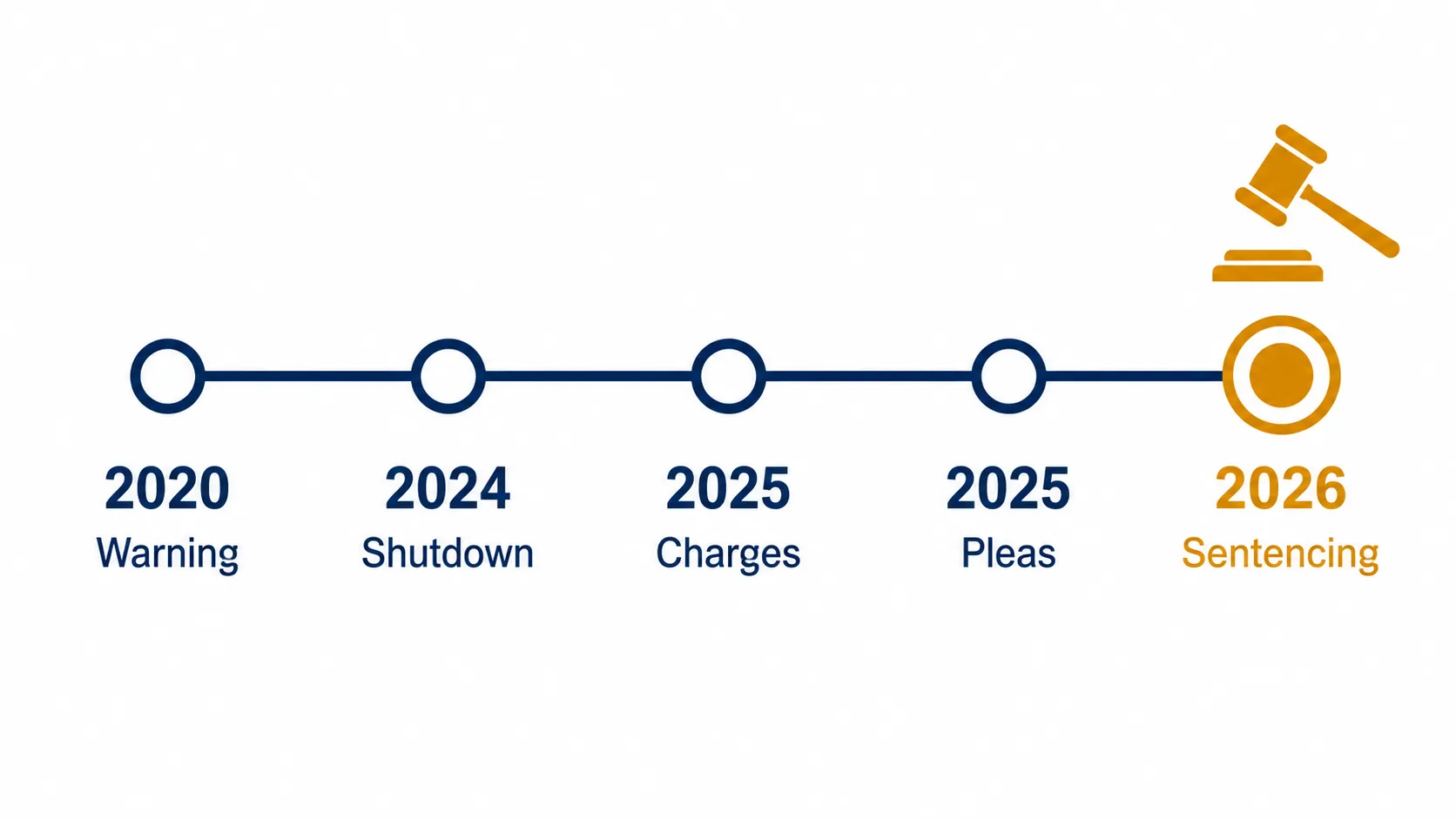
The timeline is important because the sentencing record should not be read as a sudden one-day crackdown. Public materials show a sequence beginning with a warning letter, followed by shutdown activity, charging, pleas, and then sentencing.
| Date | Event | Why it matters |
|---|---|---|
| December 7, 2020 | FDA and FTC issued a warning letter to Paradigm RE LLC. [6] | The letter is the earliest source in this record showing federal notice to the business before the criminal sentence. |
| March 2024 | Paradigm Peptides was shut down, according to CBS reporting. [4] | This marks the reported operational break before the later Information and pleas. |
| October 27, 2025 | An Information was filed in the criminal case. [1][2] | The Information is the document to check for exact count language before citing the charging terms. |
| December 10, 2025 | Kawa and Stechkober pleaded guilty. [3][4] | This is the confirmed plea date carried in the current public record. |
| July 30, 2026 | Kawa was sentenced to 70 months and Stechkober to 16 months. [3] | This is the confirmed sentencing outcome; financial terms remain judgment-check items. |
Reported harm and reach, kept in its lane
CBS reported a victim account involving Dan Murphy and described the injury as steroid-induced psychosis. That account is relevant to why the sentencing was treated as a consumer-harm matter, but it should not be used to inflate the charged facts beyond what the plea and sentencing sources support. [4]
CBS also reported prosecutorial estimates of roughly 54,000 unique customers across all 50 states and 80 countries. Those figures are useful context for scale, not independently verified customer counts in this record. They should be introduced as reported prosecutorial estimates unless the underlying sentencing materials are checked. [4]
The same reporting described a lookalike site, paradigmpeptides.is, and quoted enforcement officials using a “whack-a-mole” frame for the market. That language may capture enforcement frustration, but it is secondary context. The evidentiary spine remains the plea posture, the charged conduct, the testing result, and the sentence. [4]
What still needs primary-source verification
- Financial penalties: do not treat the $5 million money judgment or $78,317.52 restitution figure as judgment-confirmed until the sentencing judgment or docket entry is reviewed. [3][4]
- Restitution mechanics: this record does not state a payment schedule, allocation detail, collection language, or final amended restitution order.
- Appeal status: this record does not state whether any notice of appeal was filed after the July 30, 2026 sentencing.
- Count wording: descriptions of Counts 1 and 2 should be checked against the October 27, 2025 Information before quotation or litigation use.
- Market-scale figures: the 54,000-customer and 80-country figures should remain attributed to CBS-reported prosecutorial estimates unless independently confirmed from sentencing papers. [4]
The durable citation as of 2026-08-01 UTC is narrow: United States v. Matthew Kawa confirms guilty pleas in the Northern District of Indiana and a 70-month sentence for Matthew Kawa in the Paradigm Peptides unapproved drugs case. The available record also supports the conclusion that “research use only” labeling did not shield the seller where the charged conduct involved unapproved drugs in interstate commerce, unlawful importation, and tested products containing actual testosterone. It does not yet support unqualified reliance on the reported money judgment, restitution amount, appeal posture, or restitution schedule without checking the sentencing judgment or docket.
References
- United States v. Matthew Kawa — U.S. Attorney’s Office, Northern District of Indiana.
- U.S. v. Matthew Kawa, et al — U.S. Attorney’s Office, Northern District of Indiana.
- Illinois Man and Indiana Woman Sentenced Respectively to 70 Months and 16 Months in Prison — U.S. Attorney’s Office, Northern District of Indiana.
- Judge sentences peptide vendor to nearly 6 years in prison — CBS News.
- FDA Warns About Using Selective Androgen Receptor Modulators (SARMs) Among Teens, Young Adults — U.S. Food and Drug Administration.
- Paradigm RE LLC - 612014 - 12/07/2020 — U.S. Food and Drug Administration / Federal Trade Commission, December 7, 2020.
Related records
Tool profile
How Meta's AI Spending Reshapes Law Firm ProfitabilityGoverning regulation
Browse the obligations tracker →Preventive workflow
Browse verification workflows →
Report a correction or tip
Spotted an outdated figure, a misstated fact, or a ruling this case record should reflect? Public comments are disabled for this content given the professional cost of a misreported case outcome, penalty amount, or rule text — use the structured correction channel instead.
Report a correction or tip for this record →