
The SpaceX Moon crash exposes space debris law's limits
The Falcon 9 upper stage that struck the Moon on Aug 5, 2026 leaves the U.S. liable in principle as launching state but yields no compensable claim: the Liability Convention's 'damage' definition requires a protected party, and the lunar impact zone had none. The analysis maps the treaty framework, the Cosmos 954 settlement precedent, and the specific scenarios — a foreign lander, ejecta hitting third-party hardware, or astronaut injury — that would make lunar debris claims real.
- Jurisdiction
- United States
- Court
- No court; Liability Convention claims process
- AI tool named
- Falcon 9 upper stage 2025-010D
- Ruling date
- Aug 5, 2026
- Source document
- View primary court order ↗
- Last verified
- Aug 4, 2026
Lex Machina Review is an independent risk-tracking and reference resource. Nothing on this site is legal advice, and using it does not create an attorney-client relationship. Every record is reviewed against primary sources but may not reflect the most current status of a matter — always verify directly against the cited court order, rule text, or a licensed attorney before relying on it.
Companion explanation — secondary to the source document above
The short legal answer is less dramatic than the impact prediction: Falcon 9 upper stage 2025-010D is expected to hit the Moon near Einstein Crater at 06:34 UTC on Aug. 5, 2026, and the United States is the launching state in principle. But an analysis of the SpaceX Moon crash under space debris law does not end at attribution. As last verified on Aug. 4, 2026, the predicted impact zone contains no protected person, foreign lander, base, or third-party property. That means there is no compensable “damage” claim under the Liability Convention, even if the physics look spectacular.
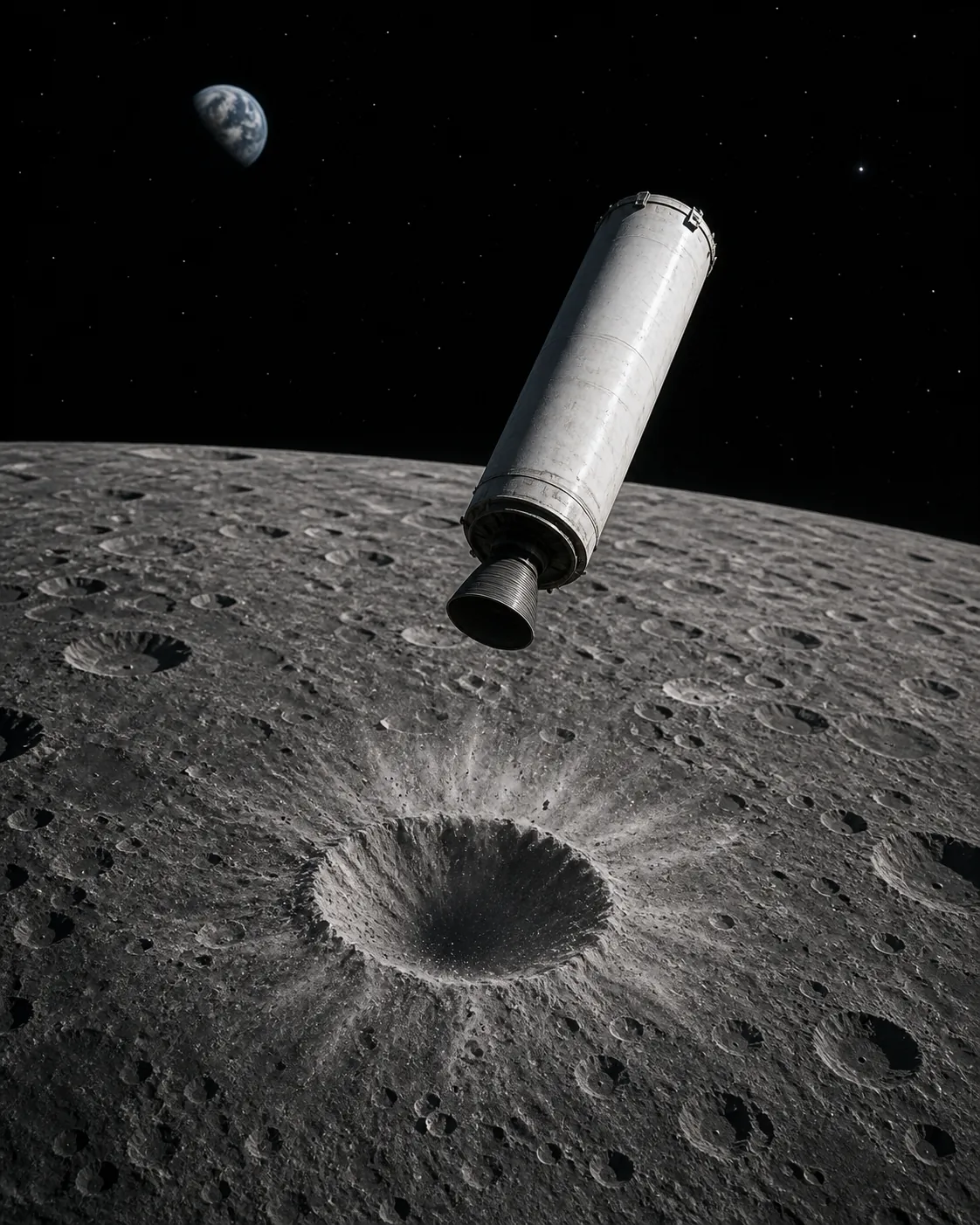
That posture matters. The expected lunar strike is not a treaty-free event; it is a treaty-covered event with a failed claim element. The Outer Space Treaty makes launching states internationally liable for damage caused by their space objects in outer space, including the Moon and other celestial bodies, and the Liability Convention treats launch-vehicle component parts as “space objects.” A spent upper stage is therefore not legally invisible. The problem is recoverable loss.
| Item | Last-verified record as of Aug. 4, 2026 |
|---|---|
| Object | Falcon 9 upper stage 2025-010D |
| Launch record | Launched Jan. 15, 2025 from Kennedy Space Center |
| Predicted impact | 06:34 UTC on Aug. 5, 2026, near Einstein Crater |
| Predicted speed | 2.43 km/s, approximately 5,400 mph |
| Mass estimate | Project Pluto lists about 4,900 kg |
| Energy estimate | About 14.5 billion joules, roughly three tons of TNT |
| Crater estimate | Project Pluto estimates about 17 m; modeling and reporting discussed larger estimates around 27 m |
| Verification status | Impact, crater size, and ejecta pattern remain predictions pending post-impact imaging |
Project Pluto’s tracking page identifies 2025-010D as the Falcon 9 upper stage, gives the Jan. 15, 2025 Kennedy Space Center launch record, and forecasts the Aug. 5, 2026 lunar impact near Einstein Crater at 2.43 km/s, with an estimated mass of about 4,900 kg, impact energy of about 14.5 billion joules, and a crater estimate around 17 m.[1] Those physical details should still be read as predictions until a lunar orbiter or other post-impact observation confirms the site.
The launching-state hook is clear; the claim is not
The starting point is not “who owns the Moon.” Article II of the Outer Space Treaty bars national appropriation of the Moon and other celestial bodies, so the lunar surface itself is not converted into a state’s compensable property merely because debris makes a new crater.[2] The more useful question is whether a launching state is responsible for damage caused by its space object.
Article VII of the Outer Space Treaty supplies the broad liability hook: each state party that launches or procures the launch of an object into outer space, and each state from whose territory or facility an object is launched, is internationally liable for damage caused by that object or its component parts on Earth, in air space, or in outer space, including the Moon and other celestial bodies.[2] A Falcon 9 upper stage launched from Kennedy Space Center therefore points to the United States as launching state in principle.
The Liability Convention then narrows the machinery. Article I(d) defines a “space object” to include component parts of a space object, as well as its launch vehicle and parts thereof.[3] That language is why the analysis does not turn on whether the upper stage is still useful, controllable, or commercially valuable. A spent upper stage remains within the Convention’s object category.
Why Article II does not do the work here
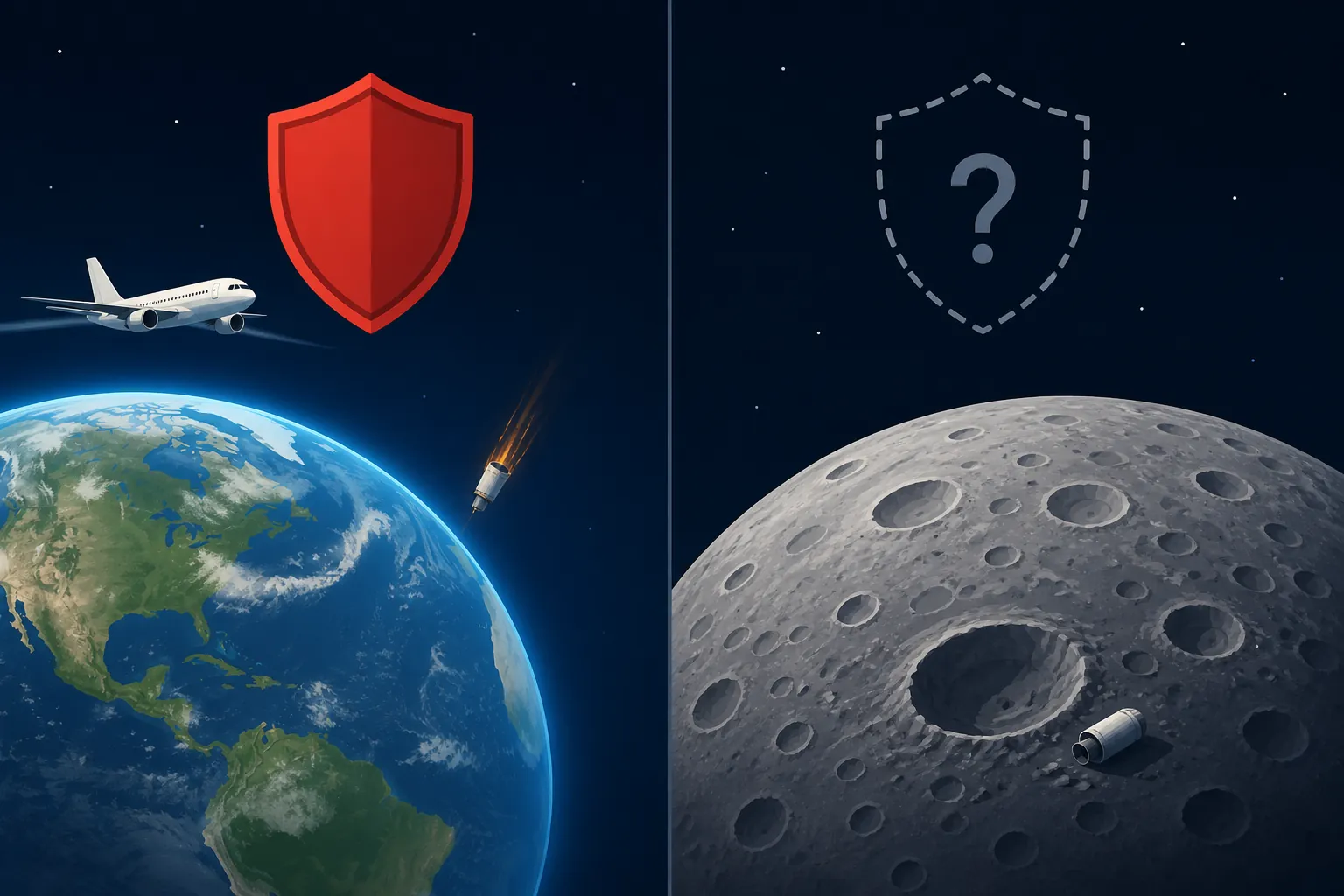
The common shortcut is to quote the word “liable” and stop. The Convention does not. Article II creates absolute liability only for damage caused by a space object on the surface of the Earth or to aircraft in flight.[3] A lunar impact is neither. It is outside the strict-liability category that would avoid a fight over fault.
Damage elsewhere is handled by Article III. There, a launching state is liable only if the damage is due to its fault or the fault of persons for whom it is responsible.[3] For lunar operations, that is the operative lane: a claimant would need both qualifying damage and a fault theory.
The threshold problem in the 2026 Falcon 9 scenario comes even earlier. Article I(a) defines “damage” as loss of life, personal injury or other impairment of health, or loss of or damage to property of states, natural or juridical persons, or international intergovernmental organizations.[3] A crater in unowned lunar terrain, with no identified person or third-party property in the impact zone, does not satisfy that definition.
That is the mismatch between the intuitive headline and the recoverable claim. The United States can be the launching state; the Falcon 9 upper stage can be a space object; the object can strike the Moon at high speed; and the treaty claim can still fail because no protected claimant has suffered the kind of damage the Convention recognizes.
This is not a direct treaty lawsuit against SpaceX
The Liability Convention is an interstate liability regime. A foreign operator whose lunar asset is damaged would ordinarily look to its state to present an international claim against the launching state, not file a Convention claim directly against SpaceX. Whether domestic licensing terms, indemnities, procurement documents, insurance arrangements, or national statutes shift cost back to a private operator is a separate layer, and it is not resolved by the Convention text.
That distinction matters for risk memos. “The United States has international liability exposure” is a different sentence from “SpaceX can be sued tomorrow for the Moon crater.” The first follows from treaty structure. The second skips over claimant identity, compensable damage, fault, forum, and any domestic recourse theory.
Cosmos 954 shows claims can be made, not how this one would be won
The usual precedent is Cosmos 954. In 1978, the Soviet nuclear-powered satellite reentered over Canada, Canada presented a claim, and the dispute ended in a diplomatic settlement reported at CAD 3 million.[4] It remains important because it shows that states can invoke space-object liability after debris causes harm.
It does less work than it is often asked to do. Cosmos 954 did not produce a claims-commission ruling defining “fault,” a judicial test for causation, or a general damages methodology for space-debris collisions. It was an Earth-surface contamination and cleanup dispute resolved diplomatically, not a litigated lunar Article III case.
That leaves the lunar-debris problem unusually exposed to first-impression arguments. Commentary on the Liability Convention continues to note the absence of an adjudicated space-debris collision liability finding and the Convention’s failure to define fault.[4] For evidentiary attribution questions—how a claimant would prove that a fragment came from a particular launching state—the site’s related analysis of AI tracking and space debris liability addresses a different piece of the same untested machinery.
The scenarios that would change the answer
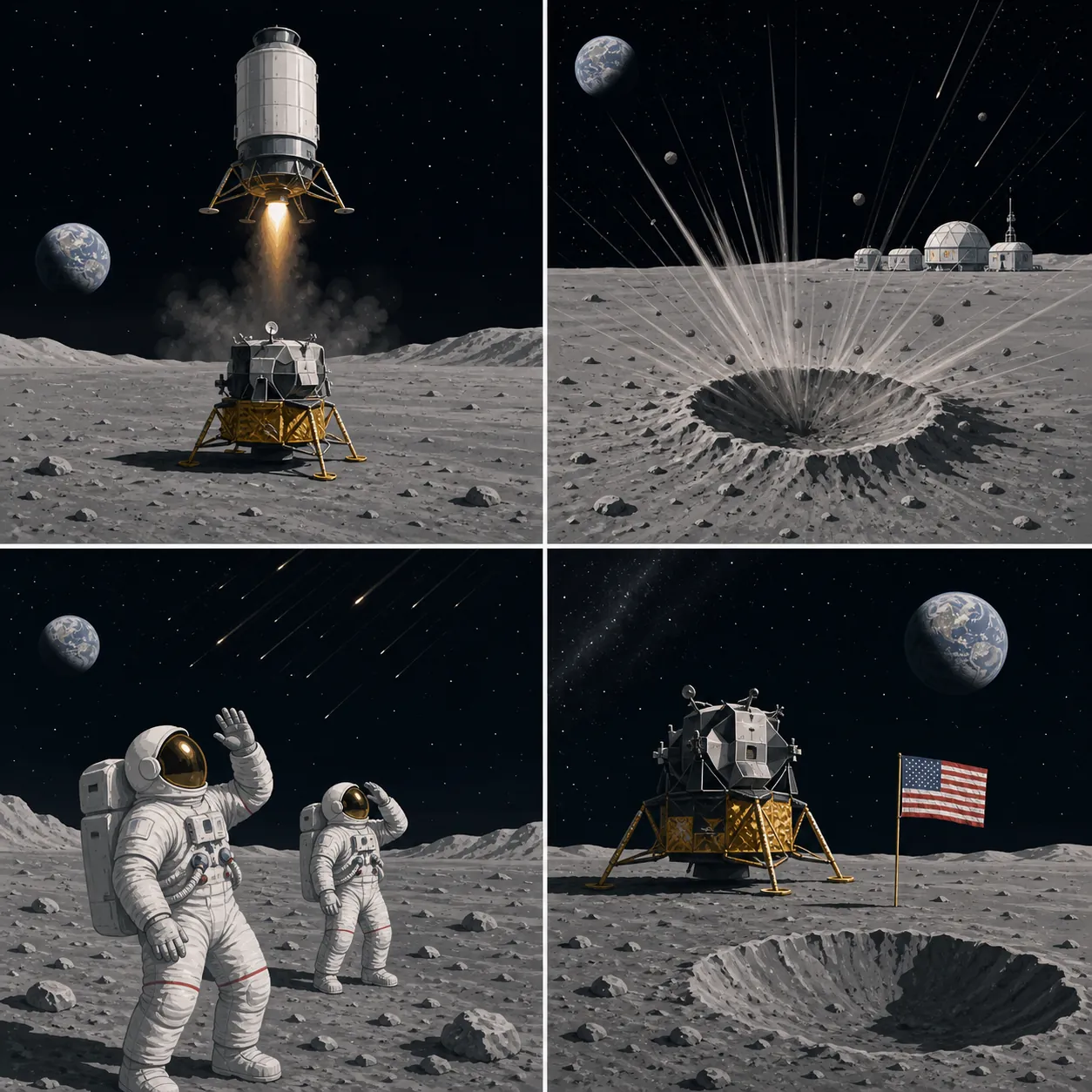
The 2026 impact is a poor damages case because the predicted target is empty. Change the facts, and the same treaty provisions become much more consequential.
| Scenario | Why it matters legally |
|---|---|
| Foreign lunar lander or base in the impact path | A protected property interest appears; Article III fault liability becomes the central issue. |
| Ejecta damages third-party infrastructure | The crater is not the loss; the distant damaged asset is. Causation and modeling become important. |
| Astronaut death or injury | The Convention’s damage definition is satisfied, and separate domestic or criminal-law questions may arise. |
| Apollo or other heritage-site damage | Diplomatic and preservation consequences may be significant, but compensation depends on a protected property or state claim, not ownership of lunar terrain. |
A lander or base in the impact path
If the upper stage struck a foreign lander, rover, power unit, habitat module, or other protected lunar hardware, the damages analysis would no longer fail at the first gate. The claimant would have property damage. The remaining fight would move to Article III: Was the damage due to the fault of the launching state or persons for whom it is responsible?
That fault inquiry is where the hard operational facts would matter. What was known about the object’s trajectory? When was it known? Could the risk have been predicted? Was anyone warned? Did the affected operator have a reasonable opportunity to move, shield, or safe the asset? The Convention does not define the standard, so those questions would be argued without a settled space-debris liability test.
Ejecta, not just direct impact
The legally interesting radius is not limited to the crater rim. Modeling by Fernando and co-authors for the 2026 Falcon 9 lunar impact discusses ejecta hazards and possible ballistic transport over distances up to roughly 1,000 km, while also treating crater and ejecta details as model-based pending observation.[5] That is why distance from the predicted crater is not just a science detail; it can become a causation fact.
For a future claimant, the better pleading would not be “the Moon was damaged.” It would be: an identified space object struck the Moon; ejecta from that strike traveled to a mapped location; the ejecta damaged a specified third-party asset; and the damage is attributable to the launching state’s fault under Article III. Each verb would need proof.
This is also where post-impact imaging matters. If LRO, Danuri, or another observing platform identifies the crater and ejecta pattern after Aug. 5, those observations may refine the physical risk map. They will not by themselves create a claimant where none exists, but they can inform later hazard models for lunar operators.
Astronaut injury
An astronaut injury would satisfy the Convention’s damage definition more directly than an empty crater. Article I(a) expressly covers loss of life, personal injury, and other impairment of health.[3] The legal problem would then shift to fault, causation, and the relationship between international responsibility and any domestic criminal, occupational-safety, mission-authorization, or licensing consequences.
That scenario is not the 2026 forecast. It is the scenario counsel should keep in the risk register as surface activity increases. A dormant object on a long lunar trajectory becomes far less abstract when crews, excavation equipment, antennas, power systems, and pressure vessels are nearby.
Heritage sites and diplomatic exposure
Apollo-era and other historic sites introduce a different category of consequence. Damage to a heritage site could provoke diplomatic claims, preservation disputes, reputational cost, and arguments about due regard for other states’ activities. But those consequences should not be confused with a simple claim that a state owns the surrounding lunar surface. The recoverability analysis still has to identify a protected person or property interest and a viable route through the applicable treaty standard.
What to tell a client before the crater is imaged
For the Aug. 5, 2026 forecast, the responsible memo should say three things plainly. First, the launching-state hook exists: the United States is exposed in principle under the Outer Space Treaty and Liability Convention for damage caused by the Falcon 9 upper stage. Second, this predicted impact does not presently produce a compensable claim because no protected person or third-party property has been identified in the impact zone. Third, any later claim would depend on post-impact verification, causation evidence, and an Article III fault theory.
The event is therefore a useful warning but a weak lawsuit. It shows how easily a launch-vehicle component can remain legally attributable long after mission value has ended. It also shows how much the liability regime still depends on ordinary damages discipline: who was hurt, whose property was hit, what caused the loss, and what standard of care was breached.
No party has yet been held liable for a space-debris collision in space, and the Convention leaves “fault” undefined.[4] That should not comfort operators too much. It means exposure is real enough to price, document, insure, and allocate, but too untested to predict like a mature tort claim.
Related international-law risk analysis
- For a distinct international-law risk analysis outside space law, see Can International Law Block the US-Israel Military Merger?.
- For the site’s related treatment of international-law risk in military AI, see US-Israel Military AI Merger Creates New International Law Risks.
References
- Pseudo-MPEC for 2025-010D, Project Pluto.
- Treaty on Principles Governing the Activities of States in the Exploration and Use of Outer Space, including the Moon and Other Celestial Bodies, UNOOSA.
- Convention on International Liability for Damage Caused by Space Objects, UNOOSA.
- Who Takes Out the Trash in Space?, Stanford Law School, Aug. 22, 2025.
- arXiv:2607.14625, arXiv, 2026.
Related records
Tool profile
Browse tool evaluations →Governing regulation
Browse the obligations tracker →Preventive workflow
Browse verification workflows →
Report a correction or tip
Spotted an outdated figure, a misstated fact, or a ruling this case record should reflect? Public comments are disabled for this content given the professional cost of a misreported case outcome, penalty amount, or rule text — use the structured correction channel instead.
Report a correction or tip for this record →