
Trump grant freeze legal challenge turns on ChatGPT
Judge McMahon's May 8, 2026 permanent injunction blocks the ChatGPT-driven cancellation of more than 1,400 NEH grants and rejects the government's 'the AI did it' defense. The court-verified record shows how DOGE used ChatGPT as the government's 'chosen instrument,' leaving agencies accountable for viewpoint discrimination, with the Thakur stipulations as corroborating context.
- Jurisdiction
- US Federal
- Court
- U.S. District Court for the Southern District of New York
- Judge
- Colleen McMahon
- AI tool named
- ChatGPT
- Ruling date
- May 8, 2026
- Source document
- View primary court order ↗
- Last verified
- Aug 3, 2026
Lex Machina Review is an independent risk-tracking and reference resource. Nothing on this site is legal advice, and using it does not create an attorney-client relationship. Every record is reviewed against primary sources but may not reflect the most current status of a matter — always verify directly against the cited court order, rule text, or a licensed attorney before relying on it.
Companion explanation — secondary to the source document above
The relevant AI-risk record is narrower and more concrete than the surrounding federal funding fight. In the Southern District of New York, Judge Colleen McMahon issued a permanent injunction on May 8, 2026, blocking the cancellation of more than 1,400 National Endowment for the Humanities grants, with ChatGPT identified in the reported record as part of the screening process used to produce the termination list. The appeal posture was not resolved in the available PBS NewsHour report; last verified for this article on August 3, 2026. [1]
That framing matters. This is not mainly a story about whether a federal agency may ever use software to organize grant files. It is a court-anchored record about attribution: who selected the criteria, who ran the screen, who accepted the output, and whether the government can later say the operative decision belonged to the tool.
The record starts with the replacement of review
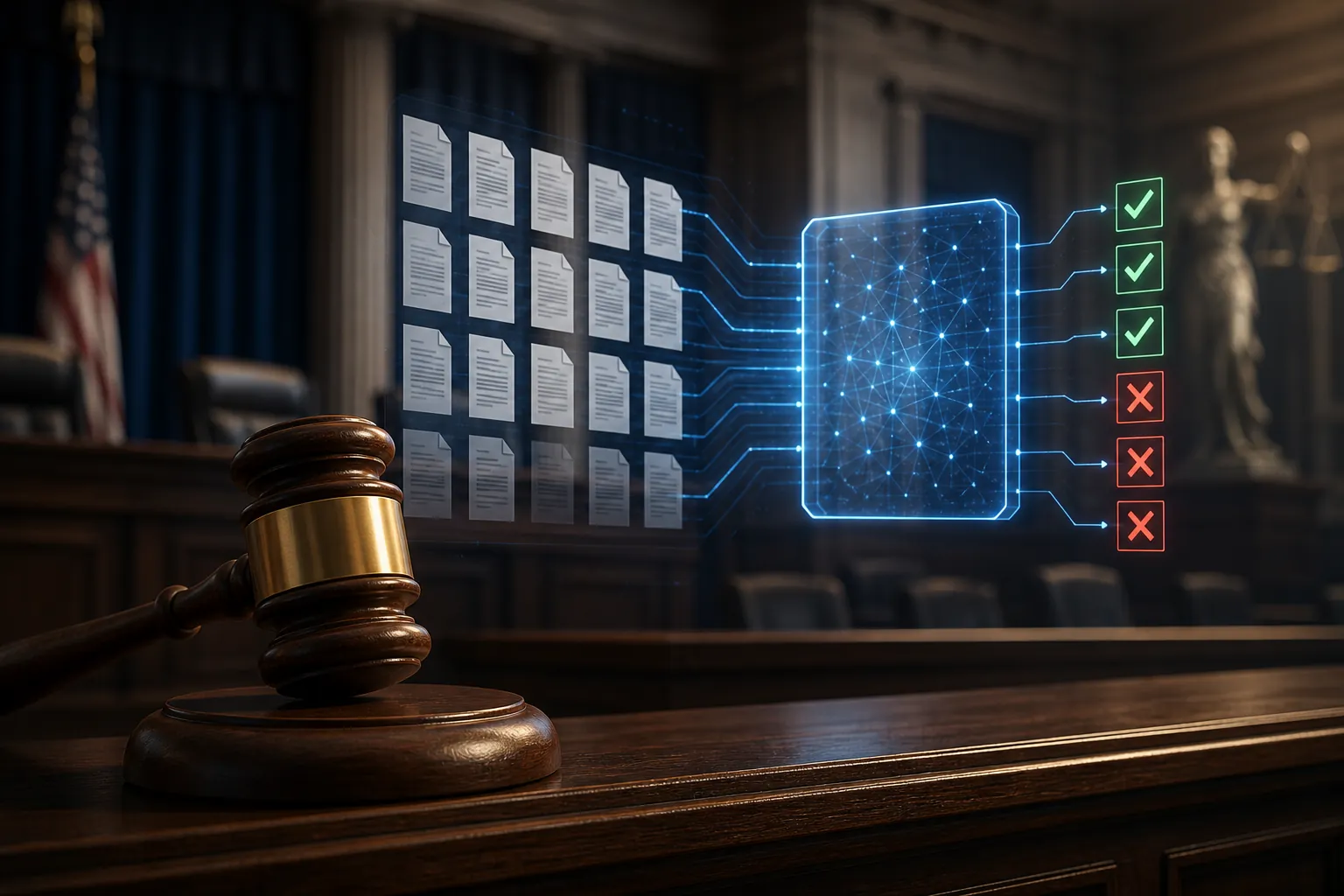
The discovery record described by the humanities plaintiffs is the useful part of this case because it moves the discussion from “AI in government” to a visible workflow. DOGE staffers allegedly fed grant descriptions into ChatGPT, asked whether the grants were “DEI,” and recorded outputs in spreadsheet columns labeled “Yes / No DEI?” and “DEI rationale.” The plaintiffs said that spreadsheet replaced a list produced by NEH staff through individualized review. [2]
Once the spreadsheet became the operative list, the tool was no longer a background aid. It had crossed into the chain of decision. The agency did not merely receive a search result, a draft summary, or an internal research note. The reported workflow describes a classifier being used to sort grants into a category that then drove termination.

The deposition material reported by the plaintiffs tightens the attribution problem. DOGE staffer Justin Fox and NEH Acting Chair Michael McDonald were described as having ceded the termination decision to that process, rather than preserving the NEH staff’s individualized assessment as the controlling review. The same release also described allegations about Signal use in connection with the process. [2]
A spreadsheet is not a neutral object in a record like this. It shows sequence. Grant description in; ChatGPT classification out; rationale logged; prior staff list displaced; terminations issued. That is the part counsel will return to when assessing future AI-assisted agency actions. The risk does not depend on a mystical view of the model. It depends on whether the model output was adopted as the mechanism that moved people, institutions, and money.
Judge McMahon treated ChatGPT as the government’s chosen instrument
PBS NewsHour reported that Judge McMahon called the terminations “a textbook example of unconstitutional viewpoint discrimination” and rejected the government’s attempt to distance itself from the ChatGPT-enabled process. The court’s reasoning, as reported, was not simply that ChatGPT made errors; it was that the government used ChatGPT as its “chosen instrument” and remained responsible for what that instrument was used to do. [1]
That is the durable point for AI governance. If an agency chooses the criterion, chooses the tool, accepts the classification, and acts on the resulting list, the decision does not become ownerless. The output remains attributable to the public actor that operationalized it.
The reported injunction covered more than 1,400 grants totaling over $100 million. Those numbers measure not adoption of AI, but the scale of funding consequences attached to the workflow challenged in the case. [1]
Misclassification was not incidental to the harm
The misclassification examples matter because they show what happens when broad political criteria replace grant-specific review. PBS NewsHour and the plaintiffs’ release identified an anthology titled “In the Shadow of the Holocaust: Short Fiction by Jewish Writers from the Soviet Union” as one of the grants flagged as DEI. They also described collections-management, preservation-training, and HVAC-related grants as examples with no conceded DEI connection. [1][2]

Those examples should not be inflated into a complete catalog of affected projects. Their value is narrower and stronger: they make visible the distance between a grant’s actual purpose and the category assigned to it in the termination process. A preservation grant, a collections-management grant, or an anthology project can become vulnerable when the operative question is reduced to whether a machine-generated rationale can attach a disfavored label.
For grant recipients, that distinction is not procedural trivia. A project can survive peer review, institutional budgeting, and program staff assessment, then be ended by a later screen whose rationale was never built to understand the project on its own terms. For agency staff, the injury is also administrative: an individualized review process can be overwritten while the agency still carries the legal consequence.
What this means for AI-assisted public decisions
The NEH injunction does not establish that every government use of ChatGPT is unlawful. It does not say that every software-assisted sorting step creates constitutional liability. The record supports a more specific rule of risk: when a government actor uses an AI tool to screen, classify, and terminate grants under criteria that would be unconstitutional if applied by a person, the tool does not interrupt responsibility.
The practical questions for counsel and risk teams are therefore evidentiary. Was the model used for background drafting, or did its output become the operative list? Was a human reviewer checking the underlying file, or only accepting the label? Were the criteria lawful, documented, and applied grant by grant? Could the agency identify who approved the final action? The NEH record is important because the alleged answers were visible in a spreadsheet and deposition testimony, not buried in general assurances about human oversight.
That is also why this record belongs beside other algorithm-liability files rather than inside a general debate about AI product quality. The closest internal parallel is the United Airlines trip-trading algorithm liability record, where automated enforcement did not make the employer’s decision disappear. Related verification-risk records include the Hank Green ChatGPT apology record, the OpenAI Astra legal applications thread, and the OpenAI Astra math and legal-tech benchmark thread. For human-review duties, the defense-attorney AI court filings ethics tracker and the AI bitcoin AML tool evaluation are better follow-on references than broad speculation about model behavior.
Thakur is corroborating context, not the holding
Thakur v. Trump, pending in the Northern District of California, supplies a second record with a similar failure pattern, but it should be handled carefully. AP and CalMatters reported in July 2026 that party stipulations acknowledged grant terminations based on general criteria rather than grant-specific assessment, and that NIH acknowledged DOGE may have used AI to target grants. Those are stipulations and reported acknowledgments, not judicial findings equivalent to Judge McMahon’s NEH injunction. [3]
The connection is still relevant. In both records, the risk is not merely that a keyword or model may be inaccurate. It is that generalized screening criteria can displace the individualized assessment that grant administration normally requires, while the terminating agency remains the actor with legal obligations.
Where the Senate stopgap bill and grant-freeze docket fit
The broader Trump grant-freeze litigation and the Senate stopgap bill belong in the routing notes for this subject, not at the center of this AI-risk record. They may affect the funding landscape and search intent around federal grants, but they do not supply the ChatGPT screening chain in the NEH case unless independently tied to the same classification-and-termination workflow.
That separation prevents a common error. The NEH injunction is not proof that every grant freeze development turns on AI. It is proof that, where the record shows a government-selected AI tool being used as the mechanism for screening, classifying, and terminating funding, the government cannot break constitutional responsibility by pointing back at the machine.
References
- Judge finds Trump's DOGE-led cancellation of humanities grants unconstitutional — PBS NewsHour
- Discovery Released in Lawsuit by Humanities Groups Reveals ChatGPT-Powered Process by DOGE in Cancelling Grants... — PR Newswire/ACLS-AHA-MLA
- White House admits it used keywords to kill billions worth of California research grants — AP/CalMatters, July 2026
Related records
Tool profile
How to Read Legal AI Benchmarks Ahead of the OpenAI IPOGoverning regulation
Browse the obligations tracker →Preventive workflow
Browse verification workflows →
Report a correction or tip
Spotted an outdated figure, a misstated fact, or a ruling this case record should reflect? Public comments are disabled for this content given the professional cost of a misreported case outcome, penalty amount, or rule text — use the structured correction channel instead.
Report a correction or tip for this record →