
Trump's hush money conviction appeal is still pending
Trump's hush money conviction appeal was not denied as of July 29, 2026 — it remained pending — while every confirmed denial in the record was procedural: sentencing-stay bids, federal removal rulings, and a remand that expressed no view on the merits. Readers can map each ruling to its court and date, see which questions remain open, and verify status against a primary-source docket checklist.
- Jurisdiction
- US-NY
- Court
- New York Supreme Court, Appellate Division, First Department
- Judge
- Alvin Hellerstein
- AI tool named
- No AI tool implicated
- Ruling date
- Jul 29, 2026
- Source document
- View primary court order ↗
- Last verified
- Aug 29, 2026
Lex Machina Review is an independent risk-tracking and reference resource. Nothing on this site is legal advice, and using it does not create an attorney-client relationship. Every record is reviewed against primary sources but may not reflect the most current status of a matter — always verify directly against the cited court order, rule text, or a licensed attorney before relying on it.
Companion explanation — secondary to the source document above

Trump’s hush money conviction appeal was still pending as of July 29, 2026. The Manhattan district attorney was asking New York’s intermediate appellate court to reject Trump’s challenges, while PBS likewise described the state-court appeal as pending—not denied. [1][2]
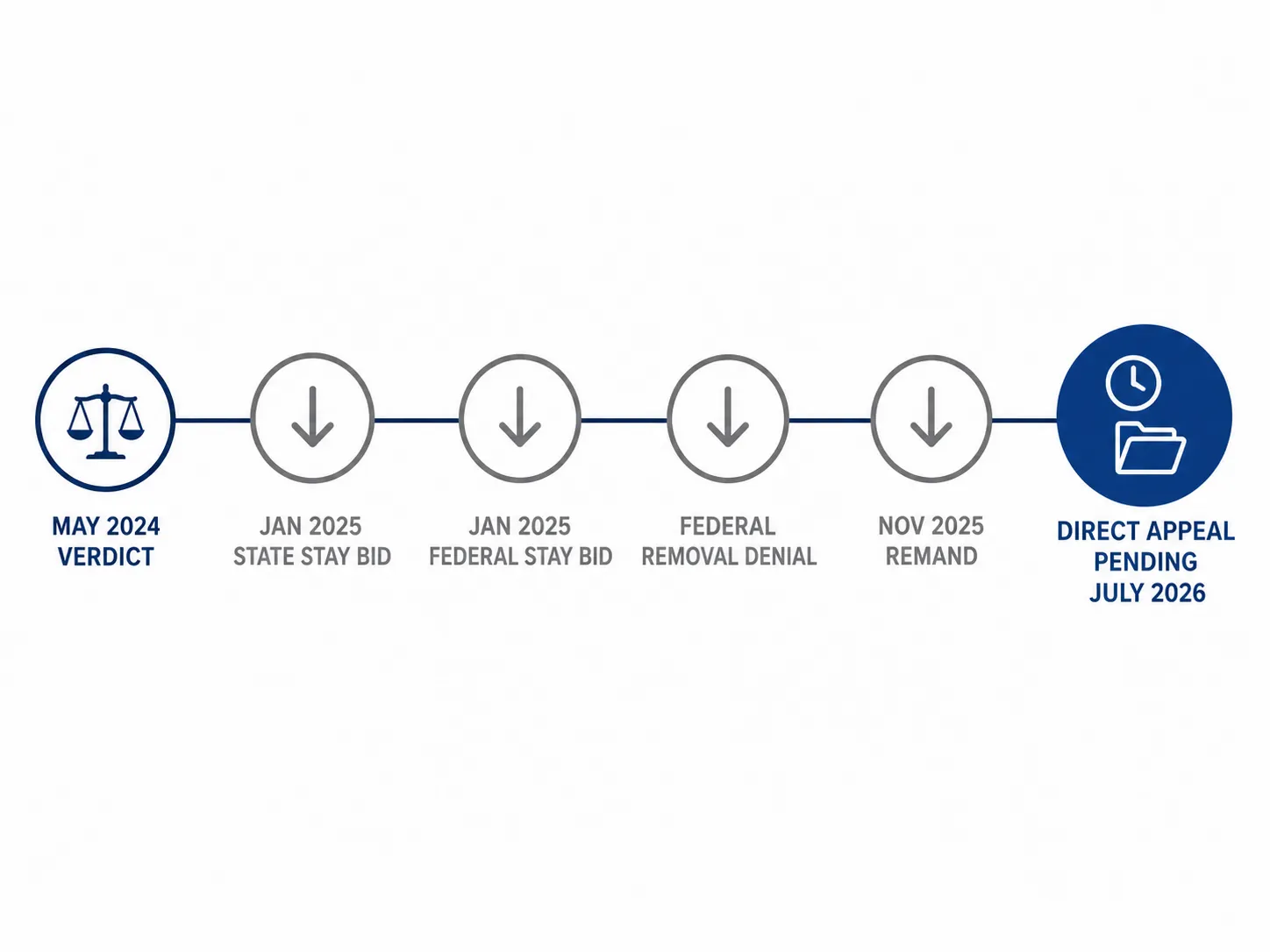
That conclusion matters because several earlier rulings were described as denials. They concerned attempts to stop sentencing or move the case into federal court. None of the confirmed rulings identified in the record is a First Department merits disposition affirming or rejecting the criminal conviction appeal.
The court-and-date map
| Proceeding | Court and timing | What the ruling did |
|---|---|---|
| Sentencing-stay request | New York Court of Appeals, January 2025 | Declined to block the scheduled sentencing; not a ruling on the conviction appeal |
| Last-ditch sentencing halt | U.S. Supreme Court, January 2025 | Rejected an effort to stop sentencing; not a merits decision on the conviction |
| Federal removal attempt | Judge Alvin Hellerstein, federal court | Denied removal of the New York criminal case to federal court |
| Challenge to the removal ruling | Second Circuit, November 2025 | Remanded for reconsideration under Trump v. United States and expressed no view on the merits |
| Direct criminal appeal | New York intermediate appellate court, status reported through July 29, 2026 | Pending in the verified record |
The January 2025 denials were about sentencing
The first category is a request to prevent sentencing from going forward. In January 2025, New York appellate proceedings declined to block the sentencing, and the U.S. Supreme Court rejected a last-ditch bid to halt it. [3][4]
A sentencing stay asks whether an event should be paused while another issue is litigated. It does not ordinarily answer whether the underlying conviction should be affirmed, reversed, or vacated. A headline that turns “sentencing stay denied” into “conviction appeal denied” has changed the object of the ruling.
The underlying matter began with a New York County jury verdict on May 30, 2024, finding Trump guilty on 34 felony counts of falsifying business records. [8] He received an unconditional discharge in January 2025. The January 2025 date is medium-confidence because it is inferred from a linked liveblog rather than freshly verified against the docket. PBS described the conviction as resting entirely on unofficial conduct, but the sentencing disposition did not itself resolve the direct appellate challenge. [8]
Removal was a federal-forum question, not the state appeal
A separate set of rulings concerned removal: Trump’s effort to transfer the Manhattan criminal case from New York state court to federal court. Judge Alvin Hellerstein denied the third removal attempt and characterized the hush money payments as involving “private unofficial acts.” [5]
That ruling addressed the forum and the legal basis for moving the prosecution. It was not the New York intermediate appellate court deciding whether the conviction should stand. The two proceedings can involve overlapping arguments without becoming the same appeal.
A remand is not a merits rejection
The Second Circuit’s November 2025 action is even less compatible with the phrase “appeal denied.” The court remanded the matter to Hellerstein for reconsideration under the immunity framework discussed in Trump v. United States. The account of the ruling expressly states that the Second Circuit took no view on the merits. [6][7]
A remand sends an issue back to the lower court for further consideration. It may alter the next procedural step, but it does not mean the appellate court rejected the conviction or approved the prosecution’s position. Calling this event a denial erases the operative instruction: reconsider, rather than decide the merits against Trump.
What the record does—and does not—establish
The available status evidence supports a narrow statement: the direct state appeal remained pending through July 29, 2026. The Manhattan district attorney’s appellate filing and PBS’s description establish that endpoint. [1][2] They do not establish what the First Department will decide.
The verified materials contain no located First Department criminal order stating the court, date, panel, disposition, or operative language of a merits ruling. That is a verification boundary, not proof that no later order exists. The only First Department opinion identified in the materials is a civil fraud liability opinion, which is unrelated to the criminal hush money appeal. [9]
The status of any application for leave to appeal to the New York Court of Appeals, including any filing deadline, also remains open on this record. It should not be supplied by inference from the federal proceedings or from the earlier sentencing decisions.
A primary-source check before citing the appeal
For a brief, broadcast script, or case-status entry, verify the proposition in this order:
- Check the First Department’s slip-opinion service for a criminal disposition in the direct appeal. Record the date, panel, docket or appeal identifier, and the exact disposition language.
- Check the New York Court of Appeals leave docket for any later application, ruling, or jurisdictional filing. Do not assume a deadline or leave status that the docket does not show.
- Check the New York County criminal docket for the underlying procedural record, including sentencing and any subsequent filings.
- Label each event by function: stay, removal, remand, leave application, or merits disposition. Only the last category answers whether the conviction appeal itself was affirmed, reversed, or otherwise decided.
This source-tracing method is also useful when auditing summaries produced under deadline; see the primary-source verification checklist and the forum-by-forum status record. Here, however, the materials show no evident AI or legal-technology issue to analyze.
References
- Manhattan DA challenges Trump's appeal of his 2024 hush money conviction — ABC7 Chicago
- Trump loses again in bid to erase his hush money conviction — PBS News
- Supreme Court narrowly rejects Trump's last-ditch bid to avoid hush money sentencing — ABC News
- Appeals court denies Trump's bid to halt Friday's hush money sentencing — ABC News
- Trump loses longshot bid to transfer NYC hush money case to federal court — Courthouse News Service
- New York judge excoriates Trump's timing in bid to scrap hush money conviction — Courthouse News Service
- Trump v. United States — Wikipedia
- Trump was sentenced to an unconditional discharge in his hush money conviction. Here's what that means — PBS News
- Attorney General James Releases Statement on First Department Opinion Affirming — New York State Office of the Attorney General
Related records
Tool profile
How Meta's AI Spending Reshapes Law Firm ProfitabilityGoverning regulation
Browse the obligations tracker →Preventive workflow
Browse verification workflows →
Report a correction or tip
Spotted an outdated figure, a misstated fact, or a ruling this case record should reflect? Public comments are disabled for this content given the professional cost of a misreported case outcome, penalty amount, or rule text — use the structured correction channel instead.
Report a correction or tip for this record →